World Stroll
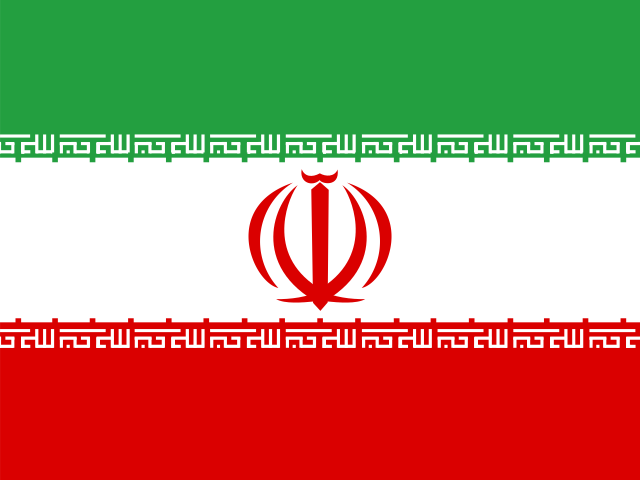
Flag of Iran
Travel guide

Learn Iran before you go

The land of ancient Persia, where Persepolis, blue-tiled mosques, saffron rice and the poems of Hafez are part of everyday life.
Take the full trip
CapitalTehran
CurrencyIranian rial (IRR). Prices are often given in toman: 1 toman = 10 rials. In 2025 parliament approved a plan to drop four zeros from the rial over several years
Official languagePersian (Farsi), as set out in the constitution. Azerbaijani, Kurdish, Luri, Baluchi, Arabic and other languages are also spoken
Drives on theRight
Calling code+98

10 phrases to learn

In Persian (Farsi). Capital letters show the stressed part. Tap the heart to practise a phrase later.

Salâm (سلام)
sa-LAAM
Hello
The everyday greeting, at any time of day
Sobh bekheyr (صبح بخیر)
SOBH be-KHEYR
Good morning
Greeting someone in the morning
Hâletun chetore? (حالتون چطوره؟)
haa-le-TOON che-to-REH
How are you?
A polite way to ask after someone
Khubam, mersi (خوبم، مرسی)
KHOO-bam, mer-SEE
I'm fine, thanks
Answering "how are you?"
Esmetun chie? (اسمتون چیه؟)
es-me-TOON CHEE-yeh
What is your name?
Meeting someone new
Khoshbakhtam (خوشبختم)
khosh-bakh-TAM
Pleased to meet you
After someone tells you their name
Bebakhshid (ببخشید)
be-bakh-SHEED
Excuse me, sorry
Getting attention or apologising
Kheyli mamnun (خیلی ممنون)
KHEY-lee mam-NOON
Thank you very much
Thanking someone warmly
Khâhesh mikonam (خواهش می‌کنم)
khaa-HESH mee-ko-NAM
You're welcome
Answering thanks
In chande? (این چنده؟)
EEN chan-DEH
How much is this?
Shopping in the bazaar

At the table

  • Taarof, a ritual of polite offers and refusals, shapes every meal. A host will press you to take more food, and it is polite to refuse once or twice before accepting. Hosts may also refuse your offer to help; ask again if you mean it.
  • In many homes, especially in the countryside and at big family meals, food is served on a cloth called a sofreh spread on the floor. Take off your shoes at the door, sit cross-legged or with your legs tucked away, and never step on the sofreh.
  • Iranians usually eat with a spoon in the right hand and a fork in the left, using the fork to push rice onto the spoon. Knives are rarely needed.
  • Tea is the first thing offered to a guest and comes again after the meal. Many people hold a sugar cube in their mouth and drink the tea through it.
  • Before or during a meal people say 'nush-e jan', may it nourish your soul, and afterwards guests thank the cook with 'dast-e shoma dard nakone', may your hand not hurt.

Local tips

Check official travel advice first

As of September 2026, the UK government advises against all travel to Iran because of the ongoing conflict, the risk of detention and airspace that may close at short notice. Other governments give similar warnings. Always check your own government's current advice before making any plans.

The dress code is the law

Women must cover their hair with a headscarf in public and wear loose clothes with long sleeves that cover the hips, and a chador may be needed at shrines. Men should wear long trousers and avoid sleeveless shirts. Rules are enforced, sometimes strictly.

No alcohol

Alcohol is illegal for visitors, including foreigners: you may not bring it in, buy it or drink it, and penalties are severe. Try doogh, fresh juices and the many teas instead.

Bring cash

Because of sanctions, foreign bank cards do not work in Iran. Visitors need to bring cash and change it only at official exchange offices. Prices are often quoted in toman (1 toman = 10 rials), so ask which one is meant.

Be careful with cameras

Never take photos near military sites, government buildings or police, and avoid drones, which need permission. Ask before photographing people, especially women.

Understand taarof

If a taxi driver or shopkeeper says 'ghâbel nadâre', it's not worthy of you, and refuses your money, it is a polite ritual. Offer again, and they will then accept.

Mind Nowruz

Around Nowruz, from about 20 March, many Iranians travel for two weeks. Offices close, trains and hotels fill up, and famous sites are very busy.

Dishes to try

  • Chelow kabab (چلوکباب (chelow kabâb)): Buttery steamed rice (chelow) with a saffron top, served with kebabs: kabab koobideh, made from minced lamb and grated onion pressed onto wide flat skewers, or kabab barg, thin strips of marinated fillet. It comes with grilled tomatoes, raw onion, a pat of butter, sumac to sprinkle and a glass of doogh.
  • Ghormeh sabzi (قرمه سبزی (ghormeh sabzi)): A deep green stew of lamb or beef slow-cooked with a big mountain of fried herbs (parsley, coriander, chives and fenugreek), red kidney beans and whole dried limes, which give it a sour, earthy taste. It is served over rice and is often called the national dish.
  • Fesenjan (فسنجان (fesenjân)): A rich, dark brown stew of chicken or duck (sometimes meatballs) cooked slowly with ground walnuts and pomegranate molasses, which make it sweet and sour at the same time. It is a dish for guests and celebrations, served with rice.
  • Tahdig (ته‌دیگ (tahdig)): The golden, crispy crust of rice that forms at the bottom of the pot. Cooks line the pot with oil or butter and often with saffron rice, yoghurt rice, flatbread or thin potato slices, then turn the rice out so the crust sits on top. The name means 'bottom of the pot'.
  • Zereshk polo (زرشک‌پلو (zereshk polow)): White and saffron rice scattered with tiny, tart red barberries fried in butter with a little sugar, usually served with saffron chicken. With its jewel colours it is a favourite at weddings and gatherings.
  • Sabzi polo ba mahi (سبزی‌پلو با ماهی (sabzi polow bâ mâhi)): Rice steamed with lots of chopped fresh herbs, such as dill, coriander, parsley and chives, served with fried or smoked fish. It is the traditional lunch on Nowruz, the Persian New Year, when the fresh green herbs suit the start of spring.
  • Ash reshteh (آش رشته (âsh-e reshteh)): A thick soup of noodles, beans, chickpeas, lentils and plenty of herbs, topped with kashk (a tangy dried whey), fried onions, garlic and dried mint fried in oil. It is a warming winter dish and is often cooked in big pots to share.
  • Abgoosht (dizi) (آبگوشت (âbgusht)): A hearty lamb stew with chickpeas, white beans, potatoes and tomato, cooked slowly in a stoneware pot called a dizi. You pour the broth over torn bread and eat it first, then mash the meat and vegetables into a paste called goosht-e koobideh and eat it with bread, herbs and pickles.

Cities to see

  • Tehran (capital): Golestan Palace, The Grand Bazaar, The Azadi Tower.
  • Mashhad: The Imam Reza Shrine, Saffron from the surrounding region, The Tomb of Ferdowsi at Tus.
  • Isfahan: Naqsh-e Jahan Square, Si-o-se-pol and the other old bridges, Gaz, a nougat with pistachios.
  • Shiraz: The Tomb of Hafez, The Nasir-ol-Molk (Pink) Mosque, Persian gardens such as Eram.
  • Tabriz: The Historic Bazaar, a UNESCO site, Tabriz carpets, The Blue Mosque of Tabriz.
  • Yazd: Windcatchers (badgirs), The Jameh Mosque, Zoroastrian fire temple.

Landmarks and the city map are on the Iran trip