World Stroll
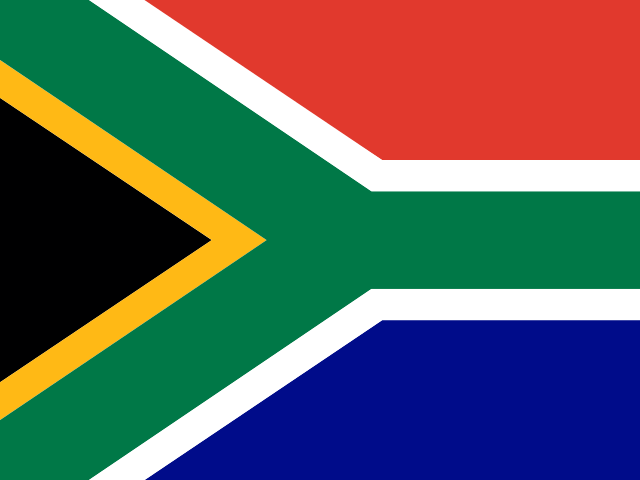
Flag of South Africa
Travel guide

Learn South Africa before you go

Two oceans, the Big Five, Table Mountain and a nation that ended apartheid at the ballot box, all at the southern tip of Africa.
Take the full trip
CapitalPretoria
CurrencySouth African rand (ZAR), divided into 100 cents
Official languageTwelve: Afrikaans, English, isiNdebele, isiXhosa, isiZulu, Sepedi, Sesotho, Setswana, siSwati, Tshivenda, Xitsonga and, since a constitutional amendment signed in 2023, South African Sign Language. isiZulu is the most common home language
Drives on theLeft
Calling code+27

10 phrases to learn

Capital letters show the stressed part. Tap the heart to practise a phrase later.

Sawubona (isiZulu)
sah-woo-BOH-nah
Hello (to one person)
Greeting one person, at any time of day
Sanibonani (isiZulu)
sah-nee-boh-NAH-nee
Hello (to a group)
Greeting two or more people
Unjani? (isiZulu)
oon-JAH-nee
How are you?
Asking one person how they are, after the greeting
Ngiyaphila (isiZulu)
ngee-yah-PEE-lah
I'm fine
Answering 'how are you?'
Ungubani igama lakho? (isiZulu)
oo-ngoo-BAH-nee ee-GAH-mah LAH-koh
What's your name?
Getting to know someone
Igama lami ngingu... (isiZulu)
ee-GAH-mah LAH-mee ngee-ngoo
My name is ...
Introducing yourself
Ngiyabonga (isiZulu)
ngee-yah-BOHN-gah
Thank you
Thanking anyone, for anything
Yimalini? (isiZulu)
yee-mah-LEE-nee
How much is it?
Asking a price at a market stall
Uyasikhuluma isiNgisi? (isiZulu)
oo-yah-see-koo-LOO-mah ee-see-NGEE-see
Do you speak English?
Before switching to English; most people in cities speak it
Ungangisiza? (isiZulu)
oo-ngah-ngee-SEE-zah
Can you help me?
Asking for help or directions

At the table

  • If you are invited to a braai, ask what to bring. Guests often bring their own meat and drinks, and a bottle of wine for the host is a welcome gift.
  • Greet everyone when you arrive, not only your host.
  • Many white South Africans eat with a knife and fork, while in many Black and Indian South African homes people eat with a spoon or their fingers. Follow your host.
  • Try to finish what is on your plate; leaving a lot of food can suggest that you did not like it. Praise the cooking towards the end of the meal.
  • It is polite to receive things, such as a plate, with both hands held out together.

Local tips

Drive on the left, and 'robot' means traffic light

Traffic keeps to the left, and South Africans call traffic lights 'robots'. Keep windows closed and bags out of sight when stopped at junctions, and ask your car hire firm for anti-smash-and-grab window film.

Know the emergency numbers

As of 2026 the official numbers are 10111 for the police and 10177 for an ambulance or the fire service. From a mobile phone you can dial 112 for any emergency.

Tip about 10 percent

In restaurants a tip of around 10 percent is normal, and many waiters depend on it. Petrol stations have attendants who fill your tank and will clean your windscreen for a small tip. Uniformed car guards in car parks also expect a few rand.

Check malaria advice before a safari

The low-lying areas of Mpumalanga and Limpopo, including the Kruger National Park, and the far northeast of KwaZulu-Natal have a malaria risk, mainly from September to May. See a doctor or travel clinic before you go. Cape Town, the Garden Route and Johannesburg have no malaria.

Keep valuables out of sight

Do not wear expensive jewellery or show large amounts of cash, use cash machines inside banks or shopping centres, and avoid walking alone after dark. Your hotel can tell you which areas are safe to explore on foot.

Hike Table Mountain in a group

On quieter trails, walk in a group of four or more, and avoid very early mornings and evenings. The weather on the mountain can change fast, so take water and a warm layer, or ride the cable car.

Swim between the flags

Currents can be strong on many beaches. Swim only where lifeguards are on duty, between the red and yellow flags.

Power cuts are rarer, but can happen

Planned power cuts, called 'loadshedding', were common for years. As of 2026 they are much less frequent, but they can still happen, so keep a torch and a charged phone to hand.

Dishes to try

  • Braai (braaivleis): More than a barbecue: a social gathering where meat is grilled over wood or charcoal in the garden or at a picnic spot. Typical foods are boerewors, lamb chops, steaks and sosaties (spiced kebabs), with fish or rock lobster on the coast, served with pap, salads and chakalaka.
  • Boerewors: A thick, coiled sausage whose name means 'farmer's sausage' in Afrikaans. It is flavoured with toasted coriander seed, black pepper, nutmeg, cloves and allspice, and is usually grilled on the braai, or served in a bread roll as a 'boerie roll'.
  • Bobotie: Gently curried minced beef or lamb with onions and dried fruit, baked under a golden layer of egg and milk. It is served with yellow rice and fruit chutney.
  • Bunny chow: A hollowed-out loaf of white bread filled with a hot curry of mutton, chicken or beans. It comes as a quarter, half or full loaf, and is eaten with the fingers.
  • Biltong: Strips of beef or game such as kudu or springbok, cured with vinegar, salt, coriander and black pepper, then air-dried for several days. It is thicker and more tender than jerky, which is dried with heat. Because it is raw cured meat, pregnant women are advised not to eat it unless it has been cooked until steaming hot.
  • Pap (uphuthu (isiZulu, the crumbly kind)): Porridge of white maize meal, cooked soft for breakfast, stiff enough to hold its shape to eat with stews, or dry and crumbly. 'Pap en wors', pap with boerewors and a tomato and onion sauce, is a braai favourite.
  • Chakalaka: A spicy relish of onions, peppers, carrots, tomatoes and beans, flavoured with curry powder and chilli. It is served warm or cold with pap, bread, stews and braai meat.
  • Potjiekos: A stew of meat, vegetables and potatoes cooked slowly for hours over a small fire in a three-legged cast-iron pot, the potjie. The ingredients are laid in layers and, by tradition, not stirred.

Cities to see

  • Pretoria (capital): The Union Buildings, Tens of thousands of jacaranda trees, which turn the streets purple in spring, Embassies and universities.
  • Johannesburg: Constitution Hill and the Constitutional Court, Soweto and Vilakazi Street, The Apartheid Museum.
  • Cape Town: Table Mountain, The V&A Waterfront and ferries to Robben Island, The colourful houses of the Bo-Kaap.
  • Durban: Bunny chow and Durban curry, The beachfront known as the Golden Mile, Moses Mabhida Stadium, built for the 2010 World Cup.
  • Bloemfontein: The nickname 'City of Roses' and its rose festival, The Supreme Court of Appeal, The birthplace of J. R. R. Tolkien in 1892.
  • Gqeberha: The nickname 'the Windy City', Beaches on Algoa Bay, The nearby Addo Elephant National Park.

Landmarks and the city map are on the South Africa trip