Thousands of green islands along the equator, ancient temples, smoking volcanoes, rich spicy food and a friendly 'selamat pagi' to start the day.
Indonesia is the world's largest archipelagic state, a chain of islands stretching between the Indian and Pacific oceans. The official survey agency counted 17,380 named islands in 2024, so the usual round figure is about 17,000. The biggest are Sumatra, Java, Sulawesi and the Indonesian parts of Borneo and New Guinea. Volcanoes rise along much of the chain, and the equator runs right across the country.
Hindu and Buddhist kingdoms built great temples such as Borobudur and Prambanan more than a thousand years ago, and Islam spread across most of the islands from the late Middle Ages. From the 1600s the Dutch gradually took control, first through the Dutch East India Company and later as a colony. Indonesia proclaimed its independence on 17 August 1945, and the Netherlands transferred sovereignty at the end of 1949.
Questions to ask the older generation
Memories fade faster than photos. Ask these over a meal or a phone call, and write the answers down.
Which town or region of Indonesia did our family come from? Was it near Medan, Bukittinggi, Palembang?
Who was the first in the family to leave Indonesia, when, and why?
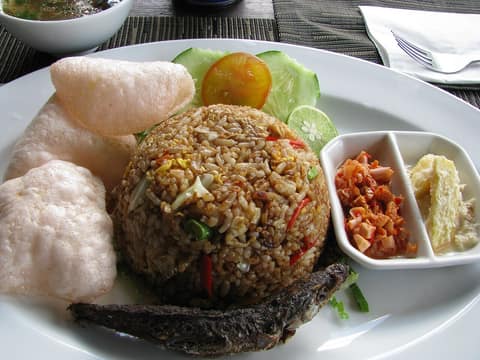
Which dishes from Indonesia were cooked at home? Did anyone make Nasi goreng or Rendang?
Does anyone in the family still speak Indonesian, or use a few words of it?
Were there songs, prayers, games or holidays from Indonesia that the family kept?
Are there old photos, letters or documents from Indonesia? Who has them?
If you could visit Indonesia together, where would you go first?
A short history of Indonesia
People have lived on these islands for a very long time: fossils of early humans have been found on Java, and cave paintings on Sulawesi are among the oldest known. Trade by sea brought Indian ideas, Hinduism and Buddhism, and later Islam. Great kingdoms such as Srivijaya on Sumatra and Majapahit on Java grew rich on that trade. From the 1600s the Dutch slowly took control of the islands. The 20th century brought a national movement, Japanese occupation, independence and a difficult road to today's democracy.
AD 671
A Chinese monk visits Srivijaya
The Chinese Buddhist monk Yijing stayed for six months in Srivijaya, a kingdom based near today's Palembang in southern Sumatra. Srivijaya grew into a great sea-trading power and a centre of Buddhist learning, and it dominated the trade routes of the region for several centuries.
AD 856
Prambanan's great Shiva temple is dedicated
According to an inscription dated 856, a great temple compound for the Hindu god Shiva was inaugurated in Central Java that year. Today it is known as Prambanan, the largest Hindu temple site in Indonesia, with a main tower 47 metres high.
1619
The Dutch found Batavia
The Dutch East India Company (VOC), founded in 1602 to trade in spices, destroyed the port town of Jayakarta on Java and built its own fortified town, Batavia, in its place. Batavia became the centre of Dutch power in Asia and is today's Jakarta.
1883
Krakatoa erupts
The volcanic island of Krakatoa, between Java and Sumatra, blew apart in one of the deadliest eruptions ever recorded. The explosion was heard about 4,800 km away, and the eruption and its tsunamis killed at least 36,417 people.
1945
Independence is proclaimed
On 17 August 1945, two days after Japan surrendered, Sukarno and Mohammad Hatta read the Proclamation of Indonesian Independence in Jakarta. The next day they were appointed the first president and vice president. 17 August is Independence Day.
1955
The Bandung Conference
In April 1955, Indonesia hosted leaders of 29 Asian and African countries in the city of Bandung. They spoke for cooperation among newly independent nations and against colonialism, and the meeting was a step towards the Non-Aligned Movement.
1998
Suharto resigns
During the Asian financial crisis, prices soared and protests and riots spread. On 21 May 1998 Suharto resigned after 32 years in power. The period of reform that followed, called Reformasi, brought free elections, a free press and more power for the regions.
2022
A law for a new capital
In January 2022 parliament passed a law to move the capital from crowded, sinking Jakarta to a new city, Nusantara, being built in East Kalimantan on Borneo. The law says Jakarta stays the capital until the president signs a decree making the move official.