Laos trivia: 48 questions and answers
The country at a glance
What is the capital of Laos?
- A. Vientiane
- B. Luang Prabang
- C. Pakse
- D. Savannakhet
Show the answer
Vientiane. Vientiane, on the Mekong opposite Thailand, is the capital and largest city. Luang Prabang was the old royal capital.
Laos has no coastline: it is a landlocked country.
True or false?
Show the answer
True. True. Laos is surrounded by China, Myanmar, Thailand, Cambodia and Vietnam, and it is the only landlocked country in Southeast Asia.
What is the official currency of Laos?
- A. Lao kip
- B. Thai baht
- C. Vietnamese dong
- D. Cambodian riel
Show the answer
Lao kip. The Lao kip has been the currency of Laos since 1953. Thai baht is sometimes accepted near the border, but the kip is the only official currency.
Which of these countries does NOT share a border with Laos?
- A. Malaysia
- B. Myanmar
- C. Cambodia
- D. China
Show the answer
Malaysia. Malaysia does not border Laos. The neighbours of Laos are China, Myanmar, Thailand, Cambodia and Vietnam.
History
Who founded the kingdom of Lan Xang in 1353?
- A. Fa Ngum
- B. Setthathirath
- C. Anouvong
- D. Sisavang Vong
Show the answer
Fa Ngum. Fa Ngum, raised in exile at Angkor, founded Lan Xang in 1353 and made Theravada Buddhism the state religion.
What does the name of the old Lao kingdom, Lan Xang, mean?
- A. A million elephants
- B. Mother of rivers
- C. City of the moon
- D. Land of rice
Show the answer
A million elephants. Lan Xang means 'a million elephants', a boast about the power of the king and his war elephants.
In 1560 King Setthathirath moved the royal capital from Luang Prabang to which city?
- A. Vientiane
- B. Pakse
- C. Savannakhet
- D. Champasak
Show the answer
Vientiane. Setthathirath moved the capital to Vientiane in 1560, and a few years later built Pha That Luang there.
The Emerald Buddha, taken from Vientiane by a Siamese army in 1779, is kept in Bangkok today.
True or false?
Show the answer
True. True. The Emerald Buddha was carried off in 1779 and is now in Wat Phra Kaew in Bangkok. Haw Phra Kaew in Vientiane, built to house it, is a museum.
What happened in Laos on 2 December 1975?
- A. The monarchy ended and the Lao People's Democratic Republic was proclaimed
- B. France granted Laos full independence
- C. Laos joined the Association of Southeast Asian Nations
- D. The kingdom of Lan Xang split into rival kingdoms
Show the answer
The monarchy ended and the Lao People's Democratic Republic was proclaimed. On 2 December 1975 the monarchy ended and the Lao People's Democratic Republic was proclaimed. Full independence came in 1953 and ASEAN membership in 1997.
Between 1964 and 1973 the United States dropped more than 2 million tons of bombs on Laos.
True or false?
Show the answer
True. True. The air campaign over Laos was officially secret, and many unexploded bombs from it still lie in the ground.
Food and drink
Which food do Lao people eat with their fingers from a small woven basket at almost every meal?
- A. Sticky rice
- B. Bread
- C. Rice noodles
- D. Potatoes
Show the answer
Sticky rice. Sticky rice, khao niao, is the heart of every Lao meal. It is rolled into small balls with the fingers and used to scoop up food.
Which dish of chopped meat or fish with lime, herbs and toasted ground rice is often called the national dish of Laos?
- A. Larb
- B. Or lam
- C. Khao poon
- D. Kaipen
Show the answer
Larb. Larb is chopped meat or fish mixed with lime juice, fish sauce, chilli, fresh herbs and toasted ground sticky rice.
The crisp snack kaipen is made from what?
- A. River algae
- B. Rice paper
- C. Dried fish skin
- D. Pressed banana leaves
Show the answer
River algae. Kaipen is made from river algae, pressed into thin sheets with sesame seeds and garlic, dried in the sun and quickly fried.
The peppery stew or lam is a speciality of which city?
- A. Luang Prabang
- B. Pakse
- C. Savannakhet
- D. Thakhek
Show the answer
Luang Prabang. Or lam comes from Luang Prabang. Slices of 'chilli wood', sakhaan, make it gently tingle on the tongue.
Khao jee pâté is a filled baguette, a legacy of French rule in Laos.
True or false?
Show the answer
True. True. The French brought the baguette, and today khao jee pâté is sold from street stalls, especially for breakfast.
Tam mak hoong, the Lao papaya salad, is made with ripe, sweet orange papaya.
True or false?
Show the answer
False. False. Tam mak hoong uses unripe green papaya, shredded and pounded in a mortar with garlic, chilli, lime and fish sauce.
In Laos it is the custom to close the lid of your sticky rice basket when you have finished eating.
True or false?
Show the answer
True. True. Closing the basket shows that you have finished your meal.
The salad nam khao is made with which crunchy main ingredient?
- A. Crispy fried rice balls
- B. Raw green papaya
- C. Fresh rice noodles
- D. Toasted coconut chips
Show the answer
Crispy fried rice balls. Nam khao is made with crispy fried rice balls, broken up and tossed with sour pork sausage, peanuts, lime and herbs, and eaten in lettuce leaves.
Cities
Which town is the usual base for visiting the Plain of Jars?
- A. Phonsavan
- B. Vang Vieng
- C. Thakhek
- D. Houayxay
Show the answer
Phonsavan. Phonsavan, on the Xiangkhoang Plateau, is the base for visiting the Plain of Jars.
Vang Vieng lies on the Nam Song River, among limestone karst hills.
True or false?
Show the answer
True. True. Vang Vieng, north of Vientiane, is known for its karst scenery, caves and kayaking on the Nam Song.
From which border town on the Mekong does the two-day slow boat to Luang Prabang set off?
- A. Houayxay
- B. Pakse
- C. Thakhek
- D. Nong Khiaw
Show the answer
Houayxay. Houayxay, opposite Chiang Khong in Thailand, is where many travellers board the slow boat down the Mekong to Luang Prabang.
Landmarks
Which golden stupa in Vientiane is the national symbol of Laos?
- A. Pha That Luang
- B. Wat Si Saket
- C. Patuxai
- D. Wat Xieng Thong
Show the answer
Pha That Luang. Pha That Luang, built in 1566, is the national symbol and appears on the national emblem.
Patuxai, the victory gate in Vientiane, looks like the Arc de Triomphe in Paris.
True or false?
Show the answer
True. True. Patuxai resembles the Arc de Triomphe, but it is decorated with Lao mythical creatures.
The ruined temple of Vat Phou in southern Laos was built mainly by which people?
- A. The Khmer
- B. The Burmese
- C. The Chinese
- D. The French
Show the answer
The Khmer. The Khmer built Vat Phou, a Hindu temple on a sacred mountain above the Mekong, a UNESCO World Heritage Site since 2001.
According to archaeologists, the great stone jars of the Plain of Jars were connected with what?
- A. Burial practices
- B. Watering rice fields
- C. Marking a royal border
- D. Measuring the seasons
Show the answer
Burial practices. Burial practices: human remains, beads and tools have been found in and around the jars, some of which were set in place more than 2,500 years ago.
On which river are the Khone Phapheng Falls?
- A. Mekong
- B. Nam Ou
- C. Nam Song
- D. Xe Don
Show the answer
Mekong. The Khone Phapheng Falls are on the Mekong, near the Cambodian border. They are the main reason ships cannot sail up the river into China.
Kuang Si Falls is in the far south of Laos, near the border with Cambodia.
True or false?
Show the answer
False. False. Kuang Si Falls is in the north, about 29 km south of Luang Prabang.
What is Kong Lo in Khammouane Province?
- A. A cave that a river flows through for about 7 km
- B. A royal palace
- C. A Khmer temple
- D. A hot spring
Show the answer
A cave that a river flows through for about 7 km. Kong Lo is a cave that a river flows through for about 7 km. Visitors cross it in small motorboats.
Fun facts
The white disc on the flag of Laos is said to represent what?
- A. A full moon over the Mekong
- B. The rising sun
- C. A bowl of rice
- D. A temple bell
Show the answer
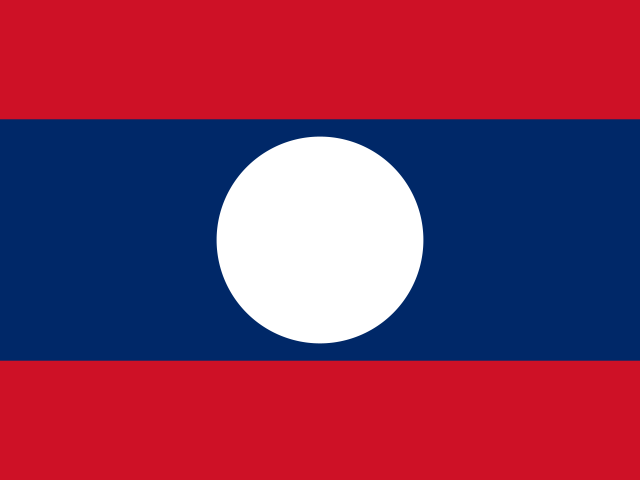
A full moon over the Mekong. The white disc is said to stand for a full moon over the Mekong, and for the unity of the Lao people. The blue stripe stands for the river.
Since 1991 the national emblem of Laos has shown the golden stupa of Pha That Luang.
True or false?
Show the answer
True. True. In 1991 the stupa replaced the hammer and sickle on the emblem.
What is the national instrument of Laos, whose music is on UNESCO's intangible heritage list?
- A. The khaen, a bamboo mouth organ
- B. The sitar, a long-necked lute
- C. The gamelan, a set of gongs
- D. The erhu, a two-stringed fiddle
Show the answer
The khaen, a bamboo mouth organ. The khaen, a bamboo mouth organ, is the national instrument. Khaen music was added to UNESCO's list in 2017.
Roughly how many cluster bomblets dropped on Laos during the war failed to explode?
- A. About 80 million
- B. About 8,000
- C. About 80,000
- D. About 8 billion
Show the answer
About 80 million. About 80 million bomblets failed to explode. Clearing them is slow work that still goes on today.
As of September 2026, how many UNESCO World Heritage Sites does Laos have?
- A. Two
- B. Three
- C. Four
- D. Five
Show the answer
Four. Four: the Town of Luang Prabang, Vat Phou, the Plain of Jars, and Hin Nam No National Park, added in 2025.
Khone Phapheng Falls is often described as the world's widest waterfall. About how wide is it from edge to edge?
- A. More than 10 km
- B. About 100 m
- C. About 500 m
- D. About 2 km
Show the answer
More than 10 km. More than 10 km: the falls spread across many channels between the islands of the Mekong.
Words
What does the Lao word 'sabaidee' mean?
- A. Hello
- B. Thank you
- C. Sorry
- D. Delicious
Show the answer
Hello. Sabaidee means hello. Thank you is khop jai, sorry is khaw thot, and delicious is sep.
What is 'khao niao'?
- A. Sticky rice
- B. A river
- C. A temple
- D. A market
Show the answer
Sticky rice. Khao niao is sticky rice: khao means rice and niao means sticky.
Lao is a tonal language: the same syllable can have different meanings depending on its tone.
True or false?
Show the answer
True. True. The Vientiane dialect has six tones, so the pitch of a word changes its meaning.
The Lao alphabet was adapted from which older script?
- A. Khmer
- B. Latin
- C. Chinese characters
- D. Arabic
Show the answer
Khmer. The Lao script was adapted from the Khmer script and is a close relative of the Thai alphabet.
Phrases
How do you say 'thank you' in Lao?
- A. Khop jai
- B. Sabaidee
- C. Bo pen nyang
- D. Sep lai
Show the answer
Khop jai. Khop jai means thank you. Khop jai lai lai means thank you very much.
What does 'bo pen nyang' mean?
- A. No problem, it's nothing
- B. How much is it?
- C. Where is the toilet?
- D. Very delicious
Show the answer
No problem, it's nothing. Bo pen nyang means 'no problem, it's nothing'. It is the answer to a thank you or an apology.
At a market, what are you asking when you say 'Tao dai?'
- A. How much?
- B. What is your name?
- C. Is it spicy?
- D. Where is the bus?
Show the answer
How much?. Tao dai? means 'How much?'. Friendly bargaining is normal in Lao markets.
To ask for food that is not spicy, you can say 'bo pet'.
True or false?
Show the answer
True. True. Bo means 'not' and pet means 'spicy'.
The Lao phrase 'sep lai' means 'I don't understand'.
True or false?
Show the answer
False. False. Sep lai means 'very delicious'. 'I don't understand' is khoy bo khao jai.
Local customs and tips
What should you do before entering a temple hall or a Lao home?
- A. Take off your shoes
- B. Clap your hands twice
- C. Ring the temple bell
- D. Leave a coin at the door
Show the answer
Take off your shoes. Take off your shoes, and wear clothes that cover your shoulders and knees when visiting temples.
In Laos it is a friendly gesture to pat a child on the head.
True or false?
Show the answer
False. False. The head is the most respected part of the body, so you should not touch anyone on the head.
Why are visitors to the countryside in eastern and northern Laos told to stay on roads and well-used paths?
- A. Unexploded bombs from the war may remain in the ground
- B. Walking on grass is against the law
- C. The paths are the only places without tolls
- D. The fields belong to the monasteries
Show the answer
Unexploded bombs from the war may remain in the ground. Unexploded bombs from the war may remain in the ground, mostly near the border with Vietnam. The main tourist towns and sites are cleared.
What may monks receive as an offering on their morning alms round?
- A. Food, such as sticky rice
- B. Money
- C. Alcohol
- D. Jewellery
Show the answer
Food, such as sticky rice. Food, such as sticky rice, is offered to monks in the morning. Monks are not allowed to accept money.
Visitors to Laos are advised to drink bottled water rather than tap water.
True or false?
Show the answer
True. True. Tap water in Laos is not safe to drink, but bottled water is cheap and easy to find.
Answer key
The country at a glance
- A. Vientiane
- True
- A. Lao kip
- A. Malaysia
History
- A. Fa Ngum
- A. A million elephants
- A. Vientiane
- True
- A. The monarchy ended and the Lao People's Democratic Republic was proclaimed
- True
Food and drink
- A. Sticky rice
- A. Larb
- A. River algae
- A. Luang Prabang
- True
- False
- True
- A. Crispy fried rice balls
Cities
- A. Phonsavan
- True
- A. Houayxay
Landmarks
- A. Pha That Luang
- True
- A. The Khmer
- A. Burial practices
- A. Mekong
- False
- A. A cave that a river flows through for about 7 km
Fun facts
- A. A full moon over the Mekong
- True
- A. The khaen, a bamboo mouth organ
- A. About 80 million
- C. Four
- A. More than 10 km
Words
- A. Hello
- A. Sticky rice
- True
- A. Khmer
Phrases
- A. Khop jai
- A. No problem, it's nothing
- A. How much?
- True
- False
Local customs and tips
- A. Take off your shoes
- False
- A. Unexploded bombs from the war may remain in the ground
- A. Food, such as sticky rice
- True
More about Laos
- The trip to LaosMap, story, food, phrases and a friendly quiz.
- Laos word searchCities and dishes in large print.
- Laotian words crosswordLearn a few words while you solve it.
- Colour the flag of LaosPrint it or colour it in on the screen.
- Laotian rootsA family guide: history, recipes and words for the grandchildren.
- Before you goPhrases, customs and tips for travellers.
- Printable packLarge print, with a quiz and answers.