World Stroll
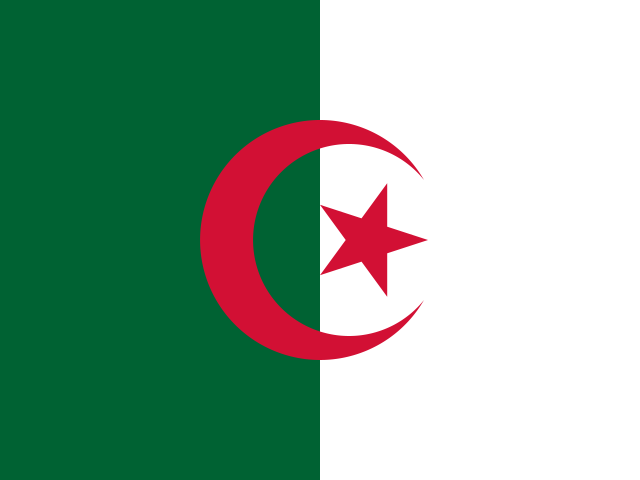
Flag of Algeria
Travel guide

Learn Algeria before you go

Africa's largest country, where Roman cities, whitewashed old towns and the green Mediterranean coast give way to the vast Sahara and its painted rocks.
Take the full trip
CapitalAlgiers
CurrencyAlgerian dinar (DZD)
Official languagesArabic and Tamazight (Berber). Most people speak Algerian Arabic (Darja) day to day, and French is widely used, although it has no official status
Drives on theRight
Calling code+213

10 phrases to learn

In Algerian Arabic (Darja). Capital letters show the stressed part. Tap the heart to practise a phrase later.

As-salamu alaykum (السلام عليكم)
ah-sah-LAH-moo ah-LAY-koom
Peace be upon you (hello)
The polite greeting for anyone, at any time of day
Wa alaykum as-salam (وعليكم السلام)
wah ah-LAY-koom ah-sah-LAHM
And upon you be peace (the reply)
Answering someone who greets you
Wesh rak? (واش راك)
wesh RAHK
How are you? (to a man; to a woman, wesh raki?)
A friendly question after the greeting
Labas, el hamdoulillah (لاباس الحمد لله)
lah-BAHS, el ham-doo-lil-LAH
Fine, thank God
The usual answer to how are you
Sbah el khir (صباح الخير)
SBAH el KHEER
Good morning
Greeting someone in the morning
Msa el khir (مسا الخير)
MSAH el KHEER
Good evening
Greeting someone in the afternoon or evening
Sahit (صحيت)
sah-HEET
Thank you (to a man; to a woman, sahiti)
Thanking a shopkeeper, a waiter or a host
Rabbi yhafdek (ربي يحفظك)
RAB-bee YAH-fdek
May God protect you (a warm thank you)
Thanking someone for a real favour
Smahli (سمحلي)
SMAH-lee
Excuse me, sorry
Getting past someone, or apologising
Ma fhemtsh (ما فهمتش)
mah FHEMTSH
I don't understand
When the conversation goes too fast

At the table

  • Eat with your right hand, and use pieces of bread to scoop up sauce and stew.
  • When a dish is shared, eat from the part in front of you rather than reaching across.
  • Guests are usually offered coffee or tea with sweets; accepting at least a little is polite.
  • Many people say 'bismillah' ('in the name of God') before eating; you can simply wait for your host to start.
  • During Ramadan the fast is often broken at sunset with dates and milk, followed by a bowl of chorba.

Local tips

Check official travel warnings first

Read your government's travel advice before you book, especially for the south and the border areas. As of September 2026, for example, the UK advises against all travel within 30 km of Algeria's borders with Libya, Mali, Mauritania and Niger, and parts of the border with Tunisia. The Sahara is best visited with a licensed local agency.

Get your visa in advance

As of 2026 most visitors need a visa from an Algerian consulate before they travel, and the application asks for a lot of paperwork. A visa on arrival is possible only in some cases, such as desert trips booked through an approved local travel agency.

Bring cash in euros

Cards are accepted in few places, so most travellers bring euros in cash. Visitors without Algerian residency may not carry dinar banknotes into or out of the country, and larger sums of foreign cash must be declared on arrival (as of 2026).

Fly between distant cities

Algeria is huge: Tamanrasset is about 1,600 km from Algiers as the crow flies, and much farther by road. Domestic flights save days of driving, and desert roads are no place to travel at night or without experience.

Be thoughtful during Ramadan

During the holy month of Ramadan most Algerians fast from dawn to sunset. Avoid eating, drinking or smoking in public in the daytime, and expect shorter opening hours. The evenings are lively, with special soups and sweets.

Leave the drone at home

Bringing drones, binoculars and some other camera equipment into Algeria without permission is illegal (as of 2026). Do not photograph police, soldiers or government buildings, and ask before taking pictures of people.

Dress modestly and take it slow

Covering shoulders and knees is respectful, especially in the south and in mosques. Algerians are known for their hospitality: accept a coffee when it is offered, and show interest in the country's history and culture.

Plan your route around the Morocco border

The land border between Algeria and Morocco has been closed since 1994 (as of 2026), so travel between the two countries is by air.

Dishes to try

  • Couscous (seksu) (كسكس (seksu)): Tiny grains of semolina, steamed two or three times over a pot of stew and served in a large dish with meat, chickpeas and vegetables such as courgettes, carrots and turnips. In Algeria it comes with a red tomato sauce or a white one, and there is also masfouf, a dry version, sometimes sweet with raisins.
  • Chakhchoukha (شخشوخة): Thin rounds of semolina flatbread are torn into small pieces and soaked in marqa, a tomato stew with lamb, chickpeas and spices. The bread softens and soaks up the sauce, a filling dish for family gatherings.
  • Rechta (رشتة): Fine, flat noodles cut by hand, steamed and served with chicken, chickpeas and turnips in a white sauce flavoured with cinnamon and white pepper. It is the signature dish of Algiers, often made for family celebrations.
  • Chorba frik (شربة فريك): A thick soup of lamb, tomato, chickpeas and frik, wheat harvested green, roasted and cracked. It is the soup of Ramadan evenings, when families break the fast with it.
  • Bourek (بوراك): Thin pastry sheets, called dyoul, rolled or folded around minced meat, potato, cheese, egg or tuna and fried until crisp. In eastern Algeria it is called brik, and it is a fixture of the Ramadan table.
  • Karantika (garantita) (كارنتيكا): A baked chickpea-flour custard with a golden, egg-glazed top, sold hot by street vendors in squares or tucked into bread and sprinkled with cumin and harissa.
  • Mhadjeb (محجب (mahdjouba)): A very thin semolina dough, stretched by hand, filled with a spicy mixture of onion, tomato and pepper, folded into a square and cooked on a griddle. The name means 'veiled' or 'covered'.
  • Kesra (كسرة): A round, flat semolina bread cooked on a clay or iron griddle. It is eaten warm or cold with almost anything, from stews to olive oil, honey or a glass of fermented milk (leben).

Cities to see

  • Algiers (capital): The Casbah, the old town on the hill, Djamaa el Djazaïr, the Great Mosque of Algiers, Maqam Echahid, the Martyrs' Memorial.
  • Oran: Raï music, The Santa Cruz fort and chapel above the bay, Karantika, the chickpea street snack.
  • Constantine: The "City of Bridges" across the gorge, The Sidi M'Cid suspension bridge, The old town on the rock.
  • Annaba: The Basilica of Saint Augustine, The ruins of Hippo Regius, Beaches and the large bourek annabi.
  • Tlemcen: The Great Mosque of Tlemcen, Andalusian music, Mansourah, a ruined medieval city nearby.
  • Béjaïa: Mount Gouraya above the bay, A gateway to the Kabylie mountains, Medieval trade with Europe.

Landmarks and the city map are on the Algeria trip