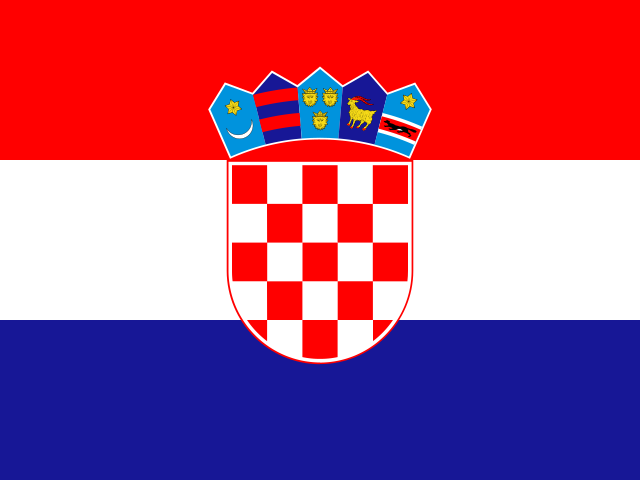
Learn Croatia before you go
10 phrases to learn
In Croatian. Capital letters show the stressed part. Tap the heart to practise a phrase later.
At the table
- Before eating, people wish each other 'Dobar tek' (enjoy your meal).
- When glasses are raised, people say 'Živjeli' (cheers).
- Wine is often mixed with water: red wine with still water is called bevanda on the Dalmatian coast, and white wine with sparkling water is gemišt in the north.
- A family Sunday lunch almost always begins with a soup, usually a clear broth with thin noodles.
- Croatians are keen coffee drinkers, and Viennese-style coffee houses can be found all over the country.
Local tips
Euros, cards and a little cash
Croatia has used the euro since 1 January 2023, so old kuna prices in guidebooks are out of date. Cards are accepted almost everywhere, but carry some small notes and coins for markets, tips and small cafés.
Tipping is modest
Service is not added to the bill. Rounding up is normal for drinks, and 5 to 10% in a restaurant shows you were happy with the service. More than 10% is unusual.
Cover up in town
In several coastal towns, walking around the town centre in swimwear or without a shirt can bring an on-the-spot fine. Save the swimsuit for the beach and put on a shirt and shorts or a dress in town.
Plitvice: book ahead, no swimming
Buy Plitvice Lakes tickets online in advance: you choose an entrance and a time, and must arrive at that entrance within your time slot. Swimming in the lakes is strictly forbidden, and not every path is suitable for wheelchairs.
Emergency number: 112
The number for police, ambulance and fire in Croatia is 112. It works from any phone, free of charge.
Respect the bura wind
The bura is a cold, dry wind that rushes down from the mountains to the sea, most often in the cooler months. It can be very strong, especially around the Velebit mountains, and can close roads and bridges and delay ferries, so check forecasts and warning signs.
Driving rules
Drive on the right. From 1 November to 31 March, dipped headlights or daytime running lights must be on even in daytime. The alcohol limit is 0.05%, and zero for drivers under 24.
Mines are cleared, but stay careful
As of 2026, Croatia has finished clearing the landmines left from the war of the 1990s and has declared itself free of mine danger. In remote countryside that was once on the front line, stay on marked trails and roads and never touch an old metal object you find.
Dishes to try
- Peka (dishes cooked under the bell) (ispod peke): Lamb, veal or octopus with potatoes, slowly cooked in a shallow dish under a heavy metal or clay bell covered with hot embers. The meat cooks in its own juices and comes out very tender.
- Zagorje štrukli (zagorski štrukli): Very thin pastry rolled around a filling of fresh cottage cheese, eggs and sour cream, cut into pieces and either boiled or baked with cream until golden.
- Pašticada (dalmatinska pašticada): A festive dish of beef marinated overnight in wine vinegar, studded with garlic, cloves and bacon, then slowly braised for hours with prunes and sweet prošek wine. It is served in slices in its rich, sweet and sour sauce, usually with gnocchi.
- Black risotto (crni rižot): Rice cooked with cuttlefish, or sometimes squid, and its own ink, which turns the whole dish a deep, glossy black. It is flavoured with garlic, onion, parsley and wine, and usually served without cheese.
- Fritule (fritule): Small, round fried doughnuts flavoured with citrus zest and a splash of rum, often with raisins inside, and dusted with icing sugar.
- Soparnik (soparnik): A thin, round pie of Swiss chard and onion between two sheets of unleavened dough, baked on an open hearth under hot embers and then brushed with olive oil and garlic.
- Pasta with Istrian truffles (tjestenina s tartufima): The damp forests around Motovun in Istria are known for black and prized white truffles. Istrian restaurants are famous for truffle dishes, above all fresh pasta topped with shaved truffle.
- Pršut (pršut): Dry-cured ham, sliced thin and served with cheese and olives as a starter. Dalmatian pršut is lightly smoked, while Istrian pršut is not smoked.
Cities to see
- Zagreb (capital): St. Mark's Church with its tiled roof, The Museum of Broken Relationships, Its Christmas market.
- Split: Diocletian's Palace, The seafront Riva, The Split Summer Festival.
- Rijeka: The Rijeka Carnival before Lent, Shipbuilding and the port, Trsat Castle above the city.
- Osijek: The baroque Tvrđa fortress, Kulen and fiš paprikaš, Kopački Rit nature park nearby.
- Zadar: The Sea Organ, The Roman forum, Maraschino cherry liqueur.
- Pula: The Pula Arena, Roman temples and gates, Beaches of southern Istria.