World Stroll
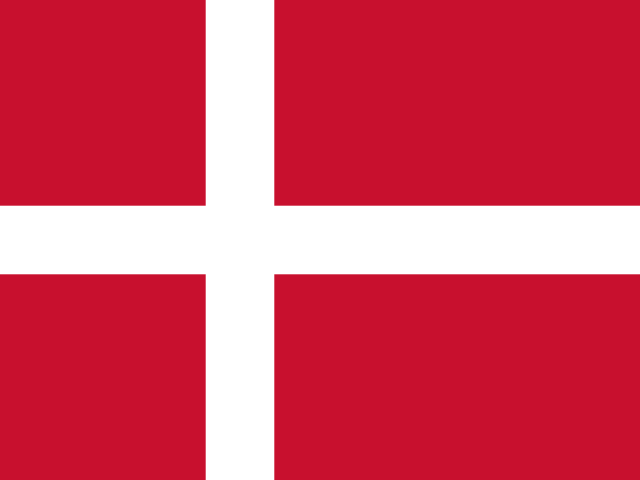
Flag of Denmark
Travel guide

Learn Denmark before you go

Fairy tales, cosy candlelit evenings, bicycles everywhere and open sandwiches, in a small kingdom of islands between two seas.
Take the full trip
CapitalCopenhagen
CurrencyDanish krone (DKK), since 1875. Denmark is in the EU but voted in 2000 to keep the krone instead of the euro
Official languageDanish, the national language. No language law or constitution names an official language. German is a recognised minority language in Southern Jutland
Drives on theRight
Calling code+45

10 phrases to learn

In Danish (dansk). Capital letters show the stressed part. Tap the heart to practise a phrase later.

Hej
HIGH
Hello, hi
Greeting anyone, at any time of day; Danes use it even with strangers
Goddag
go-DAY
Good day, hello (more formal)
A polite greeting, for example to an older person
God morgen
go MORN
Good morning
Greeting someone in the morning
God aften
go AHF-ten
Good evening
Greeting someone in the evening
God nat
go NAT
Good night
Before going to bed
Farvel
fah-VEL
Goodbye
Leaving; Danes also often say 'Hej hej'
Vi ses
vee SAYS
See you
Saying goodbye to someone you will see again
Hvordan har du det?
vor-DAN har doo day
How are you?
Asking after someone
Fint, tak
FEENT tahk
Fine, thanks
Answering 'How are you?'
Tak
TAHK
Thank you
Any time someone helps you or serves you

At the table

  • Open sandwiches are usually eaten with a knife and fork, not with your hands.
  • At a festive lunch, eat the fish first, then the meat and warm dishes, and finish with cheese.
  • After a meal in someone's home, thank the host with 'Tak for mad' (TAHK for MATH), 'thanks for the food'.
  • When raising a glass, say 'Skål' (SKOHL), meaning 'cheers'.
  • Service is included in restaurant, hotel and taxi bills, so tipping is not expected, although you may leave a little extra for great service.

Local tips

Watch out for bicycles

Danish cities have separate cycle tracks between the pavement and the road, and they are busy. Look both ways before you step onto one, and never stand or walk in it. If you rent a bike, keep to the right and signal with your hand before you turn or stop.

Cards everywhere

Denmark uses the Danish krone (kr), not the euro. Cards and mobile payments work almost everywhere, and many shops and cafés no longer take cash at all, so bring a card. Some small shops and supermarkets do not accept international credit cards.

No need to tip

Service is already included in restaurant, hotel and taxi bills. You may leave a little extra for great service, but it is up to you, and there are no fixed rules.

Two toll bridges

Roads in Denmark are free to drive, with two exceptions: the Great Belt Bridge between Zealand and Funen and the Øresund Bridge to Sweden. You can pay at the toll booths by card or cash. Cars drive on the right.

Plugs and power

Denmark uses the round two-pin continental European plugs and about 230 volts, like most of Europe. Visitors from the United Kingdom and Ireland need an adaptor, and those from North America need an adaptor and a converter for 110 volt appliances.

Long summer days

The best time to visit is June to August, when temperatures reach about 22 °C and the sun is up for 17 to 18 hours a day. The weather changes quickly, so bring a light rain jacket and warm layers, even in summer.

Emergencies

In an emergency, call 112 for police, ambulance or fire; the call is free. For the police when it is not an emergency, call 114. In the Capital Region, which includes Copenhagen, call 1813 for urgent medical advice before going to a hospital emergency department.

Dishes to try

  • Smørrebrød (open sandwiches) (Smørrebrød): A slice of buttered rye bread topped with pickled herring, liver pâté, roast beef, shrimp, egg, cheese or smoked fish, and carefully garnished. It is the classic Danish lunch and is usually eaten with a knife and fork.
  • Rye bread (Rugbrød): A dark, dense sourdough bread made from rye flour, often with whole rye grains and seeds, baked in a long rectangular tin. Most Danes eat it every day, as the base for open sandwiches.
  • Danish meatballs (Frikadeller): Flattened, pan-fried meatballs of minced pork, or pork and veal, with onion, egg and a little flour or breadcrumbs. They are served warm with potatoes, brown sauce and pickled red cabbage, or cold on rye bread.
  • Roast pork with crackling (Flæskesteg): A joint of pork roasted with its rind scored into narrow strips, so it turns into crisp crackling. It is served with boiled and caramelised potatoes, red cabbage and gravy, and, often with roast duck, it is the classic dinner on Christmas Eve.
  • Fried pork belly with parsley sauce (Stegt flæsk med persillesovs): Thick slices of pork belly fried until crisp, served with boiled potatoes and a creamy white parsley sauce. It is simple, filling and very much loved.
  • Round pancake balls (Æbleskiver): Light, fluffy balls of batter cooked in a special pan with round hollows and turned with a knitting needle or skewer. They are dipped in jam and dusted with icing sugar, especially in December with a cup of mulled wine (gløgg).
  • Danish pastry (Wienerbrød): A flaky pastry made from a yeast dough folded again and again with thin layers of butter, filled with custard, marzipan, jam or cinnamon, and often topped with icing or nuts.
  • Christmas rice pudding with almonds (Risalamande): Cold rice pudding mixed with whipped cream, vanilla and chopped almonds, served with warm cherry sauce. It is the traditional dessert on Christmas Eve.

Cities to see

  • Copenhagen (capital): Tivoli Gardens, Nyhavn harbour, The Little Mermaid.
  • Aarhus: Den Gamle By open-air museum, ARoS art museum, Moesgaard Museum.
  • Odense: Hans Christian Andersen's birthplace and museum, Saint Canute's Cathedral, Egeskov Castle nearby.
  • Aalborg: Lindholm Høje Viking burial ground, The Utzon Center, Jomfru Ane Gade, a lively street of bars and restaurants.
  • Esbjerg: 'Man Meets the Sea', four 9 m white figures, The Wadden Sea, a UNESCO World Heritage Site, Offshore wind energy.
  • Roskilde: Roskilde Cathedral, The Viking Ship Museum, The Roskilde Festival.

Landmarks and the city map are on the Denmark trip