World Stroll
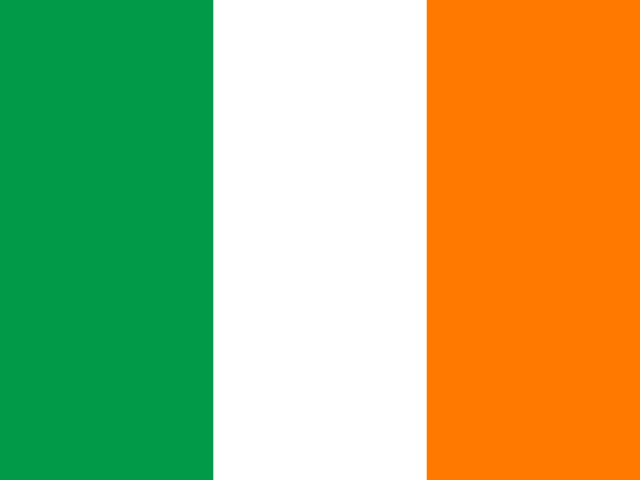
Flag of Ireland
Travel guide

Learn Ireland before you go

Green hills, ancient stories, music in the pubs and a famous welcome, on the western edge of Europe.
Take the full trip
CapitalDublin
CurrencyEuro (€), since 1999 (notes and coins since 2002); before that, the Irish pound (punt)
Official languageIrish (Gaeilge), the national and first official language, and English, the second official language
Drives on theLeft
Calling code+353

10 phrases to learn

In Irish (Gaeilge). Capital letters show the stressed part. Tap the heart to practise a phrase later.

Dia duit
DEE-uh gwitch
Hello (literally 'God be with you')
Greeting anyone, at any time of day
Dia is Muire duit
DEE-uh iss MWIR-eh gwitch
Hello in reply (literally 'God and Mary be with you')
Answering someone who has said 'Dia duit'
Maidin mhaith
MAD-jin WAH
Good morning
Greeting someone in the morning
Oíche mhaith
EE-heh WAH
Good night
Saying goodnight
Conas atá tú?
KUN-us uh-TAW too
How are you?
Asking after someone (the Munster way; each dialect has its own)
Tá mé go maith
TAW may guh MAH
I am well
Answering 'How are you?'
Go raibh maith agat
guh rev MAH AH-gut
Thank you
Thanking one person
Le do thoil
leh duh HULL
Please
Asking politely for something
Ná habair é
naw HAB-er ay
Don't mention it, you're welcome
Answering someone who thanks you
Gabh mo leithscéal
GAW muh LESH-kayl
Excuse me, sorry
Getting someone's attention or apologising

At the table

  • Visitors to an Irish home are almost always offered a cup of tea, and it is friendly to accept.
  • In a pub, friends usually take turns to buy a 'round' of drinks for the whole group. If someone buys you a drink, you are expected to buy the next round.
  • When raising a glass, say 'Sláinte' (SLAWN-cheh), which means 'health'.
  • In most pubs you order and pay at the bar, and you do not tip for each drink.
  • In restaurants, a tip of about 10 to 15 percent is usual for good service, unless a service charge is already on the bill.

Local tips

Drive on the left

Cars on the whole island of Ireland drive on the left. In the Republic, speed limits and distances are in kilometres, up to 120 km/h on motorways. In Northern Ireland they are in miles per hour.

Two currencies on one island

The Republic uses the euro. Northern Ireland, part of the United Kingdom, uses the pound sterling, so bring the right money, or a card, if you cross the border. Visa and Mastercard are widely accepted, American Express less so.

Pack for all weather

The weather can change several times in one day. Dress in layers and bring a waterproof jacket and comfortable walking shoes, even in summer.

Bring a plug adapter

Ireland uses three-pin plugs, the same as in the United Kingdom, and 230 volts. Most visitors from continental Europe and America need an adapter.

Tipping

In restaurants, about 10 to 15 percent is usual for good service, but check the bill first, as a service charge is sometimes included, especially for groups. In pubs you do not tip when ordering at the bar.

Bilingual signs

Road signs in the Republic are in Irish and English. In Gaeltacht areas, where Irish is the main community language, signs may be in Irish only, so it helps to know the Irish names of the places you are going to.

Emergencies

In an emergency call 112 or 999; both numbers work throughout Ireland and are free.

Dishes to try

  • Irish stew (Stobhach Gaelach): Lamb or mutton slowly simmered with potatoes, onions and parsley until the potatoes break down and thicken the broth. It is often called the national dish.
  • Soda bread (Arán sóide): A quick bread made with flour, buttermilk, salt and bread soda (baking soda) instead of yeast. Brown soda bread, made with wholemeal flour, is served with soup, smoked salmon or simply butter.
  • Colcannon (Cál ceannann): Creamy mashed potatoes mixed with buttered cabbage or kale and spring onions, served with a pool of melting butter in the middle. It goes well with ham or bacon.
  • Boxty (Bacstaí): A potato pancake made from grated raw potato mixed with mashed potato, flour and buttermilk, fried on a griddle or pan until golden. It can be a side dish or a breakfast.
  • Dublin coddle: Pork sausages and rashers (thin slices of bacon) slowly cooked with potatoes, onions and herbs in a covered pot, so everything steams and simmers in its own stock. It is served with soda bread to mop up the broth.
  • Bacon and cabbage: A thick piece of boiled bacon (similar to ham) served in slices with cabbage cooked in the bacon water, boiled potatoes and a white parsley sauce. It is a classic Sunday or family dinner.
  • Full Irish breakfast: A big cooked breakfast of rashers, sausages, fried or scrambled eggs, black and white pudding, grilled tomato and mushrooms, with brown soda bread and a pot of tea.
  • Seafood chowder: A creamy soup of fish such as salmon, cod and smoked haddock, often with mussels or prawns, potatoes and vegetables, served with brown bread. Almost every coastal pub has its own version.

Cities to see

  • Dublin (capital): Trinity College and the Book of Kells, Guinness at St James's Gate, Temple Bar and the Ha'penny Bridge.
  • Cork: The English Market, a covered food market, The bells of Shandon, Nickname 'the Rebel City'.
  • Galway: Nickname 'the City of the Tribes', The Spanish Arch, Galway Bay oysters.
  • Limerick: King John's Castle, built around 1210, The Treaty Stone, Ireland's first National City of Culture, in 2014.
  • Waterford: Reginald's Tower, Waterford Crystal, first made here in 1783, The blaa bread roll.
  • Kilkenny: Kilkenny Castle, St Canice's Cathedral and its round tower, Hurling.

Landmarks and the city map are on the Ireland trip