World Stroll
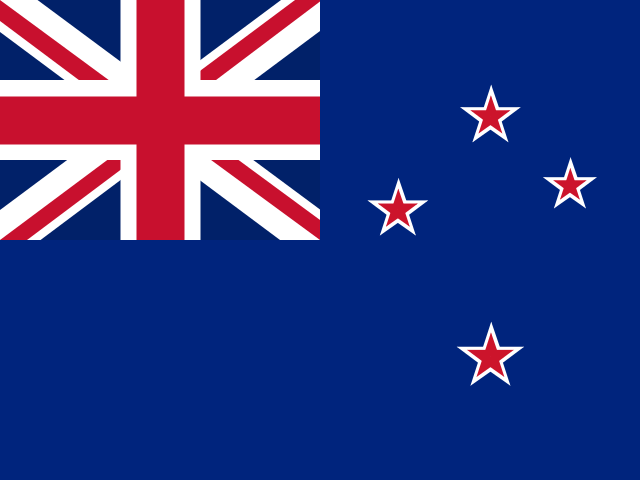
Flag of New Zealand
Travel guide

Learn New Zealand before you go

Two long green islands at the bottom of the Pacific, with snowy peaks, fiords, geysers and beaches, and a culture shaped by Māori and by settlers from far away.
Take the full trip
CapitalWellington
CurrencyNew Zealand dollar (NZD), divided into 100 cents, in use since 1967
Official languagesMāori (by law since 1987), New Zealand Sign Language (since 2006) and English, the everyday language of almost everyone, which was also written into law as an official language in August 2026
Drives on theLeft
Calling code+64

10 phrases to learn

In Te reo Māori, the Māori language. Capital letters show the stressed part. Tap the heart to practise a phrase later.

Kia ora!
kee-ah OR-ah
Hello! Also: thank you, or good health
The everyday greeting, and a friendly way to say thanks
Mōrena!
MAW-reh-nah
Good morning!
Greeting someone in the morning
Tēnā koe.
TEH-naa kweh
Hello (to one person)
A more formal greeting to one person
Tēnā kōrua.
TEH-naa KAW-roo-ah
Hello (to two people)
Greeting two people
Tēnā koutou.
TEH-naa KOH-toh
Hello (to three or more people)
Greeting a group
Nau mai, haere mai!
now my, HIGH-reh my
Welcome!
Welcoming guests; also on signs at airports and museums
Kei te pēhea koe?
kay teh PEH-heh-ah kweh
How are you?
Asking after someone
Kei te pai.
kay teh PIE
I'm fine, I'm good
Answering 'How are you?'
Ka pai!
kah PIE
Good! Well done!
Praising someone or saying something is fine
Kia kaha!
kee-ah KAH-hah
Be strong! Keep going!
Encouraging someone in a hard time

At the table

  • After the formal welcome (pōwhiri) on a marae, visitors are invited to the dining hall (wharekai) to share a meal with their hosts. Sharing food completes the welcome.
  • If a pōwhiri is held indoors, visitors take their shoes off before entering the meeting house (wharenui).
  • A hāngī is usually made for a big gathering; the food is lifted from the ground after several hours and shared by everyone.
  • Christmas falls in summer, so many families have a barbecue or a cold lunch of meats and seafood, often outdoors, with pavlova for dessert.
  • A meat pie is a common quick lunch, bought at a bakery, dairy or petrol station and eaten from the hand.

Local tips

Drive on the left and allow extra time

Traffic drives on the left. Many roads are narrow, hilly and winding, so trips often take longer than the map suggests. Plan shorter driving days, take regular breaks and use the official NZ Transport Agency advice for visiting drivers.

Get your NZeTA before you fly

As of 2026, visitors from visa-waiver countries, such as the United Kingdom, the United States and most of Europe, need an electronic travel authority (NZeTA) before they travel, and most also pay the International Visitor Conservation and Tourism Levy of 100 New Zealand dollars. Australian citizens need neither. Apply only through the official Immigration New Zealand website or app.

Declare food and outdoor gear

New Zealand protects its farms and native nature with strict biosecurity. On arrival you must declare food, plants, seeds and outdoor gear such as hiking boots, tents and fishing gear, and you can be fined for not declaring them. When in doubt, declare it or put it in the bins at the airport.

Use strong sun protection

The sun in New Zealand is fierce in summer, and you can burn quickly even on a cool or cloudy day. Wear a hat and sunglasses, use sunscreen and seek shade in the middle of the day.

Be ready for sudden weather in the hills

Mountain weather can change within hours, even in summer. Before a walk (a 'tramp'), check the forecast, take warm and waterproof clothing, and tell someone your plans. The official AdventureSmart website has advice and a way to leave your trip details.

Emergencies: call 111

The official emergency number for police, fire and ambulance is 111, from any phone. Ask for the service you need.

Visiting a marae

If you are invited onto a marae, you will usually be welcomed with a pōwhiri. Follow your hosts' lead, stay with your group, and take your shoes off before entering the meeting house. Visitors often bring a koha (a gift, usually money in an envelope), and the hongi, a greeting by pressing noses, may be offered.

A few Kiwi words

New Zealand English has its own words: a 'dairy' is a corner shop, 'jandals' are flip-flops, 'tramping' is hiking, a 'bach' (a 'crib' in the far south) is a simple holiday home, and 'sweet as' means great.

Dishes to try

  • Hāngī: A traditional Māori way of cooking food in a pit in the ground. Stones are heated in a large fire, baskets of meat and vegetables such as lamb, pork, chicken, potato, kūmara and pumpkin are placed on them, and everything is covered with cloths and earth for several hours. The food comes out tender, with a smoky, earthy taste.
  • Boil-up: A hearty broth of pork bones or meat simmered with potatoes or kūmara and greens such as pūhā (sow thistle), watercress or cabbage, with flour dumplings called 'doughboys' cooked on top.
  • Rēwena bread (Parāoa rēwena): A round sourdough loaf leavened with a fermented potato starter, often called the 'bug'. It has a slightly sweet and sour taste and is delicious with butter and golden syrup, or with a boil-up.
  • Whitebait fritters: Tiny, almost see-through young fish bound with beaten egg and fried in butter into a thin golden pancake. They are often eaten between two slices of buttered white bread, with a squeeze of lemon.
  • Green-lipped mussels (Kuku or kūtai): Large mussels with a bright green edge to the shell, found only in New Zealand. They are steamed with white wine or coconut milk, grilled on the half shell, or made into fritters and chowder.
  • Bluff oysters: Plump, rich flat oysters dredged from the cold waters of Foveaux Strait at the bottom of the South Island. Most people eat them raw with lemon, or fried in batter. Raw shellfish is not advised for pregnant women, young children, older people or anyone with weak immunity.
  • Steak and cheese pie: A hand-sized pie of chunky beef steak in gravy, topped with melted cheese under a flaky pastry lid. Mince and cheese is just as popular.
  • Pavlova: A large round of meringue, crisp outside and soft like marshmallow inside, topped with whipped cream and fruit such as kiwifruit, strawberries and passionfruit. It is the classic dessert of a summer Christmas.

Cities to see

  • Wellington (capital): Parliament and the 'Beehive', its executive wing, Te Papa, the national museum, The red cable car up to the Botanic Garden.
  • Auckland: The Sky Tower, Sailing, which gives it the nickname 'City of Sails', Volcanic cones such as Mount Eden.
  • Christchurch: Hagley Park and the Botanic Gardens, The Avon River / Ōtākaro, The Cardboard Cathedral.
  • Hamilton: Hamilton Gardens, The Waikato River, Day trips to Hobbiton and the Waitomo caves.
  • Paihia: The Waitangi Treaty Grounds, Boat trips around the Bay of Islands, Dolphin watching.
  • Rotorua: Pōhutu Geyser at Whakarewarewa, Māori cultural performances and hāngī dinners, Hot pools and mud pools.

Landmarks and the city map are on the New Zealand trip