World Stroll
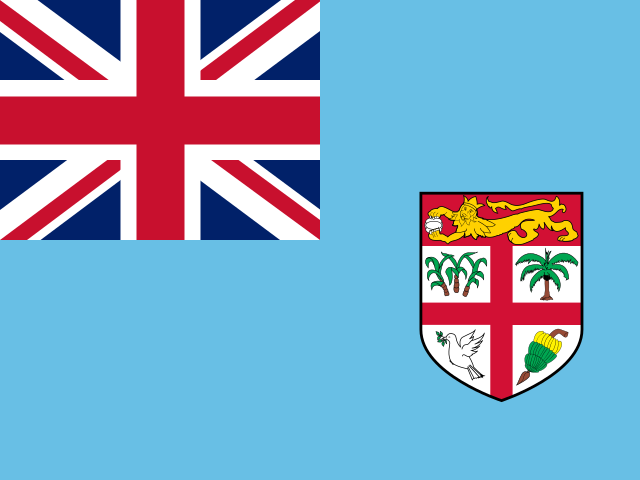
Flag of Fiji
Travel guide

Learn Fiji before you go

More than 330 green volcanic islands in the South Pacific, where people greet you with a warm 'Bula!', share a bowl of kava, and cook a feast in an earth oven.
Take the full trip
CapitalSuva
CurrencyFijian dollar (FJD)
Official languageEnglish, Fijian (iTaukei) and Hindi. The 2013 constitution names no official language, but says laws must be available in all three, and conversational iTaukei and Fiji Hindi are compulsory subjects in primary schools. English is the common language of government, business and schools
Drives on theLeft
Calling code+679

10 phrases to learn

In Fijian (iTaukei). Capital letters show the stressed part. Tap the heart to practise a phrase later.

Ni sa bula!
nee sah MBOO-lah
Hello! (polite)
Greeting someone politely, especially older people. With friends a simple 'Bula!' is enough
Ni sa yadra
nee sah YAHN-drah
Good morning
Greeting someone in the morning
Yakavi vinaka
yah-KAH-vee vee-NAH-kah
Good evening
Greeting someone in the evening
Vinaka vakalevu
vee-NAH-kah vah-kah-LEH-voo
Thank you very much
Thanking someone warmly, for a meal, a gift or a kindness
Ni sa moce
nee sah MOH-theh
Goodbye, good night (polite)
Saying goodbye, or goodnight before bed
Sota tale
SOH-tah TAH-leh
See you again
Saying goodbye to someone you hope to meet again
O cei na yacamu?
oh THAY nah yah-THAH-moo
What is your name?
Getting to know someone
Na yacaqu ko ...
nah yah-THAHNG-goo koh
My name is ...
Introducing yourself
Tulou
too-LOH-oo
Excuse me
Passing in front of someone or squeezing past people who are sitting down
Kemuni
keh-MOO-nee
Excuse me (to get attention)
Politely getting someone's attention in a shop or on the street

At the table

  • When you are offered yaqona (kava), clap once, take the coconut cup, drink it all in one go and hand the cup back.
  • If you are invited to a village or a Fijian home, bring a bundle of kava roots as your sevusevu, the gift offered on arrival. Your host will present it to the chief or head of the family.
  • In villages, cover your shoulders and knees, also at meals. A sulu, a wrap-around cloth worn by men and women, is always acceptable.
  • Kava should not be mixed with alcohol. After an evening of kava, do not drive, and avoid taking a taxi with a driver who has been drinking it.
  • Sharks are linked to the sea god Dakuwaqa and are taboo in many communities, so never bring shark meat as a gift.
  • Tipping is not expected in restaurants, taxis or hotels. Some resorts keep a staff 'Christmas box' for those who want to give something.

Local tips

Bring kava to a village

If you visit a Fijian village, or are invited into a Fijian home, bring a bundle of dried kava roots as your sevusevu, the traditional gift. You can buy them at any town market. The village chief or head of the family will accept it in a short ceremony, and after that you are a welcome guest.

Dress for the village, not the beach

Swimwear belongs on the beach and at the resort. In towns and especially in villages and churches, cover your shoulders and knees, men and women alike. A sulu, a wrap-around cloth, is perfect, and villagers are often happy to lend one.

Mind the cyclone season

Fiji is warm all year, but tropical cyclones can strike from November to April. If you travel then, take out travel insurance, keep an eye on the weather forecast and follow local advice. The drier, slightly cooler months are roughly May to October.

Keep left

Traffic in Fiji drives on the left. On the big islands, buses are cheap and frequent, run between all the towns, and in the countryside you can often simply wave one down as it approaches.

Expect quiet Sundays

Fiji is a very religious country and many shops and businesses close on Sunday, when families go to church. Plan your shopping for Saturday, and if you are invited to a church service, go: the singing is unforgettable.

No need to tip

Tipping is not part of Fijian culture, and nobody will expect it in restaurants, taxis or hotels. At many resorts there is a staff 'Christmas box' where you can leave something to be shared among all the workers.

Water and the sun

Tap water in the towns is treated and usually safe to drink. If you are unsure, for example in remote villages, boil or filter it. The tropical sun is strong: use sun cream and a hat, and cover up against mosquitoes at dawn and dusk.

Dishes to try

  • Kokoda: Fiji's best-known dish: pieces of fresh raw fish soaked in lime or lemon juice until they turn white, then mixed with coconut milk, diced tomato, onion and chilli. It is served cold, often in a coconut shell or a clam shell. Similar raw fish salads are made across Polynesia.
  • Lovo: A feast cooked in an earth oven. Stones are heated in a pit, then parcels of pork, chicken, fish and root crops wrapped in banana leaves are laid on top, covered with leaves, earth and sacks, and left to cook for several hours. Meat is often flavoured with soy sauce, garlic, chilli and ginger, and palusami (taro leaves filled with coconut cream) is a favourite lovo parcel.
  • Yaqona (kava) (yaqona): Fiji's national drink, made from the dried and powdered root of the kava plant, a relative of pepper. The powder is kneaded in water inside a cloth in a large wooden bowl called a tanoa, then served in half coconut shells. It looks muddy, tastes earthy and peppery, and makes the lips and tongue tingle and go numb for a few minutes. It is drunk at ceremonies and, more and more, simply with friends in the evening.
  • Dalo (taro) (dalo): The starchy root of the taro plant, peeled and boiled or baked in the lovo, and served in chunks beside fish, meat and coconut dishes. It is the most important staple for special occasions. The young taro leaves, called rourou, are cooked in coconut milk as a green vegetable.
  • Tavioka (cassava) (tavioka): Cassava root, boiled in salted water until soft and eaten with stews and curries. It has taken the place of yams and is now the most widely grown and eaten staple in Fiji. Grated cassava is also sweetened and steamed in banana leaves to make desserts such as vakalolo.
  • Uto (breadfruit) (uto): The large round fruit of the breadfruit tree, which grows beside most village houses. When the fruit is in season it is boiled or roasted whole over a fire, and its soft, starchy flesh is eaten like bread or potato with fish and coconut dishes.
  • Duruka (duruka): The unopened flower head of a close relative of sugarcane, sometimes called Fijian asparagus. It is sold in bundles at local markets in season and eaten raw or cooked as a vegetable. Some varieties grow wild along riverbanks.
  • Roti: A thin, soft, round flatbread cooked on a hot iron plate, the everyday bread of Indo-Fijian homes. It is torn by hand and used to scoop up curry and dhal, and many Fijian families of every background eat roti and curry for breakfast or lunch.

Cities to see

  • Suva (capital): The Fiji Museum and Thurston Gardens, The University of the South Pacific, Rain: it is much wetter than the west of the island.
  • Lautoka: The sugar mill and the Sugar Festival, A port for ships and ferries to the western islands, A large, lively market.
  • Nadi: Nadi International Airport, The Sri Siva Subramaniya Temple, Boat trips to the islands from Port Denarau.
  • Nausori: The Rewa River and its bridges, Nausori Airport, which serves Suva, Rice and vegetable farms on the Rewa delta.
  • Labasa: Sugarcane fields and the sugar mill, A farmers' market with seasonal produce and seafood, The main town of Fiji's north.
  • Ba: The Ba River, Its famous football team, The road to Navala village.

Landmarks and the city map are on the Fiji trip