World Stroll
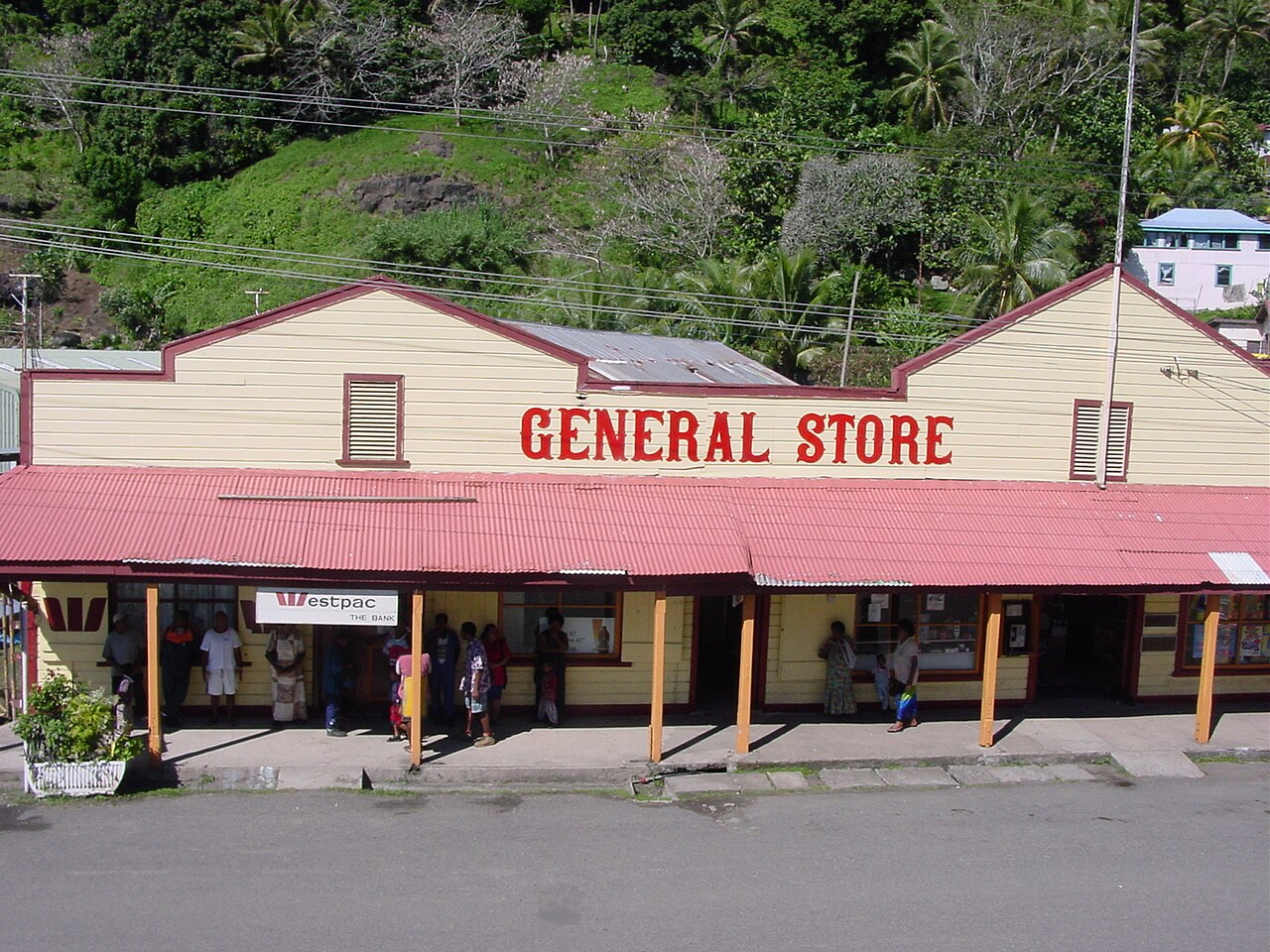
Commons: Levuka
Photo: Melbar, CC BY-SA 4.0
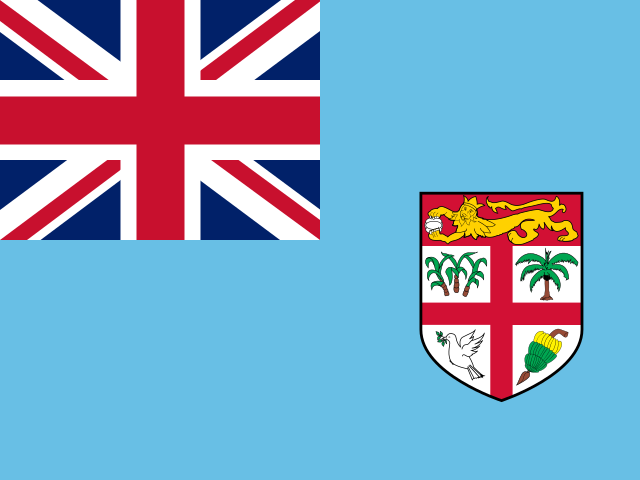
Flag of Fiji
Melanesia

Fiji

More than 330 green volcanic islands in the South Pacific, where people greet you with a warm 'Bula!', share a bowl of kava, and cook a feast in an earth oven.
Your trip to Fiji

Ready for the trip?

10 questionsAbout 3 minutesNo timer
Explore Fiji
You have explored 0 of 9 parts. Scroll on to discover the rest.
AustraliaFijiNew CaledoniaPapua New GuineaSolomon IslandsTimor-LesteVanuatu
Going to Fiji?Phrases, table manners and local tips on one printable page. Send a postcard from FijiA free digital postcard for family and friends.
Overview

Fiji at a glance

Fiji is an island country in Melanesia, in the South Pacific Ocean, about 2,000 km north of New Zealand. It is made up of more than 330 islands, about 110 of them lived on all year, plus hundreds of tiny islets. Most people live on the two big islands, Viti Levu and Vanua Levu, and about three quarters live on the coasts of Viti Levu, in and around Suva, Nadi and Lautoka. The islands are mountainous and volcanic in origin, with rainforest on the wetter eastern sides and sugarcane fields on the drier western sides.

People have lived here for about 3,000 years. The first settlers made Lapita pottery, and later waves of people from Melanesia and contact with Tonga and Samoa shaped Fijian culture. Chiefs and villages were, and still are, at the heart of indigenous Fijian life. Fiji became a British colony in 1874, and from 1879 the British brought tens of thousands of workers from India to the sugarcane fields. Fiji became independent on 10 October 1970, a date still celebrated as Fiji Day.

Today Fiji is a republic of about 900,000 people. A little over half are indigenous Fijians (iTaukei) and more than a third are Indo-Fijians, the descendants of the Indian workers, so churches, Hindu temples and mosques stand side by side and curry and roti are as Fijian as taro and coconut. Tourism, sugar, money sent home from abroad and bottled water are the pillars of the economy. Visitors come for coral reefs, white beaches and island resorts, and for the famous Fijian welcome.

CapitalSuva
PopulationAbout 0.9 million (884,887 at the 2017 census)
Official languageEnglish, Fijian (iTaukei) and Hindi. The 2013 constitution names no official language, but says laws must be available in all three, and conversational iTaukei and Fiji Hindi are compulsory subjects in primary schools. English is the common language of government, business and schools
CurrencyFijian dollar (FJD)
AreaAbout 18,300 km² of land, spread over more than 330 islands
GovernmentParliamentary republic. The president is head of state and the prime minister leads the government
Highest mountainMount Tomanivi, 1,324 m, an extinct volcano on Viti Levu
Longest riverThe Rewa River on Viti Levu, about 170 km long with its headwaters. It reaches the sea near Suva
NeighboursNo land borders. The nearest countries across the sea are Vanuatu and New Caledonia (France) to the west and southwest, Tonga to the east and southeast, and Tuvalu and Wallis and Futuna (France) to the north and northeast
Drives on theLeft
Calling code+679
Next: Story

The story

A short history of Fiji

Fiji's story runs from Lapita seafarers about 3,000 years ago, through powerful chiefdoms and the arrival of European traders and missionaries, to British rule from 1874 and the arrival of tens of thousands of workers from India. Fiji became independent in 1970. Since then it has lived through several coups, in 1987, 2000 and 2006, as well as new constitutions and elections, and it has also cheered two Olympic gold medals in rugby sevens.

  1. 1000 BC

    The first settlers arrive

    By around 1000 BC, seafaring people of the Lapita culture, known for their stamped pottery, had settled in Fiji. People with Melanesian roots followed roughly a thousand years later, and Fiji also had close contact with Tonga and Samoa. Over the centuries Fijians built large sailing canoes called drua, fortified villages and a society led by chiefs.

  2. 1643

    Abel Tasman sights the islands

    The Dutch explorer Abel Tasman, searching for a great southern continent, sighted Vanua Levu and the islands north of Taveuni. He was the first known European to see Fiji.

  3. 1774

    James Cook visits the Lau Islands

    The British navigator James Cook landed on one of the southern Lau islands in the east. Cook had heard of Fiji in Tonga, and the Tongan pronunciation of Viti, 'Fisi', gave the islands their English name.

  4. 1789

    William Bligh charts the main islands

    After the mutiny on the Bounty, Captain William Bligh sailed in an open boat between Viti Levu and Vanua Levu on his long voyage to the Dutch East Indies. The strait he crossed is still called Bligh Water, and for a time Fiji was known as the Bligh Islands.

  5. 1854

    Cakobau converts to Christianity

    Seru Epenisa Cakobau, the powerful chief of the small island of Bau, had fought the missionaries and their allies. Under pressure from Tongan forces, foreign warships and his own rivals, he accepted Christianity in 1854. Methodist and later Catholic missions spread across the islands in the decades that followed.

  6. 1871

    The Kingdom of Fiji is founded

    Settlers and chiefs formed a government, and Cakobau was crowned King of Fiji at Levuka, the busy trading town on Ovalau. The kingdom struggled with debts, conflict over land and violent settlers, and lasted only three years.

  7. 1874

    Fiji becomes a British colony

    On 10 October 1874 Cakobau, the Tongan chief Ma'afu and other senior chiefs signed the Deed of Cession at Levuka, handing Fiji to Great Britain. The Colony of Fiji lasted 96 years.

  8. 1875

    A measles epidemic strikes

    Cakobau and his sons caught measles on a visit to Sydney, and their ship was not quarantined on its return. In 1875 and 1876 the disease killed over 40,000 Fijians, about a third of the indigenous population.

  9. 1879
    The first indentured Indians arrive

    On 14 May 1879 the ship Leonidas landed 463 workers from India. They came on five-year contracts to work in the sugarcane fields. They were the first of about 60,000 Indians who came before the scheme ended in 1916, and most chose to stay in Fiji when their contracts ended. Their descendants are the Indo-Fijians.

  10. 1882

    Suva officially becomes the capital

    Levuka was squeezed between the sea and steep hills, with no room to grow. In 1877 the colony decided to move the capital to Suva on Viti Levu, and the administration completed the move in 1882.

  11. 1916

    The indenture scheme ends

    The last ships carrying indentured workers from India arrived in 1916, and the system was wound up in the years that followed. By then about 60,000 people had made the journey, on 87 voyages.

  12. 1970

    Fiji becomes independent

    The British flag was lowered in Suva at sunset on 9 October 1970, and Fiji became an independent country within the Commonwealth at midnight. 10 October is celebrated as Fiji Day.

  13. 1987

    Two coups and a republic

    In May 1987 the army overthrew a newly elected government that was mainly supported by Indo-Fijians, and a second coup followed in September. In October 1987 the military government declared Fiji a republic, ending the link with the British Crown. Many Indo-Fijians emigrated in the years that followed.

  14. 2006

    A military coup

    After a civilian coup in 2000, tensions between the army and the government grew again, and on 5 December 2006 the military took power. In April 2009 the Court of Appeal ruled the takeover illegal, the constitution was abrogated days later, and Fiji was suspended from the Commonwealth until 2014.

  15. 2014

    Elections return

    A new constitution was adopted in September 2013, and on 17 September 2014 Fiji held its first general election since the 2006 coup. International observers judged the vote credible.

  16. 2016

    Olympic gold in rugby sevens

    At the Rio de Janeiro Olympics, Fiji's rugby sevens team beat Great Britain 43 to 7 in the final and won the country's first Olympic medal of any colour. The team won gold again at the Tokyo Games, held in 2021, and the victory was celebrated with a special 7 dollar banknote. At Paris 2024 they took silver.

Next: At the table

At the table

What to eat in Fiji

Fijian food brings together the Pacific and India. In villages, a meal is built around a boiled root crop such as cassava or taro, with fish or meat, green leaves and plenty of coconut milk (lolo), and tea sweetened with cane sugar. Indo-Fijian families eat rice or roti with dhal and a meat or vegetable curry, followed by masala tea, and today these dishes are loved by everyone. Dinner is often the biggest meal. For weddings, church days and other big occasions there is the lovo, a feast cooked for hours in an earth oven. Chinese cooks added soy and oyster sauce, and the markets overflow with seafood, ferns, root crops and tropical fruit.

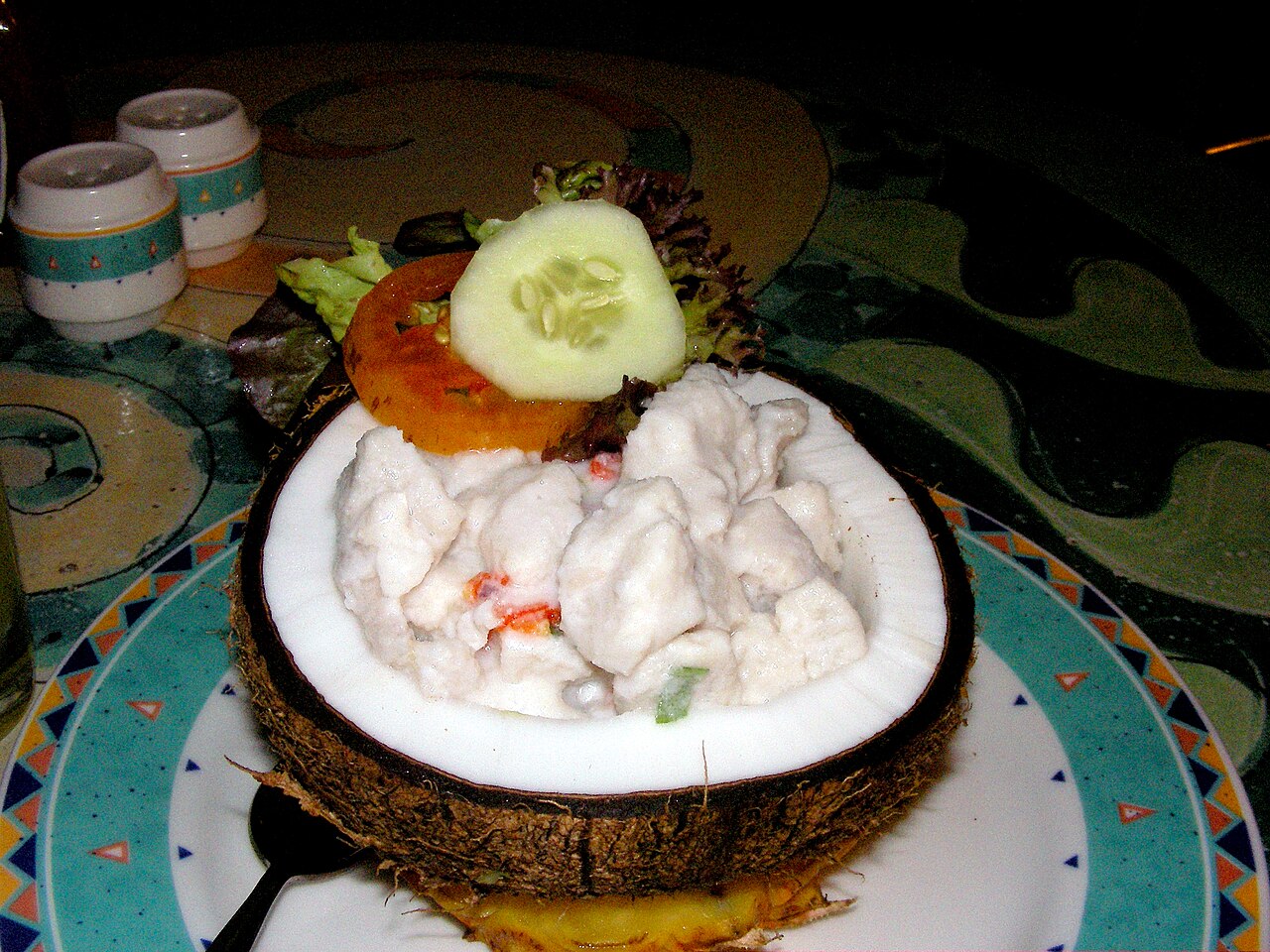
Commons: Kokodafood
Photo: yuko_ppp2501, CC BY 2.0
StarterRecipe

Kokoda

The whole country, especially the coasts

Fiji's best-known dish: pieces of fresh raw fish soaked in lime or lemon juice until they turn white, then mixed with coconut milk, diced tomato, onion and chilli. It is served cold, often in a coconut shell or a clam shell. Similar raw fish salads are made across Polynesia.

The citrus juice makes the fish firm and white, so it looks cooked, but it does not heat it. That is why very fresh fish matters.

See the recipe
Serves 4 40 min

Ingredients

  • 500 g very fresh firm white fish fillet sold for eating raw, ideally previously frozen (freezing kills parasites), such as snapper or mahi-mahi, skin and bones removed
  • Juice of 6 limes or 4 lemons
  • 200 ml thick coconut cream
  • 1 small red onion, finely chopped
  • 2 tomatoes, seeded and diced
  • Half a cucumber, diced
  • 1 small fresh chilli, finely chopped (optional)
  • 1 teaspoon salt and a little fresh coriander

Method

  1. Cut the fish into 1.5 cm cubes and put them in a glass or ceramic bowl.
  2. Pour over the lime juice and stir in the salt. Cover and chill for 20 to 30 minutes, stirring once or twice, until the fish is white on the outside.
  3. Drain off most of the juice. Mix in the onion, tomato, cucumber and chilli.
  4. Stir in the coconut cream, taste for salt, sprinkle with coriander and serve cold.
  5. Raw fish is not recommended for pregnant women, young children, older people or anyone with a weak immune system. For them, poach the fish cubes gently in simmering salted water until opaque, cool them, and then mix with the other ingredients.
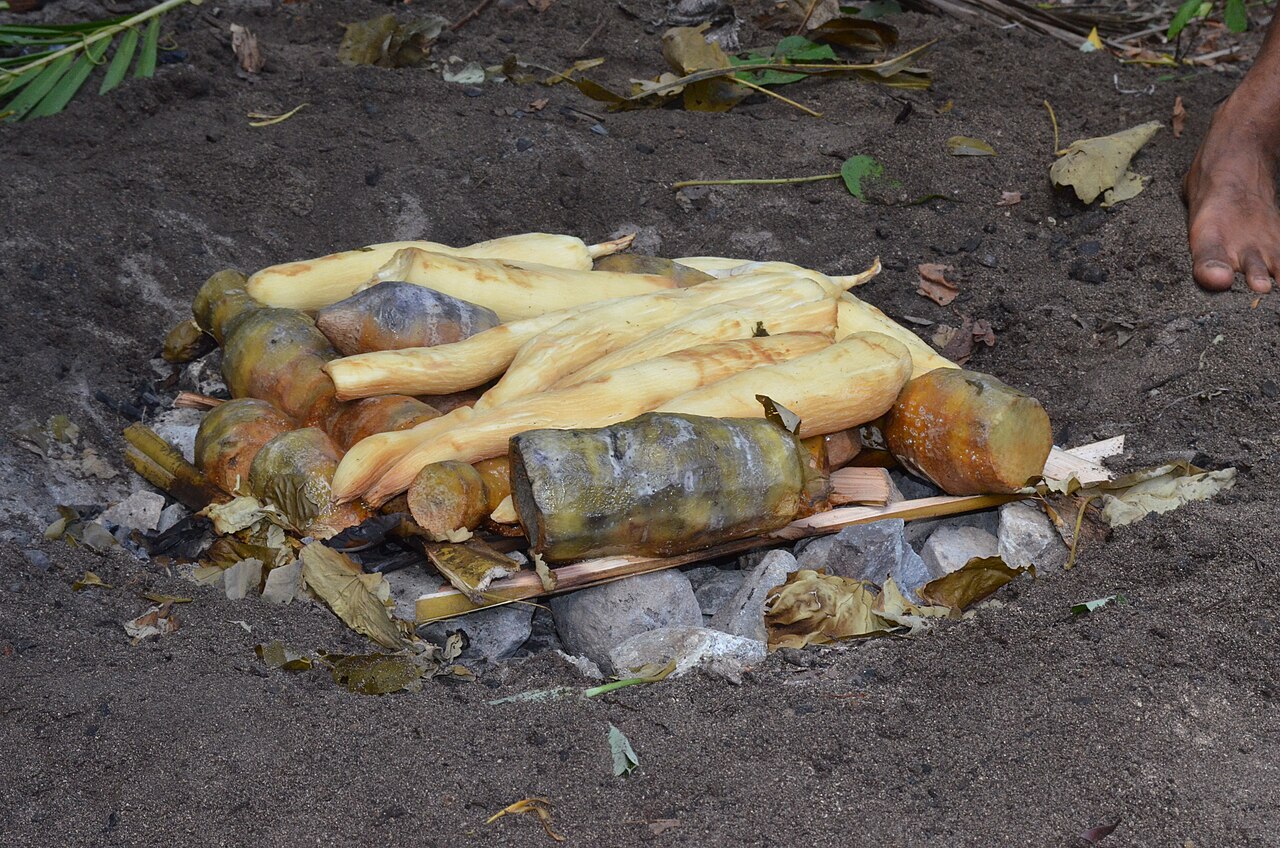
Commons: lovo Fiji
Photo: Jaejay77, CC BY-SA 4.0
Main course

Lovo

The whole country

A feast cooked in an earth oven. Stones are heated in a pit, then parcels of pork, chicken, fish and root crops wrapped in banana leaves are laid on top, covered with leaves, earth and sacks, and left to cook for several hours. Meat is often flavoured with soy sauce, garlic, chilli and ginger, and palusami (taro leaves filled with coconut cream) is a favourite lovo parcel.

A lovo takes many hands to prepare, which is part of why it belongs to weddings, church celebrations and family gatherings.

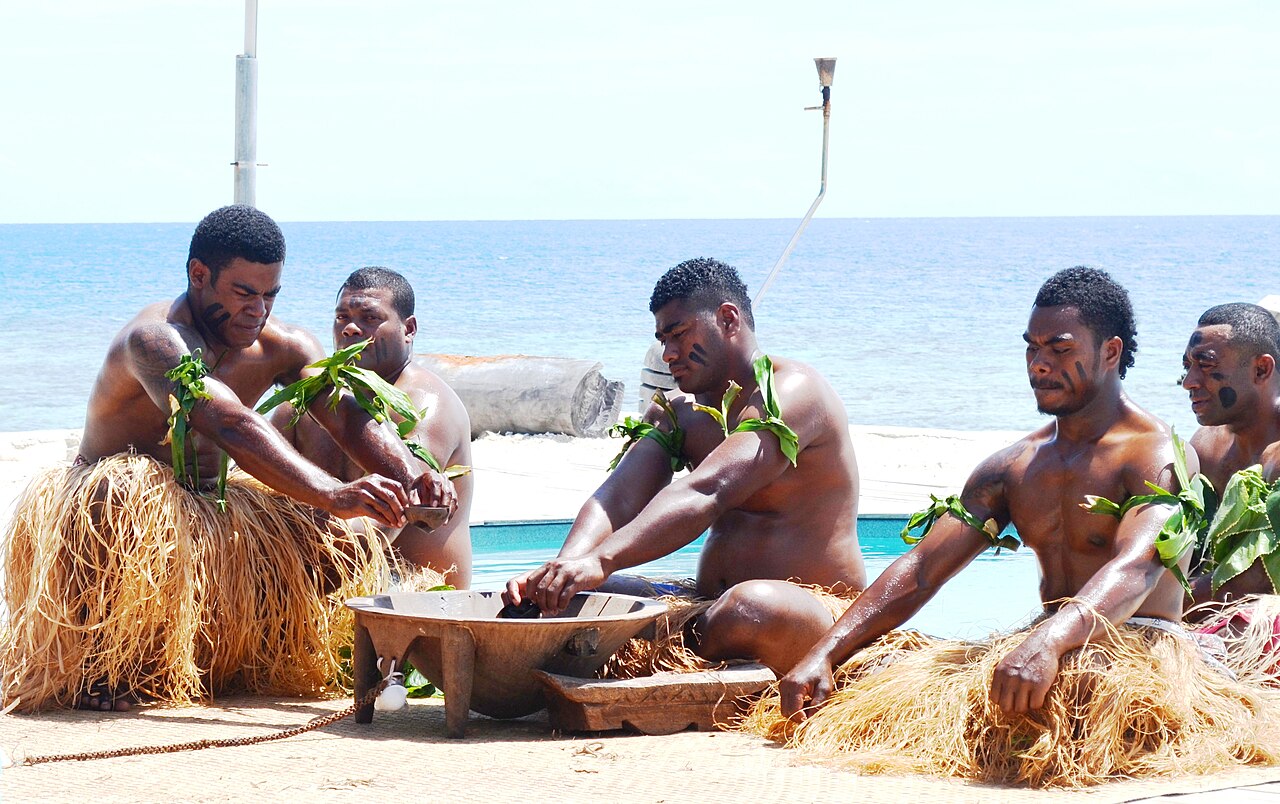
Commons: kava ceremony Fiji
Photo: Jaejay77, CC BY-SA 4.0
Drink

Yaqona (kava)

yaqona
The whole country

Fiji's national drink, made from the dried and powdered root of the kava plant, a relative of pepper. The powder is kneaded in water inside a cloth in a large wooden bowl called a tanoa, then served in half coconut shells. It looks muddy, tastes earthy and peppery, and makes the lips and tongue tingle and go numb for a few minutes. It is drunk at ceremonies and, more and more, simply with friends in the evening.

Kava roots are the classic gift, called sevusevu, that a guest presents when arriving in a Fijian village.

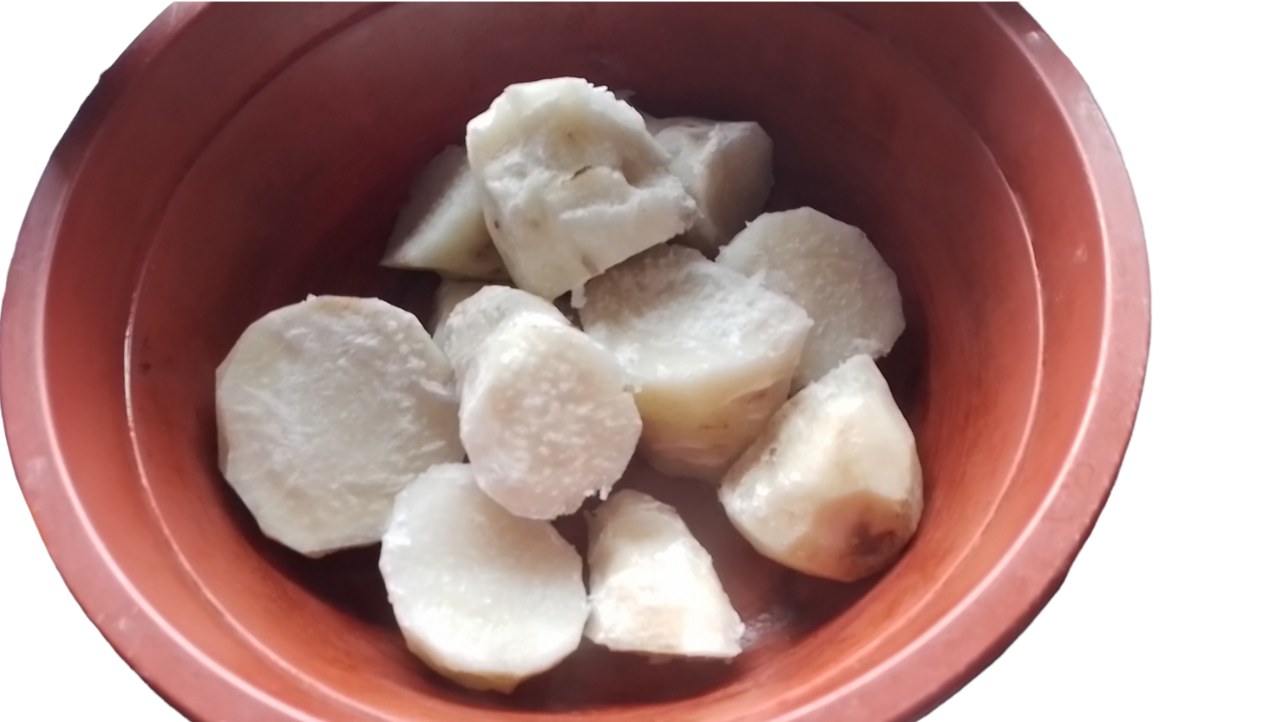
Commons: boiled taro
Photo: Rtnf, CC BY-SA 4.0
Side dish

Dalo (taro)

dalo
The whole country

The starchy root of the taro plant, peeled and boiled or baked in the lovo, and served in chunks beside fish, meat and coconut dishes. It is the most important staple for special occasions. The young taro leaves, called rourou, are cooked in coconut milk as a green vegetable.

Fiji grows about 70 varieties of taro. Some turn pink or yellow when cooked, others stay white.

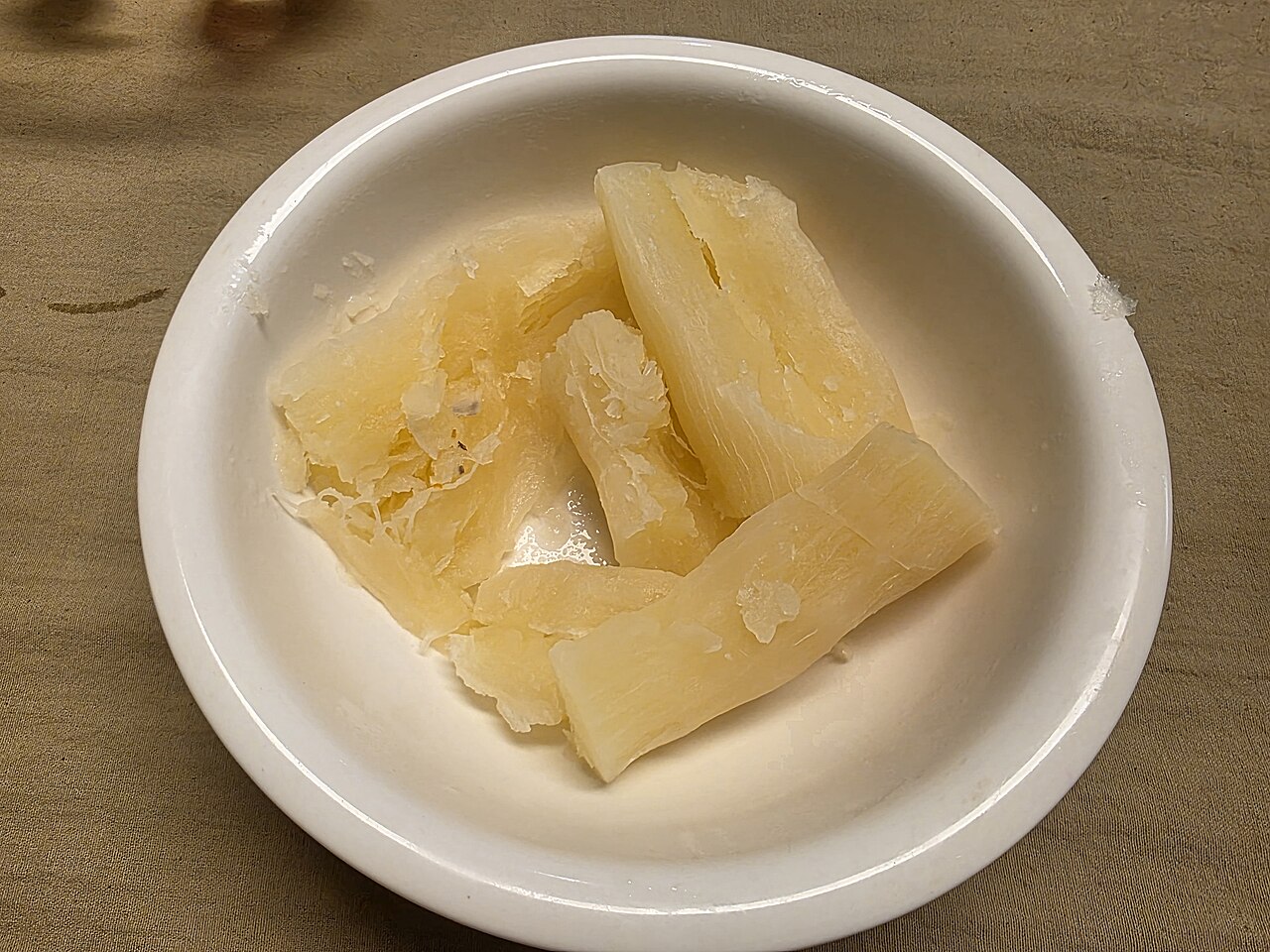
Commons: boiled cassava
Photo: Horacio Cambeiro, CC BY-SA 3.0
Side dish

Tavioka (cassava)

tavioka
The whole country

Cassava root, boiled in salted water until soft and eaten with stews and curries. It has taken the place of yams and is now the most widely grown and eaten staple in Fiji. Grated cassava is also sweetened and steamed in banana leaves to make desserts such as vakalolo.

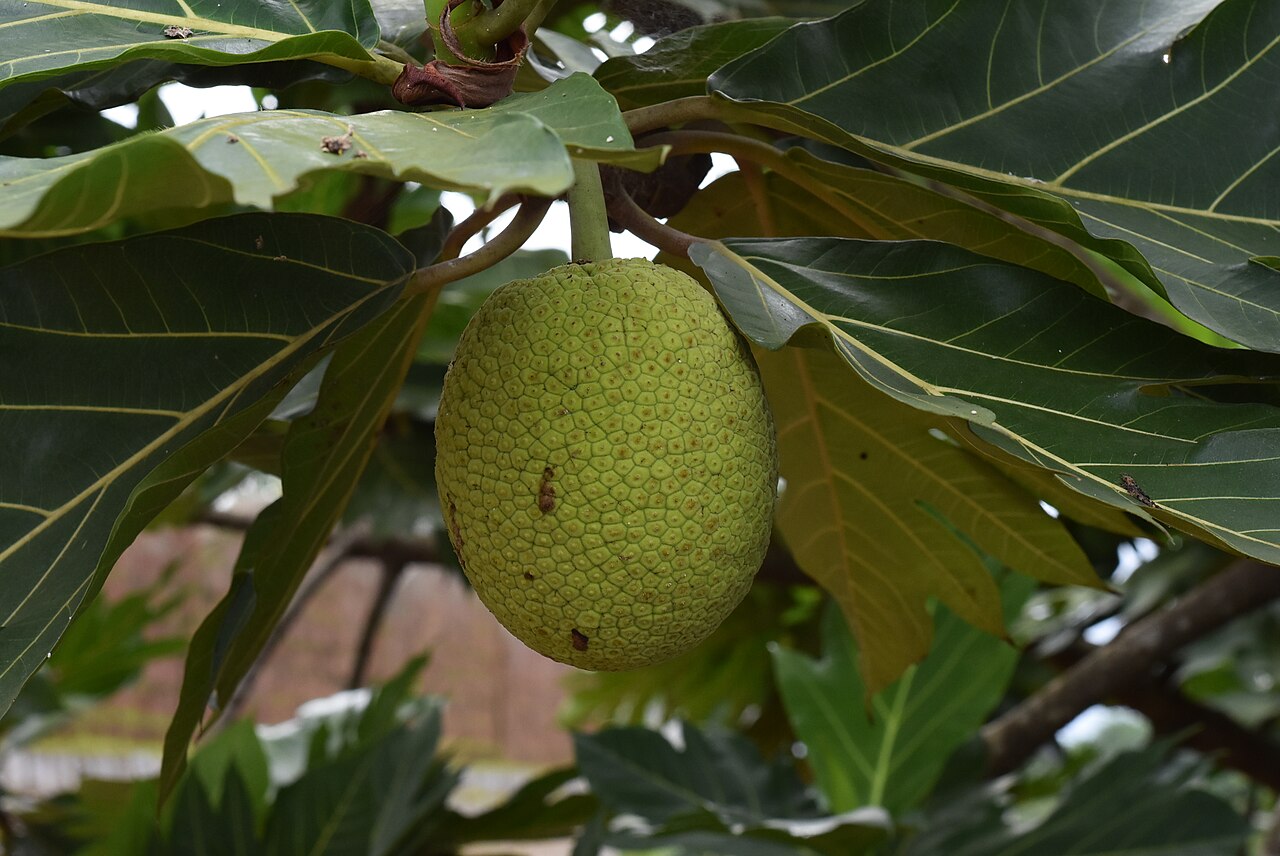
Commons: breadfruit dish
Photo: Ashay vb, CC BY-SA 4.0
Side dish

Uto (breadfruit)

uto
The whole country, especially villages

The large round fruit of the breadfruit tree, which grows beside most village houses. When the fruit is in season it is boiled or roasted whole over a fire, and its soft, starchy flesh is eaten like bread or potato with fish and coconut dishes.

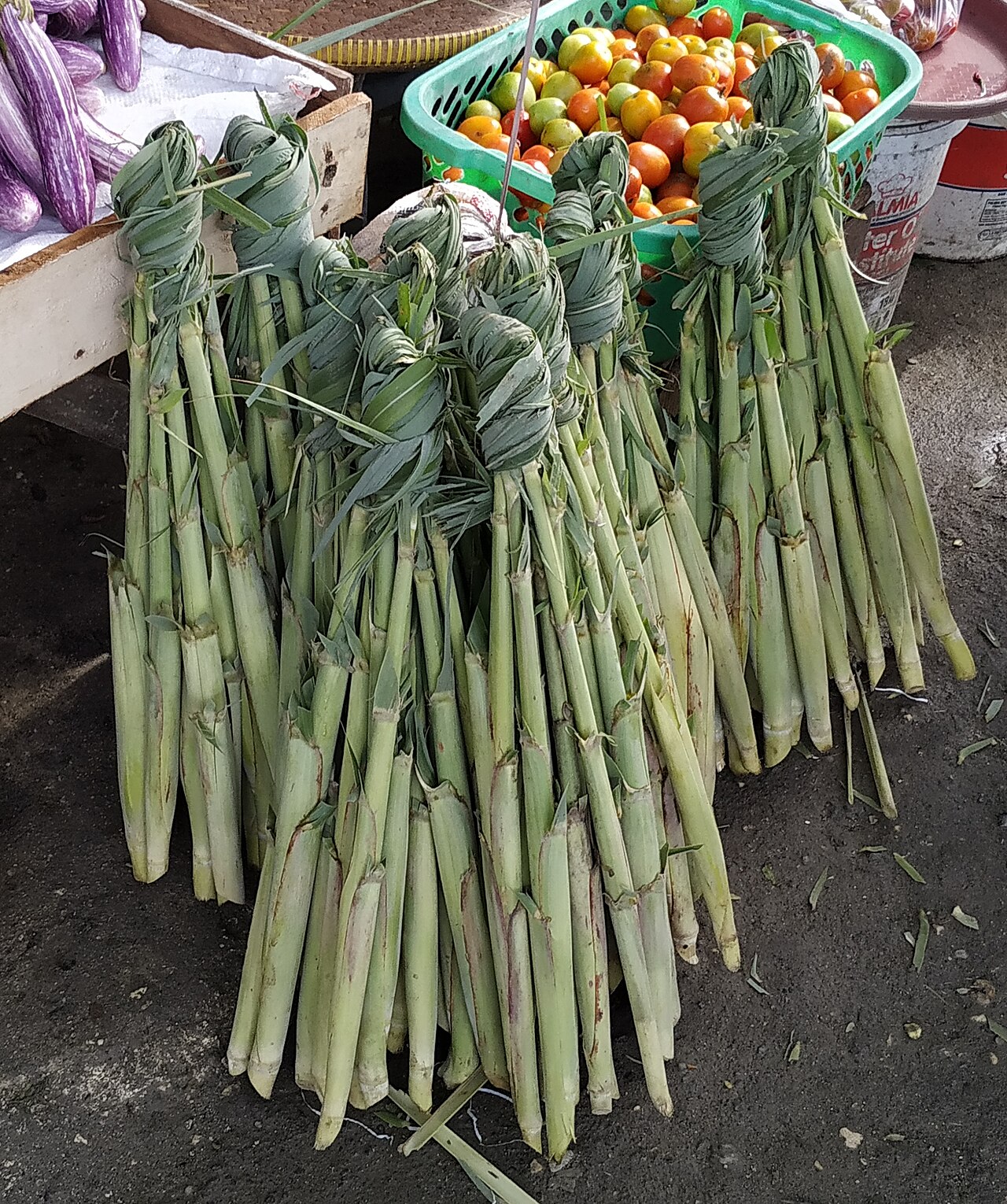
Saccharum edule
Photo: Si Gam, CC BY-SA 4.0
Side dish

Duruka

duruka
The whole country

The unopened flower head of a close relative of sugarcane, sometimes called Fijian asparagus. It is sold in bundles at local markets in season and eaten raw or cooked as a vegetable. Some varieties grow wild along riverbanks.

Children love to gather and roast the red duruka that comes early in the season, before the white varieties ripen.

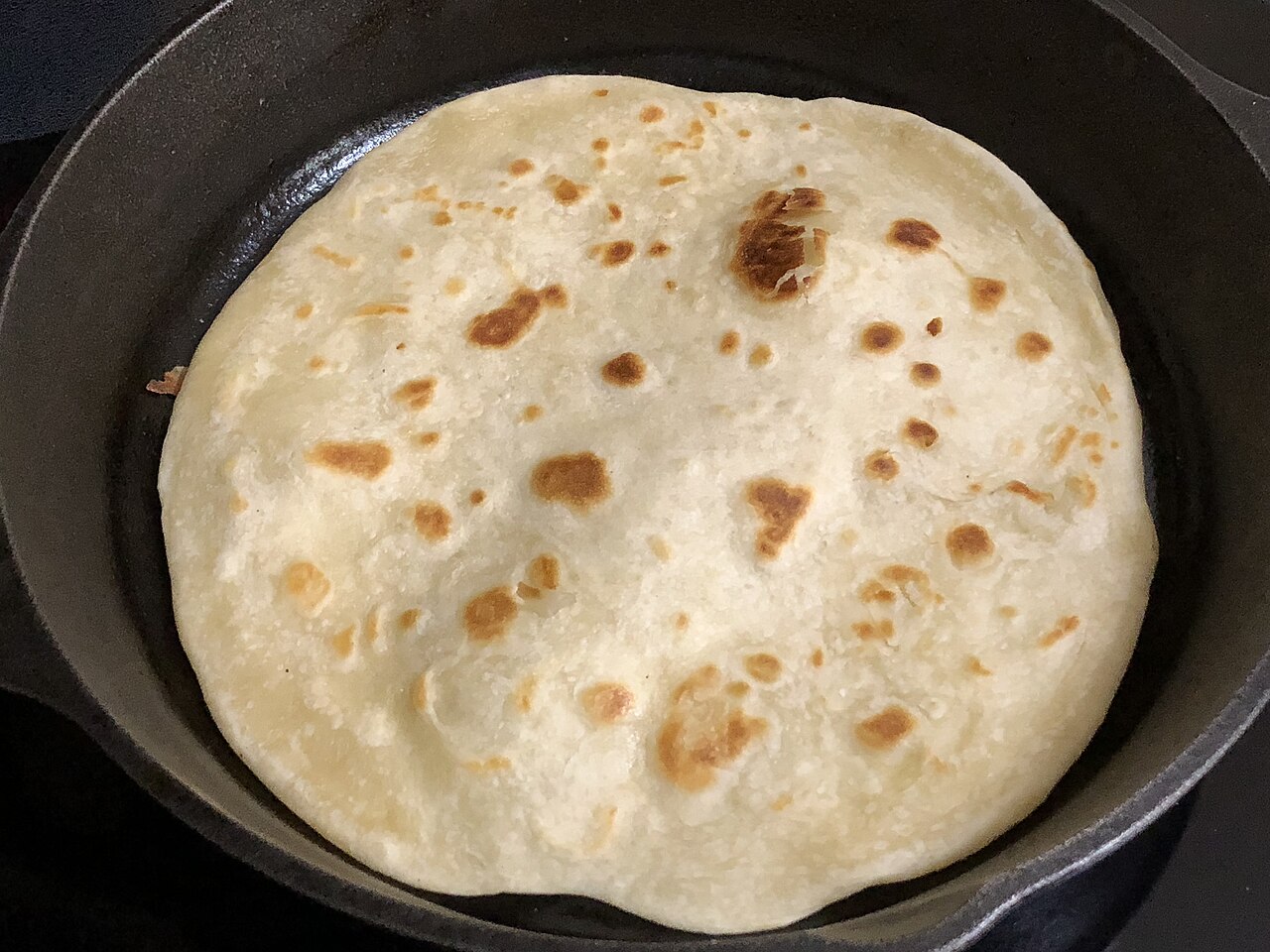
Roti
Photo: Famartin, CC BY-SA 4.0
BreadRecipe

Roti

Brought by Indian families, now eaten across Fiji

A thin, soft, round flatbread cooked on a hot iron plate, the everyday bread of Indo-Fijian homes. It is torn by hand and used to scoop up curry and dhal, and many Fijian families of every background eat roti and curry for breakfast or lunch.

See the recipe
Serves 4 1 h

Ingredients

  • 375 g (3 cups) plain flour, plus extra for rolling
  • Half a teaspoon of salt
  • 1 tablespoon vegetable oil
  • About 250 ml warm water
  • Butter or ghee for brushing

Method

  1. Mix the flour and salt in a bowl, add the oil and then the warm water a little at a time, until you have a soft dough.
  2. Knead for about 5 minutes until smooth, cover and leave to rest for 30 minutes.
  3. Divide into 8 balls. On a floured board, roll each one into a thin circle about 20 cm across.
  4. Heat a heavy frying pan or flat griddle without oil. Cook a roti for about 30 seconds until bubbles appear, turn it, and press the edges gently with a cloth so it puffs up.
  5. When both sides have light brown spots, lift it out, brush with butter or ghee and wrap in a clean tea towel to keep soft while you cook the rest.
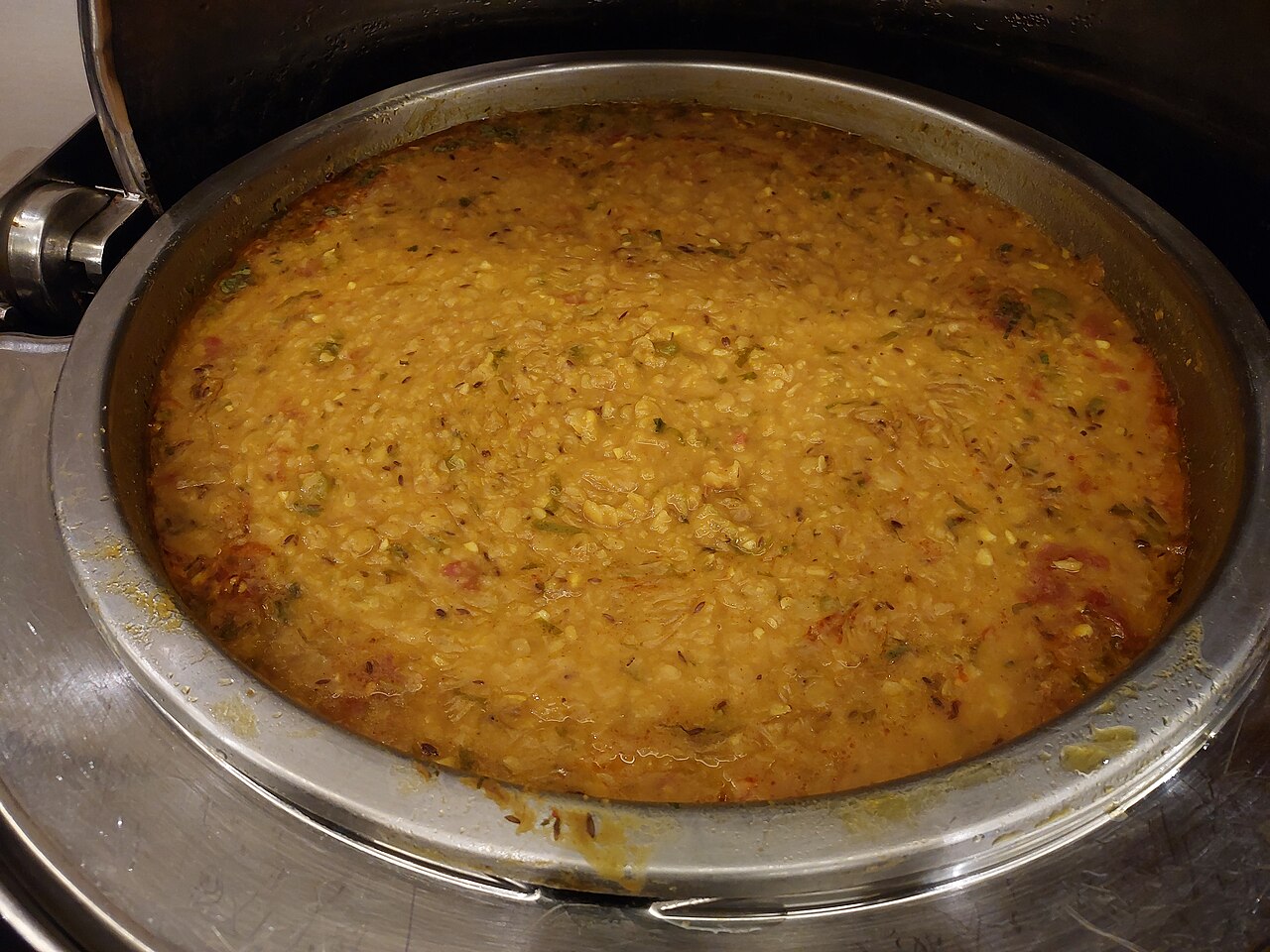
Commons: dal
Photo: Vis M, CC BY-SA 4.0
Side dishRecipe

Dhal

Indo-Fijian homes, now the whole country

A thin, golden soup of split peas or lentils, cooked with turmeric and finished with spices fried in hot oil or ghee. In Indo-Fijian homes it is served almost every day with rice, roti and a curry.

See the recipe
Serves 4 50 min

Ingredients

  • 200 g yellow split peas or toor dal, rinsed
  • 1.2 litres water
  • Half a teaspoon of ground turmeric
  • 1 teaspoon salt
  • 2 tablespoons vegetable oil or ghee
  • 1 teaspoon cumin seeds
  • 3 cloves of garlic, sliced
  • 1 small onion, sliced
  • A few curry leaves (optional) and fresh coriander

Method

  1. Put the split peas, water and turmeric in a pot, bring to the boil and skim off any foam.
  2. Simmer, partly covered, for 40 to 60 minutes, until the peas are very soft. Whisk well so the soup is smooth. Fiji dhal is thin, so add water if needed, then add the salt.
  3. In a small pan heat the oil or ghee, add the cumin seeds, garlic, onion and curry leaves, and fry until the garlic is golden.
  4. Pour the hot spices into the dhal, stand back as it sizzles, stir, and sprinkle with coriander. Serve with rice or roti.
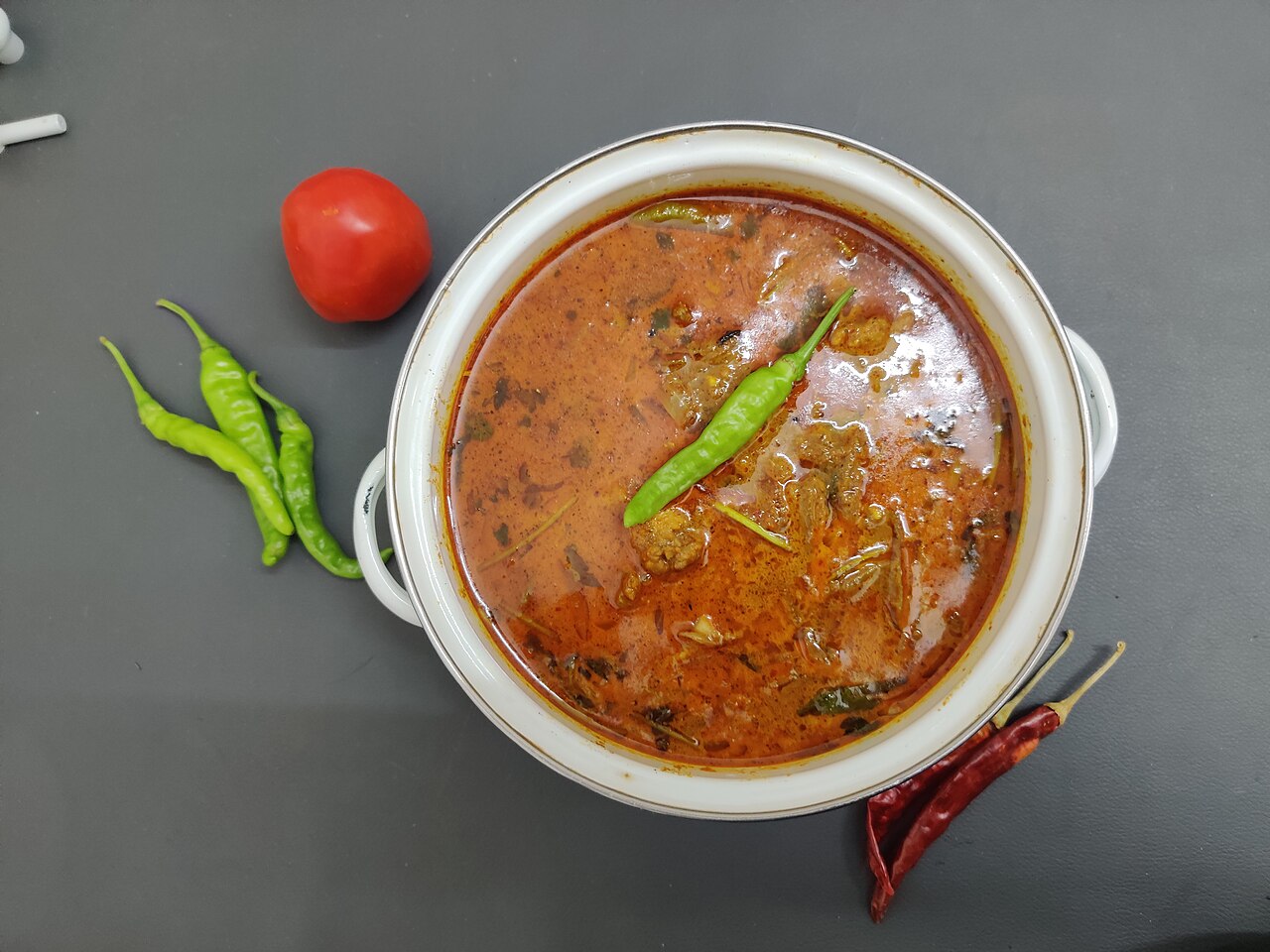
Commons: chicken curry
Photo: Abhilashsnair, CC0
Main courseRecipe

Fijian chicken curry

Indo-Fijian homes, now the whole country

Curry came to Fiji with the Indian workers of the 1800s and is now eaten all over the islands, with chicken, goat, lamb, fish or vegetables. A typical home curry is cooked slowly with onion, garlic, ginger, curry powder and potatoes, and served with rice, roti, dhal and a spoon of chutney.

See the recipe
Serves 4 1 h 10 min

Ingredients

  • 1 kg chicken pieces on the bone
  • 3 tablespoons vegetable oil
  • 1 large onion, chopped
  • 4 cloves of garlic and a 3 cm piece of ginger, crushed
  • 2 tablespoons curry powder and half a teaspoon of turmeric
  • 2 tomatoes, chopped
  • 3 medium potatoes, peeled and cut in quarters
  • A few curry leaves (optional), salt and fresh coriander
  • About 400 ml water

Method

  1. Heat the oil in a heavy pot and fry the onion until soft and golden.
  2. Add the garlic, ginger, curry leaves, curry powder and turmeric and stir for 1 minute, adding a splash of water if the spices start to stick.
  3. Add the chicken and stir until it is coated with the spices, then cook for 5 minutes.
  4. Add the tomatoes, potatoes, salt and water. Cover and simmer for 40 to 45 minutes, until the chicken is cooked through and the potatoes are soft.
  5. Taste for salt, scatter with coriander and serve with rice or roti.
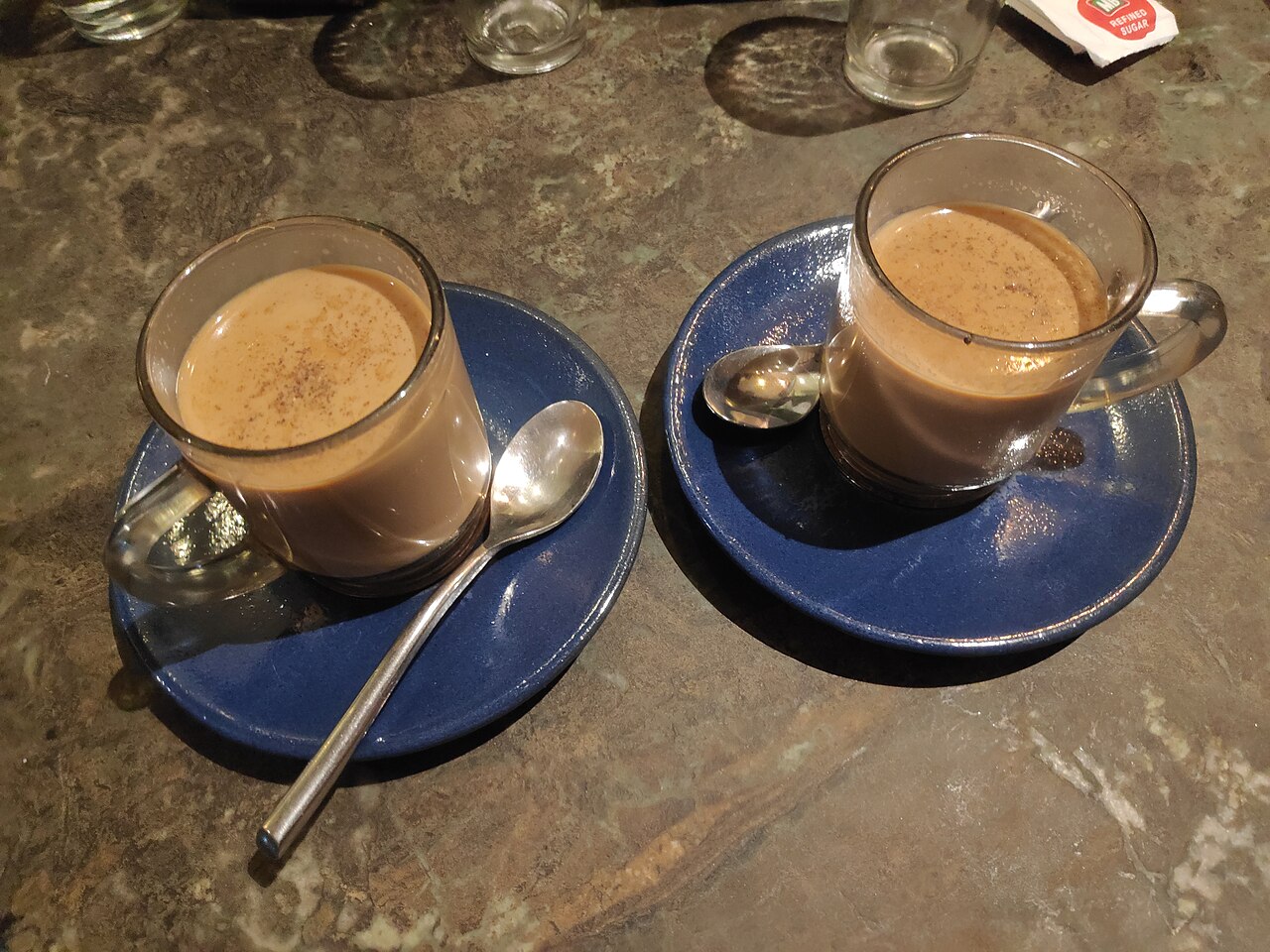
Commons: masala chai cup
Photo: Gaurav Dhwaj Khadka, CC BY-SA 4.0
Drink

Masala tea

Indo-Fijian homes

Black tea boiled with milk, sugar and spices such as cardamom, ginger and cloves. It is the main drink in many Indo-Fijian households, served morning and afternoon, often with a snack. Tea of every kind is a daily habit across Fiji.

Table manners

  • When you are offered yaqona (kava), clap once, take the coconut cup, drink it all in one go and hand the cup back.
  • If you are invited to a village or a Fijian home, bring a bundle of kava roots as your sevusevu, the gift offered on arrival. Your host will present it to the chief or head of the family.
  • In villages, cover your shoulders and knees, also at meals. A sulu, a wrap-around cloth worn by men and women, is always acceptable.
  • Kava should not be mixed with alcohol. After an evening of kava, do not drive, and avoid taking a taxi with a driver who has been drinking it.
  • Sharks are linked to the sea god Dakuwaqa and are taboo in many communities, so never bring shark meat as a gift.
  • Tipping is not expected in restaurants, taxis or hotels. Some resorts keep a staff 'Christmas box' for those who want to give something.

Next: Cities

Cities

11 cities to know

Most Fijians live on Viti Levu. Suva, the capital, lies on the wet southeast coast, with Nausori just across the Rewa River. On the drier west coast are Nadi, the gateway for visitors, and Lautoka, the Sugar City, with Ba and Tavua further north and Rakiraki on the northern tip. Sigatoka sits on the sunny Coral Coast in the south. Across Bligh Water, Labasa and Savusavu are the main towns of Vanua Levu, and the old capital Levuka lies on the small island of Ovalau.

SuvaLautokaNadiNausoriLabasaBaSigatokaLevukaSavusavuTavuaRakiraki
Suva
Photo: Maksym Kozlenko, CC BY-SA 4.0

Suva Capital

Central Division, Viti Levu

The capital, largest city and main port, on the southeast coast of Viti Levu. The city itself had about 94,000 people at the 2017 census, and about 270,000 lived in the wider area with Lami, Nasinu and Nausori, close to a third of all Fijians. It became the capital in 1882 and is a hub for the whole South Pacific, home to the main campus of the University of the South Pacific and the Pacific Islands Forum Secretariat.

  • The Fiji Museum and Thurston Gardens
  • The University of the South Pacific
  • Rain: it is much wetter than the west of the island
Lautoka
Photo: Kgx, CC BY-SA 4.0

Lautoka

Western Division, Viti Levu

Fiji's second city, on the west coast of Viti Levu, with about 72,000 people at the 2017 census. It lies in the heart of the sugarcane country, has a large sugar mill and a busy port, and is known as the Sugar City.

  • The sugar mill and the Sugar Festival
  • A port for ships and ferries to the western islands
  • A large, lively market
Nadi
Photo: Henning Blatt, CC BY-SA 3.0

Nadi

Western Division, Viti Levu

A town of about 60,000 people on the west coast, home to Nadi International Airport, where most visitors arrive. Fiji's biggest cluster of hotels lies nearby on Denarau Island and along the coast, and boats leave from Port Denarau for the Mamanuca and Yasawa islands. Nadi has a large Indo-Fijian community.

  • Nadi International Airport
  • The Sri Siva Subramaniya Temple
  • Boat trips to the islands from Port Denarau
Nausori
Photo: Felix Colatanavanua, CC BY-SA 4.0

Nausori

Central Division, Viti Levu

A town of about 58,000 people on the Rewa River, 19 km from Suva, at one end of the growing Suva to Nausori corridor. A 425 m bridge over the Rewa, opened in 2006, links it to the capital, and the airport for Suva is nearby.

  • The Rewa River and its bridges
  • Nausori Airport, which serves Suva
  • Rice and vegetable farms on the Rewa delta
Labasa
Photo: VMFoliaki, CC BY-SA 2.0

Labasa

Northern Division, Vanua Levu

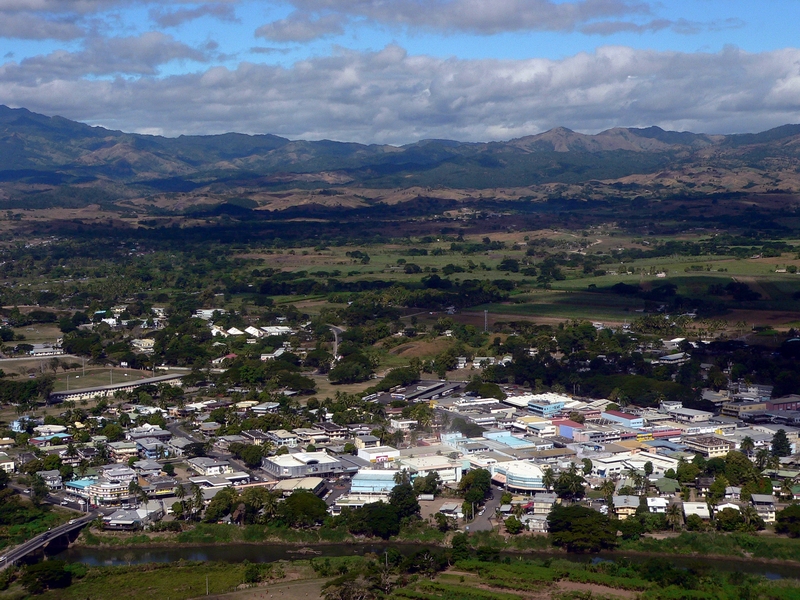
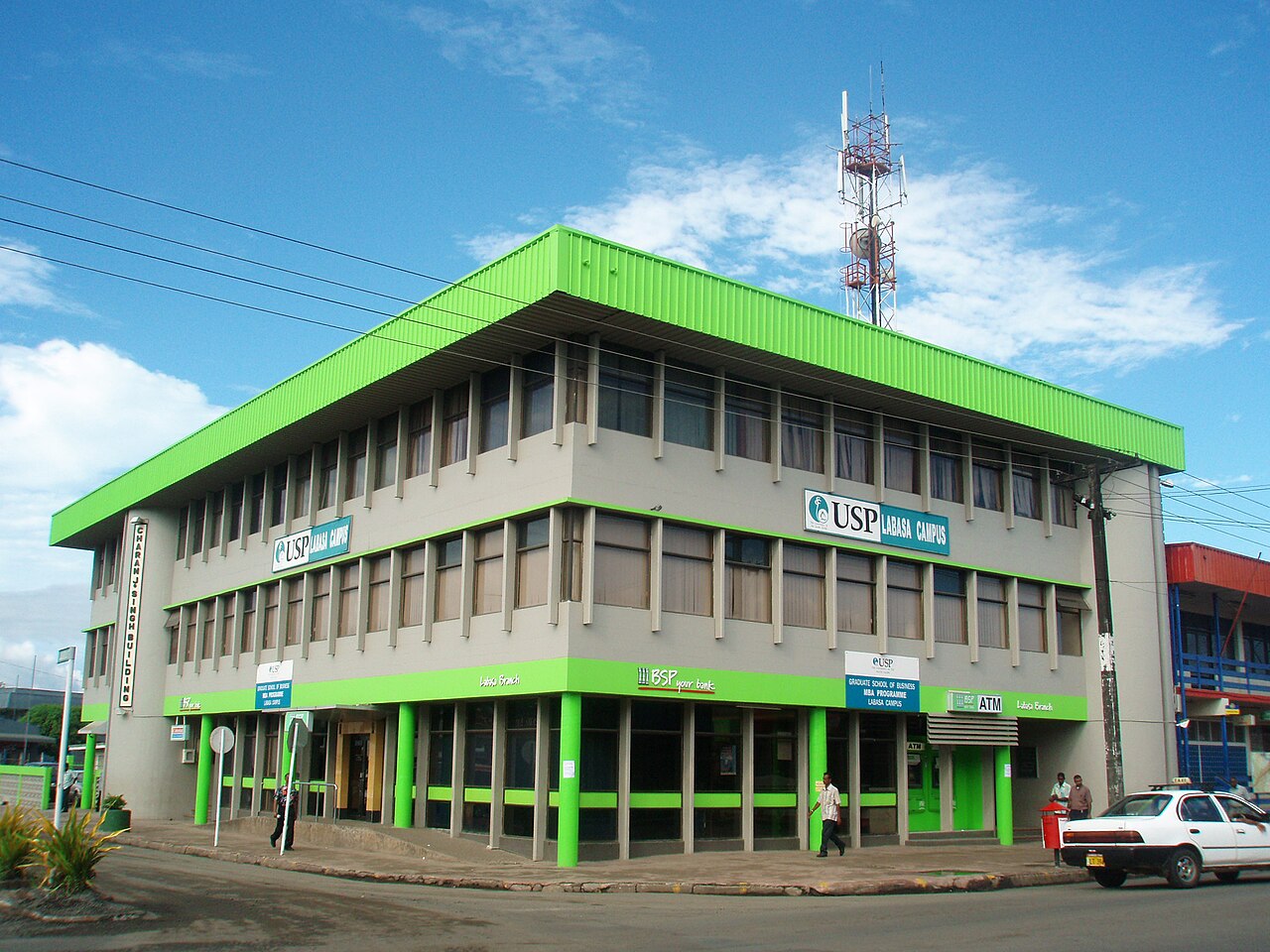
The largest town on Vanua Levu, built on a river delta in the northeast of the island. It grew up around sugarcane and a sugar mill, and it is heavily Indo-Fijian, with curry houses and sari shops downtown. Fijians call this part of the country the Friendly North.

  • Sugarcane fields and the sugar mill
  • A farmers' market with seasonal produce and seafood
  • The main town of Fiji's north
Sigatoka
Photo: Maxim75, CC BY-SA 3.0

Sigatoka

Western Division, Viti Levu

A town of about 18,000 people at the mouth of the Sigatoka River, 61 km from Nadi. It is the main centre of the Coral Coast, Fiji's strip of beach resorts along the south of Viti Levu.

  • The Sigatoka Sand Dunes
  • The Coral Coast resorts
  • A Hare Krishna temple that stands out over the town
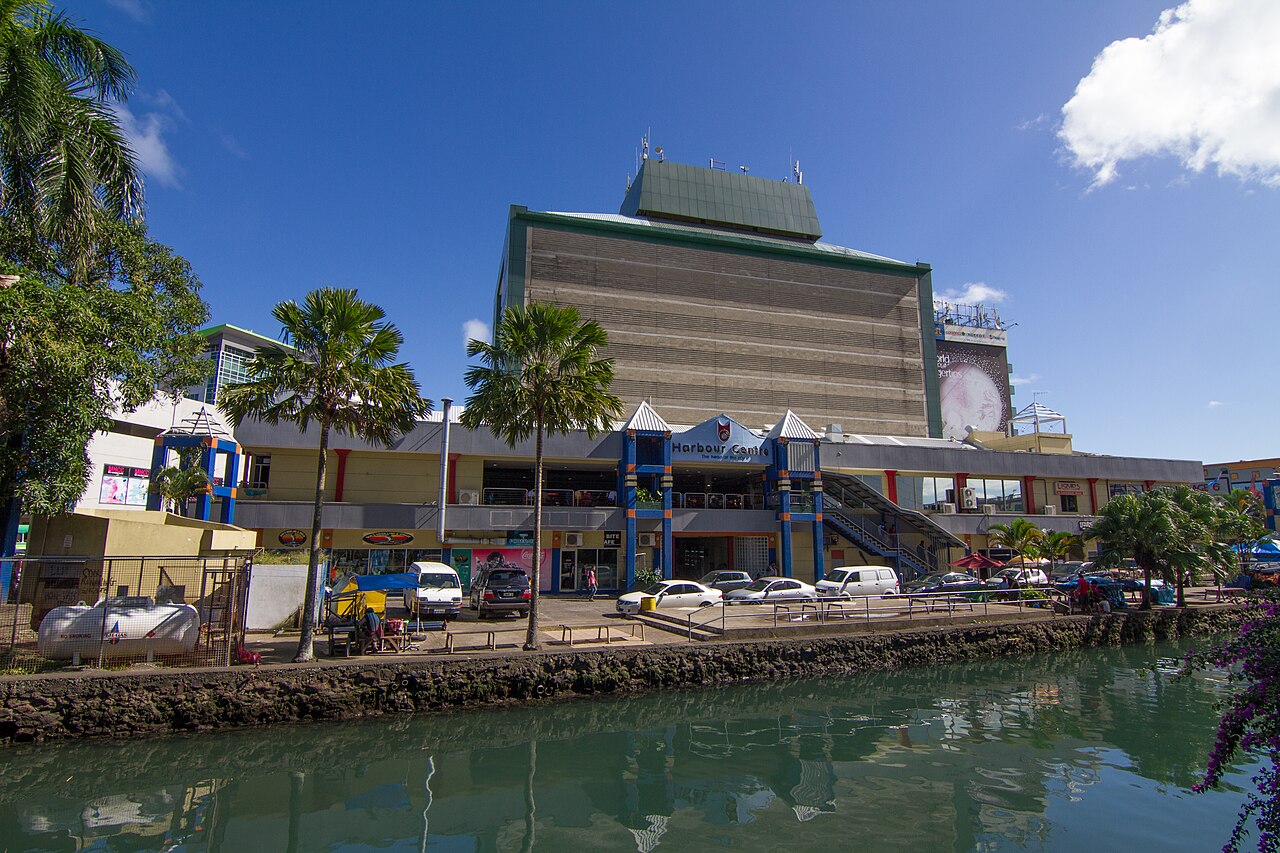
Levuka
Photo: Anton Leddin, CC BY-SA 3.0

Levuka

Eastern Division, Ovalau

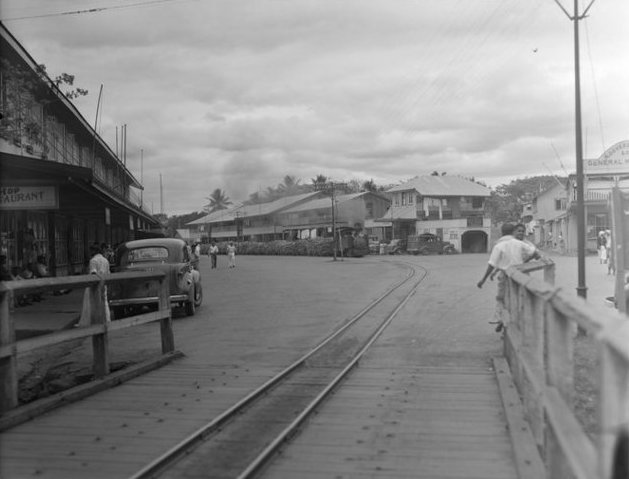
A small port town of about 1,100 people on the east coast of the island of Ovalau. Founded by European traders around 1820, it was Fiji's first modern town and its capital until the move to Suva. The Fiji Times, still published today, was founded here in 1869.

  • Its UNESCO-listed colonial waterfront
  • The place where Fiji was ceded to Britain in 1874
  • The Royal Hotel, one of the oldest hotels in the South Pacific
Savusavu
Photo: Paul Dashwood (Dashers at English Wikipedia), Public domain

Savusavu

Northern Division, Vanua Levu

A small town on a sheltered bay on the south coast of Vanua Levu, often called 'the hidden paradise of Fiji'. Yachts anchor in its harbour, and at low tide steam rises from hot springs all along the shore. Villagers have cooked taro and breadfruit in the hottest pools for centuries.

  • A sheltered harbour for yachts
  • Natural hot springs
  • Diving and snorkelling on nearby reefs
Commons: Tavua Fiji
Photo: Rajesh Tahal, CC BY-SA 3.0

Tavua

Western Division, Viti Levu

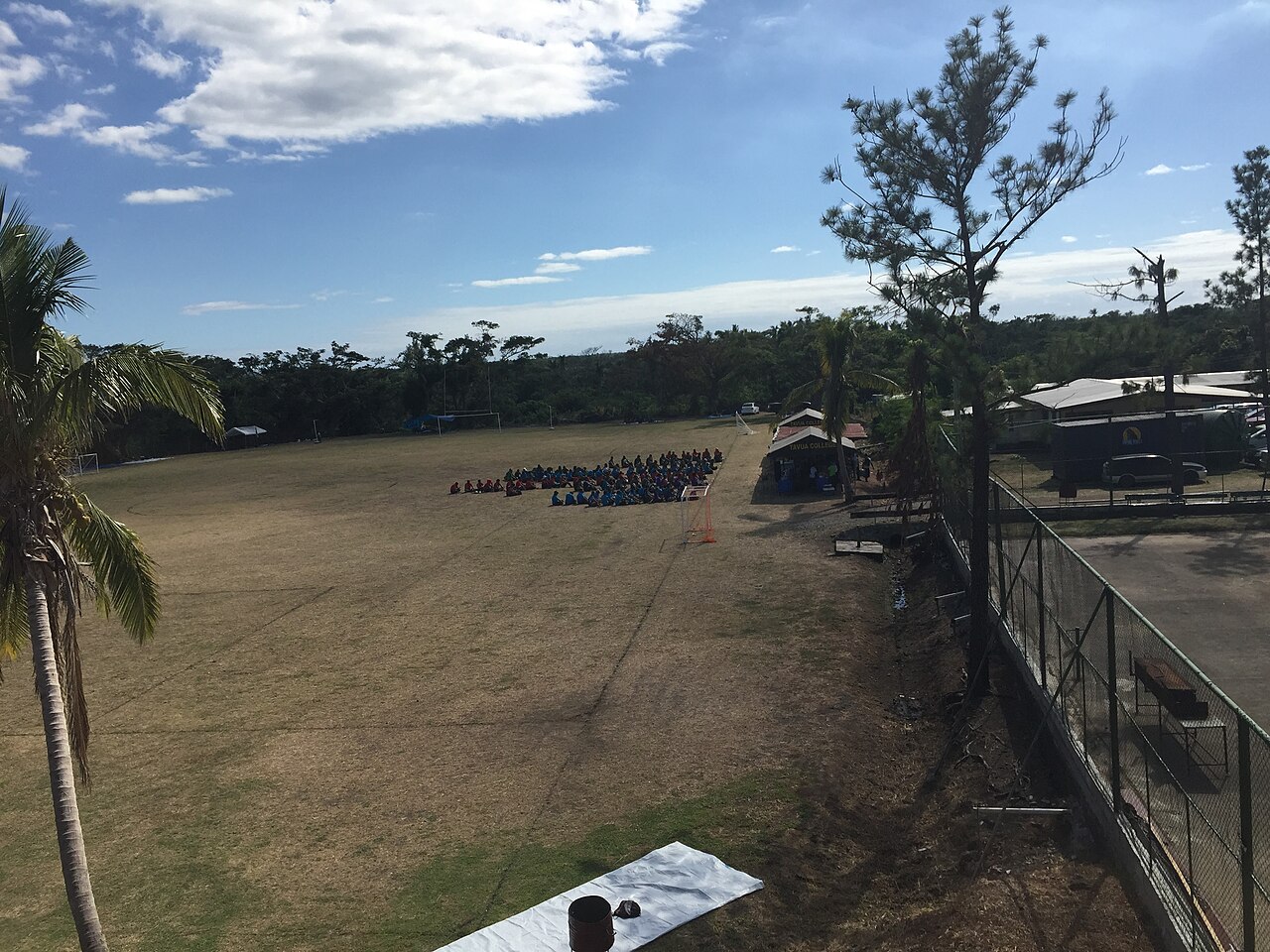
A small town on the north coast of Viti Levu, 91 km from Nadi and 9 km from the gold-mining settlement of Vatukoula. Roads lead from here into the highlands towards Mount Tomanivi, Fiji's highest peak.

  • The Vatukoula gold mine nearby
  • The way up to Mount Tomanivi
  • Sugarcane farms on the coast
Rakiraki District
Photo: Jaejay77, CC BY-SA 4.0

Rakiraki

Western Division, Viti Levu

The small town of Vaileka, usually called Rakiraki, on the northern tip of Viti Levu, about 130 km from Nadi International Airport along the King's Road. It is the main urban centre of Ra Province, although it has not been officially incorporated as a town.

  • The northern stretch of the King's Road
  • Beaches and reefs on the north coast
  • The main town of Ra Province

Next: Landmarks

Landmarks

Places everyone should see once

Commons: Levuka
Photo: Melbar, CC BY-SA 4.0
Levuka

Levuka Historical Port Town

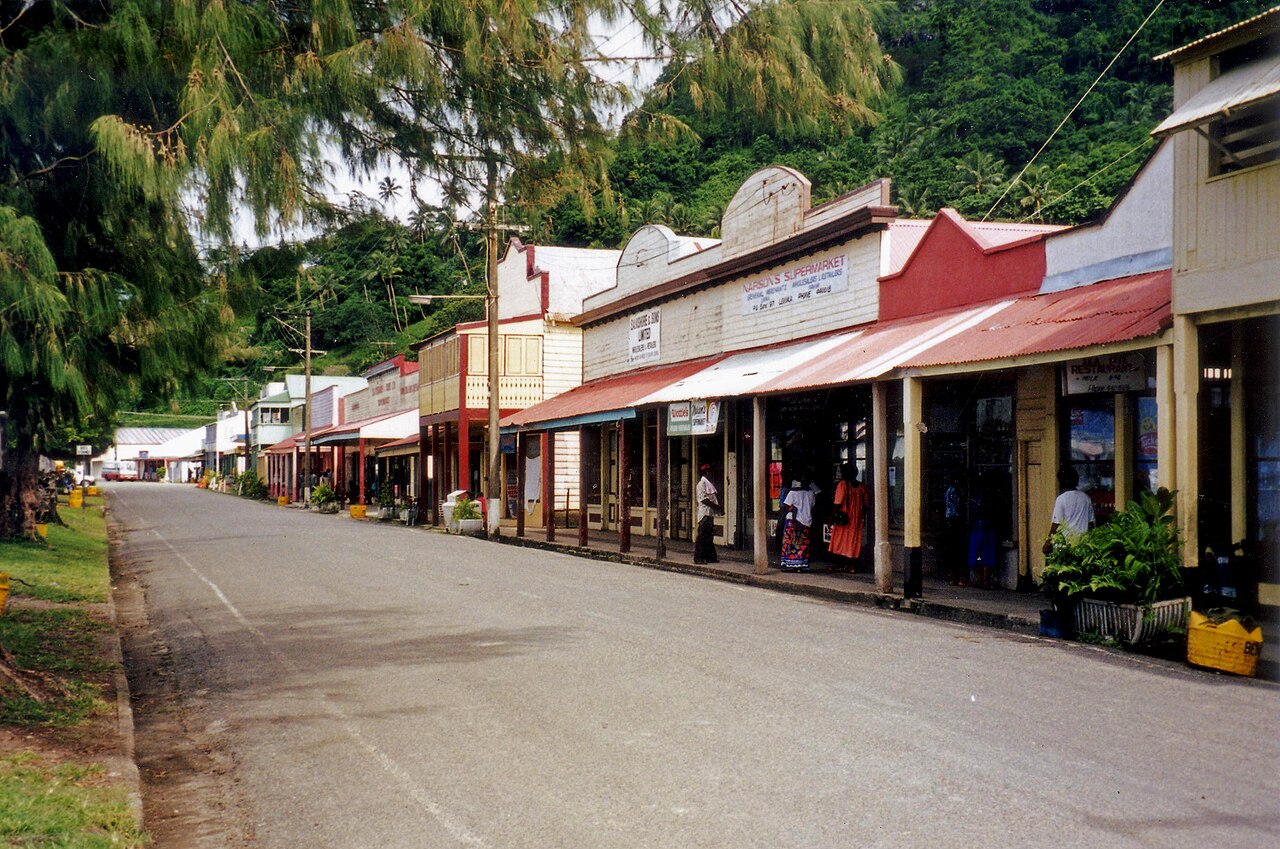
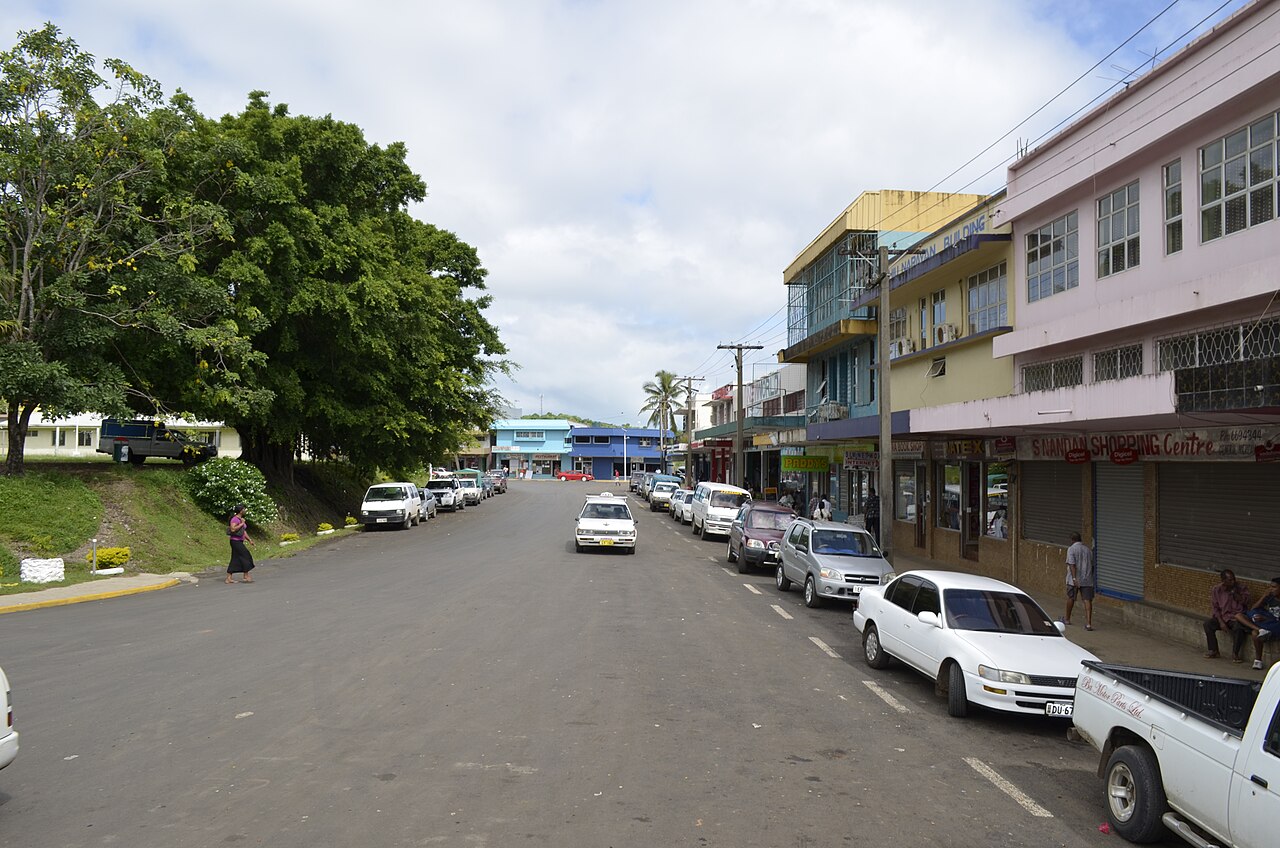
Fiji's first colonial capital, a low line of wooden shopfronts, churches and houses set among coconut and mango trees along the beach. Look for the Sacred Heart Church, whose clock tower doubles as a lighthouse guiding ships through the reef, the Town Hall of 1898, and, at the southern end of town, Nasova, where the Deed of Cession was signed in 1874. It became a UNESCO World Heritage Site in 2013.

UNESCO World Heritage
Commons: Sigatoka sand dunes
Photo: Radosław Botev, CC BY 3.0 pl
Near Sigatoka

Sigatoka Sand Dunes National Park

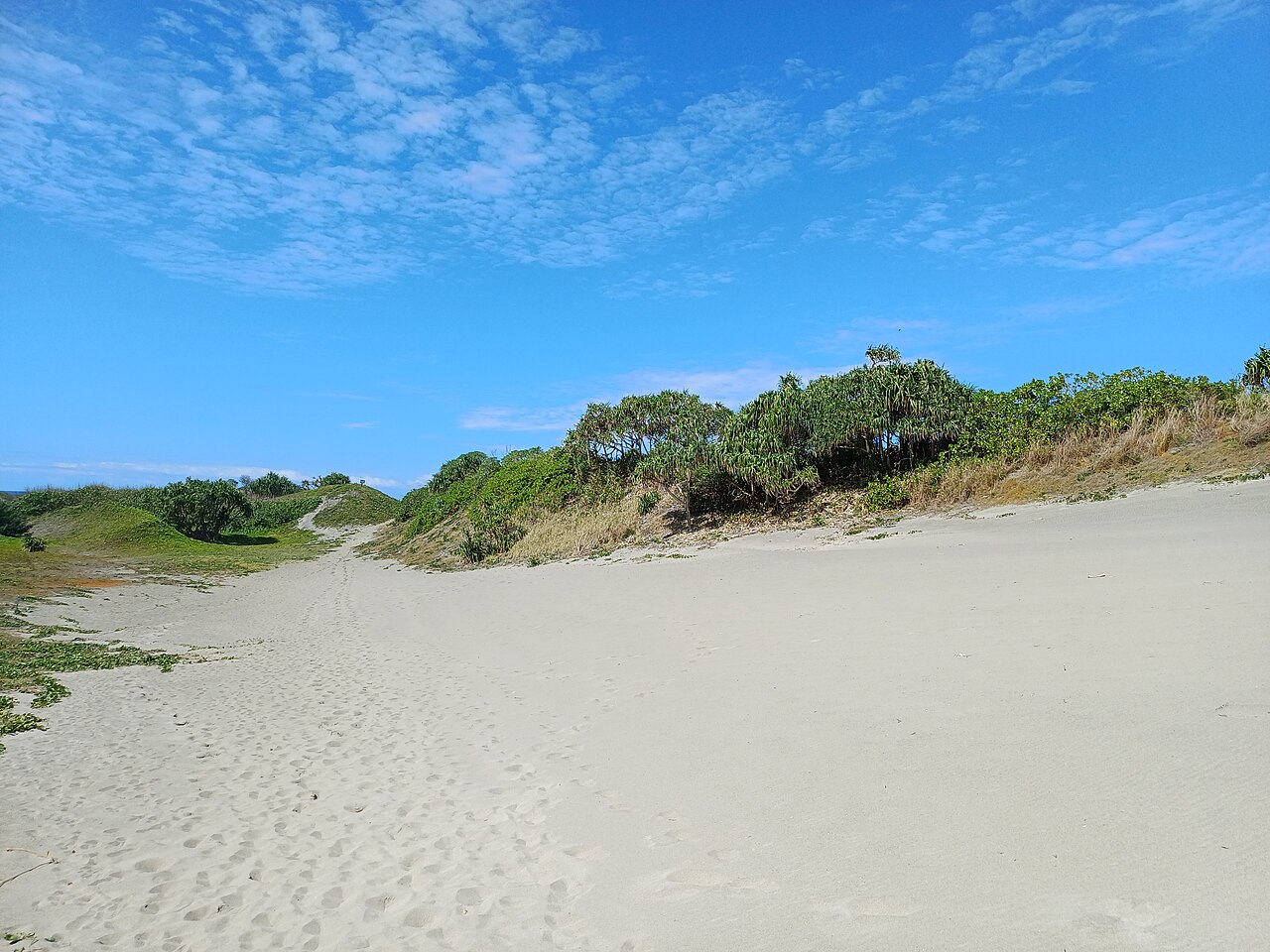
A 650-hectare field of sand dunes, 20 to 60 m high, at the mouth of the Sigatoka River about 3 km west of the town. Walking trails cross the dunes to the sea. Archaeologists have found pottery more than 2,600 years old here, and one of the largest ancient burial sites in the Pacific.

Commons: Garden of the Sleeping Giant
Photo: Radosław Botev, CC BY 3.0 pl
Near Nadi

The Garden of the Sleeping Giant

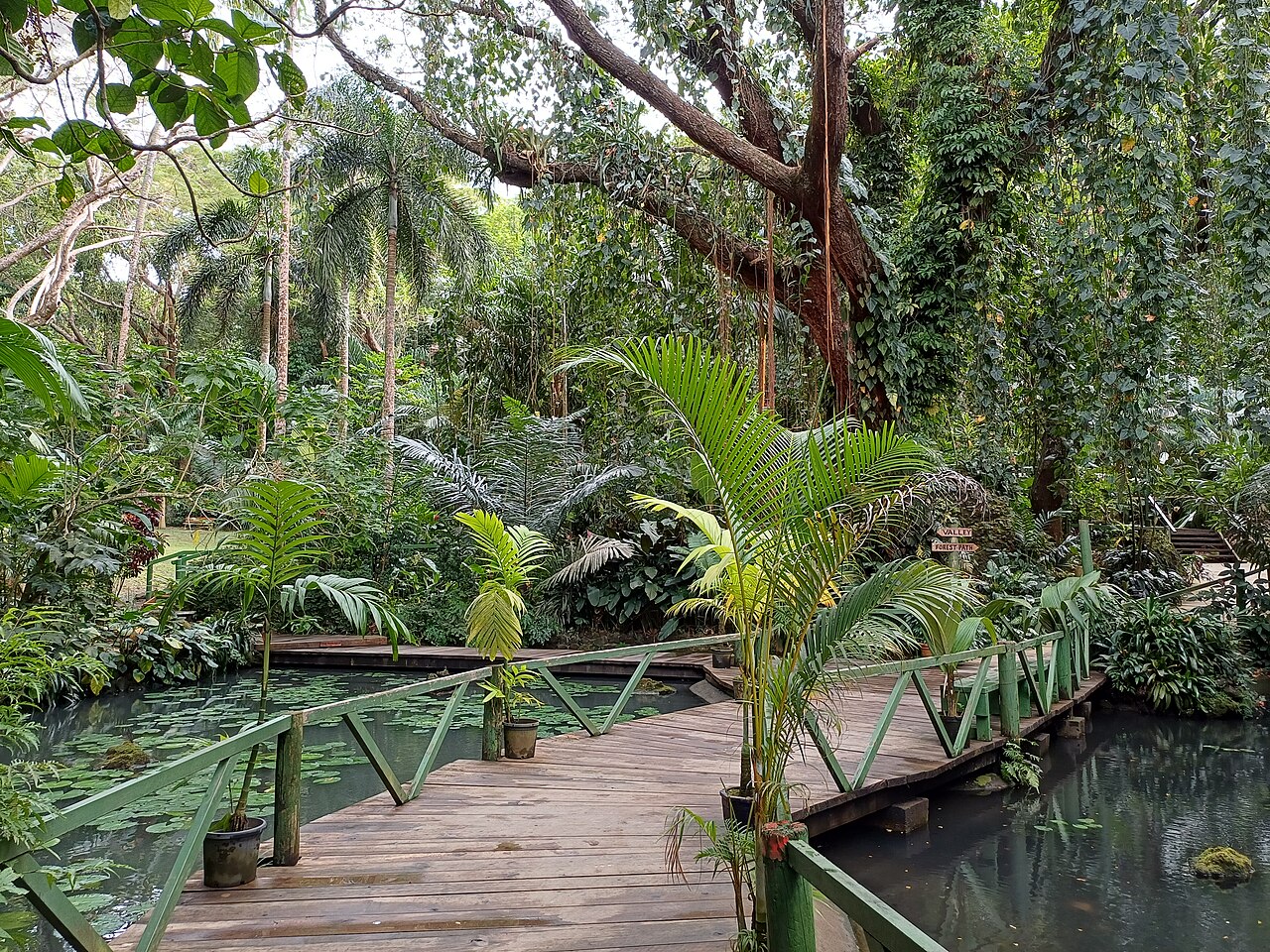
An orchid garden of almost 20 hectares in Sabeto, at the foot of the hills about 10 minutes north of Nadi Airport. It was started in 1977 by the actor Raymond Burr, famous as television's Perry Mason, for his own collection of tropical orchids. Today it shows more than a thousand kinds of orchids along with native Fijian trees and flowers, a lily pond and a forest walk.

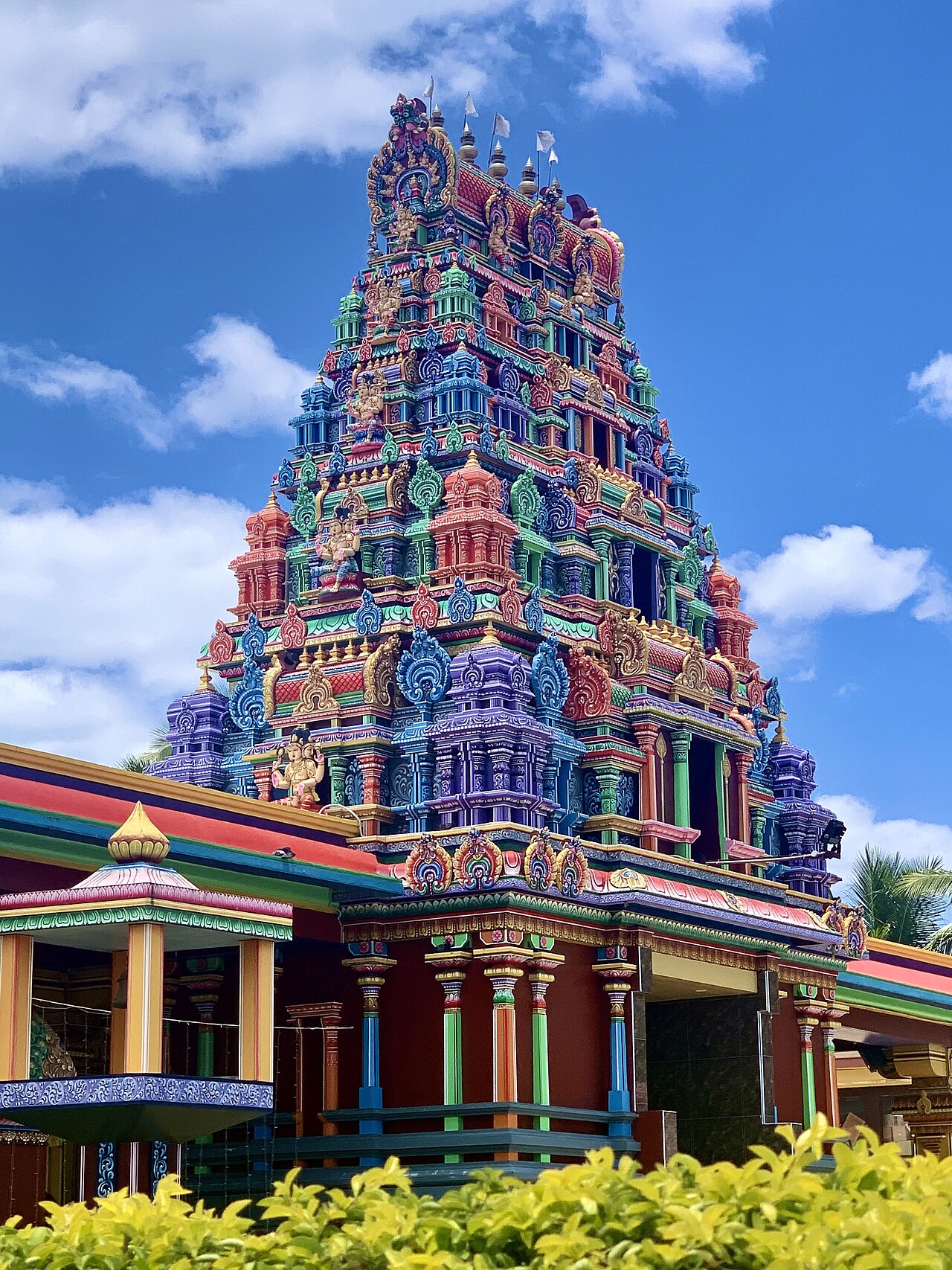
Sri Siva Subramaniya Temple
Photo: Dead.rabbit, CC BY-SA 4.0
Nadi

Sri Siva Subramaniya Temple

A brightly painted Hindu temple at the southern end of Nadi's main street, often described as the largest Hindu temple in the Southern Hemisphere. It is a place of worship and pilgrimage for Indo-Fijians and also welcomes visitors, who should dress modestly and remove their shoes.

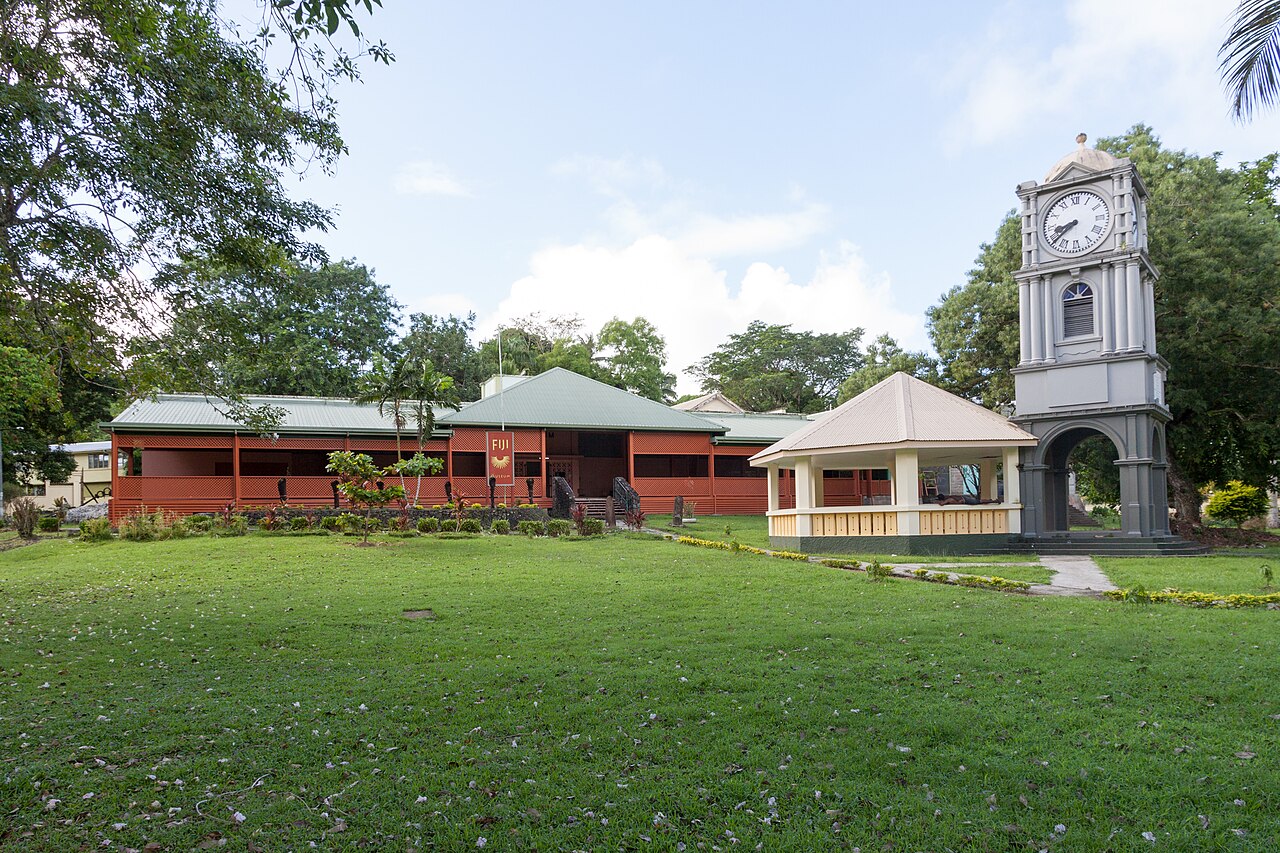
Fiji Museum
Photo: Matthias Süßen, CC BY-SA 3.0
Suva

The Fiji Museum

The national museum, founded in 1904 and now set in Thurston Gardens, Suva's botanical gardens. It holds the world's most important collection of Fijian objects. The centrepiece is a 13 m double-hulled canoe, the Ratu Finau, and you can also see the rudder of HMS Bounty, war clubs, whale tooth ornaments and displays on the Indo-Fijian community.

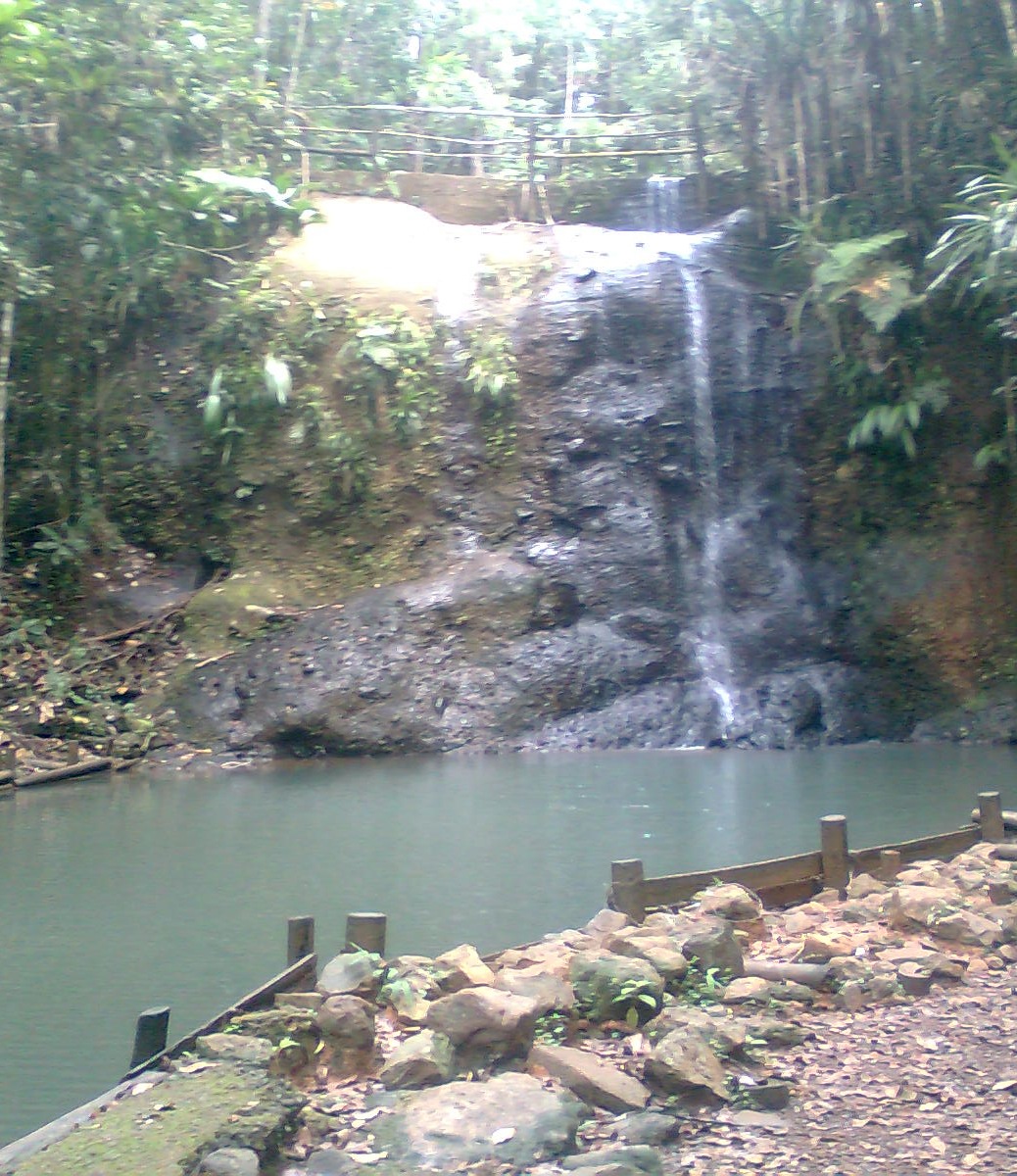
Commons: Colo-i-Suva
Photo: Tucoxn, CC BY-SA 3.0
Near Suva

Colo-i-Suva Forest Park

A cool, green rainforest reserve in the hills just north of Suva, with walking trails, natural swimming pools under small waterfalls, and good birdwatching. It is part of the Queen's Commonwealth Canopy, a network of protected forests.

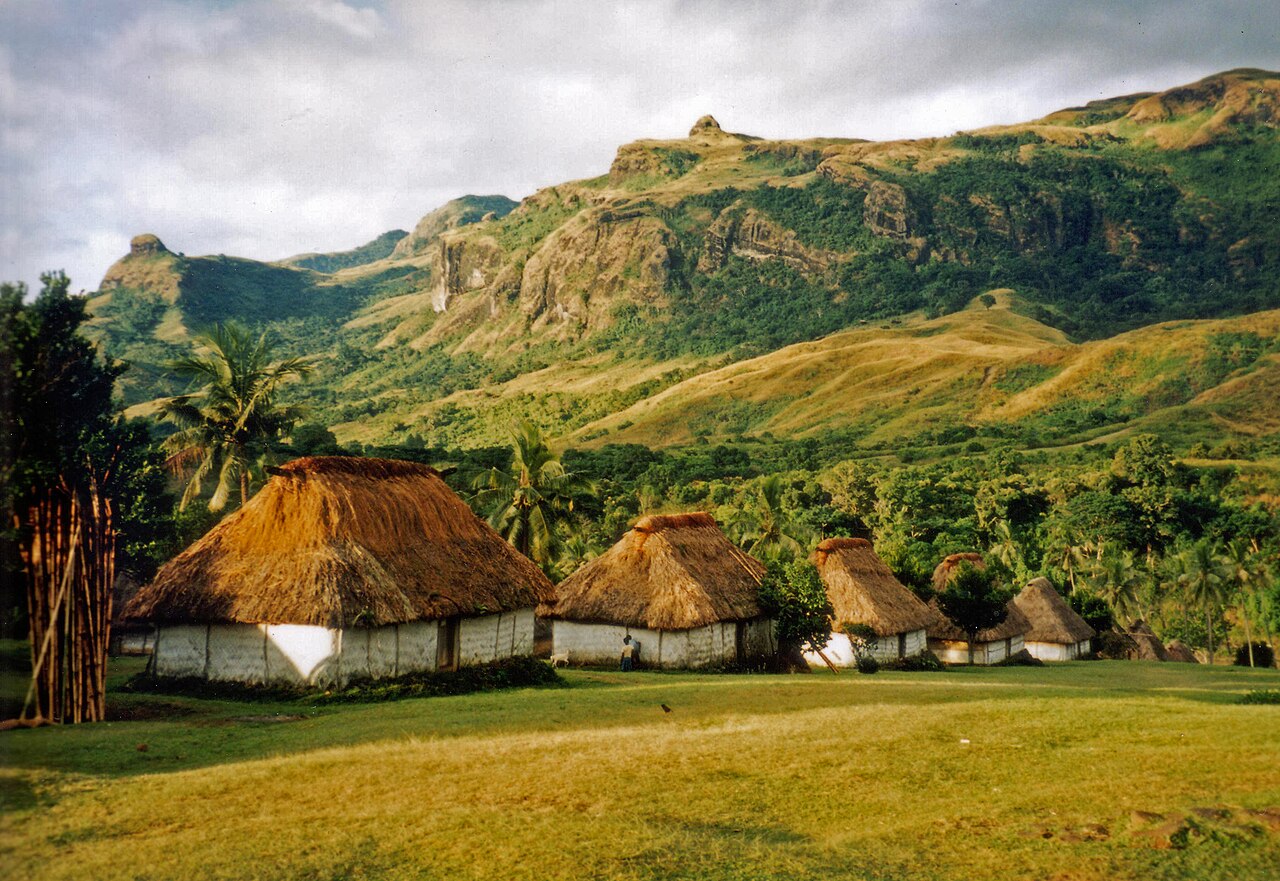
Navala
Photo: Anton Leddin, CC BY-SA 3.0
Near Ba

Navala Village

A village in the Ba Highlands with more than 200 bure, traditional houses with thatched roofs, all of a similar size. It is one of the few places in Fiji that is still completely traditional in its architecture. Buses run from Ba. Visitors pay a small fee to enter and take photographs, and should bring a sevusevu of kava for the chief.

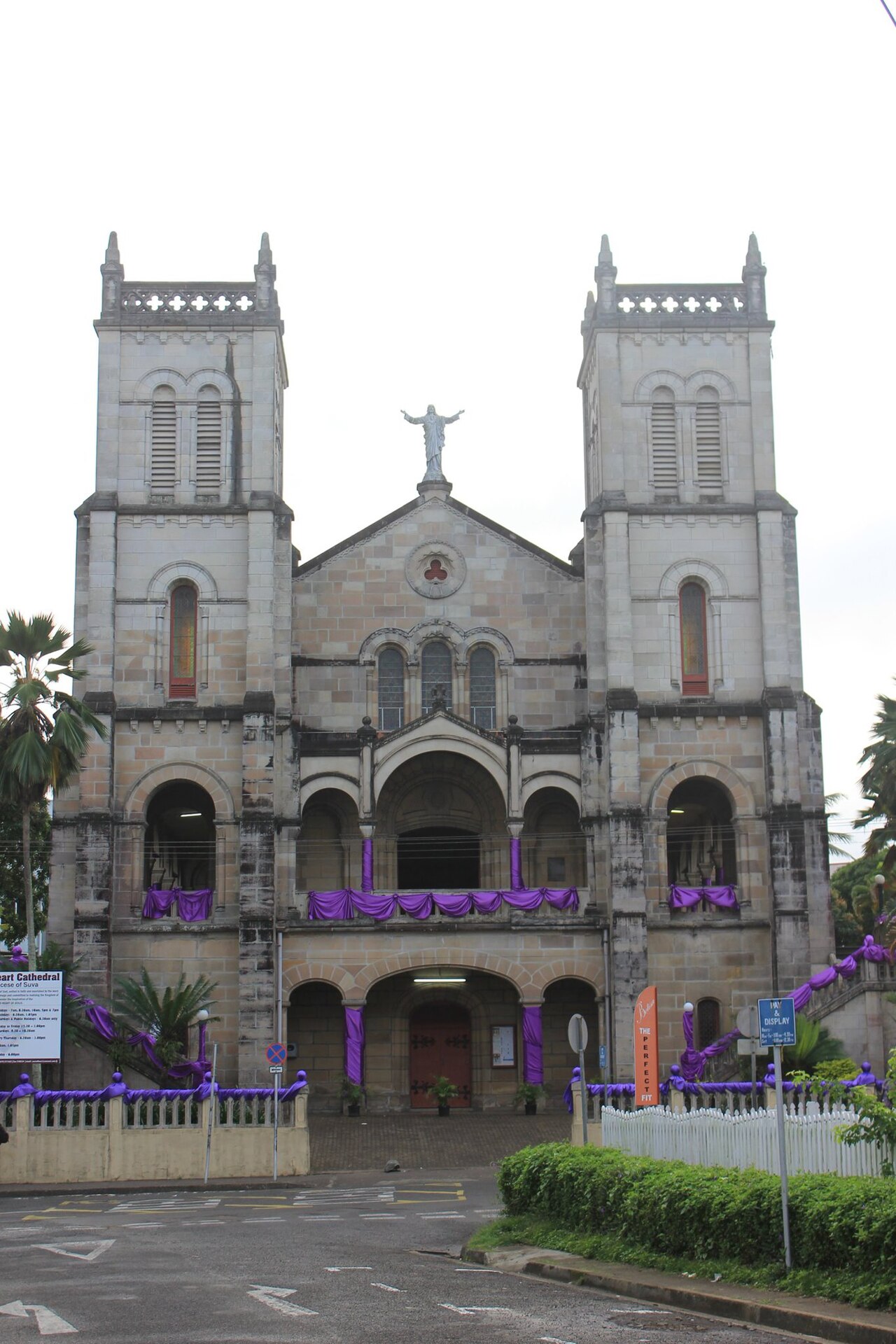
Sacred Heart Cathedral, Suva
Photo: Stemoc, CC0
Suva

Sacred Heart Cathedral, Suva

The main Catholic church of Fiji, on Pratt Street in central Suva. It was built in 1902 of sandstone brought from quarries near Sydney, in a style inspired by the churches of Rome, and is decorated with stained glass, with a crypt below. It is the seat of the Archdiocese of Suva, created in 1966.

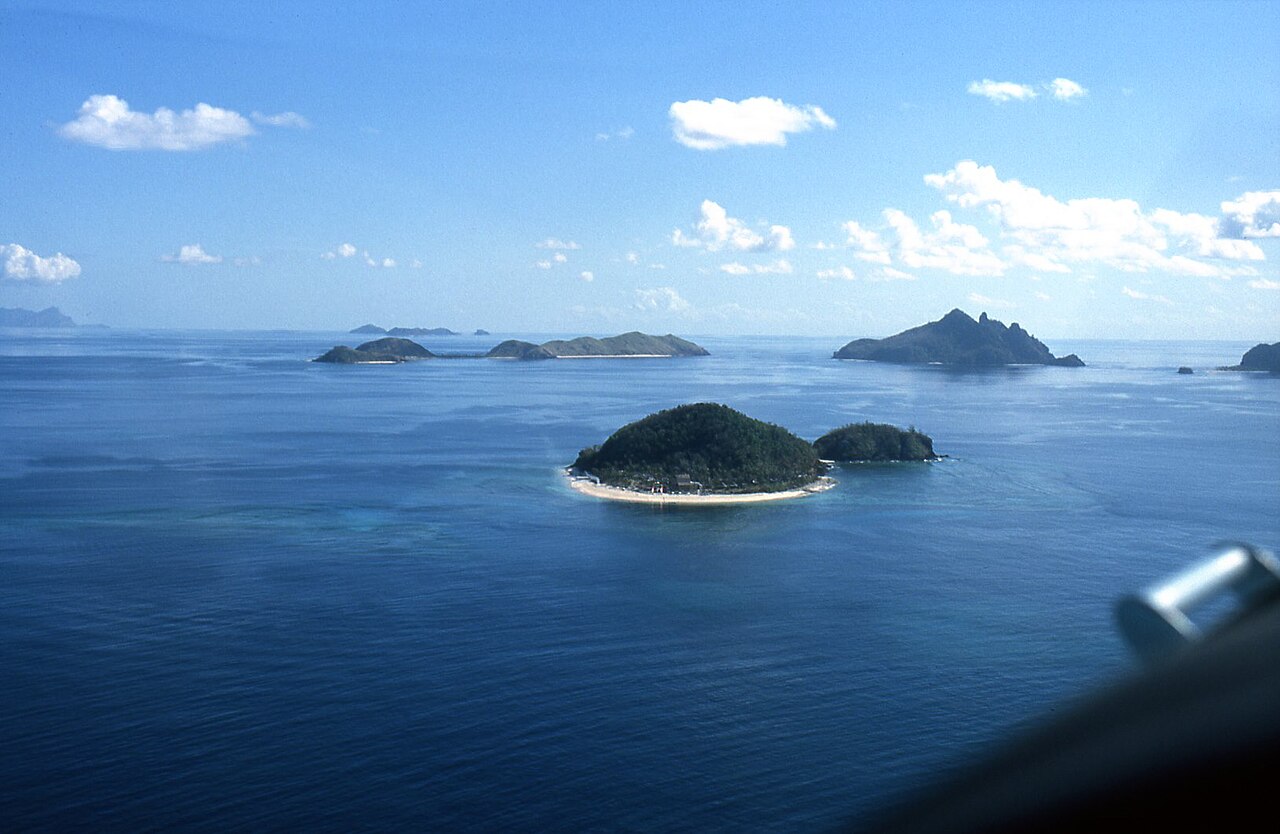
Mamanuca Islands
Photo: American at German Wikipedia, CC BY-SA 3.0
Near Nadi

The Mamanuca Islands

A group of about 20 small volcanic islands west of Nadi, with white beaches, clear water and coral reefs, and some of Fiji's best-known island resorts. About seven of them disappear under the sea at high tide. Boats leave several times a day from the marina at Port Denarau, and the pin marks Port Denarau, the harbour for the islands.

Next: Fun facts

Fun facts

Things you might not know

  1. 01

    The 180th meridian runs across the island of Taveuni, but the International Date Line bends around Fiji so that the whole country shares one date and one time zone, with standard time 12 hours ahead of Greenwich. That makes Fiji one of the first countries to greet each new day.

  2. 02

    Fijians call their islands Viti. The name Fiji comes from 'Fisi', the way their neighbours in Tonga said it, which James Cook heard and wrote down.

  3. 03

    Fiji has more than 330 islands, but only about 110 of them are lived on all year.

  4. 04

    Fiji's first Olympic medal of any colour was gold, won by the rugby sevens team in Rio de Janeiro in 2016. They won gold again at the Tokyo Games, and both victories appeared on special 7 dollar banknotes.

  5. 05

    In February 2016 Cyclone Winston swept across Fiji. As of 2026 it is the most intense tropical cyclone on record in the Southern Hemisphere, and a wind gust of 306 km/h, a national record, was measured on the island of Vanua Balavu.

  6. 06

    The sea between Viti Levu and Vanua Levu is called Bligh Water, after Captain William Bligh, who sailed through it in an open boat after the mutiny on the Bounty in 1789. The rudder of the Bounty is now in the Fiji Museum.

  7. 07

    The Sawau people of Beqa island are famous firewalkers, able to walk across white-hot stones. Their tradition says an ancestor was given this power by a spirit god, in exchange for sparing the god's life.

  8. 08

    A polished sperm whale tooth, the tabua, is one of the most precious gifts in Fijian ceremonies. In the past these teeth were used as a kind of currency.

  9. 09

    Fiji became a republic in 1987, but Queen Elizabeth II stayed on its coins and banknotes until 2013. The new series shows Fiji's own plants and animals instead.

  10. 10

    Many Fijian communities never eat shark, because sharks are linked to Dakuwaqa, the shark god of the sea. Killing or eating one is believed to bring misfortune on the village.

  11. 11

    Levuka's Fiji Times, founded in 1869, is still published today, and Levuka Public School, opened in 1879, was the first public school in Fiji.

  12. 12

    As of 2026, the American television show Survivor has filmed every season since 2016 in the Mamanuca Islands off Nadi.

Next: Words

Fijian (iTaukei) words

20 words to start with

Pronunciation is written the way it sounds; the capital letters show where the stress goes. Audio is coming soon.

Greetings

  • bulaMBOO-lah (b sounds like 'mb')hello (literally 'life')
  • vinakavee-NAH-kahthank you, good
  • moceMOH-theh (c sounds like 'th' in 'that')goodbye, good night
  • kerekerekeh-reh-KEH-rehplease

Basics

  • ioEE-ohyes
  • segaSENG-ah (g sounds like 'ng' in 'singer')no
  • tabuTAHM-booforbidden

People

  • turagatoo-RAHNG-ahman, gentleman (also a chief)
  • maramamah-RAH-mahwoman, lady

Places

  • valelailaivah-leh-lie-LIEtoilet
  • VitiVEE-teeFiji

Food

  • madraimahn-DRAI (d sounds like 'nd')bread
  • toaTOH-ahchicken
  • sucuSOO-thoomilk
  • yaqonayahng-GOH-nah (q sounds like 'ngg' in 'finger')kava, the national drink

Numbers

  • duaNDOO-ahone
  • ruaROO-ahtwo
  • toluTOH-loothree
  • limaLEE-mahfive

Shopping

  • ilavoee-LAH-vohmoney

Next: Phrases

Say it like a local

Useful phrases

Ni sa bula!
nee sah MBOO-lah
Hello! (polite)
Greeting someone politely, especially older people. With friends a simple 'Bula!' is enough
Ni sa yadra
nee sah YAHN-drah
Good morning
Greeting someone in the morning
Yakavi vinaka
yah-KAH-vee vee-NAH-kah
Good evening
Greeting someone in the evening
Vinaka vakalevu
vee-NAH-kah vah-kah-LEH-voo
Thank you very much
Thanking someone warmly, for a meal, a gift or a kindness
Ni sa moce
nee sah MOH-theh
Goodbye, good night (polite)
Saying goodbye, or goodnight before bed
Sota tale
SOH-tah TAH-leh
See you again
Saying goodbye to someone you hope to meet again
O cei na yacamu?
oh THAY nah yah-THAH-moo
What is your name?
Getting to know someone
Na yacaqu ko ...
nah yah-THAHNG-goo koh
My name is ...
Introducing yourself
Tulou
too-LOH-oo
Excuse me
Passing in front of someone or squeezing past people who are sitting down
Kemuni
keh-MOO-nee
Excuse me (to get attention)
Politely getting someone's attention in a shop or on the street
Vosoti au
voh-SOH-tee OW
I'm sorry
Apologising
Sega na lega
SENG-ah nah LENG-ah
No worries
Telling someone that everything is fine, the Fijian way
Au sega ni kila
ow SENG-ah nee KEE-lah
I don't know
When you do not know the answer
Au sega ni vosa vakaviti
ow SENG-ah nee VOH-sah vah-kah-VEE-tee
I can't speak Fijian
Explaining that you only know a few words
E vica?
eh VEE-thah
How much?
Asking the price at a market stall
Ivei na valelailai?
ee-VAY nah vah-leh-lie-LIE
Where is the toilet?
In a restaurant, a shop or a village hall
Rua na bia, kerekere
ROO-ah nah MBEE-ah, keh-reh-KEH-reh
Two beers, please
Ordering at a bar
Kere veivuke!
KEH-reh vay-VOO-keh
Help!
In an emergency

Next: Local tips

Local tips

Before you go

Bring kava to a village

If you visit a Fijian village, or are invited into a Fijian home, bring a bundle of dried kava roots as your sevusevu, the traditional gift. You can buy them at any town market. The village chief or head of the family will accept it in a short ceremony, and after that you are a welcome guest.

Dress for the village, not the beach

Swimwear belongs on the beach and at the resort. In towns and especially in villages and churches, cover your shoulders and knees, men and women alike. A sulu, a wrap-around cloth, is perfect, and villagers are often happy to lend one.

Mind the cyclone season

Fiji is warm all year, but tropical cyclones can strike from November to April. If you travel then, take out travel insurance, keep an eye on the weather forecast and follow local advice. The drier, slightly cooler months are roughly May to October.

Keep left

Traffic in Fiji drives on the left. On the big islands, buses are cheap and frequent, run between all the towns, and in the countryside you can often simply wave one down as it approaches.

Expect quiet Sundays

Fiji is a very religious country and many shops and businesses close on Sunday, when families go to church. Plan your shopping for Saturday, and if you are invited to a church service, go: the singing is unforgettable.

No need to tip

Tipping is not part of Fijian culture, and nobody will expect it in restaurants, taxis or hotels. At many resorts there is a staff 'Christmas box' where you can leave something to be shared among all the workers.

Water and the sun

Tap water in the towns is treated and usually safe to drink. If you are unsure, for example in remote villages, boil or filter it. The tropical sun is strong: use sun cream and a hat, and cover up against mosquitoes at dawn and dusk.

You have seen it all: take the quiz

Sources (54)