World Stroll
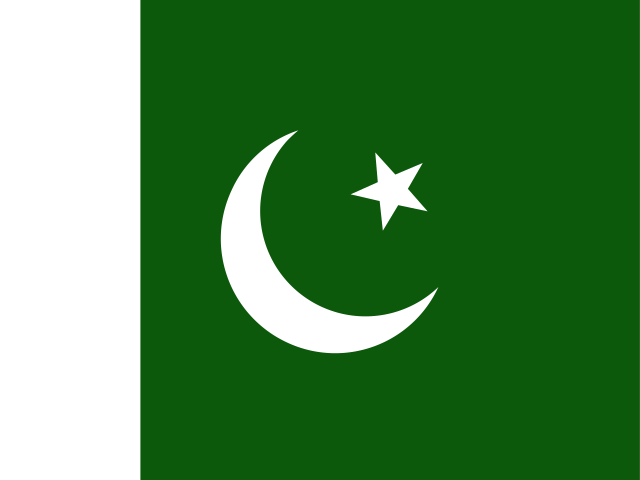
Flag of Pakistan
Travel guide

Learn Pakistan before you go

From the Arabian Sea to the high Karakoram: the cities of the Indus, Mughal Lahore and some of the warmest hospitality in Asia.
Take the full trip
CapitalIslamabad
CurrencyPakistani rupee (Rs)
Official languagesUrdu, which is also the national language, and English
Drives on theLeft
Calling code+92

10 phrases to learn

In Urdu. Capital letters show the stressed part. Tap the heart to practise a phrase later.

Assalam-o-alaikum (السلام علیکم)
us-sah-LAHM oo ah-LAY-koom
Peace be upon you: the usual hello
Greeting anyone, at any time of day. Men often shake hands with men; wait to see whether a woman offers her hand.
Wa-alaikum assalam (وعلیکم السلام)
wah-LAY-koom us-sah-LAHM
And peace be upon you too
The polite reply when someone greets you with assalam-o-alaikum
Aap kaise hain? (آپ کیسے ہیں؟)
AHP KAY-say hain
How are you?
After the greeting. To a woman, say aap kaisi hain (KAY-see).
Main theek hoon, shukriya (میں ٹھیک ہوں، شکریہ)
main TEEK hoon, shook-REE-yah
I am fine, thank you
The usual answer to how are you
Mera naam ... hai (میرا نام ... ہے)
MAY-rah NAHM ... hai
My name is ...
Introducing yourself
Aap se mil kar khushi hui (آپ سے مل کر خوشی ہوئی)
AHP say MIL kar KHOO-shee HOO-ee
Nice to meet you
When you meet someone for the first time
Shukriya (شکریہ)
shook-REE-yah
Thank you
Any time someone helps you or serves you
Bahut meherbani (بہت مہربانی)
buh-HOOT meh-her-BAH-nee
Thank you very much (literally great kindness)
A warmer thank you, for a host or for real help
Maaf kijiye (معاف کیجیے)
MAHF KEE-jee-ay
Excuse me; sorry
To get someone's attention politely or to apologise
Kya aap angrezi bolte hain? (کیا آپ انگریزی بولتے ہیں؟)
KYAH AHP un-GRAY-zee BOLE-tay hain
Do you speak English?
Before asking for help. Many people in the cities speak some English.

At the table

  • Eat and pass food with your right hand. The left hand is seen as unclean for eating, so keep it for other tasks.
  • Wash your hands before and after the meal. At many homes and restaurants a basin is offered, and bread is torn with the fingers of the right hand and used to scoop up curry.
  • Hospitality is a point of honour. Your host will offer more food again and again; leaving a little on your plate shows you have had enough.
  • Food is halal. Do not bring pork or alcohol as a gift, and ask before offering food to others.
  • During Ramadan most Muslims fast from dawn to sunset. Avoid eating, drinking or smoking in public during the day, and if you are invited to iftar, the evening meal, arrive on time: the fast is broken at the call to prayer, often with a date and water.
  • Tea is offered to almost every guest, in homes and even in shops. Accepting a cup is polite, and refusing everything may seem cold.

Local tips

Check official travel warnings first

Security differs a great deal from region to region, and several governments advise against travel to large parts of the country, including some of the cities and sites on this page. Before planning a trip, read your own government's travel advice for Pakistan, follow it, and check it again just before you leave.

Apply for your visa on the official site

Most visitors need a visa, which is applied for online on the Government of Pakistan's Online Visa System, visa.nadra.gov.pk. Your passport should be valid for at least 6 months after you apply. Make sure your passport is stamped when you arrive.

Dress modestly

Pakistan is a conservative country. Men and women both do best in loose clothes that cover the arms and legs, and women should carry a scarf to cover their hair in mosques and shrines. Many visitors buy a shalwar kameez, the local tunic and loose trousers, which is cool and comfortable.

Mosques and shrines

Take off your shoes before you enter a mosque or a shrine and leave them at the entrance. Avoid visiting during the Friday midday prayer, and ask before you take photos of people, especially women.

Drink bottled water

Tap water is not safe to drink. Buy sealed bottled water and check the seal, avoid ice unless you know it was made with safe water, and choose hot, freshly cooked food. Air pollution in Lahore and other cities in Punjab is at its worst from about October to February.

Pick the right season

The plains of Punjab and Sindh are pleasant from about October to March and can pass 45°C in May and June. The monsoon brings heavy rain and sometimes floods from about July to September. In the mountains the season is the reverse: the high roads are usually open only in summer.

Know the emergency numbers

Dial 15 for the police and 1122 for an ambulance or the fire service; Rescue 1122 operates across most of the country. Save the number of your embassy in your phone before you travel.

Dishes to try

  • Chicken karahi (چکن کڑاہی): Chicken cooked quickly in a karahi, a deep round pan like a wok, with tomatoes, ginger, garlic and green chillies. Unlike most curries of the region, the traditional version has no onions. It is brought to the table in the pan and eaten with hot naan.
  • Nihari (نہاری): A deep, silky stew of beef or lamb shank cooked slowly for many hours, often overnight, with bone marrow and warm spices such as long pepper. It is topped with fresh ginger, green chillies, coriander and a squeeze of lemon, and eaten with naan.
  • Haleem (حلیم): A thick, comforting stew of meat, wheat or barley and lentils, cooked slowly for seven or eight hours and then beaten until it becomes smooth. It is served with fried onions, ginger, green chillies and lemon, and is especially popular during Ramadan.
  • Sindhi biryani (سندھی بریانی): Layers of long-grain basmati rice and spicy meat, usually mutton or chicken, cooked with potatoes, tomatoes, yoghurt, fried onions and plenty of green chillies, and sometimes dried plums. It is one of the most eaten dishes in Pakistan.
  • Chapli kebab (چپلی کباب): A large, flat patty of spiced minced beef or mutton with tomato, onion, green chilli, coriander and crushed coriander seeds, fried in fat until the edges are crisp. It is a favourite of Pashtun cooking and is eaten with naan and yoghurt chutney.
  • Seekh kebab (سیخ کباب): Minced beef, lamb or chicken mixed with ginger, garlic, green chilli, garam masala and fresh herbs, pressed around long metal skewers and grilled over charcoal. It is served with sliced onions, lemon, mint chutney and naan.
  • Sajji (سجی): A whole leg of lamb or a whole chicken, seasoned with little more than salt, and roasted slowly on skewers until tender, often stuffed with rice. In Balochistan it is eaten with kaak, a hard bread, while in Karachi, Lahore and Islamabad it is usually chicken served with rice.
  • Aloo gosht (آلو گوشت): Everyday home cooking at its best: meat, usually lamb, mutton or beef, simmered with potatoes in a thin, spiced gravy until tender. It is eaten with roti or plain rice, and for many Pakistanis it tastes of home.

Cities to see

  • Islamabad (capital): The Faisal Mosque, Margalla Hills National Park, The Pakistan Monument.
  • Rawalpindi: Old bazaars, The Pakistan Army headquarters, The nearby ruins of Taxila.
  • Lahore: The Lahore Fort and Badshahi Mosque, The Shalimar Gardens, The Walled City.
  • Faisalabad: Textile mills, The Clock Tower and its bazaars, Farming and cotton.
  • Multan: The Tomb of Shah Rukn-e-Alam, Sufi shrines, Sohan halwa.
  • Bahawalpur: The Noor Mahal palace, The Cholistan Desert, Lal Suhanra National Park.

Landmarks and the city map are on the Pakistan trip