Pakistan trivia: 48 questions and answers
The country at a glance
What is the capital of Pakistan?
- A. Karachi
- B. Lahore
- C. Islamabad
- D. Peshawar
Show the answer
Islamabad. Islamabad is the capital, a planned city built in the 1960s. Karachi is the largest city and was the first capital, and Lahore is the second-largest city.
What is the currency of Pakistan?
- A. Pakistani rupee
- B. Taka
- C. Afghani
- D. Dirham
Show the answer
Pakistani rupee. Pakistan pays in the Pakistani rupee. The taka is Bangladesh's currency and the afghani is Afghanistan's.
Which language does Pakistan's constitution name as the national language?
- A. Punjabi
- B. Urdu
- C. Pashto
- D. Sindhi
Show the answer
Urdu. Urdu is the national language and, with English, an official language. Punjabi is the most common mother tongue, but it is not the national language.
Which city was Pakistan's capital from 1947 to 1959?
- A. Lahore
- B. Karachi
- C. Quetta
- D. Multan
Show the answer
Karachi. Karachi, the great port on the Arabian Sea, was the first capital. The government later moved north, and Islamabad was built in the 1960s.
In Pakistan, traffic drives on the left.
True or false?
Show the answer
True. True. Like India and the United Kingdom, Pakistan drives on the left.
History
Mohenjo-daro, built around 2500 BC, was a city of which ancient civilisation?
- A. The Indus Valley Civilisation
- B. Ancient Egypt
- C. The Maya
- D. The Persian Empire
Show the answer
The Indus Valley Civilisation. Mohenjo-daro was one of the largest cities of the Indus Valley Civilisation, with brick houses, straight streets and covered drains.
In 1971 East Pakistan became which independent country?
- A. Bangladesh
- B. Myanmar
- C. Nepal
- D. Sri Lanka
Show the answer
Bangladesh. After a nine-month war, East Pakistan became Bangladesh in December 1971.
Who became prime minister of Pakistan in 1988, the first woman elected to head a democratic government in a Muslim-majority country?
- A. Fatima Jinnah
- B. Benazir Bhutto
- C. Malala Yousafzai
- D. Indira Gandhi
Show the answer
Benazir Bhutto. Benazir Bhutto became prime minister in 1988 at 35 and served twice. Indira Gandhi led India, and Fatima Jinnah, the founder's sister, never held that office.
The Muslim League, which later led the movement for Pakistan, was founded in Dhaka in 1906.
True or false?
Show the answer
True. True. The All-India Muslim League was founded in Dhaka, then called Dacca, in December 1906.
Islamabad has been the capital of Pakistan since independence in 1947.
True or false?
Show the answer
False. False. Karachi was the capital from 1947 to 1959; Islamabad was built as the new capital in the 1960s.
Near which river in Punjab did Alexander the Great defeat the king Porus in 326 BC?
- A. The Jhelum, then called the Hydaspes
- B. The Nile
- C. The Ganges
- D. The Euphrates
Show the answer
The Jhelum, then called the Hydaspes. The battle was fought on the Jhelum, then called the Hydaspes, in today's Punjab. Soon after, Alexander's army refused to go further east.
Food and drink
Which dish is cooked in a deep, wok-like pan with tomatoes, ginger and garlic, and traditionally without onions?
- A. Chicken karahi
- B. Nihari
- C. Sheer khurma
- D. Sarson ka saag
Show the answer
Chicken karahi. Chicken karahi is named after the karahi, the pan it is cooked and served in. Unlike most curries of the region, it traditionally has no onions.
Nihari, a slow-cooked beef or lamb stew, takes its name from an Arabic word for which time of day?
- A. Morning
- B. Noon
- C. Evening
- D. Midnight
Show the answer
Morning. Nihari comes from the Arabic nahar, day or morning. It was first eaten as breakfast after the dawn prayer, and it is still a breakfast favourite.
The chapli kebab, a large flat patty of spiced minced meat, comes from which city?
- A. Peshawar
- B. Karachi
- C. Multan
- D. Hyderabad
Show the answer
Peshawar. The chapli kebab comes from Peshawar and is a favourite of Pashtun cooking.
Which sweet vermicelli pudding with milk and dates is served on the morning of Eid?
- A. Sheer khurma
- B. Sohan halwa
- C. Lassi
- D. Haleem
Show the answer
Sheer khurma. Sheer khurma, Persian for milk and dates, is served for breakfast after the Eid prayer and offered to every guest that day.
Pork is a common meat in Pakistani restaurants.
True or false?
Show the answer
False. False. Pakistani food is halal, so pork is not eaten. The main meats are beef, lamb, goat and chicken.
Lassi is a drink made from yoghurt and can be salty or sweet.
True or false?
Show the answer
True. True. Lassi is yoghurt blended with water, made salty with cumin or sweet with sugar, and it comes from Punjab.
Which thick stew is made of meat, wheat or barley and lentils, cooked for hours and then beaten smooth?
- A. Haleem
- B. Sindhi biryani
- C. Seekh kebab
- D. Pakora
Show the answer
Haleem. Haleem is cooked for seven or eight hours and then beaten until smooth. It is especially popular during Ramadan.
Cities
Which city forms the twin cities with Islamabad?
- A. Rawalpindi
- B. Faisalabad
- C. Larkana
- D. Bahawalpur
Show the answer
Rawalpindi. Rawalpindi, known as Pindi, lies right next to Islamabad and served as the interim capital while Islamabad was built.
Which city, founded as Lyallpur, is called the Manchester of Pakistan for its textile industry?
- A. Quetta
- B. Faisalabad
- C. Larkana
- D. Peshawar
Show the answer
Faisalabad. Faisalabad, called Lyallpur until 1979, is the third-largest city and a centre of the textile industry.
Which city in south Punjab is known as the City of Saints for its Sufi shrines?
- A. Multan
- B. Karachi
- C. Quetta
- D. Rawalpindi
Show the answer
Multan. Multan attracted many Sufi mystics in the Middle Ages, and its great brick shrines earned it the name City of Saints.
Landmarks
Which Mughal emperor built the Badshahi Mosque in Lahore?
- A. Babur
- B. Humayun
- C. Aurangzeb
- D. Akbar
Show the answer
Aurangzeb. Aurangzeb built the Badshahi Mosque in 1671 to 1673, facing the Alamgiri Gate of the Lahore Fort, which he also built.
The Shalimar Gardens in Lahore were laid out in 1641 and 1642 for which emperor?
- A. Shah Jahan
- B. Babur
- C. Ranjit Singh
- D. Aurangzeb
Show the answer
Shah Jahan. Shah Jahan, who also built the Taj Mahal in India, had the Shalimar Gardens laid out as a Persian paradise garden.
Which mosque in Islamabad has no dome and is shaped like a Bedouin tent?
- A. The Faisal Mosque
- B. The Badshahi Mosque
- C. The Wazir Khan Mosque
- D. The Tomb of Shah Rukn-e-Alam
Show the answer
The Faisal Mosque. The Faisal Mosque, designed by the Turkish architect Vedat Dalokay, was completed in 1986. It was the largest mosque in the world until 1993.
The white marble Mazar-e-Quaid in Karachi is the mausoleum of whom?
- A. Muhammad Ali Jinnah
- B. Muhammad Iqbal
- C. Ranjit Singh
- D. Aurangzeb
Show the answer
Muhammad Ali Jinnah. Mazar-e-Quaid is the tomb of Muhammad Ali Jinnah, the founder of Pakistan, called the Quaid-e-Azam. The poet Iqbal is buried in Lahore.
As of 2026, the Badshahi Mosque is on UNESCO's World Heritage List.
True or false?
Show the answer
False. False. As of 2026 it is only on UNESCO's tentative list. The Lahore Fort across the square is a World Heritage Site, together with the Shalimar Gardens.
Taxila, near Rawalpindi, was a great centre of learning in which ancient region?
- A. Gandhara
- B. Mesopotamia
- C. Anatolia
- D. Bengal
Show the answer
Gandhara. Taxila was one of the chief cities of Gandhara, famous for Buddhist learning and sculpture. It is a World Heritage Site.
Fun facts
K2, in the Karakoram, is the world's ... highest mountain?
- A. Second
- B. Third
- C. Fifth
- D. Tenth
Show the answer
Second. At 8,611 m, K2 is the second-highest mountain on Earth, after Everest, and one of the hardest to climb.
In Urdu and Persian, what does the word pak in Pakistan mean?
- A. Pure
- B. Green
- C. River
- D. Mountain
Show the answer
Pure. Pak means pure and stan means land, so Pakistan is often explained as the land of the pure.
Jahangir Khan won 555 matches in a row between 1981 and 1986. Which sport did he play?
- A. Squash
- B. Cricket
- C. Tennis
- D. Hockey
Show the answer
Squash. Jahangir Khan played squash. Guinness World Records lists his streak as the longest by any athlete in top-level professional sport.
What is mined at Khewra, in Punjab, and sold around the world with a pink colour?
- A. Salt
- B. Coal
- C. Marble
- D. Copper
Show the answer
Salt. Khewra is the second-largest salt mine in the world. Its pink rock salt is sold as Himalayan salt.
What kind of animal is the markhor, Pakistan's national animal?
- A. A wild mountain goat with spiral horns
- B. A river dolphin
- C. A snow leopard
- D. A falcon
Show the answer
A wild mountain goat with spiral horns. The markhor is a wild mountain goat with spiral horns, living in the mountains of the north and west.
The Indus river dolphin is effectively blind and finds its food by echolocation.
True or false?
Show the answer
True. True. Its eyes have no lens, so it navigates and hunts in the muddy Indus by echolocation.
As of 2026, the Tarbela Dam on the Indus is the largest earth-filled dam in the world.
True or false?
Show the answer
True. True. The Tarbela Dam, completed in 1976 and 143 m high, is the largest earth-filled dam in the world.
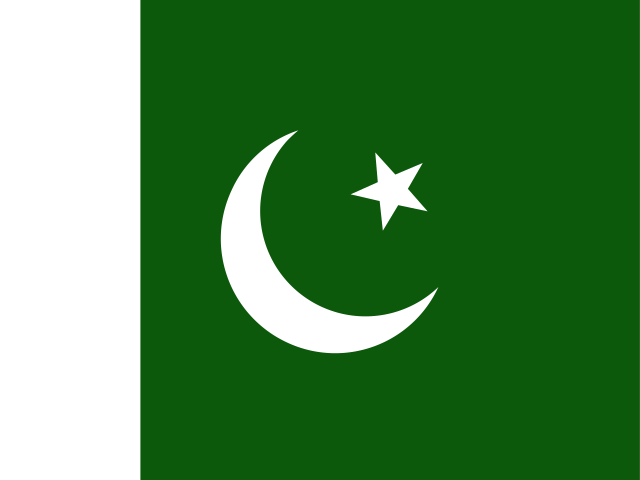
On Pakistan's flag, what does the white stripe stand for?
- A. The country's religious minorities
- B. The snows of the Karakoram
- C. The Indus River
- D. The cotton fields of Punjab
Show the answer
The country's religious minorities. The green stands for the Muslim majority and the white stripe for the country's religious minorities.
Words
What does the Urdu word paani mean?
- A. Water
- B. Bread
- C. Tea
- D. Rice
Show the answer
Water. Paani means water. Bread is roti, tea is chai and rice is chawal.
The Urdu word nahin means yes.
True or false?
Show the answer
False. False. Nahin means no. A polite yes is jee haan.
How is Urdu written?
- A. In a Perso-Arabic script, from right to left
- B. In the Latin alphabet, from left to right
- C. In the Cyrillic alphabet
- D. In Chinese characters
Show the answer
In a Perso-Arabic script, from right to left. Urdu is written in a Perso-Arabic script, from right to left, usually in the flowing Nastaliq style.
What does the Urdu word dost mean?
- A. Friend
- B. Guest
- C. City
- D. River
Show the answer
Friend. Dost means friend. A guest is mehmaan, a city is shehr and a river is darya.
Phrases
Someone greets you with assalam-o-alaikum. What is the usual reply?
- A. Wa-alaikum assalam
- B. Khuda hafiz
- C. Insha'Allah
- D. Maaf kijiye
Show the answer
Wa-alaikum assalam. Wa-alaikum assalam, and peace be upon you too, is the reply. Khuda hafiz means goodbye.
In a bazaar you want to know the price of a shawl. What do you ask?
- A. Yeh kitne ka hai?
- B. Aap kaise hain?
- C. Mera naam ... hai
- D. Kahan hai?
Show the answer
Yeh kitne ka hai?. Yeh kitne ka hai? means how much is this? Aap kaise hain? means how are you?
Mirch kam means less chilli.
True or false?
Show the answer
True. True. Mirch is chilli and kam means less, so mirch kam asks for a milder dish.
What does Insha'Allah mean?
- A. If God wills
- B. Thank you very much
- C. Nice to meet you
- D. Where is it?
Show the answer
If God wills. Insha'Allah means if God wills. You will hear it after almost any plan for the future.
Local customs and tips
Where should most visitors apply for a Pakistani visa?
- A. The Government of Pakistan's Online Visa System
- B. Any website that promises a fast visa
- C. At a hotel after arrival
- D. Visitors never need a visa
Show the answer
The Government of Pakistan's Online Visa System. Most visitors need a visa and apply on the Government of Pakistan's Online Visa System, visa.nadra.gov.pk.
What is the official number for the police in Pakistan?
- A. 15
- B. 100
- C. 17
- D. 999
Show the answer
15. Dial 15 for the police in Pakistan, and 1122 for an ambulance or the fire service.
You take off your shoes before entering a mosque or a shrine.
True or false?
Show the answer
True. True. Shoes are left at the entrance, and women should cover their hair with a scarf.
When is the pleasant season for visiting the plains of Punjab and Sindh?
- A. From about October to March
- B. May and June
- C. During the monsoon, July to September
- D. Only in August
Show the answer
From about October to March. The plains are pleasant from about October to March. May and June can pass 45°C, and the monsoon brings heavy rain.
Several governments advise against travel to some regions of Pakistan, so it is wise to check official travel warnings before a trip.
True or false?
Show the answer
True. True. Security differs a great deal between regions. Read your own government's travel advice before planning a trip and again just before you leave.
Answer key
The country at a glance
- C. Islamabad
- A. Pakistani rupee
- B. Urdu
- B. Karachi
- True
History
- A. The Indus Valley Civilisation
- A. Bangladesh
- B. Benazir Bhutto
- True
- False
- A. The Jhelum, then called the Hydaspes
Food and drink
- A. Chicken karahi
- A. Morning
- A. Peshawar
- A. Sheer khurma
- False
- True
- A. Haleem
Cities
- A. Rawalpindi
- B. Faisalabad
- A. Multan
Landmarks
- C. Aurangzeb
- A. Shah Jahan
- A. The Faisal Mosque
- A. Muhammad Ali Jinnah
- False
- A. Gandhara
Fun facts
- A. Second
- A. Pure
- A. Squash
- A. Salt
- A. A wild mountain goat with spiral horns
- True
- True
- A. The country's religious minorities
Words
- A. Water
- False
- A. In a Perso-Arabic script, from right to left
- A. Friend
Phrases
- A. Wa-alaikum assalam
- A. Yeh kitne ka hai?
- True
- A. If God wills
Local customs and tips
- A. The Government of Pakistan's Online Visa System
- A. 15
- True
- A. From about October to March
- True
More about Pakistan
- The trip to PakistanMap, story, food, phrases and a friendly quiz.
- Pakistan word searchCities and dishes in large print.
- Pakistani words crosswordLearn a few words while you solve it.
- Colour the flag of PakistanPrint it or colour it in on the screen.
- Pakistani rootsA family guide: history, recipes and words for the grandchildren.
- Before you goPhrases, customs and tips for travellers.
- Printable packLarge print, with a quiz and answers.