13 fun facts about Vietnam
- 01
Vietnamese is written in the Latin alphabet with extra marks. The system was developed by Portuguese and other European missionaries in the 1600s, and a dictionary by Alexandre de Rhodes, printed in Rome in 1651, helped fix the spelling.
- 02
Standard northern Vietnamese has six tones. Five of them are shown by accent marks over or under the vowels, and the level tone has no mark, so the same letters can mean different things.
- 03
By some estimates between 30 and 39 percent of Vietnamese people have the family name Nguyễn, the name of the last royal dynasty.
- 04
As of 2026, Vietnam is the second-largest coffee producer in the world, after Brazil, and almost all of its coffee is robusta.
- 05
Sơn Đoòng cave in Phong Nha-Kẻ Bàng is the largest known cave passage in the world by volume. A local man, Hồ Khanh, found its entrance in 1990, and British cavers surveyed it in 2009. It is so big that it has its own river inside, and trees grow where parts of its roof have collapsed.
- 06
Water puppetry began in the villages of the Red River Delta as far back as the 11th century. The puppeteers stand hidden in waist-deep water behind a screen and move the puppets across the water's surface.
- 07
Tết, the Lunar New Year in late January or February, is the biggest festival of the year. Families gather, clean their homes, honour their ancestors and give children lucky money in red envelopes.
- 08
The áo dài, a long silk tunic worn over trousers, is Vietnam's national dress. Its early form goes back to a 1744 decree by Lord Nguyễn Phúc Khoát, and the modern, close-fitting style appeared in the 1930s.
- 09
The saola, a shy forest animal with long straight horns, was discovered by scientists in the mountains of Vietnam in 1992. It was the first large mammal discovered in the region in 50 years.
- 10
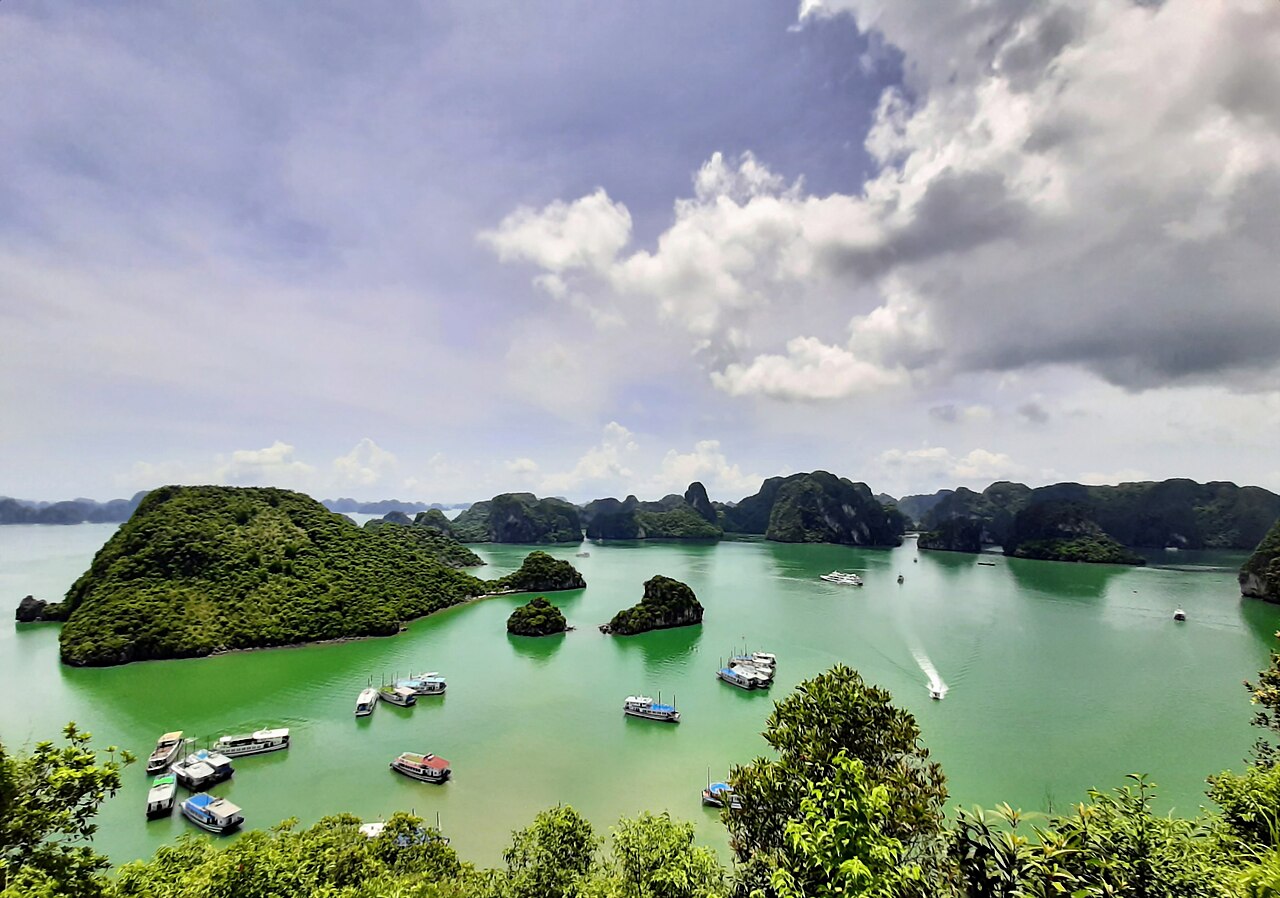
Hạ Long means 'descending dragon', and the old name of Hanoi, Thăng Long, means 'ascending dragon'.
- 11
The Temple of Literature in Hanoi housed Vietnam's first national university, the Imperial Academy, from 1076 to 1779.
- 12
As of 2026, Vietnam has nine UNESCO World Heritage Sites, from Ha Long Bay and the caves of Phong Nha-Kẻ Bàng to the old towns and citadels of Hội An, Huế and Hanoi.
- 13
From north to south Vietnam is about 1,650 km long, but at its narrowest point it is only about 50 km wide.
Sources (15)
- Geography of Vietnam (Wikipedia)
- Hanoi (Wikipedia)
- Coffee production in Vietnam (Wikipedia)
- UNESCO World Heritage Centre: Viet Nam
- Hạ Long Bay (Wikipedia)
- Temple of Literature, Hanoi (Wikipedia)
- Hang Sơn Đoòng (Wikipedia)
- Vietnamese alphabet (Wikipedia)
- Vietnamese phonology (Wikipedia)
- Nguyễn, surname (Wikipedia)
- Water puppetry (Wikipedia)
- Tết (Wikipedia)
- Áo dài (Wikipedia)
- Saola (Wikipedia)
- Wikivoyage: Vietnam
Fun facts from nearby countries
More about Vietnam
- The trip to VietnamMap, story, food, phrases and a friendly quiz.
- Vietnamese foodThe dishes to try, with photos and recipes.
- Vietnam triviaQuestions and answers to read aloud or print.
- Vietnam word searchCities and dishes in large print.
- Vietnamese words crosswordLearn a few words while you solve it.
- Colour the flag of VietnamPrint it or colour it in on the screen.
- Vietnamese rootsA family guide: history, recipes and words for the grandchildren.
- Before you goPhrases, customs and tips for travellers.
- Printable packLarge print, with a quiz and answers.