Great rivers, rice and fish, the world's largest mangrove forest and a people deeply proud of their language.
Bangladesh lies in the northeast of the South Asian subcontinent, on the Bay of Bengal. Almost all of it is the flat, green Ganges Delta, the largest river delta in the world, where the Padma (the Ganges), the Jamuna (the Brahmaputra) and the Meghna meet on their way to the sea. Only the southeast rises into hills, the Chittagong Hill Tracts. India surrounds it on three sides, and in the southeast it borders Myanmar.
Buddhist and Hindu kingdoms, the Bengal Sultanate and the Mughals all ruled here, and Bengal became famous for its fine cotton muslin. After almost two centuries of British rule, East Bengal became the eastern part of Pakistan in 1947. Anger over language, money and power grew, and after the Liberation War of 1971 Bangladesh became an independent country. Its name means 'the land of Bengal'.
Questions to ask the older generation
Memories fade faster than photos. Ask these over a meal or a phone call, and write the answers down.
Which town or region of Bangladesh did our family come from? Was it near Chittagong, Khulna, Rajshahi?
Who was the first in the family to leave Bangladesh, when, and why?
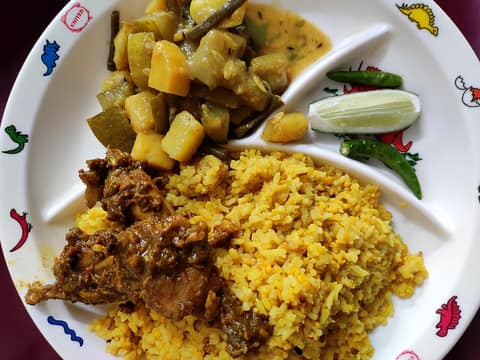
Which dishes from Bangladesh were cooked at home? Did anyone make Shorshe ilish or Panta bhat?
Does anyone in the family still speak Bengali, or use a few words of it?
Were there songs, prayers, games or holidays from Bangladesh that the family kept?
Are there old photos, letters or documents from Bangladesh? Who has them?
If you could visit Bangladesh together, where would you go first?
A short history of Bangladesh
The story of Bangladesh is the story of Bengal. Ancient cities rose in the delta more than 2,000 years ago, Buddhist kings built great monasteries, and sultans and Mughal governors made Bengal one of the richest lands in Asia. British rule, the partition of 1947 and a long struggle for the Bengali language led to independence in 1971.
300 BC
A city rises at Mahasthangarh
A stone slab with an inscription in Prakrit, found in 1931, shows that a walled city, Pundranagara, stood at Mahasthangarh near today's Bogura by at least the 3rd century BC, when the region was part of the Maurya Empire. It is one of the earliest city sites found so far in Bangladesh.
1204
Bakhtiyar Khalji conquers Bengal
Around 1204 the general Muhammad Bakhtiyar Khalji, serving the Ghurid rulers of Afghanistan and northern India, captured Nabadwip and then Gauda, the capital of Bengal, and the Sena king fled to the east. It began more than 500 years of rule by Muslim sultans and governors in Bengal.
1576
The Mughals conquer Bengal
In 1576 the armies of the Mughal emperor Akbar defeated the last sultan of Bengal. Under the Mughals, Bengal became one of the wealthiest provinces of the empire, famous for its rice, silk, shipbuilding and very fine cotton muslin.
1757
The Battle of Plassey
On 23 June 1757 the army of the British East India Company defeated Siraj ud-Daulah, the last independent Nawab of Bengal, at Plassey, in today's India. It began almost two centuries of British rule over Bengal and, in time, the whole subcontinent.
1952
The Language Movement
Pakistan's government wanted Urdu to be the only state language, although most of its people spoke Bengali. On 21 February 1952 police in Dhaka opened fire on students protesting for Bengali, and several were killed. In 1956 Bengali was made an official language of Pakistan, and 21 February is remembered every year.
1971
The Liberation War
On the night of 25 March 1971 the Pakistani army began a crackdown in Dhaka, and independence was declared on 26 March. Bengali fighters, the Mukti Bahini, fought back; about 10 million people fled to India, and many civilians were killed in mass killings, though estimates of the dead vary widely. India joined the war in December, and on 16 December 1971 Pakistan's forces surrendered in Dhaka.
1974
Bangladesh joins the United Nations
On 17 September 1974 Bangladesh became a full member of the United Nations. A week later, on 25 September, its prime minister gave the first speech ever made in Bengali at the UN General Assembly.
2022
The Padma Bridge opens
On 25 June 2022 the Padma Bridge opened over the Padma River. At 6.15 km it is the longest bridge in Bangladesh, carrying a four-lane road above and a railway below, and it links the southwest of the country to Dhaka without a ferry.