The Treaty of Tordesillas
Spain and Portugal agreed on a line 370 leagues west of the Cape Verde islands. New lands to the east of it would belong to Portugal. That line later gave Portugal the eastern part of South America.
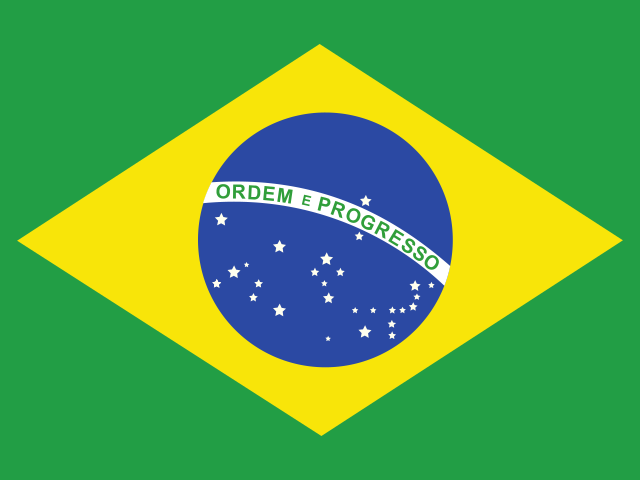
Brazil is the largest country in South America and the fifth largest in the world. It covers roughly half of the continent and borders every South American country except Chile and Ecuador. The north is covered by the Amazon rainforest and the Amazon River; the long Atlantic coast has most of the big cities; and inland lie the grassy highlands of the cerrado and the Pantanal, the largest tropical wetland on Earth.
Indigenous peoples lived here for thousands of years before the Portuguese arrived in 1500. For more than three centuries Brazil was a Portuguese colony, built on sugar, gold and coffee, and on the labour of millions of enslaved Africans. Brazil declared its independence in 1822, became an empire, abolished slavery in 1888 and became a republic in 1889. In 1960 the capital moved from Rio de Janeiro to Brasília, a new city built in the middle of the country.
Memories fade faster than photos. Ask these over a meal or a phone call, and write the answers down.
Brazil's recorded history begins in 1500, when a Portuguese fleet reached its coast, but Indigenous peoples had lived here for thousands of years before. Portugal ruled Brazil for more than three centuries, first for sugar and brazilwood, then for gold and diamonds, and brought millions of enslaved Africans to work the land and the mines. In 1808 the Portuguese royal family moved to Rio de Janeiro, and in 1822 Brazil declared its independence. It was an empire until 1889, then a republic, and in 1960 it moved its capital to Brasília, a new city in the heart of the country.
Spain and Portugal agreed on a line 370 leagues west of the Cape Verde islands. New lands to the east of it would belong to Portugal. That line later gave Portugal the eastern part of South America.
Tomé de Sousa founded Salvador on the Bay of All Saints in 1549 as the seat of the colonial government. It stayed Brazil's capital until 1763.
The Dutch West India Company captured the rich sugar lands of the northeast and ruled them from Recife until 1654. Under Johan Maurits of Nassau, artists and scientists came to paint and describe Brazil.
The colonial capital moved from Salvador south to Rio de Janeiro, closer to the gold and diamond region of Minas Gerais. Rio stayed the capital for almost 200 years.
On 7 September 1822, by the Ipiranga brook in São Paulo, Prince Pedro, son of King João VI, declared Brazil independent from Portugal. He was crowned Emperor Pedro I in December 1822.
On 15 November 1889 Marshal Deodoro da Fonseca led a military coup that deposed Emperor Pedro II. The imperial family went into exile in Europe, and Brazil became a republic.
On 21 April 1960 President Juscelino Kubitschek inaugurated Brasília, a new capital built in about 41 months on the high plateau of central Brazil. Rio de Janeiro stopped being the capital after almost two centuries.
In 1985 an electoral college chose a civilian president, ending military rule. A new constitution, still in force, was adopted in 1988.
Cook one of the recipes, print the large-print pack about Brazil, and finish with the big-screen quiz or the words crossword. Grandchildren can colour the flag.