Two seas, three Andean ranges, a walled Caribbean city, the Amazon, the finest coffee hills and more kinds of birds than almost anywhere on Earth.
Colombia sits in the north-west corner of South America, with coasts on two seas: the Caribbean to the north and the Pacific Ocean to the west. The Andes split into three long mountain ranges here, and most Colombians live in their cool valleys and high plateaus. To the east lie the grassy plains of the Llanos and the Amazon rainforest, which together cover more than half the country but hold less than 6 percent of its people.
People have lived here for at least 12,000 years. Peoples such as the Muisca, famous for their gold work, and the Tairona, who built stone terraces in the mountains, were here when Spain arrived in 1499. Colombia declared independence in 1810 and won it at the Battle of Boyacá in 1819. The country took its name from Christopher Columbus.
Questions to ask the older generation
Memories fade faster than photos. Ask these over a meal or a phone call, and write the answers down.
Which town or region of Colombia did our family come from? Was it near Medellín, Cali, Barranquilla?
Who was the first in the family to leave Colombia, when, and why?
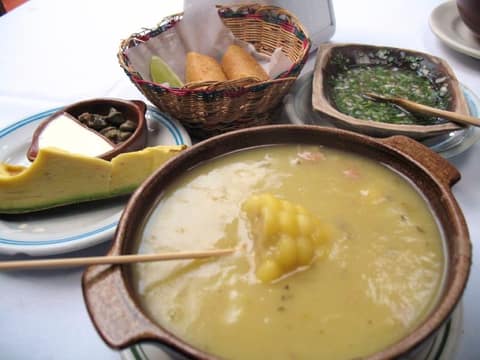
Which dishes from Colombia were cooked at home? Did anyone make Ajiaco santafereño or Bandeja paisa?
Does anyone in the family still speak Spanish, or use a few words of it?
Were there songs, prayers, games or holidays from Colombia that the family kept?
Are there old photos, letters or documents from Colombia? Who has them?
If you could visit Colombia together, where would you go first?
A short history of Colombia
Colombia's story begins with Indigenous peoples such as the Muisca of the high plateau around Bogotá and the Tairona of the Sierra Nevada de Santa Marta. Spain conquered the land in the 1500s and ruled it as the New Kingdom of Granada, later a viceroyalty with its capital in Bogotá. After independence the country changed its name and shape several times, lost Panama in 1903, and in the 20th century went through long periods of political violence. A new constitution in 1991 and a peace agreement with the FARC guerrillas in 2016 opened a calmer chapter, although some armed groups remain active.
AD 800
The Tairona build Ciudad Perdida
Around AD 800, the Tairona people built a town of stone terraces, paths and plazas high in the jungle of the Sierra Nevada de Santa Marta. Today it is called Ciudad Perdida, the Lost City, and it is thought to be about 650 years older than Machu Picchu.
1525
Santa Marta is founded
On 29 July 1525 the Spanish conqueror Rodrigo de Bastidas founded Santa Marta on a bay of the Caribbean coast. It is Colombia's oldest surviving city.
1538
Jiménez de Quesada founds Bogotá
On 6 August 1538 the conquistador Gonzalo Jiménez de Quesada founded Santa Fe, later Bogotá, on the high plateau of the Muisca people. It became the capital of the New Kingdom of Granada.
1810
Bogotá declares self-government
On 20 July 1810 a quarrel over a borrowed flower vase sparked protests in Bogotá, and local leaders removed the Spanish viceroy and formed their own government. 20 July is celebrated as Colombia's Independence Day.
1903
Panama separates from Colombia
On 3 November 1903 Panama, until then a part of Colombia, declared its independence with the backing of the United States, which wanted to build the Panama Canal. This gave Colombia its present borders.
1964
The FARC guerrillas are formed
In 1964 left-wing rebels formed the FARC in the countryside. For more than five decades, fighting between the state, guerrilla groups, right-wing paramilitaries and drug traffickers cost many lives and forced millions of people from their homes.
1991
A new constitution
In July 1991 Colombia adopted a new constitution, replacing the one from 1886. It recognises the country's ethnic and cultural diversity and protects the rights of citizens, and many Colombians see it as a step forward.
2017
The FARC hand over their weapons
On 27 June 2017 the FARC finished handing over their weapons to the United Nations and stopped being an armed group. They became a legal political party, later renamed the Commons. Most former fighters kept to the agreement, but some breakaway groups rejected it or later took up arms again.