Nara becomes the capital
Japan built its first long-lasting capital, Heijō-kyō, at Nara, laid out on a grid like the Chinese capital. Buddhism flourished and the great temple of Tōdai-ji was built here.
Japan is an island nation in the Pacific Ocean, off the east coast of Asia. Four large islands make up most of the country: Hokkaido in the north, Honshu in the middle, and Shikoku and Kyushu in the south, together with thousands of smaller islands. Mountains cover most of the land, so people live crowded along the coasts and plains.
For more than 200 years Japan kept most of the world out, ruled by shoguns and samurai. When it opened up in the 1850s it changed at astonishing speed, and after the destruction of the Second World War it rebuilt itself into one of the richest countries on earth.
Memories fade faster than photos. Ask these over a meal or a phone call, and write the answers down.
Japan's written history begins later than China's, but its imperial family is one of the oldest in the world. For most of the last thousand years real power lay with warrior families, until the emperor was restored to the centre of the state in 1868.
Japan built its first long-lasting capital, Heijō-kyō, at Nara, laid out on a grid like the Chinese capital. Buddhism flourished and the great temple of Tōdai-ji was built here.
After winning a long war between two great clans, Yoritomo was named shogun, the top military ruler, and governed from Kamakura. Shoguns would hold real power, in the emperor's name, for almost 700 years.
A ship carrying Portuguese traders landed on the island of Tanegashima, the first Europeans known to reach Japan. They brought guns, which soon changed the way Japanese lords fought.
Ieyasu was named shogun and ruled from Edo, today's Tokyo. His family kept Japan at peace for about 250 years, a time called the Edo period.
The last shogun gave up power and the young Emperor Meiji was restored as head of the state. Edo was renamed Tokyo, meaning eastern capital, and Japan began to modernise at great speed.
In August 1945 the United States dropped atomic bombs on Hiroshima and Nagasaki, and Japan surrendered, ending the Second World War.
The Tokyo Olympics were the first Olympic Games held in Asia. The first bullet train line opened just days before, and the Games showed the world a rebuilt, modern Japan.
Emperor Akihito stepped down, the first emperor to do so in about 200 years, and his son Naruhito took the throne on 1 May 2019. Japan names its years by era, and the new one is called Reiwa.
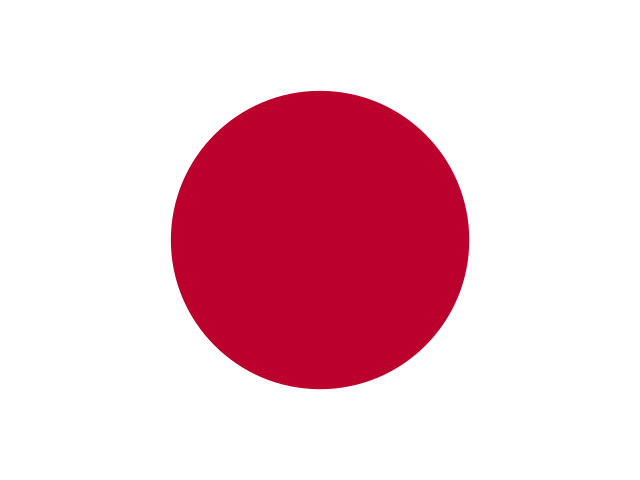
Cook one of the recipes, print the large-print pack about Japan, and finish with the big-screen quiz or the words crossword. Grandchildren can colour the flag.