The oldest known wooden wheel
People living in pile dwellings in the Ljubljana Marsh made a wooden wheel that was found in 2002. Radiocarbon dating shows it is roughly 5,100 to 5,350 years old, the oldest wooden wheel yet discovered.
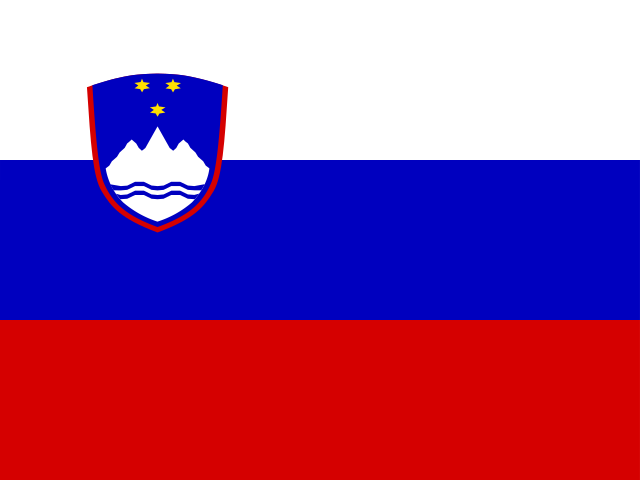
Slovenia is one of Europe's smaller countries, but it packs a great deal into about 20,000 square kilometres. Four major landscapes meet here: the Alps in the north, the Dinaric mountains and the limestone Karst in the south-west, the flat Pannonian plain in the east, and a short strip of Adriatic coast, only about 47 km long, on the Gulf of Trieste. About 60% of the land is forest, and the white peak of Triglav appears on the national flag.
The land has been home to many peoples and states: Roman towns such as Emona, the Slavic principality of Carantania, centuries under the Habsburgs, and in the 20th century the kingdom and then the socialist federation of Yugoslavia. Slovenes kept their own language through it all, and the first books in Slovene were printed in 1550.
Memories fade faster than photos. Ask these over a meal or a phone call, and write the answers down.
Slovenia's story runs from prehistoric pile dwellings and a Roman town, through the Slavic principality of Carantania and more than five centuries of Habsburg rule, to Yugoslavia and independence in 1991.
People living in pile dwellings in the Ljubljana Marsh made a wooden wheel that was found in 2002. Radiocarbon dating shows it is roughly 5,100 to 5,350 years old, the oldest wooden wheel yet discovered.
After the death of the Slavic king Samo in 658, the Slavic principality of Carantania emerged in the eastern Alps. Its dukes were installed in a ritual held in Slovene at the Prince's Stone, a custom last performed in 1414.
When Henry of Gorizia died without a male heir, Carinthia and Carniola passed to Duke Albert II of Austria. Most of today's Slovenia became a hereditary land of the Habsburgs, who ruled it until 1918.
The Protestant preacher Primož Trubar wrote the first two books in Slovene, Catechismus and Abecedarium, printed in 1550 in Germany. He is seen as a founder of the Slovene written language.
From June 1915 to November 1917, Italy and Austria-Hungary fought twelve battles along the Soča river, mostly on land that is now in Slovenia. More than 30,000 Slovene soldiers died in the First World War.
After the Second World War, when Slovenia had been divided mainly between Germany, Italy and Hungary, Slovenia became one of the six republics of socialist Yugoslavia led by Josip Broz Tito.
Slovenia declared independence on 25 June 1991. Two days later the Yugoslav army moved in, and a short war followed until the Brioni Agreement was signed on 7 July.
On 1 January 2007 Slovenia became the first of the countries that joined the EU in 2004 to adopt the euro, replacing the tolar, which had been its currency since 1991.
Cook one of the recipes, print the large-print pack about Slovenia, and finish with the big-screen quiz or the words crossword. Grandchildren can colour the flag.