Ibn Battuta visits Kilwa
The Moroccan traveller Ibn Battuta visited Kilwa, then the richest Swahili city-state on the coast, and described it as one of the most beautiful cities in the world. Kilwa grew wealthy from the gold trade from the south.
Tanzania lies in East Africa, just south of the equator, with a long, warm coastline on the Indian Ocean. Inland the land rises to a wide central plateau, crossed by the Great Rift Valley and ringed by great lakes: Lake Victoria in the north, Lake Tanganyika in the west and Lake Nyasa in the southwest. In the northeast stands Mount Kilimanjaro, at 5,895 m the highest mountain in Africa.
The country is a union of two parts. The mainland, once called Tanganyika, was ruled by Germany and then Britain and became independent in 1961. The islands of Zanzibar, long ruled by sultans from Oman, became independent in 1963. In 1964 the two joined to form the United Republic of Tanzania, and Zanzibar keeps its own president and parliament for its local affairs.
Memories fade faster than photos. Ask these over a meal or a phone call, and write the answers down.
Some of the oldest remains of early humans were found in northern Tanzania. Over thousands of years Cushitic, Nilotic and Bantu-speaking peoples settled the land, and from the first millennium AD Swahili trading towns such as Kilwa grew rich along the coast. The Portuguese arrived around 1500, followed by the sultans of Oman, who made Zanzibar their capital. Germany took the mainland in the 1880s and Britain after the First World War. Tanganyika became independent in 1961, Zanzibar in 1963, and in 1964 they united as Tanzania.
The Moroccan traveller Ibn Battuta visited Kilwa, then the richest Swahili city-state on the coast, and described it as one of the most beautiful cities in the world. Kilwa grew wealthy from the gold trade from the south.
Sultan Said bin Sultan moved his capital from Muscat in Oman to Stone Town on Zanzibar. The island grew rich from cloves and trade, but also became the centre of the East African slave trade.
Under a British ultimatum, Sultan Barghash bin Said agreed in June 1873 to end the slave trade by sea from Zanzibar, and the great slave market in Stone Town was closed. Slavery itself was only abolished in the 1890s.
The German geographer Hans Meyer and the Austrian climber Ludwig Purtscheller reached the highest point of Kilimanjaro, helped by local porters and guides. The summit was later renamed Uhuru Peak, 'Freedom Peak' in Swahili.
After Germany's defeat in the First World War, most of German East Africa passed to Britain, and on 10 January 1920 the territory took the name Tanganyika. Britain ruled it under a League of Nations mandate.
On 9 December 1961 Tanganyika became independent from Britain, with Julius Nyerere as prime minister. A year later it became a republic, with Nyerere as its first president.
On 26 April 1964 Tanganyika and Zanzibar joined as one country. In October of the same year it took the name the United Republic of Tanzania, made from the first letters of both names.
On 1 July 1992 the constitution was changed to allow political parties other than the ruling party, which had been the only legal party. The first multiparty elections were held in 1995.
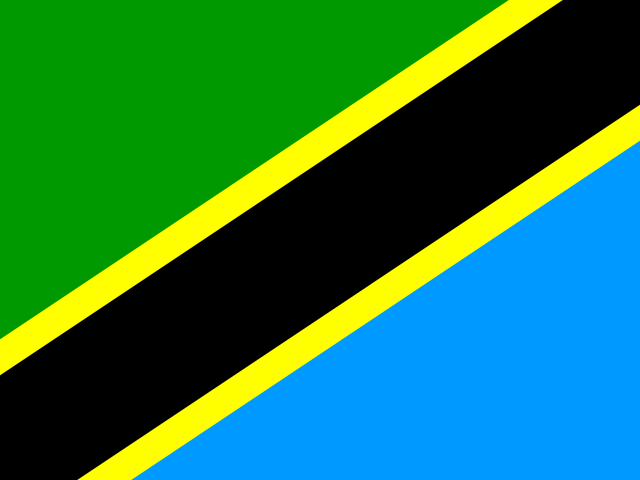
Cook one of the recipes, print the large-print pack about Tanzania, and finish with the big-screen quiz or the words crossword. Grandchildren can colour the flag.