Trypillia farmers
Around 4000 BC, farmers of the Trypillia culture were living between the Carpathians and the Dnipro. Some of their villages held thousands of houses and were among the largest settlements in Europe at the time.
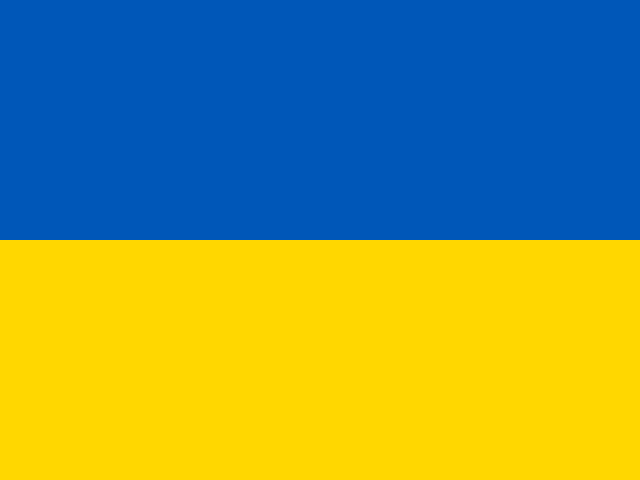
Ukraine is the second-largest country in Europe after Russia, and the largest that lies entirely within Europe. Most of it is a vast plain of steppe and farmland on rich black soil, crossed by rivers such as the Dnipro, the Dniester and the Southern Bug, which flow south to the Black Sea. In the south-east, smaller rivers flow into the Sea of Azov. Its only mountains are the Carpathians in the west and the Crimean Mountains in the far south.
Kyiv was the capital of Kyivan Rus', a great medieval state, and its oldest churches date back a thousand years. Over the following centuries the land was divided among Lithuania, Poland, the Ottoman Empire, the Russian Empire and the Habsburgs, and in the 17th century Cossacks built their own state here. In the 20th century Ukraine was part of the Soviet Union, and it became independent in 1991.
Memories fade faster than photos. Ask these over a meal or a phone call, and write the answers down.
Ukraine's story runs from some of Europe's largest prehistoric villages, through the golden age of Kyiv and the Cossack state, to the hard years of the 20th century, independence in 1991 and a war that is still going on.
Around 4000 BC, farmers of the Trypillia culture were living between the Carpathians and the Dnipro. Some of their villages held thousands of houses and were among the largest settlements in Europe at the time.
Prince Volodymyr the Great was baptised, and by tradition the people of Kyiv were baptised in the river in 988, although historians debate the exact year. Christianity from Byzantium shaped the art, churches and writing of Rus'.
The Cossack leader Bohdan Khmelnytsky led a great uprising against the Polish-Lithuanian Commonwealth. Out of it grew the Cossack Hetmanate, a Cossack state in central Ukraine.
Taras Shevchenko, a poet and painter born into a family of serfs, published his book of poems Kobzar, 'The Bard'. Shevchenko himself became known as the Kobzar, and the book became a symbol of the Ukrainian national and literary revival.
Germany invaded the Soviet Union in 1941 and occupied Ukraine. Great battles and atrocities followed, and millions of civilians in Ukraine were killed, including most of Ukraine's Jews. At Babyn Yar in Kyiv, tens of thousands of Jews were murdered in September 1941.
On 24 August 1991 the Ukrainian parliament declared independence as the Soviet Union fell apart. On 1 December 1991 more than 92% of voters approved it in a referendum.
After a disputed presidential election, huge peaceful protests filled Kyiv, with orange as their colour. The Supreme Court ordered the vote to be repeated, and the opposition candidate Viktor Yushchenko won.
On 24 February 2022 Russia launched a full-scale invasion of Ukraine. Kyiv was not taken, and Ukraine won back large areas later that year. As of September 2026 the war continues, and Ukraine is a candidate for membership of the European Union.
Cook one of the recipes, print the large-print pack about Ukraine, and finish with the big-screen quiz or the words crossword. Grandchildren can colour the flag.