Alexander the Great takes Samarkand
In 329 BC Alexander the Great conquered Sogdiana, the land around Samarkand, which the Greeks called Marakanda. The local people resisted fiercely, and his army was held up in the region for a long time.
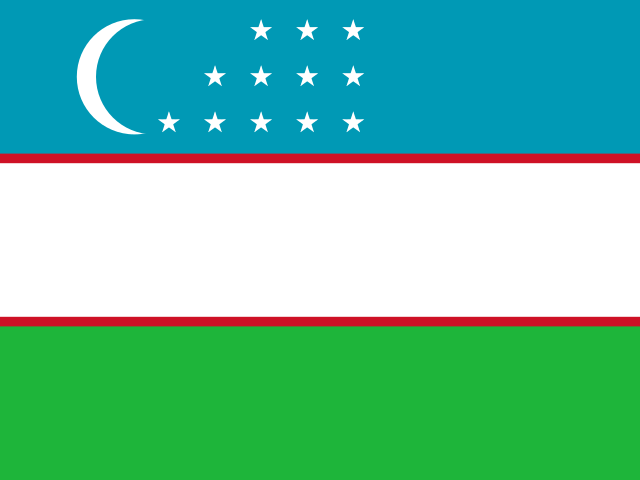
Uzbekistan lies in the heart of Central Asia, between two great rivers, the Amu Darya and the Syr Darya. Much of the west is the Kyzylkum Desert and the dry bed of the old Aral Sea, while the east rises into the foothills of the Tian Shan and Pamir-Alay mountains. The richest farmland lies in the green Fergana Valley in the east. Uzbekistan is doubly landlocked: it is surrounded only by countries that are themselves landlocked, so reaching an ocean means crossing at least two borders.
For more than two thousand years caravans on the Silk Road passed through the oasis cities of Samarkand, Bukhara and Khiva. Alexander the Great, the Arab caliphs, Genghis Khan and Timur all left their mark here, and great scholars such as Ibn Sina (Avicenna) and the astronomer Ulugh Beg lived and worked in these cities. In the 1800s the region fell under Russian rule, and from 1924 it was a Soviet republic. Uzbekistan became independent in 1991.
Memories fade faster than photos. Ask these over a meal or a phone call, and write the answers down.
The land that is now Uzbekistan has been a crossroads for thousands of years. Persian, Greek, Arab, Turkic and Mongol rulers came and went, and the Silk Road made its oasis cities rich and famous for learning. Under Timur and his descendants, Samarkand became one of the great cities of the world. Russia conquered the region in the 1800s, the Soviet Union created the Uzbek republic in 1924, and Uzbekistan became independent in 1991.
In 329 BC Alexander the Great conquered Sogdiana, the land around Samarkand, which the Greeks called Marakanda. The local people resisted fiercely, and his army was held up in the region for a long time.
In 1220 the Mongol armies of Genghis Khan captured Bukhara and then Samarkand, destroying much of both cities and killing many of their people. It was part of the Mongol conquest of the Khwarazmian Empire, which ruled the region at the time.
Timur died in February 1405 while leading an army toward China. The mountain passes to his home town of Shahrisabz were blocked by snow, so he was buried in the Gur-e-Amir mausoleum in Samarkand, which later became the family tomb of his dynasty.
Babur, a descendant of Timur, was born in Andijan in the Fergana Valley on 14 February 1483. After losing Samarkand several times to the Uzbek Shaybanid rulers, he turned south, conquered Kabul and then northern India, where in 1526 he founded the Mughal Empire.
On 27 October 1924 the Soviet authorities redrew the borders of Central Asia along national lines and created the Uzbek Soviet Socialist Republic. It remained part of the Soviet Union for the next 67 years.
Early on 26 April 1966 a shallow earthquake struck right under the centre of Tashkent. Most buildings were damaged or destroyed and hundreds of thousands of people lost their homes. The city was rebuilt in a modern Soviet style with wide avenues and large public buildings.
On 31 August 1991, as the Soviet Union was breaking up, Uzbekistan declared independence. Independence Day is celebrated on 1 September. The country joined the United Nations in March 1992.
In June 2025 a goalless draw away against the United Arab Emirates sent Uzbekistan's football team, the White Wolves, to the FIFA World Cup for the first time. They became the first Central Asian country ever to qualify, and played at the 2026 tournament in North America.
Cook one of the recipes, print the large-print pack about Uzbekistan, and finish with the big-screen quiz or the words crossword. Grandchildren can colour the flag.