Cyprus trivia: 46 questions and answers
The country at a glance
What is the capital of Cyprus?
- A. Nicosia
- B. Limassol
- C. Larnaca
- D. Paphos
Show the answer
Nicosia. Nicosia is the capital and largest city. It has been the island's capital since the 10th century.
Which two languages are the official languages of Cyprus?
- A. Greek and Turkish
- B. Greek and English
- C. Greek and Italian
- D. Turkish and Arabic
Show the answer
Greek and Turkish. Greek and Turkish are both official. English is widely spoken and seen on road signs, but it has no official status.
Cyprus is the largest island in the Mediterranean Sea.
True or false?
Show the answer
False. False. Cyprus is the third-largest, after Sicily and Sardinia.
What is the highest mountain in Cyprus?
- A. Mount Olympus (Chionistra)
- B. Mount Etna
- C. Mount Athos
- D. Mount Ararat
Show the answer
Mount Olympus (Chionistra). Mount Olympus (Chionistra), 1,952 m, rises in the Troodos Mountains. It shares its name with the higher Mount Olympus in Greece.
In Cyprus, cars drive on the left side of the road.
True or false?
Show the answer
True. True. Driving on the left is a habit left over from British rule.
History
Which English king captured Cyprus in 1191 on his way to the Third Crusade?
- A. Richard I, the Lionheart
- B. Henry VIII
- C. Edward I
- D. Alfred the Great
Show the answer
Richard I, the Lionheart. Richard I, the Lionheart, captured the island in 1191 and married Berengaria of Navarre in Limassol the same year.
Which Italian republic ruled Cyprus from 1489 until the Ottoman conquest?
- A. Venice
- B. Florence
- C. Pisa
- D. San Marino
Show the answer
Venice. Venice took over in 1489, when Queen Catherine Cornaro gave up the throne, and built the walls that still ring old Nicosia.
Cyprus became an independent republic in 1960.
True or false?
Show the answer
True. True. Cyprus became independent on 16 August 1960, after more than 80 years of British rule.
Which organisation has kept a peacekeeping force in Cyprus since 1964?
- A. The United Nations
- B. NATO
- C. The Red Cross
- D. The Olympic Committee
Show the answer
The United Nations. The United Nations set up UNFICYP in 1964, and it is one of the longest-running UN peacekeeping missions.
In which year did Cyprus join the European Union?
- A. 1981
- B. 1995
- C. 2004
- D. 2013
Show the answer
2004. Cyprus joined the EU on 1 May 2004, together with nine other countries.
On 1 January 2008 the euro replaced the Cypriot pound.
True or false?
Show the answer
True. True. Cyprus has used the euro since 1 January 2008.
Greek and Turkish Cypriots have been free to cross the dividing line since 1975.
True or false?
Show the answer
False. False. Ordinary Cypriots could not cross freely until April 2003, almost 30 years after the island was divided.
Food and drink
Which Cypriot cheese is usually grilled, keeps its shape in the pan and squeaks against your teeth?
- A. Halloumi
- B. Mozzarella
- C. Camembert
- D. Ricotta
Show the answer
Halloumi. Halloumi has a high melting point, so it can be grilled or fried until golden without melting.
What is wrapped around sheftalia instead of a sausage casing?
- A. Caul fat
- B. Vine leaves
- C. Filo pastry
- D. Cabbage leaves
Show the answer
Caul fat. Caul fat, the thin lacy membrane around a pig's or lamb's stomach, holds the minced meat together while it grills.
Afelia is pork cooked in red wine with which crushed spice?
- A. Coriander seeds
- B. Saffron
- C. Vanilla
- D. Star anise
Show the answer
Coriander seeds. Coarsely crushed coriander seeds give afelia its warm, citrusy flavour.
For which holiday are flaounes, the cheese-filled pastries, traditionally baked?
- A. Easter
- B. Christmas
- C. New Year
- D. Halloween
Show the answer
Easter. Easter. Families bake flaounes together before Easter and eat them once the Lenten fast is over.
Commandaria is a sweet dessert wine made from sun-dried grapes.
True or false?
Show the answer
True. True. It is made from sun-dried Xynisteri and Mavro grapes in villages north of Limassol.
What is zivania?
- A. A strong spirit distilled from grape pomace
- B. A sweet almond syrup
- C. A salty yoghurt drink
- D. A rose-flavoured pudding
Show the answer
A strong spirit distilled from grape pomace. Zivania is a strong spirit distilled from grape pomace and local wine, usually around 45% alcohol.
Souvla is grilled in just a few minutes over a very hot flame.
True or false?
Show the answer
False. False. The large chunks of meat turn slowly on long skewers over charcoal for one and a half to three hours.
Halloumi has protected designation of origin status in the European Union as a cheese of Cyprus.
True or false?
Show the answer
True. True. Within the EU, cheese sold as halloumi must be made in Cyprus.
Cities
Which city was built on the ruins of ancient Kition, birthplace of the philosopher Zeno?
- A. Larnaca
- B. Limassol
- C. Paphos
- D. Nicosia
Show the answer
Larnaca. Larnaca stands on the site of Kition, where Zeno, the founder of Stoic philosophy, was born.
Which village is famous for its hand-stitched lace, listed by UNESCO in 2009?
- A. Lefkara
- B. Platres
- C. Kakopetria
- D. Polis
Show the answer
Lefkara. Lefkara lace, or lefkaritika, has been made in Lefkara for centuries and is on UNESCO's intangible heritage list.
Paphos was a European Capital of Culture in 2017.
True or false?
Show the answer
True. True. Paphos shared the title of European Capital of Culture in 2017.
Which Troodos hill resort is linked by local story to the first Cypriot brandy sour?
- A. Platres
- B. Ayia Napa
- C. Larnaca
- D. Polis
Show the answer
Platres. Platres. The story says the drink was first mixed at a hotel there in the 1930s.
Landmarks
The Tombs of the Kings in Paphos are part of a UNESCO World Heritage Site.
True or false?
Show the answer
True. True. They were listed in 1980 together with the rest of ancient Paphos.
According to Greek myth, which goddess rose from the sea foam at Petra tou Romiou?
- A. Aphrodite
- B. Athena
- C. Hera
- D. Artemis
Show the answer
Aphrodite. Aphrodite, the goddess of love, is said to have been born from the sea foam at this rock, also called Aphrodite's Rock.
Which order of knights built the present tower of Kolossi Castle in 1454?
- A. The Knights Hospitaller
- B. The Teutonic Knights
- C. The Knights of the Garter
- D. The Knights of Santiago
Show the answer
The Knights Hospitaller. The Knights Hospitaller built the present keep in 1454 to guard their estate near Limassol.
In Orthodox tradition, who became the first bishop of Kition and was buried in Larnaca?
- A. Lazarus
- B. Saint George
- C. Saint Nicholas
- D. Saint Patrick
Show the answer
Lazarus. Lazarus, whom Jesus raised from the dead, is said to have lived in Cyprus for thirty more years. His church in Larnaca was built over the tomb believed to be his.
Choirokoitia is the site of a Stone Age village founded around 7000 BC.
True or false?
Show the answer
True. True. Its round stone houses and protective wall make it one of the best-preserved prehistoric sites in the eastern Mediterranean.
Which pink birds gather on Larnaca Salt Lake, beside Hala Sultan Tekke, in winter?
- A. Flamingos
- B. Penguins
- C. Puffins
- D. Ostriches
Show the answer
Flamingos. Flamingos, thousands of them, spend the winter on the salt lake feeding on tiny brine shrimp.
The Church of St Nicholas of the Roof near Kakopetria is a Gothic cathedral built by the Venetians.
True or false?
Show the answer
False. False. It is an 11th-century Byzantine monastery church with painted walls, one of the Painted Churches in the Troodos Region on the UNESCO list.
Fun facts
Which metal's name goes back to the name of Cyprus?
- A. Copper
- B. Tin
- C. Silver
- D. Iron
Show the answer
Copper. Copper. The Romans called it 'aes Cyprium', 'metal of Cyprus', later shortened to 'cuprum'.
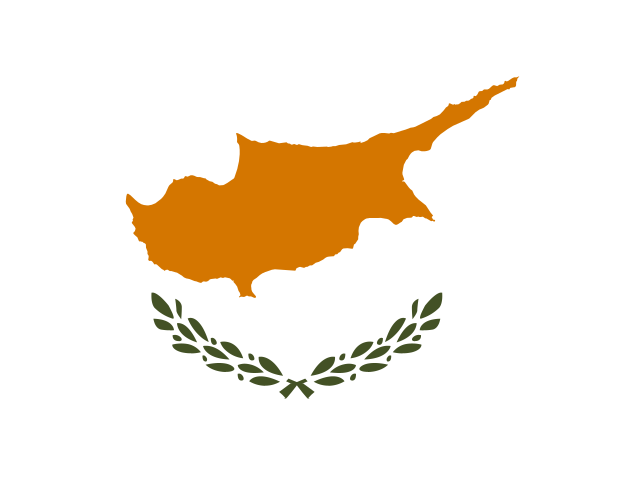
What does the flag of Cyprus show above two olive branches?
- A. The outline of the island
- B. A white cross
- C. A crescent moon
- D. A golden lion
Show the answer
The outline of the island. The outline of the island, in a copper colour, sits on a white field above two olive branches for peace.
The Republic of Cyprus uses the same national anthem as Greece.
True or false?
Show the answer
True. True. Both countries use the 'Hymn to Liberty'; Cyprus adopted it in 1966.
Which animal is the national animal of Cyprus?
- A. The Cyprus mouflon, a wild sheep
- B. The brown bear
- C. The grey wolf
- D. The reindeer
Show the answer
The Cyprus mouflon, a wild sheep. The Cyprus mouflon, a wild sheep, lives in the forests of the Paphos mountains and appears on Cypriot 1, 2 and 5 cent coins.
As of 2026, Cyprus has no working railway.
True or false?
Show the answer
True. True. The only line, the Cyprus Government Railway, ran from 1905 to 1951.
Words
What does the Greek word 'nai' mean?
- A. Yes
- B. No
- C. Thank you
- D. Hello
Show the answer
Yes. 'Nai' means yes, even though to English ears it sounds a little like 'nay'.
What does the Greek word 'neró' mean?
- A. Water
- B. Wine
- C. Bread
- D. Sea
Show the answer
Water. 'Neró' means water. Wine is 'krasí' and bread is 'psomí'.
The Greek word 'óchi' means 'yes'.
True or false?
Show the answer
False. False. 'Óchi' means no; 'nai' means yes.
Phrases
What does 'Kaliméra' mean?
- A. Good morning
- B. Good night
- C. Thank you
- D. Cheers
Show the answer
Good morning. 'Kaliméra' means good morning. In the evening you say 'Kalispéra'.
What do Cypriots say when they raise a glass?
- A. Stin ygeiá mas!
- B. Kaliméra
- C. Signómi
- D. Voítheia!
Show the answer
Stin ygeiá mas!. 'Stin ygeiá mas!' means 'to our health', the Greek way of saying cheers.
In Greek, 'Geia sas' can be used to say both hello and goodbye.
True or false?
Show the answer
True. True. 'Geia sas' is the polite greeting for arriving and for leaving.
Local customs and tips
What kind of electric sockets does Cyprus use?
- A. British three-pin (Type G)
- B. American two flat pins (Type A)
- C. Australian slanted pins (Type I)
- D. Swiss three round pins (Type J)
Show the answer
British three-pin (Type G). Cyprus uses British three-pin (Type G) sockets at 230 volts, another reminder of British rule.
Which emergency number, used across the European Union, reaches police, ambulance and fire in Cyprus?
- A. 112
- B. 000
- C. 110
- D. 119
Show the answer
112. 112 is the EU-wide emergency number. In Cyprus the local number 199 also works.
Greek Cypriots follow the Orthodox calendar, so their Easter usually falls on a different date from Western Easter.
True or false?
Show the answer
True. True. Orthodox Easter is calculated with the older Julian calendar, so it often falls later than Western Easter.
In Cyprus, drivers are allowed to drink a bottle of water while driving.
True or false?
Show the answer
False. False. Eating or drinking anything, even water, while driving is against the law in Cyprus.
Trivia from nearby countries
Answer key
The country at a glance
- A. Nicosia
- A. Greek and Turkish
- False
- A. Mount Olympus (Chionistra)
- True
History
- A. Richard I, the Lionheart
- A. Venice
- True
- A. The United Nations
- C. 2004
- True
- False
Food and drink
- A. Halloumi
- A. Caul fat
- A. Coriander seeds
- A. Easter
- True
- A. A strong spirit distilled from grape pomace
- False
- True
Cities
- A. Larnaca
- A. Lefkara
- True
- A. Platres
Landmarks
- True
- A. Aphrodite
- A. The Knights Hospitaller
- A. Lazarus
- True
- A. Flamingos
- False
Fun facts
- A. Copper
- A. The outline of the island
- True
- A. The Cyprus mouflon, a wild sheep
- True
Words
- A. Yes
- A. Water
- False
Phrases
- A. Good morning
- A. Stin ygeiá mas!
- True
Local customs and tips
- A. British three-pin (Type G)
- A. 112
- True
- False
More about Cyprus
- The trip to CyprusMap, story, food, phrases and a friendly quiz.
- Fun facts about CyprusSurprising facts, each one checked with a source.
- Cypriot foodThe dishes to try, with photos and recipes.
- Cyprus word searchCities and dishes in large print.
- Cypriot words crosswordLearn a few words while you solve it.
- Colour the flag of CyprusPrint it or colour it in on the screen.
- Cypriot rootsA family guide: history, recipes and words for the grandchildren.
- Before you goPhrases, customs and tips for travellers.
- Printable packLarge print, with a quiz and answers.