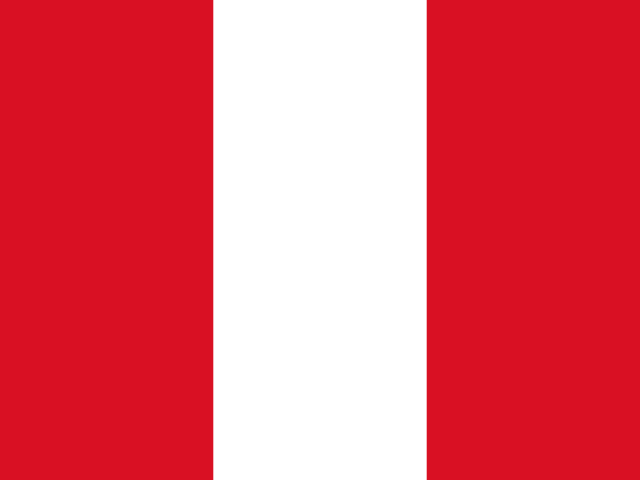
Peru trivia: 48 questions and answers
The country at a glance
Which of these countries does NOT share a border with Peru?
- A. Argentina
- B. Bolivia
- C. Chile
- D. Ecuador
Show the answer
Argentina. Argentina does not border Peru. Peru's neighbours are Ecuador, Colombia, Brazil, Bolivia and Chile.
Under Peru's constitution, Quechua is an official language in the areas where it predominates.
True or false?
Show the answer
True. True. The 1993 constitution makes Spanish official, and also Quechua, Aymara and other Indigenous languages in the areas where they predominate.
History
Caral, one of the oldest cities in the Americas, was built more than 4,500 years ago in which valley north of Lima?
- A. The Supe Valley
- B. The Sacred Valley
- C. The Colca Valley
- D. The Mantaro Valley
Show the answer
The Supe Valley. Caral lies in the Supe Valley, about 180 km north of Lima. The Sacred Valley is near Cusco, the Colca Valley near Arequipa and the Mantaro Valley in the central Andes.
In 1532, in which town did Francisco Pizarro capture the Inca emperor Atahualpa?
- A. Cajamarca
- B. Cusco
- C. Lima
- D. Quito
Show the answer
Cajamarca. Pizarro ambushed Atahualpa in the town square of Cajamarca on 16 November 1532. Lima did not exist yet: Pizarro founded it in 1535.
Who commanded the independence army that won the Battle of Ayacucho in 1824?
- A. Antonio José de Sucre
- B. José de San Martín
- C. Bernardo O'Higgins
- D. Túpac Amaru II
Show the answer
Antonio José de Sucre. Antonio José de Sucre, a general of Simón Bolívar, led the independence forces at Ayacucho. San Martín had declared independence in 1821 and had already left Peru, and Túpac Amaru II died in 1781.
Peru's national holiday, Fiestas Patrias, is celebrated on 28 and 29 July.
True or false?
Show the answer
True. True. It remembers 28 July 1821, when José de San Martín declared Peru's independence in Lima.
In the War of the Pacific, from 1879 to 1884, Peru and Bolivia fought together against Chile.
True or false?
Show the answer
True. True. Chile fought an alliance of Peru and Bolivia. Peru lost the province of Tarapacá, and Bolivia lost its coast.
Pope Leo XIV was born in Peru.
True or false?
Show the answer
False. False. He was born in Chicago. He spent many years in Peru as a missionary, was Bishop of Chiclayo and became a Peruvian citizen, so he is the first pope who is a citizen of Peru.
Food and drink
In classic Peruvian ceviche, raw fish is marinated in the juice of which fruit?
- A. Lime
- B. Apple
- C. Pineapple
- D. Grape
Show the answer
Lime. Ceviche is marinated in fresh lime juice. The acid turns the fish white and firm, but it does not kill germs the way cooking does.
What do Peruvians call the leftover ceviche marinade, often served in a small glass?
- A. Leche de tigre
- B. Chicha morada
- C. Mazamorra
- D. Inca Kola
Show the answer
Leche de tigre. It is called leche de tigre, tiger's milk. Chicha morada is a purple corn drink, mazamorra a pudding and Inca Kola a soft drink.
Lomo saltado, beef stir-fried with onion, tomato and chips, comes from which cooking tradition?
- A. Chinese-Peruvian (chifa)
- B. Japanese-Peruvian (Nikkei)
- C. Italian-Peruvian
- D. Afro-Peruvian
Show the answer
Chinese-Peruvian (chifa). Lomo saltado comes from Chinese-Peruvian (chifa) cooking: it is stir-fried in a wok with soy sauce and served with rice.
Papa a la huancaína, potatoes in a creamy cheese and chilli sauce, is named after which city?
- A. Huancayo
- B. Huánuco
- C. Huaraz
- D. Huancavelica
Show the answer
Huancayo. Huancaína means 'from Huancayo', a city in the central Andes. The best-known story links the dish to the railway between Lima and Huancayo.
Chicha morada gets its deep purple colour from what?
- A. Purple corn
- B. Beetroot
- C. Blueberries
- D. Purple potatoes
Show the answer
Purple corn. Chicha morada is made by boiling purple corn with pineapple peel, quince, cinnamon and cloves.
Which of these goes into a Peruvian pisco sour?
- A. Egg white
- B. Milk
- C. Coffee
- D. Tomato juice
Show the answer
Egg white. A Peruvian pisco sour is shaken with lime juice, sugar syrup, ice and egg white, and topped with bitters. The egg is raw, so pregnant women, older people and anyone with a weak immune system should ask for it without egg or with pasteurised egg white.
Cuy, a traditional dish of the Andes, is roast or fried guinea pig.
True or false?
Show the answer
True. True. Guinea pigs were first raised for food in the Andes thousands of years ago, and cuy is still a dish for festivals and family celebrations.
In Peru, supper in the evening is usually the main meal of the day.
True or false?
Show the answer
False. False. Lunch, el almuerzo, is the main meal. Many small restaurants serve a cheap set lunch called the menú, and supper is lighter.
Cities
How do you get to Iquitos, the largest city of the Peruvian Amazon?
- A. By plane or boat
- B. By motorway from Lima
- C. By train from Cusco
- D. By bus across the Andes
Show the answer
By plane or boat. Only by plane or boat. Iquitos is the largest city in the world that is not on an island and cannot be reached by road.
Peru's constitution names Cusco as the historical capital of Peru.
True or false?
Show the answer
True. True. Lima is the capital, but the 1993 constitution calls Cusco, the old Inca capital, the historical capital of Peru.
Landmarks
Which civilisation built Machu Picchu?
- A. The Incas
- B. The Moche
- C. The Nazca
- D. The Chimú
Show the answer
The Incas. Machu Picchu was built by the Incas around 1450, probably as a royal estate for Pachacuti. The Moche, Nazca and Chimú lived on the coast, much earlier or far away.
Which small town, reached only by train or on foot, lies in the valley just below Machu Picchu?
- A. Aguas Calientes
- B. Ollantaytambo
- C. Puno
- D. Chivay
Show the answer
Aguas Calientes. Aguas Calientes, officially Machupicchu Pueblo, is about 6 km from the ruins. Ollantaytambo is where many trains start, Puno is on Lake Titicaca and Chivay is in the Colca Canyon.
Nobody in Peru knew about Machu Picchu before Hiram Bingham arrived in 1911.
True or false?
Show the answer
False. False. Local farmers knew the site and led Bingham there, and a Peruvian explorer, Agustín Lizárraga, had written his name on a wall in 1902. Bingham made it famous around the world.
How were the Nazca Lines made?
- A. By removing the dark stones on the desert surface
- B. By painting the ground with white chalk
- C. By piling up rows of large boulders
- D. By burning lines into desert grass
Show the answer
By removing the dark stones on the desert surface. They were made by removing the dark stones on the desert surface, which uncovered the lighter ground beneath. The very dry desert climate has kept them for up to 2,500 years.
What are the floating islands of the Uros on Lake Titicaca made of?
- A. Totora reeds
- B. Pumice stone
- C. Bamboo
- D. Floating tree trunks
Show the answer
Totora reeds. The islands are built from bundles of totora reeds laid over floating blocks of reed roots. The Uros make their boats from the same reeds.
Chan Chan, the great adobe city near Trujillo, was the capital of which people?
- A. The Chimú
- B. The Incas
- C. The Nazca
- D. The Aymara
Show the answer
The Chimú. Chan Chan was the capital of the Chimú kingdom, built from around AD 850. The Incas conquered the Chimú around 1470.
Which Spanish building was built on top of Qorikancha, the Incas' great sun temple in Cusco?
- A. The Convent of Santo Domingo
- B. The Santa Catalina Monastery
- C. The Government Palace
- D. The Royal Tombs of Sipán Museum
Show the answer
The Convent of Santo Domingo. The Church and the Convent of Santo Domingo stand on Qorikancha's Inca walls. The Santa Catalina Monastery is in Arequipa, the Government Palace in Lima and the Sipán museum near Chiclayo.
The Santa Catalina Monastery in Arequipa was closed to outsiders until 1970.
True or false?
Show the answer
True. True. For almost four centuries the nuns lived hidden from the city. In 1970 a large part of the monastery opened to visitors.
Fun facts
Paddington Bear, the bear who loves marmalade, comes from which country?
- A. Peru
- B. Bolivia
- C. Chile
- D. Brazil
Show the answer
Peru. Paddington comes from 'darkest Peru', home of the real spectacled bear.
The potato was first domesticated by farmers around which lake?
- A. Lake Titicaca
- B. Lake Victoria
- C. Lake Superior
- D. Lake Maracaibo
Show the answer
Lake Titicaca. Potatoes were first grown around Lake Titicaca, in today's southern Peru and northwestern Bolivia, about 7,000 to 10,000 years ago.
Which of these English words comes from Quechua, the language of the Incas?
- A. Jerky
- B. Barbecue
- C. Tomato
- D. Chocolate
Show the answer
Jerky. Jerky comes from the Quechua ch'arki, dried salted meat. Barbecue comes from the Caribbean, and tomato and chocolate from Nahuatl, the language of the Aztecs.
Huascarán, Peru's highest mountain, is also the highest point in which part of the world?
- A. The Earth's tropics
- B. South America
- C. The Southern Hemisphere
- D. The Americas
Show the answer
The Earth's tropics. At 6,768 m, Huascarán is the highest point in the Earth's tropics. The highest mountain in South America, the Americas and the Southern Hemisphere is Aconcagua in Argentina.
What was a quipu, used by the Incas?
- A. Knotted cords for keeping records
- B. A reed boat
- C. A woollen poncho
- D. A stone calendar
Show the answer
Knotted cords for keeping records. Quipus were bundles of coloured, knotted cords for keeping records such as taxes and population counts. The knots stood for numbers in a decimal system.
Which animal is Peru's national animal and appears on its coat of arms?
- A. The vicuña
- B. The jaguar
- C. The Andean condor
- D. The spectacled bear
Show the answer
The vicuña. The vicuña, a wild relative of the llama with very fine wool, is Peru's national animal and stands on its coat of arms.
Lake Titicaca lies entirely inside Peru.
True or false?
Show the answer
False. False. Peru shares the lake with Bolivia: the western part is in Peru's Puno region and the eastern part in Bolivia.
Inca Kola, Peru's bright yellow soft drink, is flavoured with lemon verbena.
True or false?
Show the answer
True. True. Its main flavouring is lemon verbena. It was created in Peru in 1935 by a British immigrant, Joseph Robinson Lindley.
Words
In Peru, what is a 'palta'?
- A. An avocado
- B. A potato
- C. A bread roll
- D. A spoon
Show the answer
An avocado. Palta is an avocado. The word comes from Quechua. In Mexico and Spain it is called aguacate.
With ceviche you often get a small bowl of 'cancha'. What is it?
- A. Toasted corn kernels
- B. Fried plantain
- C. Seaweed
- D. Sliced bread
Show the answer
Toasted corn kernels. Cancha is toasted corn kernels, a crunchy snack served with ceviche, sweet potato and corn on the cob.
Peru's currency is the sol. What does 'sol' mean in Spanish?
- A. Sun
- B. Salt
- C. Silver
- D. Gold
Show the answer
Sun. Sol means sun, a link to Inti, the sun god of the Incas, who gave his name to Peru's previous currency, the inti.
In Peru, 'papa' is the everyday word for potato.
True or false?
Show the answer
True. True. In Peru and the rest of Latin America a potato is a papa. In most of Spain it is called a patata.
Phrases
You pass a table of people eating. Which phrase wishes them an enjoyable meal?
- A. ¡Buen provecho!
- B. ¡Salud!
- C. Mucho gusto
- D. Con permiso
Show the answer
¡Buen provecho!. ¡Buen provecho! means 'enjoy your meal'. ¡Salud! is 'cheers', mucho gusto is 'nice to meet you' and con permiso is 'excuse me, may I pass?'.
What are you asking if you point at a sauce and say '¿Pica?'
- A. Is it spicy?
- B. Is it fresh?
- C. Is it free?
- D. Is it far?
Show the answer
Is it spicy?. ¿Pica? means 'Is it spicy?'. A useful question in Peru, where rocoto sauce can be very hot.
You do not want your food spicy. What do you say to the waiter?
- A. Sin ají, por favor
- B. La cuenta, por favor
- C. ¿Habla inglés?
- D. Con permiso
Show the answer
Sin ají, por favor. Sin ají, por favor means 'without chilli, please'. La cuenta, por favor asks for the bill.
'Buenas noches' is the usual greeting when you meet someone at 10 in the morning.
True or false?
Show the answer
False. False. In the morning you say 'Buenos días'. 'Buenas noches' is for after dark or for saying goodnight.
Local customs and tips
About how high above sea level is Cusco?
- A. About 400 m
- B. About 1,400 m
- C. About 3,400 m
- D. About 6,400 m
Show the answer
About 3,400 m. Cusco is about 3,400 m above sea level, so altitude sickness is a real risk. Rest on your first day and walk slowly.
What must you bring to the entrance of Machu Picchu?
- A. The passport you used to buy the ticket
- B. A printed hotel booking
- C. A letter from your doctor
- D. Your plane ticket
Show the answer
The passport you used to buy the ticket. Bring the passport you used to buy the ticket: Machu Picchu tickets are linked to it and checked at the gate.
For good service in a Peruvian restaurant, what is a normal tip?
- A. About 10 percent
- B. About 30 percent
- C. About half the bill
- D. About 1 percent
Show the answer
About 10 percent. About 10 percent is welcome for good service. Check the bill first, because some upscale restaurants already add a service charge.
The classic Inca Trail to Machu Picchu is closed each February for cleaning.
True or false?
Show the answer
True. True. It closes in February for cleaning. The rest of the year, permits are limited and often sell out months ahead.
Travel advice recommends hailing taxis in the street in Lima.
True or false?
Show the answer
False. False. UK travel advice says not to hail taxis in the street. Use the official desks at the airport, a licensed taxi company by phone or app, or ask your hotel to call one.
Coca tea is legal in Peru, but you should not take coca tea bags home to the United States.
True or false?
Show the answer
True. True. Coca tea is legal in Peru and is often offered against altitude sickness, but it is illegal in the United States unless the cocaine has been removed.
Answer key
The country at a glance
- A. Argentina
- True
History
- A. The Supe Valley
- A. Cajamarca
- A. Antonio José de Sucre
- True
- True
- False
Food and drink
- A. Lime
- A. Leche de tigre
- A. Chinese-Peruvian (chifa)
- A. Huancayo
- A. Purple corn
- A. Egg white
- True
- False
Cities
- A. By plane or boat
- True
Landmarks
- A. The Incas
- A. Aguas Calientes
- False
- A. By removing the dark stones on the desert surface
- A. Totora reeds
- A. The Chimú
- A. The Convent of Santo Domingo
- True
Fun facts
- A. Peru
- A. Lake Titicaca
- A. Jerky
- A. The Earth's tropics
- A. Knotted cords for keeping records
- A. The vicuña
- False
- True
Words
- A. An avocado
- A. Toasted corn kernels
- A. Sun
- True
Phrases
- A. ¡Buen provecho!
- A. Is it spicy?
- A. Sin ají, por favor
- False
Local customs and tips
- C. About 3,400 m
- A. The passport you used to buy the ticket
- A. About 10 percent
- True
- False
- True
More about Peru
- The trip to PeruMap, story, food, phrases and a friendly quiz.
- Peru word searchCities and dishes in large print.
- Peruvian words crosswordLearn a few words while you solve it.
- Colour the flag of PeruPrint it or colour it in on the screen.
- Peruvian rootsA family guide: history, recipes and words for the grandchildren.
- Before you goPhrases, customs and tips for travellers.
- Printable packLarge print, with a quiz and answers.