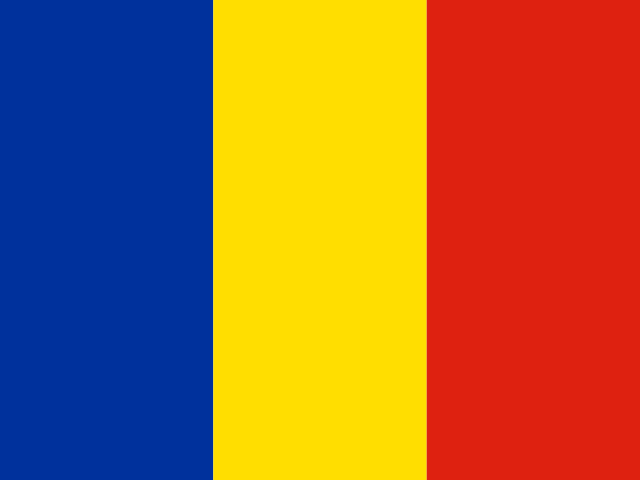
Romania trivia: 46 questions and answers
The country at a glance
What is the capital of Romania?
- A. Bucharest
- B. Cluj-Napoca
- C. Iași
- D. Timișoara
Show the answer
Bucharest. Bucharest is the capital and by far the largest city, on the Dâmbovița river in the south-east.
As of September 2026, what is the currency of Romania?
- A. The Romanian leu
- B. The euro
- C. The Hungarian forint
- D. The Serbian dinar
Show the answer
The Romanian leu. The Romanian leu (plural lei) is the currency. Romania is in the EU but has not adopted the euro.
Romania joined the European Union in 2007.
True or false?
Show the answer
True. True. Romania joined the EU on 1 January 2007, together with Bulgaria.
Which is the highest mountain in Romania?
- A. Moldoveanu Peak
- B. Mont Blanc
- C. Musala
- D. Mount Olympus
Show the answer
Moldoveanu Peak. Moldoveanu Peak, about 2,544 m, rises in the Făgăraș Mountains of the Southern Carpathians.
History
Which Roman emperor conquered Dacia in 106?
- A. Trajan
- B. Augustus
- C. Nero
- D. Constantine
Show the answer
Trajan. Trajan defeated the Dacian king Decebalus in 106 and made much of Dacia a Roman province.
In which city did the revolution of December 1989 begin?
- A. Timișoara
- B. Constanța
- C. Iași
- D. Craiova
Show the answer
Timișoara. The protests began in Timișoara and spread across the country within days.
Which prince briefly ruled Wallachia, Transylvania and Moldavia together in 1600?
- A. Michael the Brave
- B. Stephen the Great
- C. Alexandru Ioan Cuza
- D. Carol I
Show the answer
Michael the Brave. Michael the Brave, prince of Wallachia, was the first ruler to hold all three lands, if only for a few months.
In 1859 both Moldavia and Wallachia elected the same prince. Who was he?
- A. Alexandru Ioan Cuza
- B. Carol I
- C. Basarab I
- D. Michael I
Show the answer
Alexandru Ioan Cuza. Alexandru Ioan Cuza was elected in both principalities in 1859, the start of the modern Romanian state.
Romania proclaimed its independence from the Ottoman Empire in 1877.
True or false?
Show the answer
True. True. Independence was proclaimed on 10 May 1877 and won in the Russo-Turkish War that followed.
Romania joined NATO and the European Union in the same year.
True or false?
Show the answer
False. False. Romania joined NATO in 2004 and the European Union in 2007.
Romania's national day, Great Union Day, is 1 December.
True or false?
Show the answer
True. True. It marks the union of Transylvania with Romania, declared at Alba Iulia on 1 December 1918.
Food and drink
What are sarmale?
- A. Cabbage leaves rolled around minced meat and rice
- B. Grilled rolls of minced meat
- C. Cheese doughnuts with jam
- D. A spread of roasted aubergine and peppers
Show the answer
Cabbage leaves rolled around minced meat and rice. Sarmale are cabbage leaves rolled around minced meat and rice and simmered for hours, often called the national dish.
Mămăligă is a thick porridge made from which flour?
- A. Maize (corn) flour
- B. Wheat flour
- C. Rice flour
- D. Chickpea flour
Show the answer
Maize (corn) flour. Mămăligă is made from maize (corn) flour, much like Italian polenta, and is eaten instead of bread.
What do the Romanian words "mici" and "mititei" mean?
- A. Little ones
- B. Fire bites
- C. Shepherd food
- D. Sunday meat
Show the answer
Little ones. Both words mean "little ones", a good name for these small grilled rolls of minced meat.
Țuică, often offered to guests before a meal, is distilled from which fruit?
- A. Plums
- B. Grapes
- C. Apples
- D. Cherries
Show the answer
Plums. Țuică is a strong spirit made only from plums. Spirits from other fruit have other names.
Papanași are doughnuts made mainly from which ingredient?
- A. Fresh cheese
- B. Mashed potato
- C. Ground walnuts
- D. Pumpkin
Show the answer
Fresh cheese. Papanași are made from fresh cheese, eggs and flour and served with sour cream and jam.
Ciorbă is the Romanian name for a family of sour soups.
True or false?
Show the answer
True. True. Ciorbă soups are soured with borș, vinegar, lemon or sauerkraut juice.
Cozonac is a savoury pie filled with minced meat.
True or false?
Show the answer
False. False. Cozonac is a sweet yeast bread, often rolled around walnuts or poppy seeds, baked for Christmas and Easter.
Cities
Which Transylvanian city was a European Capital of Culture in 2007?
- A. Sibiu
- B. Craiova
- C. Tulcea
- D. Suceava
Show the answer
Sibiu. Sibiu, the old Saxon town of Hermannstadt, was European Capital of Culture in 2007.
Which city was the capital of the Principality of Moldavia from 1564 to 1859?
- A. Iași
- B. Bucharest
- C. Cluj-Napoca
- D. Oradea
Show the answer
Iași. Iași was the capital of Moldavia from 1564 to 1859. Before that, the capital was Suceava.
At the 2021 census, Cluj-Napoca was the second-largest city in Romania.
True or false?
Show the answer
True. True. Cluj-Napoca, the unofficial capital of Transylvania, came second after Bucharest.
Landmarks
Which castle near Brașov is marketed as Dracula's Castle?
- A. Bran Castle
- B. Peleș Castle
- C. Corvin Castle
- D. Oradea Fortress
Show the answer
Bran Castle. Bran Castle is sold as Dracula's Castle, although there is no evidence that Bram Stoker knew about it.
Which leader ordered the building of the Palace of the Parliament in Bucharest?
- A. Nicolae Ceaușescu
- B. King Carol I
- C. Stephen the Great
- D. Alexandru Ioan Cuza
Show the answer
Nicolae Ceaușescu. The communist leader Nicolae Ceaușescu ordered it. It was built from 1984 to 1997.
Which painted monastery is famous for the intense colour known as 'Voroneț blue'?
- A. Voroneț Monastery
- B. The Black Church
- C. Biertan Fortified Church
- D. Peleș Castle
Show the answer
Voroneț Monastery. Voroneț Monastery, built by Stephen the Great in 1488, is known for its blue frescoes and is called the Sistine Chapel of the East.
Where does the Danube meet the Black Sea in a huge maze of channels, reeds and lakes?
- A. The Danube Delta
- B. The Iron Gates
- C. Lake Balaton
- D. The Bosphorus
Show the answer
The Danube Delta. The Danube Delta, Europe's second-largest river delta, lies mostly in Romania and is a UNESCO World Heritage Site.
Peleș Castle was built for King Carol I.
True or false?
Show the answer
True. True. It was built between 1873 and 1914 above Sinaia for King Carol I.
Salina Turda, the old salt mine near Cluj-Napoca, is a UNESCO World Heritage Site.
True or false?
Show the answer
False. False. It is a popular attraction but not on UNESCO's list. As of September 2026, Romania's 11 World Heritage Sites include Sighișoara and the Danube Delta.
Fun facts
In which year did Nadia Comăneci score the first perfect 10 in Olympic gymnastics?
- A. 1976
- B. 1968
- C. 1984
- D. 1992
Show the answer
1976. At the 1976 Olympics in Montreal, 14-year-old Nadia Comăneci was the first gymnast awarded a perfect 10.0 at the Games.
What does "leu", the name of the Romanian currency, mean?
- A. Lion
- B. Eagle
- C. Crown
- D. Coin
Show the answer
Lion. Leu means lion. The plural is lei.
Romanians give each other a mărțișor on a red and white string on the first day of which month?
- A. March
- B. January
- C. May
- D. December
Show the answer
March. The mărțișor is given on 1 March to welcome spring. The custom is on the UNESCO list of Intangible Cultural Heritage.
As of September 2026, how many UNESCO World Heritage Sites does Romania have?
- A. 11
- B. 5
- C. 18
- D. 25
Show the answer
11. As of September 2026 Romania has 11 World Heritage Sites, including the Churches of Moldavia and the Danube Delta.
Bram Stoker visited Transylvania before he wrote Dracula.
True or false?
Show the answer
False. False. Stoker never visited Eastern Europe. He built his Transylvania from books and notes.
Timișoara lit its streets with electric lamps as early as 1884.
True or false?
Show the answer
True. True. In 1884 Timișoara became one of the first cities in Europe with electric street lighting.
What is the Merry Cemetery in Săpânța known for?
- A. Brightly painted crosses with funny verses
- B. Crosses carved from salt
- C. Graves of Romanian kings
- D. Tombs built into a cave
Show the answer
Brightly painted crosses with funny verses. Brightly painted crosses with funny verses: the wooden crosses of the Merry Cemetery carry pictures and humorous poems about the people buried there.
Words
What does "brânză" mean?
- A. Cheese
- B. Bread
- C. Wine
- D. Salt
Show the answer
Cheese. Brânză means cheese. Salty sheep cheese is often eaten with mămăligă.
What does "apă" mean?
- A. Water
- B. Apple
- C. Beer
- D. Coffee
Show the answer
Water. Apă means water. Still water is apă plată, sparkling is apă minerală.
In Romanian, "stânga" means right.
True or false?
Show the answer
False. False. Stânga means left. Right is dreapta.
Phrases
What do Romanians say to wish each other "enjoy your meal"?
- A. Poftă bună
- B. Noroc
- C. La revedere
- D. Cu plăcere
Show the answer
Poftă bună. Poftă bună means enjoy your meal and is said before eating.
How do you say "thank you" in Romanian?
- A. Mulțumesc
- B. Vă rog
- C. Pardon
- D. Salut
Show the answer
Mulțumesc. Mulțumesc (mool-tsoo-MESK) means thank you. 'Mersi' is also widely used.
What do Romanians say when they raise their glasses?
- A. Noroc!
- B. Ajutor!
- C. Pardon!
- D. Salut!
Show the answer
Noroc!. Noroc! means cheers, and also good luck.
Local customs and tips
As of September 2026, which currency should you use to pay in Romanian shops?
- A. Romanian lei
- B. Euros
- C. US dollars
- D. Hungarian forints
Show the answer
Romanian lei. Pay in Romanian lei, the local currency. Paying in euros usually means a poor rate or a refusal.
What is the official emergency phone number in Romania?
- A. 112
- B. 999
- C. 000
- D. 110
Show the answer
112. Call 112 for police, ambulance or fire anywhere in Romania.
What is a 'rovinietă'?
- A. A road toll sticker for national roads
- B. A train pass for pensioners
- C. A museum ticket for Bucharest
- D. A permit to hike in the mountains
Show the answer
A road toll sticker for national roads. A rovinietă is a road toll sticker for national roads. You can buy it online, at borders and at most petrol stations.
As of September 2026, how long can travellers from the UK stay in Romania without a visa?
- A. Up to 90 days in any 180-day period
- B. Up to 30 days a year
- C. Up to 1 year
- D. Up to 14 days per visit
Show the answer
Up to 90 days in any 180-day period. Romania follows Schengen rules: up to 90 days in any 180-day period, counting time in other Schengen countries.
The Transfăgărășan mountain road usually stays open through the winter.
True or false?
Show the answer
False. False. It is usually closed by snow from late October until late June.
In Romanian restaurants, a tip of about 5 to 10% is usual.
True or false?
Show the answer
True. True. A tip of 5 to 10% is normal in restaurants and cafés.
Answer key
The country at a glance
- A. Bucharest
- A. The Romanian leu
- True
- A. Moldoveanu Peak
History
- A. Trajan
- A. Timișoara
- A. Michael the Brave
- A. Alexandru Ioan Cuza
- True
- False
- True
Food and drink
- A. Cabbage leaves rolled around minced meat and rice
- A. Maize (corn) flour
- A. Little ones
- A. Plums
- A. Fresh cheese
- True
- False
Cities
- A. Sibiu
- A. Iași
- True
Landmarks
- A. Bran Castle
- A. Nicolae Ceaușescu
- A. Voroneț Monastery
- A. The Danube Delta
- True
- False
Fun facts
- A. 1976
- A. Lion
- A. March
- A. 11
- False
- True
- A. Brightly painted crosses with funny verses
Words
- A. Cheese
- A. Water
- False
Phrases
- A. Poftă bună
- A. Mulțumesc
- A. Noroc!
Local customs and tips
- A. Romanian lei
- A. 112
- A. A road toll sticker for national roads
- A. Up to 90 days in any 180-day period
- False
- True
More about Romania
- The trip to RomaniaMap, story, food, phrases and a friendly quiz.
- Romania word searchCities and dishes in large print.
- Romanian words crosswordLearn a few words while you solve it.
- Colour the flag of RomaniaPrint it or colour it in on the screen.
- Romanian rootsA family guide: history, recipes and words for the grandchildren.
- Before you goPhrases, customs and tips for travellers.
- Printable packLarge print, with a quiz and answers.