United Kingdom trivia: 45 questions and answers
The country at a glance
What is the capital of the United Kingdom?
- A. London
- B. Edinburgh
- C. Manchester
- D. Birmingham
Show the answer
London. London, on the River Thames, is the capital of the United Kingdom and of England. Edinburgh is the capital of Scotland.
Which of these is NOT part of the United Kingdom?
- A. The Isle of Man
- B. Wales
- C. Scotland
- D. Northern Ireland
Show the answer
The Isle of Man. The Isle of Man is a Crown Dependency: it belongs to the Crown but is not part of the United Kingdom. England, Scotland, Wales and Northern Ireland are the UK's four nations.
Northern Ireland is part of the island of Great Britain.
True or false?
Show the answer
False. False. Great Britain is the island with England, Scotland and Wales. Northern Ireland lies on the island of Ireland, which is why the country's full name is the United Kingdom of Great Britain and Northern Ireland.
What is the highest mountain in the United Kingdom?
- A. Ben Nevis
- B. Snowdon
- C. Scafell Pike
- D. Slieve Donard
Show the answer
Ben Nevis. Ben Nevis, 1,345 m, in the Scottish Highlands, is the highest mountain in the UK and in the British Isles.
A UK-wide law names English as the official language of the United Kingdom.
True or false?
Show the answer
False. False. No law names an official language for the whole UK; English is the official language in practice. Welsh is official in Wales by law, Gaelic has been official in Scotland since 2005, and Scots joined it in 2025.
History
Who won the Battle of Hastings in 1066?
- A. William of Normandy
- B. Harold II
- C. Alfred the Great
- D. Richard the Lionheart
Show the answer
William of Normandy. William of Normandy defeated the English king Harold II, who died in the battle. William, now 'the Conqueror', was crowned on Christmas Day 1066.
In 1603, which King of Scotland also became King of England?
- A. James VI
- B. Robert the Bruce
- C. Charles I
- D. William III
Show the answer
James VI. James VI of Scotland became James I of England when Elizabeth I died without children. This was the Union of the Crowns: one king, but two kingdoms.
Which 1998 agreement set up a power-sharing government in Northern Ireland?
- A. The Good Friday Agreement
- B. The Treaty of Versailles
- C. The Acts of Union
- D. Magna Carta
Show the answer
The Good Friday Agreement. The Good Friday Agreement, signed on 10 April 1998 and approved by voters on both sides of the Irish border, largely ended about 30 years of conflict known as the Troubles.
In which year did the United Kingdom leave the European Union?
- A. 2016
- B. 2018
- C. 2020
- D. 2022
Show the answer
2020. The referendum was held in 2016, and the UK left the European Union on 31 January 2020.
Hadrian's Wall marks the border between England and Scotland.
True or false?
Show the answer
False. False. Hadrian's Wall lies entirely in England and has never been the border with Scotland, although many people think so.
Charles III became king in 2022, after the death of his mother, Queen Elizabeth II.
True or false?
Show the answer
True. True. Elizabeth II died on 8 September 2022 after 70 years on the throne, and Charles III was crowned at Westminster Abbey on 6 May 2023.
Food and drink
Haggis is the national dish of which part of the UK?
- A. Scotland
- B. Wales
- C. England
- D. Northern Ireland
Show the answer
Scotland. Haggis is Scotland's national dish, made famous by Robert Burns's poem 'Address to a Haggis' and eaten on Burns Night, 25 January.
Which roast meat is Yorkshire pudding traditionally served with?
- A. Beef
- B. Lamb
- C. Pork
- D. Turkey
Show the answer
Beef. Yorkshire pudding is the traditional partner of roast beef, with gravy. Lamb comes with mint sauce and pork with apple sauce.
Welsh rarebit is made with rabbit meat.
True or false?
Show the answer
False. False. Welsh rarebit is toast with a melted cheese sauce. It was first called 'Welsh rabbit' in 1725, probably as a joke.
Since 2011, pasties sold as 'Cornish pasties' must be prepared in Cornwall.
True or false?
Show the answer
True. True. The Cornish pasty has had Protected Geographical Indication status since 2011, so it must be prepared in Cornwall to the traditional recipe.
Fish and chips was one of the few foods not rationed in Britain during the Second World War.
True or false?
Show the answer
True. True. Fish and chips was never rationed during the war, and it helped keep people's spirits up.
Cullen skink, a Scottish soup, is made with which smoked fish?
- A. Haddock
- B. Salmon
- C. Mackerel
- D. Trout
Show the answer
Haddock. Cullen skink is made with smoked haddock, potatoes, onions and milk. It comes from the fishing town of Cullen on the Moray coast.
Cities
Which city is the home town of the Beatles?
- A. Liverpool
- B. Manchester
- C. Glasgow
- D. Newcastle upon Tyne
Show the answer
Liverpool. The Beatles came from Liverpool, a port on the River Mersey, where they played at the Cavern Club.
Inverness is the northernmost city in the United Kingdom.
True or false?
Show the answer
True. True. Inverness, the unofficial capital of the Scottish Highlands, became a city in 2000 and is the northernmost city in the UK.
Landmarks
Strictly speaking, 'Big Ben' is the name of the great bell, not of the clock tower.
True or false?
Show the answer
True. True. Big Ben is the great bell. The clock tower has been called the Elizabeth Tower since 2012, although most people call the whole thing Big Ben.
Which city is closest to Stonehenge?
- A. Salisbury
- B. Bath
- C. York
- D. Cardiff
Show the answer
Salisbury. Stonehenge stands on Salisbury Plain, about 13 km north of Salisbury.
In which part of the UK is the Giant's Causeway?
- A. Northern Ireland
- B. Scotland
- C. Wales
- D. England
Show the answer
Northern Ireland. The Giant's Causeway, with about 40,000 basalt columns, is on the north coast of County Antrim in Northern Ireland.
Edinburgh Castle stands on the rock of what?
- A. An extinct volcano
- B. A chalk cliff
- C. A man-made mound
- D. A coral reef
Show the answer
An extinct volcano. Edinburgh Castle sits on the plug of an extinct volcano, with steep cliffs on three sides.
Which part of the Palace of Westminster survived the great fire of 1834?
- A. Westminster Hall
- B. The Elizabeth Tower
- C. The Victoria Tower
- D. The House of Commons chamber
Show the answer
Westminster Hall. Westminster Hall, built in 1097, survived the fire, along with a few smaller parts such as the Jewel Tower. Most of the palace was rebuilt afterwards in Gothic style, with its famous towers.
As of 2026, York Minster is on UNESCO's World Heritage List.
True or false?
Show the answer
False. False. York Minster is not a World Heritage Site as of 2026; York's historic centre is on the UK's tentative list. Stonehenge, the Tower of London and the City of Bath are on the list.
Fun facts
Which nation is not represented on the Union Flag?
- A. Wales
- B. Scotland
- C. England
- D. Ireland
Show the answer
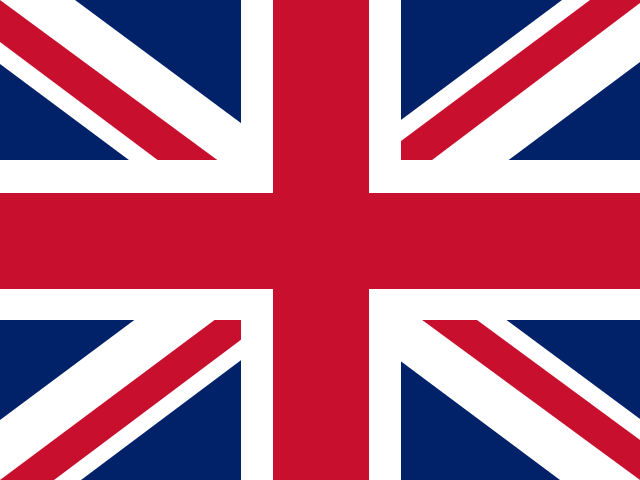
Wales. Wales is not on the flag, because it was treated as part of the Kingdom of England when the first union flag was made in 1606. The flag combines the crosses of England, Scotland and Ireland.
What is the national animal of Scotland?
- A. The unicorn
- B. The red deer
- C. The otter
- D. The golden eagle
Show the answer
The unicorn. The unicorn is Scotland's national animal. On the royal coat of arms, a unicorn for Scotland faces a lion for England.
The London Underground, which opened in 1863, was the world's first underground railway.
True or false?
Show the answer
True. True. The first line opened on 10 January 1863 between Paddington and Farringdon, with steam trains.
On coins, King Charles III faces the same way as Queen Elizabeth II did.
True or false?
Show the answer
False. False. By tradition each new monarch faces the opposite way: Elizabeth II faced right and Charles III faces left.
The village with a 58-character name, Llanfairpwllgwyngyll for short, is on which island?
- A. Anglesey
- B. The Isle of Wight
- C. Skye
- D. The Isle of Man
Show the answer
Anglesey. The village is on Anglesey, an island in north Wales. The long name was probably made up around 1869 to attract visitors to the railway station.
Loch Ness holds more fresh water than the lakes of England and Wales combined.
True or false?
Show the answer
True. True. Loch Ness is about 230 m deep, so it holds more water than all the lakes of England and Wales combined.
Which British city lost its UNESCO World Heritage status in 2021?
- A. Liverpool
- B. Bath
- C. Edinburgh
- D. Salisbury
Show the answer
Liverpool. Liverpool's waterfront was removed from the list in 2021 because of new building, only the third site ever to be removed. Bath and Edinburgh are still on the list.
Words
In a British hotel, you take the 'lift'. What is that in American English?
- A. The elevator
- B. The escalator
- C. The stairs
- D. The shuttle bus
Show the answer
The elevator. A 'lift' in a building is the elevator.
In a British shop, what are 'crisps'?
- A. Potato chips
- B. French fries
- C. Crackers
- D. Cornflakes
Show the answer
Potato chips. Crisps are thin potato chips from a bag. 'Chips' in Britain are what Americans call French fries.
In the UK, if you order fish and 'chips', you get thin potato slices from a bag.
True or false?
Show the answer
False. False. British chips are thick-cut fried potatoes, like French fries. The thin slices from a bag are called crisps.
At a British railway station, what is a 'return ticket'?
- A. A round-trip ticket
- B. A refund
- C. A one-way ticket
- D. A seat reservation
Show the answer
A round-trip ticket. A return ticket takes you there and back: a round-trip ticket. A one-way ticket is called a 'single'.
Phrases
Besides a toast, what does 'Cheers' often mean in everyday British English?
- A. Thanks
- B. I disagree
- C. Please repeat that
- D. Be careful
Show the answer
Thanks. 'Cheers' is a casual way to say thanks, and also goodbye, as well as a toast.
Where are you most likely to hear 'Mind the gap'?
- A. On the London Underground
- B. In a pub
- C. At a football match
- D. In a church
Show the answer
On the London Underground. 'Mind the gap' warns passengers about the gap between the train and the platform on the London Underground, where it has been heard since around 1968.
When a British person greets you with 'You alright?', they usually think you look unwell.
True or false?
Show the answer
False. False. 'You alright?' is simply a friendly hello. A cheerful 'Yes, fine thanks, you?' is the usual reply.
How do you usually ask for the check in a British restaurant?
- A. Could I have the bill, please?
- B. Could I have the ticket, please?
- C. Could I have the score, please?
- D. Could I have the menu, please?
Show the answer
Could I have the bill, please?. In Britain you ask for 'the bill': 'Could I have the bill, please?'
Local customs and tips
UK road signs show speed limits in kilometres per hour.
True or false?
Show the answer
False. False. UK speed limits are in miles per hour: usually 30 mph in towns (20 mph in Wales) and 70 mph on motorways, and distances are in miles.
What is the UK's own emergency number for police, ambulance or fire?
- A. 999
- B. 911
- C. 111
- D. 101
Show the answer
999. 999 is the UK's own emergency number, and the European number 112 also works. 911 is the North American number, 111 is for non-urgent medical advice and 101 for non-emergency police matters.
What kind of plug do UK sockets take?
- A. Type G, with three rectangular pins
- B. Type C, with two round pins
- C. Type A, with two flat pins
- D. Type F, with two round pins and side clips
Show the answer
Type G, with three rectangular pins. UK sockets take Type G, with three rectangular pins, so visitors from mainland Europe and North America need an adapter.
As of 2026, most visitors from the United States and the European Union need an Electronic Travel Authorisation (ETA) to visit the UK.
True or false?
Show the answer
True. True. As of 2026, most visitors who do not need a visa, including US and EU citizens, must get an ETA before they travel. It costs £20; Irish citizens do not need one.
Your restaurant bill already includes a 12.5 percent service charge. What should you do?
- A. Nothing extra is needed
- B. Add another 20 percent
- C. Tip the chef separately in cash
- D. Ask for the charge to be doubled
Show the answer
Nothing extra is needed. Nothing extra is needed: if a service charge is already on the bill, you do not have to tip again.
Answer key
The country at a glance
- A. London
- A. The Isle of Man
- False
- A. Ben Nevis
- False
History
- A. William of Normandy
- A. James VI
- A. The Good Friday Agreement
- C. 2020
- False
- True
Food and drink
- A. Scotland
- A. Beef
- False
- True
- True
- A. Haddock
Cities
- A. Liverpool
- True
Landmarks
- True
- A. Salisbury
- A. Northern Ireland
- A. An extinct volcano
- A. Westminster Hall
- False
Fun facts
- A. Wales
- A. The unicorn
- True
- False
- A. Anglesey
- True
- A. Liverpool
Words
- A. The elevator
- A. Potato chips
- False
- A. A round-trip ticket
Phrases
- A. Thanks
- A. On the London Underground
- False
- A. Could I have the bill, please?
Local customs and tips
- False
- A. 999
- A. Type G, with three rectangular pins
- True
- A. Nothing extra is needed
More about the United Kingdom
- The trip to the United KingdomMap, story, food, phrases and a friendly quiz.
- United Kingdom word searchCities and dishes in large print.
- British words crosswordLearn a few words while you solve it.
- Colour the flag of the United KingdomPrint it or colour it in on the screen.
- British rootsA family guide: history, recipes and words for the grandchildren.
- Before you goPhrases, customs and tips for travellers.
- Printable packLarge print, with a quiz and answers.