World Stroll
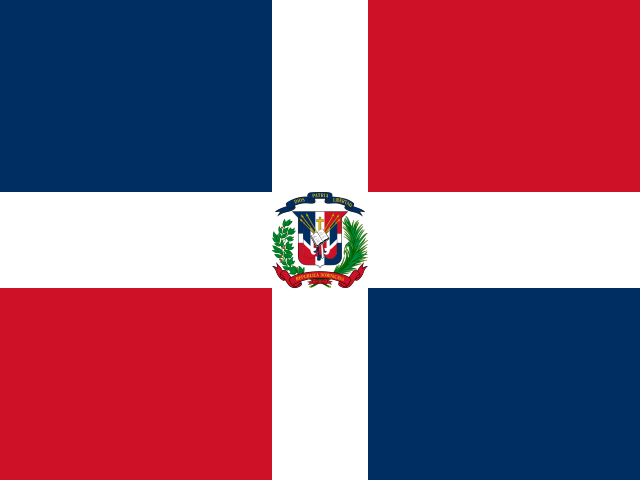
Flag of Dominican Republic
Travel guide

Learn the Dominican Republic before you go

The eastern part of Hispaniola: the oldest continuously inhabited European city in the Americas, the highest mountain in the Caribbean, merengue and bachata, and a plate of rice and beans called the flag.
Take the full trip
CapitalSanto Domingo
CurrencyDominican peso (DOP)
Official languageSpanish. Haitian Creole is widely spoken by Haitian immigrants and their descendants, and on the Samaná peninsula some descendants of 19th-century African American settlers still speak Samaná English
Drives on theRight
Calling code+1, the same as the United States and Canada, with the area codes 809, 829 and 849

10 phrases to learn

In Spanish (Dominican). Capital letters show the stressed part. Tap the heart to practise a phrase later.

Buenos días
BWEH-nohs DEE-ahs
Good morning, hello
Greeting someone in the morning, until about noon
Buenas tardes
BWEH-nahs TAR-dehs
Good afternoon
Greeting someone from about noon until dark
Buenas noches
BWEH-nahs NOH-chehs
Good evening, good night
Greeting someone after dark, or saying goodnight
¿Cómo está?
KOH-moh ehs-TAH
How are you?
Politely asking an adult how they are
¿Qué lo qué?
keh loh KEH
What's up?
A very Dominican, casual greeting among friends
Mucho gusto
MOO-choh GOOS-toh
Nice to meet you
When you are introduced to someone
Por favor
por fah-VOR
Please
Asking for anything
Muchas gracias
MOO-chahs GRAH-syahs
Thank you very much
Thanking someone
De nada
deh NAH-dah
You're welcome
Answering someone who thanks you
Permiso
pehr-MEE-soh
Excuse me, may I pass?
Squeezing past people or entering a room

At the table

  • Lunch, served around midday, is the main meal of the day. Breakfast and dinner are usually lighter.
  • When you pass people who are eating, or sit down near them, it is polite to say '¡Buen provecho!', enjoy your meal.
  • Most restaurant bills add 18 percent tax and a 10 percent service charge. For very good service, many people leave about 10 percent more in cash.
  • Many families prize the concón, the crisp rice from the bottom of the pot, and share it out at the table.
  • Drink bottled water, and avoid ice and washed salads outside good hotels and restaurants.

Local tips

Know the seasons

It is warm all year, about 28 °C on the coast and cooler in the mountains, where nights can be chilly. January and February are the coolest months and August the hottest. The hurricane season runs from June to November, and the sea can be rough then; follow local warnings and check the forecast before you travel.

Fill in the entry and exit form before you fly

Every traveller must fill in an online entry and exit form, often called the e-Ticket, up to 7 days before arrival and again before departure. It gives you a QR code that your airline may ask to see. As of September 2026, British visitors can stay up to 30 days for tourism without a visa; check the latest rules for your nationality before you go.

Drink bottled water

Tap water is not safe to drink. Use bottled water for drinking and brushing your teeth, and be careful with ice and washed salads outside good hotels and restaurants.

Check the currency and the bill

The Dominican peso and the US dollar both use the dollar sign, so prices in pesos are often written RD with the sign. Dollars are accepted at many tourist places, but pesos are better value elsewhere. Restaurant bills usually add 18 percent tax and a 10 percent service charge, and many people leave about 10 percent more for very good service.

Travel between cities by coach

Private coach companies such as Caribe Tours run comfortable, air-conditioned buses between the main cities; bring a jumper, as the air conditioning can be cold. Local minibuses called guaguas and shared cars are cheap but often crowded and poorly maintained. Motorbike taxis, motoconchos, are common but risky and often have no helmet for the passenger.

Take care on the roads

The country has a high rate of road accidents, especially around Christmas and Easter. If you drive, avoid driving at night outside the cities, when poor lighting, animals, pedestrians and cars without headlights make roads dangerous.

Keep your bag on the side away from the road

Bag-snatching from motorbikes happens in the cities. Carry bags away from the traffic, keep phones and jewellery out of sight, keep car windows shut, and use cash machines inside banks or shopping centres.

Know who to call

The national emergency number is 911, but it does not yet cover the whole country. Outside Santo Domingo you can also call the tourist police, Politur. Bring enough of your regular medicines and good travel insurance, because private hospitals are good but expensive.

Protect yourself from sun and mosquitoes

The tropical sun is strong, so wear a hat and sunscreen. Mosquitoes spread dengue fever and, in some areas, malaria and Oropouche virus, so use insect repellent and check the latest health advice before you travel.

Dishes to try

  • La bandera (La bandera dominicana): The everyday Dominican lunch, and the most popular dish in the country. It is a plate of fluffy white rice with red beans stewed in a sauce, and meat stewed in a tomato sauce, usually chicken, beef or pork. Salad, fried plantains or avocado often come on the side.
  • Sancocho: A thick, hearty stew of meat, root vegetables such as cassava, yautía and potato, green plantain, corn and pumpkin, simmered until the broth becomes rich and creamy. It is served with white rice and slices of avocado, and it is a favourite dish for family gatherings and celebrations.
  • Mangú: The national breakfast dish: boiled green plantains mashed until smooth with a little of the cooking water, often with butter, and topped with red onions softened in vinegar and oil. Served with fried cheese, fried Dominican salami and fried eggs, it is called 'los tres golpes', 'the three hits'. It is also eaten at lunch and dinner.
  • Tostones: Slices of green plantain fried once, flattened, then fried again until crisp and golden. They come with almost everything, from fried fish at the beach to pork and chicken, and in the Dominican Republic they are usually served with lime wedges and salt.
  • Moro de guandules: A one-pot dish of rice cooked with pigeon peas (guandules), celery, peppers, onion, garlic, herbs and a little tomato paste. Cooked with coconut milk it becomes moro de guandules con coco, a favourite at Christmas and on the coconut-growing northeast coast.
  • Locrio de pollo: Seasoned rice cooked in one pot with chicken, and a close cousin of Spanish paella. Locrio can also be made with Dominican salami, pork, herring, sardines or seafood.
  • Pica pollo (Chicharrón de pollo): Dominican fried chicken: small pieces of chicken marinated in lime juice, garlic and oregano, coated in seasoned flour and fried until very crisp. It is sold in small fast-food shops all over the country and is served with tostones and lime.
  • Chimi (Chimichurri): The Dominican street burger: a seasoned patty of ground pork or beef, grilled and served in a soft bread roll with shredded cabbage, onion, tomato and a pink sauce of ketchup and mayonnaise. It is sold from street carts and food trucks.

Cities to see

  • Santo Domingo (capital): The Colonial City, with the cathedral and the Alcázar de Colón, The Malecón, the seafront avenue along the Caribbean, The Faro a Colón, the Columbus Lighthouse, on the east bank.
  • Santiago de los Caballeros: The Monument to the Heroes of the Restoration on its hill, Cigars and tobacco from the Cibao valley, The Centro León museum of Dominican art and culture.
  • La Vega: Carnival in February, with the masked diablos cojuelos, The ruins of the old town, La Vega Vieja, Farming in the Cibao valley.
  • Jarabacoa: The Jimenoa and Baiguate waterfalls, Pine forests and a cool climate, The Ébano Verde Scientific Reserve nearby.
  • Puerto Plata: The cable car up Pico Isabel de Torres, The Fortaleza San Felipe, a Spanish fort by the sea, The old town centre and its seafront.
  • Samaná: Whale watching from January to March, Cayo Levantado, a small island in the bay, Boat trips across the bay to Los Haitises National Park.

Landmarks and the city map are on the Dominican Republic trip