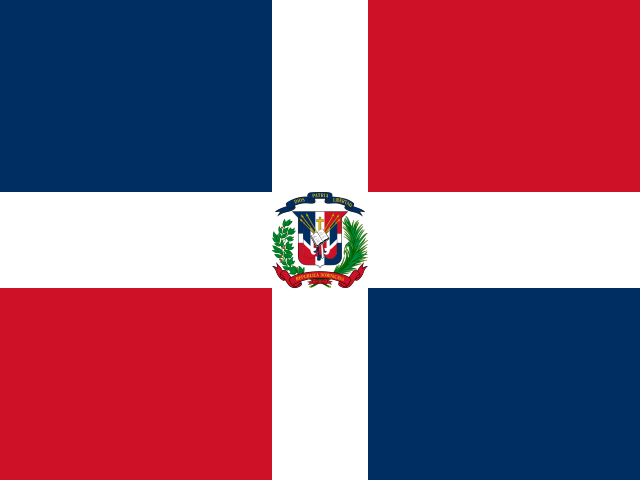
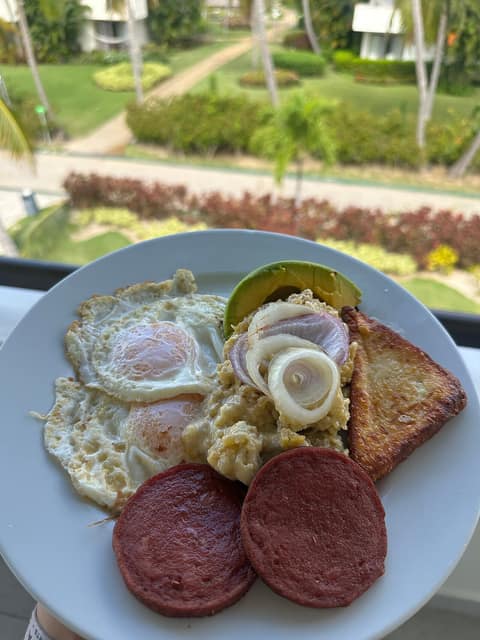
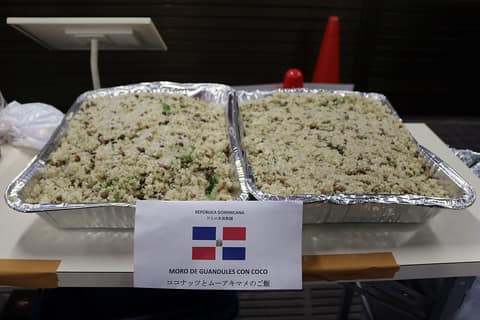
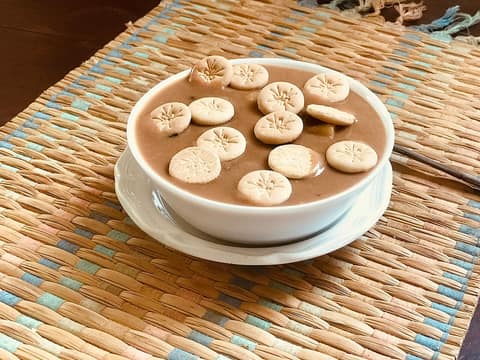
The eastern part of Hispaniola: the oldest continuously inhabited European city in the Americas, the highest mountain in the Caribbean, merengue and bachata, and a plate of rice and beans called the flag.
The Dominican Republic covers the eastern five-eighths of Hispaniola, an island in the Greater Antilles that it shares with Haiti. The Atlantic Ocean lies to the north and the Caribbean Sea to the south, and Puerto Rico is across the Mona Passage to the east. It is the second largest country in the Caribbean after Cuba, and its landscape changes fast: pine-covered mountains in the centre, the fertile Cibao valley in the north, dry cactus country in the southwest, and long white beaches in the east.
The Taíno lived on the island, which they called Ayiti or Quisqueya, when Christopher Columbus arrived in December 1492. Santo Domingo, founded in the 1490s, became the first seat of Spanish rule in the Americas and is the oldest continuously inhabited European settlement there. After Spanish rule, a short-lived independence and 22 years of Haitian rule, the Dominican Republic declared independence on 27 February 1844. Its later history includes a return to Spanish rule, a war to restore independence, an American occupation and the long dictatorship of Rafael Trujillo, which ended in 1961.
Questions to ask the older generation
Memories fade faster than photos. Ask these over a meal or a phone call, and write the answers down.
Which town or region of the Dominican Republic did our family come from? Was it near Santiago de los Caballeros, La Vega, Jarabacoa?
Who was the first in the family to leave the Dominican Republic, when, and why?
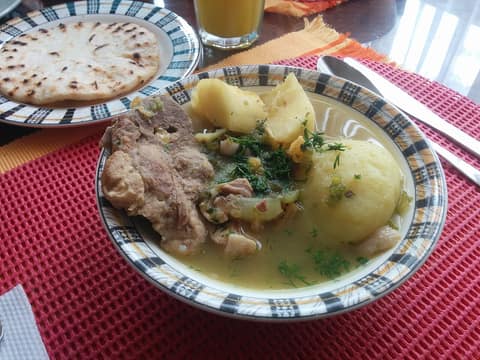
Which dishes from the Dominican Republic were cooked at home? Did anyone make La bandera or Sancocho?
Does anyone in the family still speak Spanish, or use a few words of it?
Were there songs, prayers, games or holidays from the Dominican Republic that the family kept?
Are there old photos, letters or documents from the Dominican Republic? Who has them?
If you could visit the Dominican Republic together, where would you go first?
A short history of the Dominican Republic
The island was home to the Taíno when Columbus arrived in 1492, and Santo Domingo soon became the first capital of Spain's empire in the Americas. Over the next centuries the eastern part of Hispaniola passed between Spain, France and Haiti before declaring independence in 1844. The young country was annexed by Spain again, fought a war to restore its independence, was occupied by the United States from 1916 to 1924, and lived through the dictatorship of Rafael Trujillo from 1930 to 1961. After a civil war in 1965, elections gradually became freer, and international observers have judged the elections held since 1996 to be generally free and fair.
1492
Columbus reaches Hispaniola
On 5 December 1492, on his first voyage, Christopher Columbus reached the island the Taíno called Ayiti or Quisqueya, landing first on its northwestern coast in what is now Haiti. He claimed it for the Crown of Castile and named it La Española. At the time the island was divided into five Taíno chiefdoms. Within a few decades most of the Taíno had died from war, forced labour and diseases brought from Europe.
1586
Francis Drake captures Santo Domingo
The English privateer Sir Francis Drake captured Santo Domingo in 1586 and held it for ransom. His raid marked the start of a long decline in Spanish power on the island. In the early 1600s Spain emptied much of the north and west of the island to stop smuggling, and French settlers moved into the west.
1821
The Ephemeral Independence
On 30 November 1821 José Núñez de Cáceres, a former top official of the colony, declared Santo Domingo independent from Spain as Spanish Haiti. The new state lasted only about two months. It is remembered as the Ephemeral Independence.
1838
Duarte founds La Trinitaria
In 1838 Juan Pablo Duarte founded La Trinitaria, a secret society that worked for complete independence. Duarte, Francisco del Rosario Sánchez and Matías Ramón Mella are honoured as the three Founding Fathers, and Duarte as the Father of the Nation. His birthday, 26 January, is a public holiday.
1863
The Restoration War begins
On 16 August 1863 Dominican rebels began the War of Restoration against Spanish rule. After nearly two years of guerrilla fighting, Spain withdrew its troops in July 1865 and independence was restored. 16 August is now celebrated as Restoration Day.
1930
Trujillo seizes power
In 1930 Rafael Trujillo, head of the army trained during the occupation, took power. He ruled as a dictator for 31 years, renamed the capital Ciudad Trujillo in 1936 and crushed all opposition with prison, torture and murder. In October 1937 his troops killed thousands of Haitians and Dominicans of Haitian descent living in the border region, in what is known as the Parsley massacre; estimates of the dead range from about 14,000 to 40,000.
1961
Trujillo is assassinated
On 30 May 1961 Trujillo was shot dead by Dominican opponents in a car ambush near the capital. His family left the country later that year, and Santo Domingo got its old name back.
2016
Merengue joins UNESCO's heritage list
On 30 November 2016 UNESCO added the music and dance of Dominican merengue to its list of the Intangible Cultural Heritage of Humanity. Bachata, the guitar music born in the countryside and poor city neighbourhoods, followed in December 2019.
graciasGRAH-syahs (often GRAH-syah, with the final s dropped)thank you
¿qué lo qué?keh loh KEHwhat's up?
Everyday words
chévereCHEH-veh-rehgreat, cool
jeviHEH-veecool (from the English 'heavy')
vainaBUY-nahthing, stuff (informal)
un chinoon CHEENa little bit
tíguereTEE-geh-reh (g as in 'go')a street-smart guy
colmadokohl-MAH-dohneighbourhood corner shop, often also a meeting place
Getting around
guaguaGWAH-gwahbus
conchoKOHN-chohshared taxi that runs along a fixed route
motoconchomoh-toh-KOHN-chohmotorbike taxi
Towns and regions
Santo Domingo, National District: The Colonial City, with the cathedral and the Alcázar de Colón, The Malecón, the seafront avenue along the Caribbean.
Santiago de los Caballeros, Santiago: The Monument to the Heroes of the Restoration on its hill, Cigars and tobacco from the Cibao valley.
La Vega, La Vega: Carnival in February, with the masked diablos cojuelos, The ruins of the old town, La Vega Vieja.
Jarabacoa, La Vega: The Jimenoa and Baiguate waterfalls, Pine forests and a cool climate.
Puerto Plata, Puerto Plata: The cable car up Pico Isabel de Torres, The Fortaleza San Felipe, a Spanish fort by the sea.
Samaná, Samaná: Whale watching from January to March, Cayo Levantado, a small island in the bay.
San Pedro de Macorís, San Pedro de Macorís: Baseball and famous baseball players, Cocolo culture and the guloya dance-drama.
La Romana, La Romana: Altos de Chavón, a recreated Mediterranean village, The sugar mill and cane fields.
Higüey, La Altagracia: The Basilica of Our Lady of Altagracia, The pilgrimage on 21 January.
Punta Cana, La Altagracia: White sand beaches such as Bávaro, All-inclusive resorts.
Barahona, Barahona: Larimar, the blue stone found only here, Mountain and coast scenery.
Monte Cristi, Monte Cristi: The Manifesto of Montecristi of 1895, Salt flats, mangroves and offshore cays.