World Stroll
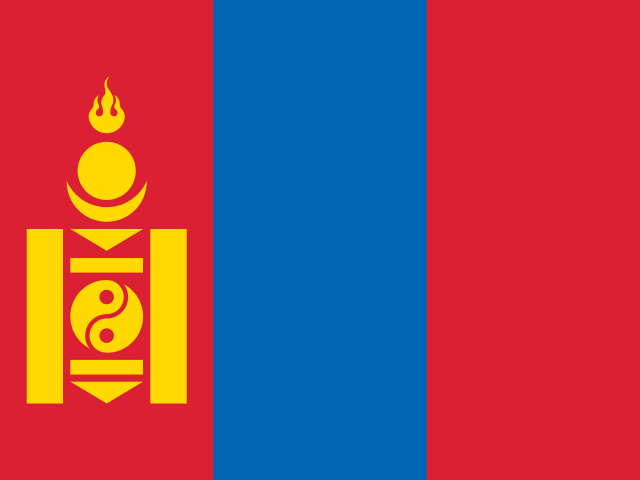
Flag of Mongolia
Travel guide

Learn Mongolia before you go

Endless steppe, the Gobi Desert, nomad tents and horses, in the homeland of Genghis Khan and the largest contiguous land empire in history.
Take the full trip
CapitalUlaanbaatar
CurrencyMongolian tögrög (₮)
Official languageMongolian, written in the Cyrillic alphabet; as of 2026 the traditional vertical Mongolian script is also used in official documents
Drives on theRight
Calling code+976
Time zoneUTC+8 in most of the country, UTC+7 in the far west

10 phrases to learn

In Mongolian (written in Cyrillic). Capital letters show the stressed part. Tap the heart to practise a phrase later.

Sain baina uu? (Сайн байна уу?)
SAIN bain OH
Hello, how are you?
The everyday greeting, to anyone, at any time of day
Sain, sain (Сайн, сайн)
SAIN, SAIN
Fine, fine
The usual answer to 'Sain baina uu?'
Amar baina uu? (Амар байна уу?)
AH-mar bain OH
Are you at peace?
The traditional greeting at Tsagaan Sar, the Lunar New Year, while the younger person supports the elder's arms from below
Bayarlalaa (Баярлалаа)
BAI-yar-laa
Thank you
For any kindness, and when you are given tea or food
Bayartai (Баяртай)
BAI-yar-tai
Goodbye
When leaving
Uuchlaarai (Уучлаарай)
OOCH-laa-rai
Sorry, excuse me
To apologise or to get someone's attention
Nokhoi khor! (Нохой хорь!)
NO-khoi KHOR
Hold the dog!
Called out as you approach a ger in the countryside, instead of knocking, so the family can hold back their guard dogs
Tany neriig khen gedeg ve? (Таны нэрийг хэн гэдэг вэ?)
TAH-nee NEH-reeg KHEN GEH-deg VEH
What is your name? (polite)
When you meet someone
Minii neriig ... gedeg (Миний нэрийг ... гэдэг)
MEE-nee NEH-reeg ... GEH-deg
My name is ...
Introducing yourself
Ta angliar yaridag uu? (Та англиар ярьдаг уу?)
TAH ANG-lee-ar YAH-ree-dag OH
Do you speak English?
Before asking for help

At the table

  • A guest is always offered milk tea first. Take the bowl with your right hand, or with both hands, and it is polite to support your right elbow with your left hand.
  • Try at least a little of everything you are offered, even a small bite or a sip. Refusing food outright is impolite.
  • The stove or hearth in the middle of the ger is sacred. Never throw rubbish into the fire.
  • Do not point the soles of your feet towards the hearth or the family altar at the back of the ger.
  • When khorkhog is served, the hot, greasy stones are passed round from hand to hand before the meal. Take one when it reaches you, then pass it on.
  • Older men may offer you a small snuff bottle. Take it with your right hand, sniff the stopper or the bottle, and hand it back with your right hand.

Local tips

Pack for every kind of weather

Mongolia's climate is extreme. Summer days can be hot, but nights on the steppe and in the mountains are cold even in July, and in Ulaanbaatar winter temperatures can fall below minus 30 °C. The most popular months are May to September; bring warm layers, a hat and sunscreen whatever the season.

Book early for Naadam

The national Naadam festival is held from 11 to 13 July, with wrestling, horse racing and archery in Ulaanbaatar and smaller Naadams all over the country. Hotels, flights and tours fill up months ahead, and the crowds are huge, so book well in advance and keep an eye on your belongings.

Check the entry rules before you go

As of September 2026, British citizens can visit Mongolia for tourism for up to 30 days without a visa until 31 December 2026, and visitors must be registered with the immigration authorities (hotels usually do this). Your passport should be valid for at least six months after arrival. Rules differ by nationality, so check before you travel.

Travel with a driver

Distances are huge and many country roads are dirt tracks with few signs. Most visitors travel in a four-wheel-drive vehicle with a local driver or join a tour. Avoid driving at night. The Trans-Mongolian Railway links Ulaanbaatar with Russia and China and is a slow but memorable way to arrive.

Carry cash outside the capital

Cards are widely accepted in Ulaanbaatar, but in the countryside you will need cash in tögrög. Change or withdraw money in the capital before a long trip.

Look after your health

Medical care outside Ulaanbaatar is limited, so bring your regular medicines and a first aid kit, and make sure your travel insurance covers evacuation by air. Air pollution in Ulaanbaatar can be very bad in winter, especially for people with breathing problems. Keep away from marmots, which can carry plague, and from dogs, which can carry rabies.

Visiting a ger

Call out 'Nokhoi khor!' ('Hold the dog!') as you approach. Inside, do not step on the threshold, do not walk between the two central posts or lean on them, and accept tea and food with your right hand. Try at least a little of what you are offered.

Dishes to try

  • Buuz (бууз): Steamed dumplings filled with minced mutton or beef, onion and garlic, pleated by hand and left with a small opening at the top. They are the traditional dish eaten at home during Tsagaan Sar, the Lunar New Year, when relatives visit one another.
  • Khuushuur (хуушуур): A flat pastry filled with minced mutton or beef, onion and garlic, folded into a half-moon and fried until golden. Khuushuur is the food of the Naadam festival in July, when stalls near the stadium and the race tracks fry them by the thousand.
  • Bansh (банш): Small dumplings filled with meat, smaller than buuz. Instead of being steamed like buuz, bansh are boiled, often in a clear mutton soup, to make a warming winter meal.
  • Tsuivan (цуйван): Home-made flat noodles steamed on top of fried strips of meat with onion, carrot and cabbage, then stirred together. It is one of the most common everyday meals in Mongolian homes and cafés.
  • Guriltai shul (гурилтай шөл): A simple, filling soup of mutton, noodles and a few vegetables such as potato, carrot and onion. The name means 'soup with flour', because the noodles are made from flour at home. It is a favourite in the cold months and a common roadside café meal.
  • Khorkhog (хорхог): A feast dish for guests and special days. Pieces of mutton on the bone are cooked with water, vegetables and fist-sized stones heated in the fire, all sealed inside a metal milk can or pot. When the meat is ready, the hot, greasy stones are passed from hand to hand before the meal.
  • Boodog (боодог): A goat or a marmot cooked from the inside: the meat is taken out through the neck, then put back into the skin with red-hot stones, and the outside is singed, today often with a blowtorch. It is prepared for special occasions and is one of the oldest ways of cooking on the steppe.
  • Chanasan makh (чанасан мах): Big pieces of mutton on the bone, simply boiled in salted water and served on a platter. Each person cuts off meat with a knife, and the broth can be drunk as soup.

Cities to see

  • Ulaanbaatar (capital): Sükhbaatar Square and the Government Palace, Gandan Monastery and its giant golden statue of Avalokiteshvara, The Bogd Khan's Winter Palace.
  • Erdenet: The huge open-pit copper mine, Green hills and forests of northern Mongolia.
  • Darkhan: The Trans-Mongolian Railway, A monument to the morin khuur, the horsehead fiddle.
  • Choibalsan: The Kherlen River, The eastern steppe.
  • Mörön: Gateway to Lake Khövsgöl, The Uushigiin Övör deer stones nearby.
  • Khovd: Gateway to the Mongolian Altai, A mix of Mongol, Kazakh and other peoples of the west.

Landmarks and the city map are on the Mongolia trip