World Stroll
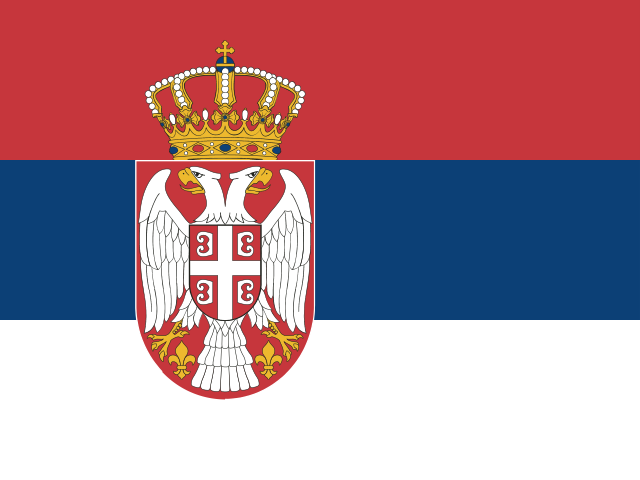
Flag of Serbia
Travel guide

Learn Serbia before you go

A landlocked land of great rivers, where the Sava meets the Danube, with painted medieval monasteries, Roman palaces, grilled meat, plum brandy and famously warm hospitality.
Take the full trip
CapitalBelgrade
CurrencySerbian dinar (RSD)
Official languageSerbian, written in both Cyrillic and Latin letters. Cyrillic is the official script
Drives on theRight
Calling code+381

10 phrases to learn

In Serbian. Capital letters show the stressed part. Tap the heart to practise a phrase later.

Dobro jutro
DOH-broh YOO-troh
Good morning
Greeting someone in the morning
Dobar dan
DOH-bar DAHN
Good day, hello
The polite greeting for most of the day, in shops and with strangers
Dobro veče
DOH-broh VEH-cheh
Good evening
Greeting someone in the evening
Laku noć
LAH-koo nohch
Good night
Saying goodnight before bed
Doviđenja
doh-vee-JEH-nyah
Goodbye
Leaving a shop, a restaurant or a person
Kako ste?
KAH-koh steh
How are you? (polite)
Asking an older person or someone you do not know well
Dobro, hvala
DOH-broh, HVAH-lah
Well, thank you
Answering 'How are you?'
Drago mi je
DRAH-goh mee yeh
Pleased to meet you
When you are introduced to someone
Izvinite
eez-VEE-nee-teh
Excuse me, sorry
Getting someone's attention or apologising
Ne razumem
neh rah-ZOO-mehm
I don't understand
When someone speaks too fast

At the table

  • Before eating, people wish each other 'Prijatno!' (enjoy your meal). The same word is also a friendly way to say goodbye.
  • When glasses are raised, say 'Živeli!' (cheers) and look the other person in the eye.
  • Bread is treated with great respect. Guests may be welcomed with bread and salt, and many Serbs feel it is wrong to throw bread away.
  • Lunch in the early afternoon is the main meal of the day, and it usually begins with a soup.
  • Guests are often welcomed with slatko, a spoonful of fruit preserve, and coffee, sometimes with a glass of rakija.
  • If you are invited to a home for the first time, bring a small gift such as flowers or chocolates.

Local tips

Pay in dinars

Serbia uses the dinar, not the euro. Change money at banks or official exchange offices, called menjačnica, never with street dealers. Euros are sometimes accepted, but usually at a worse price. Cards work in most shops and restaurants, and change your leftover dinars before you leave, as they are hard to exchange abroad.

Carry small notes

Taxis, market stalls and small cafés often have no change for large notes such as 5,000 dinars. Break big notes in supermarkets and keep smaller ones for everyday costs.

Tipping

Tipping is not required, but rounding up or leaving 10 to 15% in a restaurant is common when you are happy with the service. In taxis and bars people simply round up the bill.

Registering your stay

Visitors must be registered with the local police within 24 hours of arrival. Hotels do this for you at check-in. If you stay anywhere else, ask your host how you will be registered, as you can be fined if it is not done.

Emergency numbers

As of September 2026, the local emergency numbers are 192 for police, 193 for fire and 194 for an ambulance. From a mobile phone you can also call 112, the European emergency number, which puts you through to the police. Save them in your phone. For roadside help, call 1987.

Taxis

Use only registered taxis, which show a municipal registration number next to the cab number, or call a radio taxi by phone. Most operators speak some English.

Learn a few Cyrillic letters

Official signs, some menus and timetables are written in Cyrillic. Learning to spot a few words, such as улаз (entrance) and излаз (exit), makes getting around much easier.

Crossing from Kosovo

According to UK travel advice, to travel from Kosovo into Serbia you must already have a Serbian entry stamp, from a Serbian airport or from one of Serbia's other land borders. Many Serbian car hire firms also do not allow their cars to be driven into Kosovo. Check the rules before you plan such a trip.

Dishes to try

  • Ćevapi (grilled minced meat) (ćevapi, ćevapčići): Small finger-shaped rolls of minced meat, grilled over charcoal and served five or ten at a time on a plate or in a soft flatbread, with chopped raw onion, kajmak and sometimes ajvar. In Serbia they are made of beef, lamb, pork or a mixture.
  • Pljeskavica (grilled meat patty) (pljeskavica): A large, thin patty of spiced minced pork, beef and lamb, grilled and served with onions, kajmak and urnebes, either on a plate or in a flatbread like a hamburger. It is one of Serbia's national dishes.
  • Karađorđe's schnitzel (Karađorđeva šnicla): A veal or pork steak rolled around kajmak, then breaded and fried golden. It is served with tartar sauce and a slice of lemon, often with chips.
  • Sarma (stuffed cabbage rolls) (sarma): Leaves of soured cabbage rolled around minced meat and rice, then simmered slowly for hours, often with smoked meat. It is a classic of winter feasts and family celebrations.
  • Pasulj (bean stew) (pasulj): A thick stew of white beans cooked slowly with onion, paprika and smoked meat such as bacon or sausage. It is served with bread and sometimes sour cream. A baked version is called prebranac.
  • Gibanica (cheese and egg pie) (gibanica): A golden pie of thin filo pastry, crumpled in layers with a filling of white cheese, eggs, milk and kajmak. It is eaten warm for breakfast, at celebrations and as a snack.
  • Burek (burek): A large round pie of thin, flaky pastry filled with minced meat, cheese, spinach or potato, cut into wedges. In Serbia it is a classic breakfast, often with a glass of drinking yoghurt.
  • Proja (cornbread) (proja): A simple, moist cornbread made from maize flour, oil and sparkling water, sometimes with white cheese. It is often eaten for breakfast with kajmak, ajvar or sour cream.

Cities to see

  • Belgrade (capital): The Belgrade Fortress and Kalemegdan Park, Knez Mihailova, the main pedestrian street, Skadarlija, the old bohemian quarter.
  • Novi Sad: Petrovaradin Fortress across the river, European Capital of Culture in 2022, The Library of Matica srpska, founded in 1826.
  • Niš: The birthplace of Constantine the Great, Skull Tower, Nišville jazz festival.
  • Kragujevac: Serbia's first constitution, 1835, The Šumarice memorial park, A large car factory.
  • Subotica: The Art Nouveau City Hall, Its Hungarian name, Szabadka, Nearby Lake Palić.
  • Kraljevo: Žiča Monastery, where kings were crowned, Studenica Monastery nearby, The seven crowns on its coat of arms.

Landmarks and the city map are on the Serbia trip