World Stroll
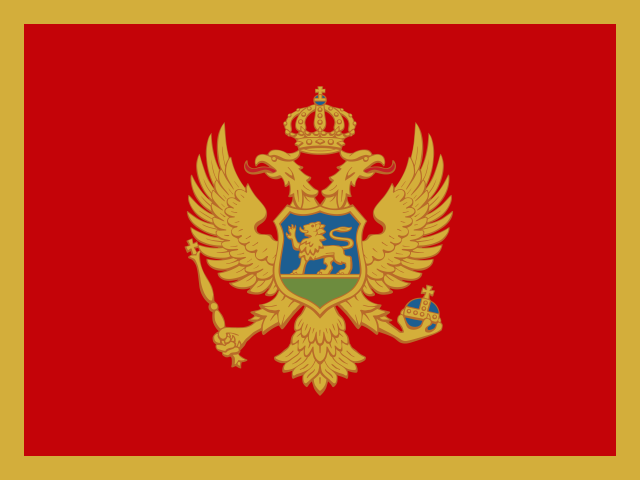
Flag of Montenegro
Travel guide

Learn Montenegro before you go

A small country of steep mountains and a short, dramatic Adriatic coast, where walled Venetian towns sit below peaks that plunge straight into the sea.
Take the full trip
CapitalPodgorica
CurrencyEuro (€), used since 2002 although Montenegro is not in the eurozone
Official languageMontenegrin. Serbian, Bosnian, Albanian and Croatian are also in official use
Drives on theRight
Calling code+382

10 phrases to learn

In Montenegrin. Capital letters show the stressed part. Tap the heart to practise a phrase later.

Dobro jutro
DOH-broh YOO-troh
Good morning
Greeting someone in the morning
Dobar dan
DOH-bahr dahn
Good day, hello
The polite greeting for most of the day, in shops and with strangers
Dobro veče
DOH-broh VEH-cheh
Good evening
Greeting someone in the evening
Laku noć
LAH-koo nohch
Good night
Saying goodbye late at night or before bed
Doviđenja
doh-vee-JEH-nyah
Goodbye
Leaving a shop, a restaurant or people you don't know well
Kako si?
KAH-koh see
How are you? (informal)
Asking a friend how they are
Dobro, hvala na pitanju
DOH-broh, HVAH-lah nah PEE-tah-nyoo
Fine, thank you for asking
Answering 'How are you?'
Drago mi je da vas upoznam
DRAH-goh mee yeh dah vahs OO-poz-nahm
Nice to meet you
Meeting someone for the first time
Nema na čemu
NEH-mah nah CHEH-moo
You're welcome
Answering when someone thanks you
Izvinjavam se
eez-vee-NYAH-vahm seh
Excuse me, or I'm sorry
Getting someone's attention or apologising

At the table

  • Bread is served with every meal.
  • Before eating, people wish each other 'Dobar tek' (enjoy your meal).
  • When glasses are raised, people say 'Živjeli' (cheers).
  • Lunch at midday usually starts with a clear soup.
  • Turkish coffee is almost always offered on any visit to a Montenegrin home, however short.
  • Sweets are not usually eaten straight after a meal. They are served on their own, with coffee.

Local tips

Register within 24 hours

As of September 2026, every visitor must be registered with the local tourist office or police within 24 hours of arrival. Hotels and most holiday lets do it for you, but in private accommodation make sure it is done, or you risk a fine.

Euros, but not Schengen

Prices are in euros, and cards are taken in hotels, restaurants and supermarkets. Keep some cash for markets, bakeries, museums and buses. Montenegro is not in the Schengen area, so make sure your passport is stamped when you enter and leave.

Always carry ID

You must carry a passport or photocard driving licence at all times, and the police can fine you if you do not. Keep a copy of your passport's photo page somewhere safe.

Headlights on, day and night

Drive on the right, and keep dipped headlights on even in daylight. Seat belts are compulsory and phones may not be used while driving. The drink-driving limit is less than half the limit in England and Wales, and fines must be paid within 8 days or before you leave.

Take mountain roads slowly

Most roads are two-lane, curvy and mountainous. The road north through the Morača canyon can be dangerous in winter and in bad weather, when an experienced bus driver is the safer choice. Coastal roads are very busy in summer.

Emergency number: 112

The general emergency number is 112, for police, ambulance and fire. The separate numbers are 122 for police, 123 for the fire brigade and 124 for an ambulance.

Stay on marked paths

Hikers in Durmitor and the other mountains have got lost after leaving marked trails. Take a charged phone, tell someone your route, and remember that weather changes fast at altitude.

Pay the bus station fee

Buses are the easiest way to get around. Bus stations charge a small platform fee that is included when you buy at the station but not in online tickets, so allow time to pay it before your bus leaves.

Dishes to try

  • Njeguši ham (njeguški pršut): Dry-cured ham, lightly smoked over beech wood and dried in the cool mountain air. It is sliced very thin and served uncooked as a cold starter, often with Njeguši cheese.
  • Pljevlja cheese (pljevaljski sir): A salted, aged white cheese made from cow's milk. It is served as part of a cold starter platter.
  • Kačamak (kačamak): A thick, filling porridge of cornmeal and crushed potatoes, stirred with cheese and kajmak until smooth. It is traditionally eaten with a glass of cold milk, buttermilk or yoghurt.
  • Cicvara (cicvara): Cornmeal slowly cooked in kajmak or fresh cream until the fat rises to the top. It is very rich and is eaten for breakfast or as a hearty meal in the mountains.
  • Carp from Lake Skadar (krap): Fresh or smoked carp from Lake Skadar, a speciality of central Montenegro. Small smoked and dried fish called ukljeva (bleak) are also a lakeside speciality.
  • Black risotto (crni rižot): Rice cooked with cuttlefish and its ink, which turns the whole dish a glossy black. It is one of the classic seafood dishes of the coast, together with grilled squid and octopus salad.
  • Brudet (brudet or brodet): A fish stew made in one pot with several kinds of sea fish, tomato, onion and wine, often served with polenta to soak up the sauce.
  • Stuffed peppers (punjene paprike): Bell peppers filled with minced meat and rice, then baked or simmered in a tomato sauce. A common home-cooked main course all over the country.

Cities to see

  • Podgorica (capital): The Millennium Bridge over the Morača, The old city Clock Tower, The Roman ruins of Doclea nearby.
  • Nikšić: Nikšić beer from the Trebjesa brewery, The wide Nikšić field, The railway to Podgorica.
  • Cetinje: The National Museum of Montenegro, Biljarda, the residence Njegoš built in 1838, Old foreign embassies from royal times.
  • Kotor: The Cathedral of Saint Tryphon, City walls climbing the mountain, Its many cats.
  • Budva: The walled Old Town, Sandy beaches of the Budva Riviera, Sveti Stefan nearby.
  • Bar: The port and the ferry to Bari, Stari Bar, the old town, The end of the Belgrade to Bar railway.

Landmarks and the city map are on the Montenegro trip