Alpine peaks, imperial palaces, coffee houses and the music of Mozart, in the heart of Europe.
Austria is a landlocked country in Central Europe with eight neighbours and about 9.2 million people. The Alps cover roughly six tenths of the land, rising to the Grossglockner, 3,798 m, while the Danube flows across the north past Linz and Vienna. It is a federal republic of nine states, each with its own capital, dialect and dishes.
For more than six hundred years Austria was the heart of the Habsburg lands, a great multinational empire ruled from Vienna. The empire broke apart at the end of the First World War, and in November 1918 Austria became a small republic. It was annexed by Nazi Germany in 1938, and after the Second World War it was occupied by the four Allied powers for ten years.
Questions to ask the older generation
Memories fade faster than photos. Ask these over a meal or a phone call, and write the answers down.
Which town or region of Austria did our family come from? Was it near Graz, Linz, Salzburg?
Who was the first in the family to leave Austria, when, and why?
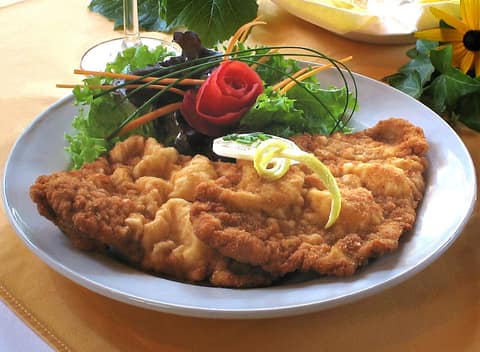
Which dishes from Austria were cooked at home? Did anyone make Wiener Schnitzel or Tafelspitz?
Does anyone in the family still speak German, or use a few words of it?
Were there songs, prayers, games or holidays from Austria that the family kept?
Are there old photos, letters or documents from Austria? Who has them?
If you could visit Austria together, where would you go first?
A short history of Austria
From Iron Age salt miners to a great empire, two world wars, occupation and a new start as a neutral republic, Austria's story is the story of Central Europe.
800 BC
The Hallstatt culture
Salt had been mined in the mountains above Hallstatt since the Bronze Age. From about 800 BC, the Early Iron Age culture found there spread across much of Central Europe. Archaeologists named the whole culture after Hallstatt, where a great prehistoric cemetery was discovered in 1846.
1156
Austria becomes a duchy
On 17 September 1156, Emperor Frederick Barbarossa raised the March of Austria to a duchy with a document known as the Privilegium Minus. Austria was given as a hereditary fief to the Babenberg family, its rulers at the time.
1683
The Battle of Vienna
An Ottoman army besieged Vienna from July 1683, as it had already done once in 1529. On 12 September 1683 a relief army led by King Jan III Sobieski of Poland defeated the besiegers. The victory ended the Ottoman advance into Central Europe.
1804
The Austrian Empire is proclaimed
On 11 August 1804, in answer to Napoleon making himself Emperor of the French, Francis II proclaimed the Austrian Empire and became its first emperor as Francis I. Two years later he gave up the old crown of the Holy Roman Empire.
1914
The assassination in Sarajevo
On 28 June 1914, Archduke Franz Ferdinand, heir to the throne, and his wife Sophie were shot dead in Sarajevo by Gavrilo Princip, a Bosnian Serb student. One month later Austria-Hungary declared war on Serbia, and the First World War began.
1920
The Federal Constitution
On 1 October 1920, parliament adopted the Federal Constitutional Law, drafted mainly by the legal scholar Hans Kelsen. It was set aside under the authoritarian regime of 1934, restored in 1945, and is still the basis of Austria's constitution today.
1945
The Second Republic begins
In April 1945 Soviet troops took Vienna, and on 27 April a provisional government under Karl Renner declared Austria independent again. The country and its capital were divided into four zones of occupation, run by the Soviet Union, the United States, Britain and France.
1995
Austria joins the European Union
After a referendum in June 1994, in which about two thirds voted yes, Austria joined the European Union on 1 January 1995, together with Finland and Sweden. It adopted the euro in 1999.