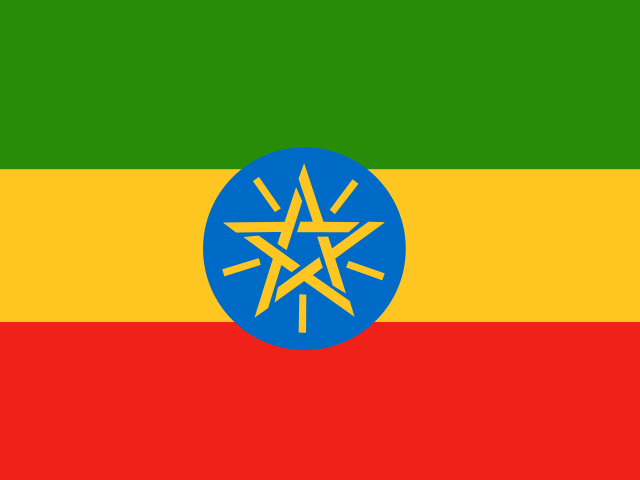
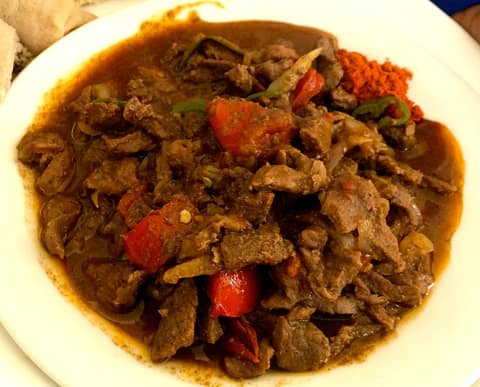
Churches carved out of solid rock, a calendar with thirteen months, the home of the wild coffee plant, and injera shared from one great platter.
Ethiopia lies in the Horn of Africa, the eastern corner of the continent. Most of the country is a high, cool plateau, the Ethiopian Highlands, cut in two by the Great Rift Valley. The capital, Addis Ababa, stands at about 2,355 m, and from Lake Tana in the north the Blue Nile begins its long journey to Egypt. In the far northeast, the Danakil Depression drops more than 100 m below sea level and is one of the hottest places on Earth.
Few countries have such a long written history. The Kingdom of Aksum traded with Rome and India, became Christian in the 4th century and left giant carved stone pillars behind. Later kings carved churches out of the rock at Lalibela and built castles at Gondar. In 1896 Ethiopia defeated an Italian army at Adwa, and apart from the Italian occupation of 1936 to 1941, it kept its independence through the whole colonial era.
Questions to ask the older generation
Memories fade faster than photos. Ask these over a meal or a phone call, and write the answers down.
Which town or region of Ethiopia did our family come from? Was it near Aksum, Mekelle, Gondar?
Who was the first in the family to leave Ethiopia, when, and why?
Which dishes from Ethiopia were cooked at home? Did anyone make Injera or Doro wat?
Does anyone in the family still speak Amharic, or use a few words of it?
Were there songs, prayers, games or holidays from Ethiopia that the family kept?
Are there old photos, letters or documents from Ethiopia? Who has them?
If you could visit Ethiopia together, where would you go first?
A short history of Ethiopia
Ethiopia's story goes back further than almost any other country's. Some of the oldest fossils of human ancestors were found here, including Lucy, who lived about 3.2 million years ago. Around the start of the Common Era, the Kingdom of Aksum grew rich from trade across the Red Sea, and its kings later ruled for many centuries from the highlands. Emperors, churches and monasteries shaped the country until 1974, when the last emperor was overthrown. The events below follow the story from Aksum to today.
AD 330
King Ezana adopts Christianity
Around 330, King Ezana of Aksum became a Christian, taught by his tutor Frumentius, a Christian from Syria who became the first head of the Ethiopian Church. Aksum became one of the first Christian kingdoms in the world, and the Ethiopian Orthodox Tewahedo Church still traces its roots to this time.
1270
The Solomonic dynasty begins
In 1270 Yekuno Amlak overthrew the last king of the Zagwe dynasty, the family that had built the churches of Lalibela. He founded the Solomonic dynasty, which claimed descent from King Solomon and the Queen of Sheba and ruled Ethiopia until 1974.
1636
Gondar becomes the capital
Earlier emperors moved around the country with their court in great camps. Emperor Fasilides broke with this tradition and made Gondar his permanent capital in 1636. He and the emperors after him built stone castles there, now the Fasil Ghebbi World Heritage Site.
1886
Addis Ababa is founded
In 1886 Menelik II, then King of Shewa, and his wife Taytu moved from the cold heights of Mount Entoto to a valley with hot springs below it. Taytu named the new town Addis Ababa, 'new flower', and it became the capital of the whole empire.
1936
Italy occupies Ethiopia
Italy under Mussolini invaded in October 1935, using modern weapons and poison gas. Italian troops entered Addis Ababa on 5 May 1936, and Haile Selassie went into exile, where he appealed to the League of Nations for help. Ethiopian patriots kept up a resistance throughout the occupation.
1963
The OAU is founded in Addis Ababa
On 25 May 1963, leaders of more than 30 independent African states met in Addis Ababa and founded the Organisation of African Unity. It was replaced in 2002 by the African Union, which still has its headquarters in the city.
1991
The Derg falls
In May 1991 rebel forces took Addis Ababa and the Derg government fell. A new constitution in 1995 turned Ethiopia into a federal republic, with regions drawn mainly along ethnic and language lines.
2025
The Renaissance Dam is inaugurated
On 9 September 2025 Ethiopia inaugurated the Grand Ethiopian Renaissance Dam on the Blue Nile, near the border with Sudan. As of 2025 it is the largest hydroelectric power station in Africa. Building began in 2011, and Egypt and Sudan, downstream on the Nile, have long raised concerns about the river's water.