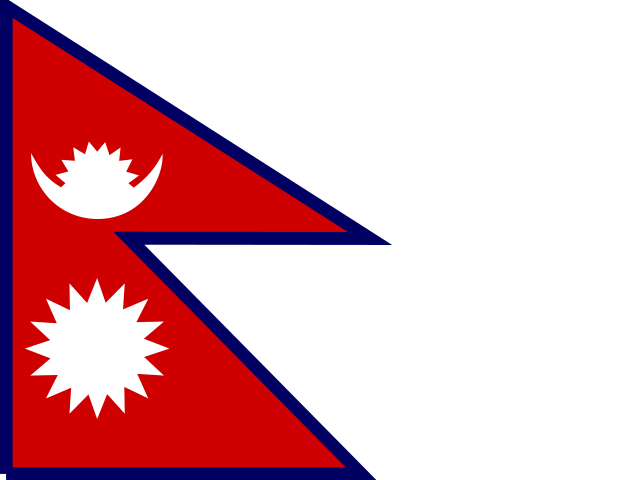
Eight of the world's ten highest mountains, the birthplace of the Buddha and valleys full of carved wooden temples.
Nepal is a landlocked country in the Himalayas, wedged between China to the north and India on the other three sides. In less than 200 km from south to north the land climbs from the hot, flat Terai plains, about 60 m above sea level, through green terraced hills to the highest mountain on Earth, Mount Everest, which Nepalis call Sagarmatha. Eight of the world's ten highest peaks stand in Nepal or on its borders with China and India.
The Kathmandu Valley in the middle of the country was the heart of the old kingdoms. Its Newar craftsmen built pagoda temples, palaces and stupas that fill the royal squares of Kathmandu, Patan and Bhaktapur. In the 1760s the king of Gorkha, Prithvi Narayan Shah, conquered the valley and united many small states into one kingdom. Nepal was never colonised, and it was a kingdom until 2008, when it became a republic.
Questions to ask the older generation
Memories fade faster than photos. Ask these over a meal or a phone call, and write the answers down.
Which town or region of Nepal did our family come from? Was it near Pokhara, Lalitpur, Bhaktapur?
Who was the first in the family to leave Nepal, when, and why?
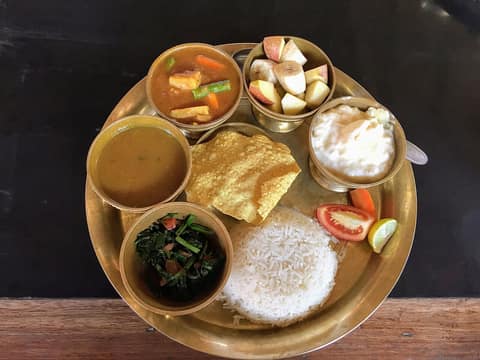
Which dishes from Nepal were cooked at home? Did anyone make Dal bhat or Dhindo?
Does anyone in the family still speak Nepali, or use a few words of it?
Were there songs, prayers, games or holidays from Nepal that the family kept?
Are there old photos, letters or documents from Nepal? Who has them?
If you could visit Nepal together, where would you go first?
A short history of Nepal
Nepal's written history begins with a stone pillar set up by an Indian emperor at the Buddha's birthplace. For centuries the Kathmandu Valley was a rich land of Newar kings and craftsmen, until the king of Gorkha united the hills into one kingdom in the 1760s. Nepal kept its independence through the British era, then went through a century of Rana prime ministers, royal rule, a ten-year civil war and, in 2008, the end of the monarchy.
563 BC
The Buddha is born at Lumbini
According to Buddhist tradition, Queen Maya gave birth to Prince Siddhartha Gautama in the garden of Lumbini. The date is uncertain: it is often given as around 563 BC, and Nepal uses the traditional date of 623 BC. He left his royal life, became the Buddha and founded one of the world's great religions.
AD 400
The Licchavi kings rule the valley
From around AD 400 the Licchavi dynasty ruled the Kathmandu Valley. They left temples and many stone inscriptions, and most of what is known about this period comes from them. The temple of Changu Narayan dates back to their time.
1768
Prithvi Narayan Shah takes Kathmandu
The king of Gorkha, Prithvi Narayan Shah, entered Kathmandu on 25 September 1768 during the Indra Jatra festival, and Patan and Bhaktapur fell soon after. He is honoured as the founder of modern Nepal.
1846
The Kot massacre brings the Ranas to power
On 14 September 1846 Jung Bahadur Kunwar and his brothers killed dozens of officials at the palace armoury in Kathmandu. He became Jung Bahadur Rana, and his family ruled as hereditary prime ministers for more than a century, while the kings had little power.
1960
King Mahendra bans political parties
In 1960 King Mahendra dismissed the elected government and banned political parties. A partyless panchayat system governed Nepal for the next thirty years.
1996
The civil war begins
On 13 February 1996 the Communist Party of Nepal (Maoist) began an armed insurgency against the monarchy. The war lasted ten years and cost about 17,000 lives.
2008
Nepal becomes a republic
On 28 May 2008 an elected Constituent Assembly abolished the monarchy, about 240 years after Prithvi Narayan Shah founded the kingdom. Nepal had been the world's last Hindu kingdom.
2015
A new constitution creates seven provinces
On 20 September 2015 Nepal adopted its present constitution, which made the country a federal democratic republic divided into seven provinces.