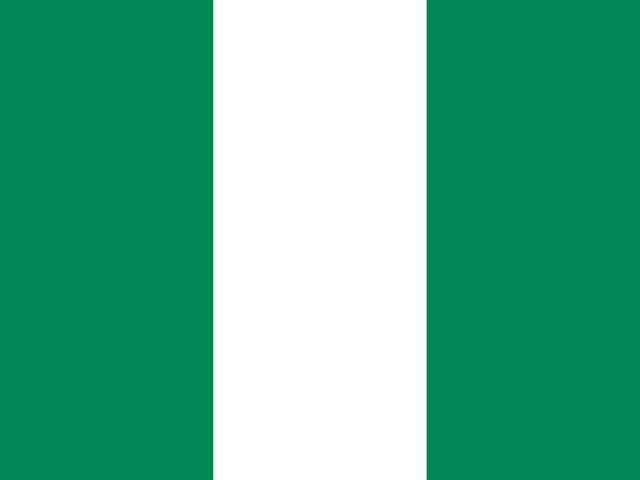
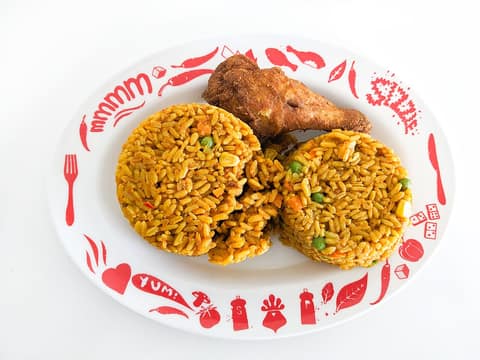
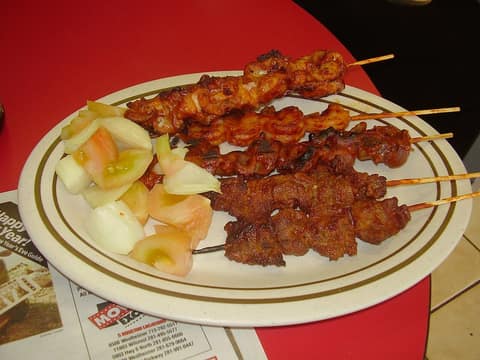
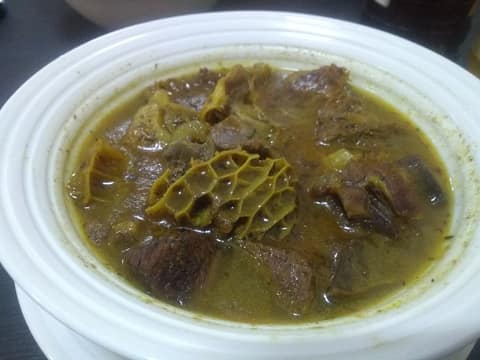
Africa's most populous country: busy Lagos by the ocean, the old walled city of Kano in the north, a pot of jollof rice on every party table and one of the busiest film industries in the world.
Nigeria lies in West Africa, on the Gulf of Guinea. The south is warm and green, with rainforest, mangrove swamps and the huge delta of the Niger River, while the north is open savanna that grows drier towards the Sahara. The Niger and its largest tributary, the Benue, meet in the middle of the country and form a great Y on the map. The country takes its name from the Niger.
People have lived and made art here for thousands of years: the clay heads of the Nok culture are among the oldest sculptures in Africa south of the Sahara, and the kingdoms of Benin, Oyo, Kano and many more grew rich on trade. Britain took control step by step in the 1800s and joined the north and the south into one colony in 1914. Nigeria became independent on 1 October 1960.
Questions to ask the older generation
Memories fade faster than photos. Ask these over a meal or a phone call, and write the answers down.
Which town or region of Nigeria did our family come from? Was it near Lagos, Kano, Ibadan?
Who was the first in the family to leave Nigeria, when, and why?
Which dishes from Nigeria were cooked at home? Did anyone make Jollof rice or Egusi soup?
Does anyone in the family still speak Yoruba, or use a few words of it?
Were there songs, prayers, games or holidays from Nigeria that the family kept?
Are there old photos, letters or documents from Nigeria? Who has them?
If you could visit Nigeria together, where would you go first?
A short history of Nigeria
The land that is now Nigeria was home to many peoples and states long before it had one name. Nok artists made clay sculptures more than 2,000 years ago, the Kingdom of Benin traded with Portugal from the 1480s, and in the north the Hausa city-states and later the Sokoto Caliphate ruled the savanna. Britain took Lagos in 1861 and the rest over the following decades, joining north and south in 1914. After independence in 1960 came a painful civil war and long years of military rule, and civilian government returned in 1999.
500 BC
The Nok culture flourishes
By around 500 BC the Nok people of central Nigeria were smelting iron and making striking terracotta figures with large eyes and carefully shaped hair. The culture is named after the village of Nok, where tin miners found clay figures in 1928 and again in 1943, and its sculptures are among the earliest known in Africa south of the Sahara.
1804
The Sokoto Caliphate is founded
In 1804 the Fulani scholar Usman dan Fodio led a religious war against the Hausa kings of the north and founded the Sokoto Caliphate. By the 1830s it was the most populous state in West Africa, ruled from the city of Sokoto, which his son founded in 1809. Britain took it over in 1903, but the Sultan of Sokoto is still an important Muslim leader today.
1897
British troops take Benin City
In February 1897 a British military expedition captured Benin City, burned much of it, including the royal palace, and sent the Oba into exile. Thousands of bronze and ivory works of art, now known as the Benin Bronzes, were taken to Britain. Since the 2020s some museums abroad have begun to return pieces to Nigeria.
1960
Nigeria becomes independent
On 1 October 1960 Nigeria became independent from Britain as a federation of three regions, with Abubakar Tafawa Balewa as prime minister. The day is celebrated every year as Independence Day.
1967
The civil war begins
After two military coups and violence against Igbo people in the north in 1966, the Eastern Region declared itself the independent Republic of Biafra in May 1967, and fighting began in July. A blockade of the east caused a terrible famine, and pictures of starving children shocked the world. Estimates of the number of people who died vary widely.
1976
Abuja is chosen as the new capital
In 1976 the military government decided to move the capital from crowded Lagos to a new city in the centre of the country, in a place seen as neutral between the country's main ethnic and religious groups. Abuja was planned from scratch and built mainly in the 1980s.
1991
Abuja becomes the capital
On 12 December 1991 Abuja officially replaced Lagos as the capital of Nigeria. Lagos remains the country's largest city and its business centre.
1999
Civilian rule returns
After most of the years since 1966 under military governments, Nigeria adopted a new constitution and held elections in 1999. On 29 May 1999 power was handed to an elected civilian president.