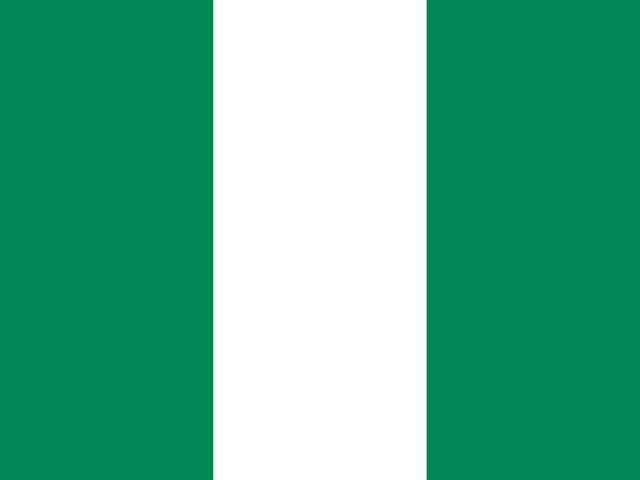
Nigeria trivia: 48 questions and answers
The country at a glance
What is the capital of Nigeria?
- A. Abuja
- B. Lagos
- C. Kano
- D. Ibadan
Show the answer
Abuja. Abuja has been the capital since 1991. Lagos, the former capital, is still the largest city.
As of 2026, Nigeria has more people than any other country in Africa.
True or false?
Show the answer
True. True. With more than 240 million people, Nigeria is the most populous country in Africa.
What is the official language of Nigeria?
- A. English
- B. French
- C. Hausa
- D. Portuguese
Show the answer
English. English is the official language. Hausa, Yoruba and Igbo are the largest of more than 500 languages, and Nigerian Pidgin is heard everywhere.
Where does the name Nigeria come from?
- A. The Niger River
- B. Lake Chad
- C. The Nok culture
- D. A Hausa king
Show the answer
The Niger River. The name comes from the Niger River, which flows through the country. It was suggested in 1897 by the journalist Flora Shaw.
History
Nigeria became independent from France in 1960.
True or false?
Show the answer
False. False. Nigeria became independent from Britain on 1 October 1960, now celebrated every year as Independence Day.
What did the British join together in 1914 to create a single Nigeria?
- A. The Northern and Southern Nigeria Protectorates
- B. The Gold Coast and Sierra Leone
- C. Lagos and Dahomey
- D. Benin and Cameroon
Show the answer
The Northern and Southern Nigeria Protectorates. On 1 January 1914 the Northern and Southern Nigeria Protectorates were joined into the Colony and Protectorate of Nigeria.
After British troops captured which city in 1897 were the famous Bronzes taken to Britain?
- A. Benin City
- B. Kano
- C. Lagos
- D. Calabar
Show the answer
Benin City. The Benin Bronzes were taken from the royal palace of Benin City in 1897. Since the 2020s some museums abroad have begun to return pieces.
Who founded the Sokoto Caliphate in 1804?
- A. Usman dan Fodio
- B. Frederick Lugard
- C. Nnamdi Azikiwe
- D. Abubakar Tafawa Balewa
Show the answer
Usman dan Fodio. The Fulani scholar Usman dan Fodio founded the Sokoto Caliphate in 1804; by the 1830s it was the most populous state in West Africa.
The Nigerian Civil War ended in 1970.
True or false?
Show the answer
True. True. The war began in 1967 and ended in January 1970, when Biafra surrendered after 30 months of fighting.
Abuja replaced Lagos as the capital of Nigeria in 1991.
True or false?
Show the answer
True. True. Abuja officially became the capital on 12 December 1991, fifteen years after it was chosen in 1976.
Food and drink
Which rice dish is the star of Nigerian parties and the subject of a friendly rivalry with Ghana?
- A. Jollof rice
- B. Paella
- C. Risotto
- D. Biryani
Show the answer
Jollof rice. Jollof rice is cooked in one pot in a tomato and pepper sauce. Nigerians and Ghanaians enjoy arguing about whose version is best.
In Nigerian cooking, what is a "swallow"?
- A. A soft dough such as pounded yam, eaten with soup
- B. A cold drink made from hibiscus
- C. Spiced grilled meat on skewers
- D. A sweet fried snack
Show the answer
A soft dough such as pounded yam, eaten with soup. A swallow is a soft dough such as pounded yam, eaten with soup; eba and amala are other favourites. A small piece is dipped in the soup and eaten with the right hand.
Egusi soup is thickened with which ground ingredient?
- A. Melon seeds
- B. Cashew nuts
- C. Sesame seeds
- D. Almonds
Show the answer
Melon seeds. Egusi soup is made with ground melon seeds, which cook into soft curds, together with palm oil, greens and meat or fish.
What is suya, sold by street sellers in the evening?
- A. Spiced grilled meat on skewers
- B. Fried bean fritters
- C. A steamed bean pudding
- D. Fried sweet dough balls
Show the answer
Spiced grilled meat on skewers. Suya is spiced grilled meat on skewers: thin slices rubbed with yaji, a spice mix with ground peanuts and chilli. It comes from the Hausa north.
Zobo, a deep red drink, is made from which dried flowers?
- A. Hibiscus
- B. Rose
- C. Lavender
- D. Chamomile
Show the answer
Hibiscus. Zobo is made from dried hibiscus flowers boiled with ginger, then sweetened and served cold.
As of 2020, Nigeria grew about two thirds of the world's yams.
True or false?
Show the answer
True. True. In 2020 Nigeria produced about 67 percent of the world's yams, which are used for pounded yam, amala and many other dishes.
In Nigeria it is polite to eat and pass food with your left hand.
True or false?
Show the answer
False. False. Eat, give and take with your right hand; using the left hand is seen as rude.
Akara travelled with enslaved Yoruba people to Brazil. What is it called there?
- A. Acarajé
- B. Feijoada
- C. Brigadeiro
- D. Pão de queijo
Show the answer
Acarajé. In Brazil akara became acarajé, a famous street food of Salvador da Bahia.
Cities
Which is the largest city in Nigeria?
- A. Lagos
- B. Abuja
- C. Port Harcourt
- D. Enugu
Show the answer
Lagos. Lagos is Nigeria's largest city and one of the largest in Africa. It was the capital until 1991.
Which city in the southeast is nicknamed the Coal City?
- A. Enugu
- B. Jos
- C. Kano
- D. Abeokuta
Show the answer
Enugu. Enugu grew up after coal was found there in 1909. Its name means "hill top" in Igbo.
Nigeria's first crude oil export was shipped through Port Harcourt in 1958.
True or false?
Show the answer
True. True. Port Harcourt, founded in 1912 to export coal, turned to oil when Nigeria's first crude oil was shipped from there in 1958.
Jos, on its high plateau, is hotter than most of Nigeria.
True or false?
Show the answer
False. False. Jos lies about 1,200 m above sea level, so its climate is cooler than most of the country.
Landmarks
Which huge rock rises beside the Presidential Complex in Abuja?
- A. Aso Rock
- B. Olumo Rock
- C. Zuma Rock
- D. Chappal Waddi
Show the answer
Aso Rock. Aso Rock rises about 400 m above the land around it, and the Presidential Complex, the National Assembly and the Supreme Court stand at its foot.
Which rock near Abuja appears on the 100 naira note?
- A. Zuma Rock
- B. Aso Rock
- C. Olumo Rock
- D. Idanre Hill
Show the answer
Zuma Rock. Zuma Rock, a giant dome of rock beside the road from Abuja to Kaduna, appears on the 100 naira note.
The Osun-Osogbo Sacred Grove is a UNESCO World Heritage Site.
True or false?
Show the answer
True. True. The grove, sacred to the Yoruba river goddess Osun, was added to the World Heritage List in 2005.
As of 2026, the Ancient Kano City Walls are on UNESCO's World Heritage List.
True or false?
Show the answer
False. False. As of 2026 the Kano walls are only on UNESCO's tentative list. Nigeria's two World Heritage Sites are Sukur and the Osun-Osogbo Sacred Grove.
In which city does Olumo Rock stand?
- A. Abeokuta
- B. Ibadan
- C. Enugu
- D. Kano
Show the answer
Abeokuta. Olumo Rock stands in the middle of Abeokuta, and visitors climb it for a view over the city.
What can visitors swim in at Yankari Game Reserve?
- A. A natural warm spring
- B. A salt lake
- C. The Niger River
- D. A crater lake
Show the answer
A natural warm spring. At Yankari visitors can swim in a natural warm spring, the clear Wikki Warm Spring.
Fun facts
What is the Nigerian film industry often called?
- A. Nollywood
- B. Bollywood
- C. Hollywood
- D. Tollywood
Show the answer
Nollywood. Nollywood, a blend of Nigeria and Hollywood, is based mainly in Lagos. By the number of films made each year it is often ranked second in the world, after India and ahead of Hollywood.
Who wrote Things Fall Apart, the 1958 novel read around the world?
- A. Chinua Achebe
- B. Wole Soyinka
- C. Fela Kuti
- D. Flora Shaw
Show the answer
Chinua Achebe. Chinua Achebe wrote Things Fall Apart, which has been translated into more than 50 languages.
Which Nigerian bandleader created Afrobeat in the late 1960s?
- A. Fela Kuti
- B. Burna Boy
- C. Wizkid
- D. Davido
Show the answer
Fela Kuti. Fela Kuti created Afrobeat, a mix of West African music with jazz, funk and soul. Burna Boy, Wizkid and Davido are stars of a much later generation.
About how many languages are spoken in Nigeria?
- A. More than 500
- B. About 50
- C. About 20
- D. About 5
Show the answer
More than 500. More than 500 languages are spoken in Nigeria, making it one of the most language-rich countries on Earth.
As of 2026, how many UNESCO World Heritage Sites does Nigeria have?
- A. 2
- B. 5
- C. 8
- D. 12
Show the answer
2. As of 2026 Nigeria has 2 sites: the Sukur Cultural Landscape (1999) and the Osun-Osogbo Sacred Grove (2005).
Chappal Waddi, Nigeria's highest point, is also the highest point in West Africa.
True or false?
Show the answer
True. True. Chappal Waddi, 2,419 m high on the Mambilla Plateau, is the highest point in Nigeria and in West Africa.
Which animals are at the heart of the Durbar festivals of the northern emirates?
- A. Horses
- B. Elephants
- C. Ostriches
- D. Dogs
Show the answer
Horses. Horses are at the heart of the Durbar: horsemen in bright robes parade and charge towards the emir, then stop and salute him.
Words
What does the Yoruba word "omi" mean?
- A. Water
- B. Fish
- C. Pepper
- D. Yam
Show the answer
Water. Omi means water. Fish is ẹja, pepper is ata and yam is iṣu.
The Yoruba word "ọba", also used in English, means what?
- A. King or monarch
- B. Child
- C. Friend
- D. Market
Show the answer
King or monarch. Ọba means king or monarch, as in the Oba of Benin. Child is ọmọ.
What is the Yoruba name for Lagos?
- A. Èkó
- B. Ìbàdàn
- C. Ọ̀yọ́
- D. Ifẹ̀
Show the answer
Èkó. Lagos is called Èkó in Yoruba. Ìbàdàn, Ọ̀yọ́ and Ifẹ̀ are other Yoruba cities.
Yoruba is a tonal language, in which the pitch of a syllable can change the meaning of a word.
True or false?
Show the answer
True. True. Yoruba has high, middle and low tones. Accents mark the high and low tones, and the middle tone is usually left unmarked.
Phrases
How do you say "thank you" in Hausa?
- A. Na gode
- B. Sannu
- C. Sai gobe
- D. Don Allah
Show the answer
Na gode. Na gode means thank you. Sannu is hello, sai gobe is see you tomorrow and don Allah is please.
What does the Hausa greeting "Sannu" mean?
- A. Hello
- B. Goodbye
- C. Thank you
- D. I am full
Show the answer
Hello. Sannu is a simple hello, used at any time of day.
The Hausa greeting "Ina kwana?" literally asks "How did you sleep?"
True or false?
Show the answer
True. True. Ina kwana? is the morning greeting and literally asks how you slept. The usual answer is lafiya lau, fine.
When would you say "Don Allah" in Hausa?
- A. When asking for something politely
- B. When saying goodbye
- C. When you have eaten enough
- D. When greeting someone at work
Show the answer
When asking for something politely. Don Allah means please, so you say it when asking for something politely. To greet someone at work you say sannu da aiki.
"Taimaka!" is the Hausa way to say "thank you".
True or false?
Show the answer
False. False. Taimaka! means help!; thank you is na gode.
Local customs and tips
What is the official emergency number in Nigeria for police, fire and ambulance?
- A. 112
- B. 999
- C. 000
- D. 111
Show the answer
112. The emergency number in Nigeria is 112. There is no national ambulance service, so good travel insurance matters.
As of 2026, which vaccination certificate must visitors show to enter Nigeria?
- A. Yellow fever
- B. Rabies
- C. Measles
- D. Chickenpox
Show the answer
Yellow fever. Visitors must show a certificate of yellow fever vaccination, with exemptions only for small babies and older adults.
As of 2026, British visitors can simply get a Nigerian visa on arrival at the airport.
True or false?
Show the answer
False. False. As of 2026 visas on arrival are no longer given; visitors must apply online before they travel.
Photographing government or military buildings and airports in Nigeria can lead to arrest.
True or false?
Show the answer
True. True. Ask before photographing people, and never photograph government or military sites or airports.
Answer key
The country at a glance
- A. Abuja
- True
- A. English
- A. The Niger River
History
- False
- A. The Northern and Southern Nigeria Protectorates
- A. Benin City
- A. Usman dan Fodio
- True
- True
Food and drink
- A. Jollof rice
- A. A soft dough such as pounded yam, eaten with soup
- A. Melon seeds
- A. Spiced grilled meat on skewers
- A. Hibiscus
- True
- False
- A. Acarajé
Cities
- A. Lagos
- A. Enugu
- True
- False
Landmarks
- A. Aso Rock
- A. Zuma Rock
- True
- False
- A. Abeokuta
- A. A natural warm spring
Fun facts
- A. Nollywood
- A. Chinua Achebe
- A. Fela Kuti
- A. More than 500
- A. 2
- True
- A. Horses
Words
- A. Water
- A. King or monarch
- A. Èkó
- True
Phrases
- A. Na gode
- A. Hello
- True
- A. When asking for something politely
- False
Local customs and tips
- A. 112
- A. Yellow fever
- False
- True
More about Nigeria
- The trip to NigeriaMap, story, food, phrases and a friendly quiz.
- Nigeria word searchCities and dishes in large print.
- Nigerian words crosswordLearn a few words while you solve it.
- Colour the flag of NigeriaPrint it or colour it in on the screen.
- Nigerian rootsA family guide: history, recipes and words for the grandchildren.
- Before you goPhrases, customs and tips for travellers.
- Printable packLarge print, with a quiz and answers.