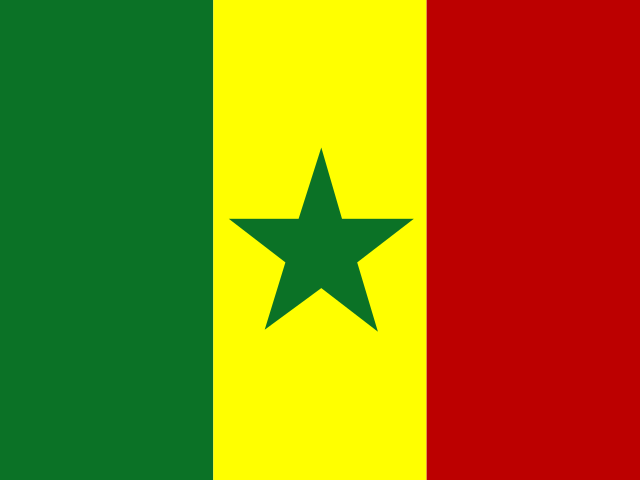
Senegal trivia: 46 questions and answers
The country at a glance
What is the capital of Senegal?
- A. Dakar
- B. Saint-Louis
- C. Touba
- D. Thiès
Show the answer
Dakar. Dakar, on the Cap-Vert peninsula, is the capital and largest city. Saint-Louis was the capital of French West Africa until 1902, and Touba is the holy city of the Mourides.
The westernmost point of mainland Africa is in Senegal.
True or false?
Show the answer
True. True. Pointe des Almadies, on the Cap-Vert peninsula at the edge of Dakar, is the westernmost point of mainland Africa.
History
Which empire broke apart after the Battle of Danki in 1549?
- A. The Jolof Empire
- B. The Roman Empire
- C. The Ottoman Empire
- D. The Aztec Empire
Show the answer
The Jolof Empire. The Jolof Empire. At Danki, Amari Ngoné Fall of Cayor defeated the ruler of Jolof, and Cayor and the other Wolof kingdoms became independent.
In 1902 Dakar replaced which city as the capital of French West Africa?
- A. Saint-Louis
- B. Bamako
- C. Abidjan
- D. Conakry
Show the answer
Saint-Louis. Saint-Louis, the old colonial capital on its island in the Senegal River, lost the role to Dakar in 1902.
In 1677 France captured the island of Gorée from which country?
- A. The Netherlands
- B. Spain
- C. Denmark
- D. Sweden
Show the answer
The Netherlands. The Netherlands. A French fleet took Gorée from the Dutch in 1677. Apart from a few periods of British occupation, it stayed French until independence.
Senegal first became independent in 1960 as part of the Mali Federation, together with French Sudan.
True or false?
Show the answer
True. True. The Mali Federation became independent on 20 June 1960, but Senegal left it two months later, and French Sudan became the Republic of Mali.
In 1914 Blaise Diagne became the first person of full West African descent to sit in which parliament?
- A. The French Chamber of Deputies
- B. The British House of Commons
- C. The Portuguese Cortes
- D. The United States Congress
Show the answer
The French Chamber of Deputies. The French Chamber of Deputies. Diagne, born on Gorée, represented Senegal's Four Communes there from 1914 to 1934.
Senegal has been producing oil since the 1960s.
True or false?
Show the answer
False. False. Senegal became an oil producer only in June 2024, when oil began to flow from the Sangomar field, about 100 km south of Dakar.
Food and drink
What are the two main ingredients of thieboudienne (ceebu jën), Senegal's national dish?
- A. Rice and fish
- B. Millet and lamb
- C. Couscous and chicken
- D. Bread and beans
Show the answer
Rice and fish. Rice and fish: 'ceeb' means rice and 'jën' means fish in Wolof. The fish and vegetables are cooked in tomato sauce, and the rice absorbs the sauce.
In 2021 UNESCO added ceebu jën to its list of the Intangible Cultural Heritage of Humanity.
True or false?
Show the answer
True. True. 'Ceebu jën, a culinary art of Senegal' was inscribed in 2021. UNESCO says the dish began in the fishing communities of the island of Saint-Louis.
Which ingredient is used in large amounts in chicken yassa?
- A. Onions
- B. Coconut milk
- C. Potatoes
- D. Cheese
Show the answer
Onions. Onions. The chicken is marinated with lemon or lime juice, mustard and a great heap of sliced onions, which are then cooked down into a soft, tangy sauce.
What gives mafé its thick, rich sauce?
- A. Peanut paste
- B. Cream
- C. Coconut
- D. Cheese
Show the answer
Peanut paste. Peanut paste. Mafé is meat stewed in a peanut and tomato sauce, and peanuts are Senegal's main cash crop.
Bissap, Senegal's favourite juice, is made from which part of a plant?
- A. Dried hibiscus flowers
- B. Baobab bark
- C. Coffee leaves
- D. Tamarind roots
Show the answer
Dried hibiscus flowers. Dried hibiscus flowers, from the roselle plant. They are steeped in water and sweetened to make a deep red drink.
Attaya, the green tea Senegalese friends share, is traditionally served in how many rounds?
- A. Three
- B. One
- C. Five
- D. Seven
Show the answer
Three. Three. The same leaves are used for each round, and each glass is sweeter than the last. The slow ritual is a time for conversation.
Café Touba is coffee roasted and ground together with which spice?
- A. Guinea pepper (djar)
- B. Saffron
- C. Vanilla
- D. Cardamom
Show the answer
Guinea pepper (djar). Guinea pepper (djar), and sometimes cloves. The drink is named after the holy city of Touba.
Ndambé is a sweet dessert of millet and yogurt.
True or false?
Show the answer
False. False. Ndambé is a breakfast sandwich of black-eyed beans in a spicy tomato sauce. The millet and yogurt dessert is thiakry.
Cities
Which city is the holy city of the Mouride Sufi brotherhood?
- A. Touba
- B. Mbour
- C. Ziguinchor
- D. Kédougou
Show the answer
Touba. Touba, founded by Amadou Bamba in 1887. Millions of pilgrims come every year for the Grand Magal.
In which town was Léopold Sédar Senghor, Senegal's first president, born?
- A. Joal
- B. Touba
- C. Kédougou
- D. Tambacounda
Show the answer
Joal. Joal, today part of Joal-Fadiouth on the Petite Côte, where Senghor was born in 1906.
Landmarks
Gorée Island, off Dakar, is best known today as a memorial to what?
- A. The Atlantic slave trade
- B. The First World War
- C. A great earthquake
- D. A famous shipwreck
Show the answer
The Atlantic slave trade. The Atlantic slave trade. Historians debate how many enslaved people passed through the island, but its House of Slaves has become one of the world's best-known memorials to the victims.
The African Renaissance Monument in Dakar shows a man, a woman and what else?
- A. A child
- B. A lion
- C. A horse
- D. A fishing canoe
Show the answer
A child. A child. The bronze group, about 50 m high, stands on one of the Mamelles hills and was unveiled in 2010 for the 50th anniversary of independence.
What colour can the water of Lake Retba turn?
- A. Pink
- B. Green
- C. Black
- D. White
Show the answer
Pink. Pink. Lake Retba is known as the Pink Lake; its colour comes from tiny algae that thrive in its very salty water.
What is the island village of Fadiouth built on?
- A. Shells
- B. Coral
- C. Volcanic rock
- D. Floating reeds
Show the answer
Shells. Shells. Fadiouth stands on piled-up clam and oyster shells, which cover its lanes, and a nearby shell island holds a cemetery shared by Christians and Muslims.
Djoudj National Bird Sanctuary near Saint-Louis is famous mainly for its birds, such as pelicans and flamingos.
True or false?
Show the answer
True. True. Almost 400 bird species have been recorded in the Djoudj National Bird Sanctuary, many of them after crossing the Sahara.
Which metal bridge, opened in 1897, links the island of Saint-Louis to the mainland?
- A. The Faidherbe Bridge
- B. The Senghor Bridge
- C. The Gorée Bridge
- D. The Almadies Bridge
Show the answer
The Faidherbe Bridge. The Faidherbe Bridge, about 507 m long, named after a French colonial governor. The island of Saint-Louis is a World Heritage Site.
In which year was Gorée Island among the first 12 places named World Heritage Sites?
- A. 1978
- B. 1960
- C. 1994
- D. 2010
Show the answer
1978. 1978. Gorée was one of the very first 12 World Heritage Sites.
Fun facts
Which country is almost completely surrounded by Senegal?
- A. The Gambia
- B. Guinea-Bissau
- C. Mali
- D. Mauritania
Show the answer
The Gambia. The Gambia, a long, narrow country along the Gambia River, borders only Senegal and the Atlantic Ocean.
Senegal's first president, Léopold Sédar Senghor, was also famous as what?
- A. A poet
- B. A footballer
- C. A film director
- D. A painter
Show the answer
A poet. A poet. In 1983 he became the first African elected to the Académie française.
What is the nickname of Senegal's national football team?
- A. The Lions of Teranga
- B. The Super Eagles
- C. The Pharaohs
- D. The Black Stars
Show the answer
The Lions of Teranga. The Lions of Teranga, after the Wolof word for hospitality. The Super Eagles are Nigeria, the Pharaohs Egypt and the Black Stars Ghana.
Which team did Senegal beat in the final to win its first Africa Cup of Nations, in February 2022?
- A. Egypt
- B. Cameroon
- C. Morocco
- D. Nigeria
Show the answer
Egypt. Egypt, on penalties after a 0 to 0 draw. The tournament was called the 2021 Africa Cup of Nations but was played in Cameroon in early 2022.
At the 2002 World Cup Senegal beat the defending champions, France, in the opening match.
True or false?
Show the answer
True. True. In its first World Cup ever, Senegal beat France and went on to reach the quarter-finals.
Which sport, called laamb in Wolof, is the most popular sport in Senegal?
- A. Wrestling
- B. Cricket
- C. Rugby
- D. Ice hockey
Show the answer
Wrestling. Wrestling. Senegalese wrestling allows blows with the hands, and top wrestlers are national stars.
Senegal was chosen to host which Olympic event, set for 31 October to 13 November 2026, the first Olympic event ever held in Africa?
- A. The Youth Olympic Games
- B. The Summer Olympic Games
- C. The Winter Olympic Games
- D. The Paralympic Games
Show the answer
The Youth Olympic Games. The Youth Olympic Games. They were first planned for 2022 and moved to 2026 because of the COVID-19 pandemic.
Senegal's coat of arms shows a lion and a baobab tree.
True or false?
Show the answer
True. True. The shield has a lion on one half and a baobab tree on the other; baobabs can live for well over a thousand years.
Which famous motor race usually finished in Dakar from 1979 until 2007?
- A. The Paris-Dakar Rally
- B. The Monte Carlo Rally
- C. The Le Mans 24 Hours
- D. The Mille Miglia
Show the answer
The Paris-Dakar Rally. The Paris-Dakar Rally, which crossed the Sahara and ended near the Pink Lake. Since 2009 it has been held on other continents.
Words
What does the Wolof word 'jën' mean, as in ceebu jën?
- A. Fish
- B. Meat
- C. Water
- D. Bread
Show the answer
Fish. Fish. 'Ceebu jën' means rice and fish, and 'ceebu yàpp' means rice and meat.
What does the Wolof word 'teraanga' (teranga) mean?
- A. Hospitality
- B. Football
- C. Market
- D. Ocean
Show the answer
Hospitality. Hospitality. The Senegalese are proud of their teranga, and the national football team is called the Lions of Teranga.
In Wolof, 'waaw' means 'no'.
True or false?
Show the answer
False. False. 'Waaw' means yes; 'no' is 'déedéet'.
Phrases
How do you say 'thank you' in Wolof?
- A. Jërejëf
- B. Ñaata la?
- C. Baal ma
- D. Wóoy!
Show the answer
Jërejëf. Jërejëf means thank you. Ñaata la? asks the price, baal ma means sorry, and wóoy! is a cry for help.
Someone greets you with 'Salaam aleekum'. What is the usual reply?
- A. Maleekum salaam
- B. Ba beneen yoon
- C. Dégguma
- D. Seer na lool
Show the answer
Maleekum salaam. Maleekum salaam, 'and upon you be peace'. Ba beneen yoon is goodbye, dégguma means I don't understand, and seer na lool means that's very expensive.
'Ñaata la?' is how you ask the price at a market in Wolof.
True or false?
Show the answer
True. True. 'Ñaata la?' means how much is it? If the price seems high, you can say 'seer na lool!', that's very expensive.
What does 'Maa ngi fi', the usual answer to 'Na nga def?', literally mean?
- A. I am here
- B. I am hungry
- C. I am leaving
- D. I am sorry
Show the answer
I am here. 'I am here', which is how you say you are fine.
Local customs and tips
In Senegal it is polite to go straight to your question without a greeting, to save people time.
True or false?
Show the answer
False. False. Greetings are very important, and skipping them is seen as rude. Say hello and ask how the person is before asking anything.
In Senegal it is polite to shake hands and pass things with your left hand.
True or false?
Show the answer
False. False. Use your right hand to shake hands, give, receive and eat; using the left hand for these is considered disrespectful.
Before travelling to which southern region should you check the latest official travel advice, because of a long-running separatist conflict?
- A. Casamance
- B. Cap-Vert
- C. The Petite Côte
- D. Thiès
Show the answer
Casamance. Casamance, south of The Gambia. The conflict has been much quieter in recent years, but travellers are advised to check the latest advice, travel by day and keep to main roads.
As of 2026, what is the official number for the police in Senegal?
- A. 17
- B. 15
- C. 118
- D. 100
Show the answer
17. 17 is the police number, and 15 is for an ambulance.
Malaria is present throughout Senegal, so travellers are advised to protect themselves from mosquitoes and ask a travel clinic about anti-malaria tablets.
True or false?
Show the answer
True. True. Health services such as the CDC advise anti-malaria tablets for Senegal, and a yellow fever vaccination is also recommended.
Answer key
The country at a glance
- A. Dakar
- True
History
- A. The Jolof Empire
- A. Saint-Louis
- A. The Netherlands
- True
- A. The French Chamber of Deputies
- False
Food and drink
- A. Rice and fish
- True
- A. Onions
- A. Peanut paste
- A. Dried hibiscus flowers
- A. Three
- A. Guinea pepper (djar)
- False
Cities
- A. Touba
- A. Joal
Landmarks
- A. The Atlantic slave trade
- A. A child
- A. Pink
- A. Shells
- True
- A. The Faidherbe Bridge
- A. 1978
Fun facts
- A. The Gambia
- A. A poet
- A. The Lions of Teranga
- A. Egypt
- True
- A. Wrestling
- A. The Youth Olympic Games
- True
- A. The Paris-Dakar Rally
Words
- A. Fish
- A. Hospitality
- False
Phrases
- A. Jërejëf
- A. Maleekum salaam
- True
- A. I am here
Local customs and tips
- False
- False
- A. Casamance
- A. 17
- True
More about Senegal
- The trip to SenegalMap, story, food, phrases and a friendly quiz.
- Senegal word searchCities and dishes in large print.
- Senegalese words crosswordLearn a few words while you solve it.
- Colour the flag of SenegalPrint it or colour it in on the screen.
- Senegalese rootsA family guide: history, recipes and words for the grandchildren.
- Before you goPhrases, customs and tips for travellers.
- Printable packLarge print, with a quiz and answers.