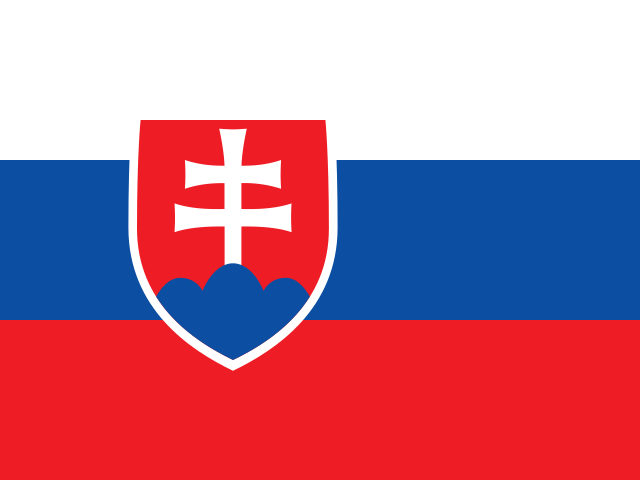
Slovakia trivia: 46 questions and answers
The country at a glance
What is the capital of Slovakia?
- A. Bratislava
- B. Košice
- C. Žilina
- D. Nitra
Show the answer
Bratislava. Bratislava is the capital and largest city, on the Danube in the far west of the country.
Slovakia adopted the euro as its currency on 1 January 2009.
True or false?
Show the answer
True. True. Slovakia replaced the koruna with the euro on 1 January 2009, as the 16th member of the eurozone.
What is the highest mountain in Slovakia?
- A. Gerlachovský štít
- B. Kriváň
- C. Ďumbier
- D. Triglav
Show the answer
Gerlachovský štít. Gerlachovský štít, 2,655 m in the High Tatras, is the highest peak in Slovakia and in the whole Carpathian range. Kriváň and Ďumbier are lower, and Triglav is in Slovenia.
Slovakia has a short coastline on the Adriatic Sea.
True or false?
Show the answer
False. False. Slovakia is landlocked. Its neighbours are Poland, Ukraine, Hungary, Austria and the Czech Republic.
Which is the longest river within Slovakia?
- A. The Váh
- B. The Hron
- C. The Nitra
- D. The Ipeľ
Show the answer
The Váh. The Váh, about 406 km long, rises in the Tatras and flows into the Danube at Komárno. The Hron, Nitra and Ipeľ are all shorter.
History
Which two brothers came to Great Moravia in 863 to teach in a Slavic language?
- A. Cyril and Methodius
- B. Samo and Pribina
- C. Rastislav and Svätopluk
- D. Štúr and Hurban
Show the answer
Cyril and Methodius. Cyril and Methodius, Byzantine missionaries, came at Prince Rastislav's request and created the Glagolitic alphabet.
According to the chronicler Fredegar, what was Samo, who became king of the Slavs around 623, by trade?
- A. A Frankish merchant
- B. A Roman soldier
- C. A Byzantine priest
- D. A Hungarian nobleman
Show the answer
A Frankish merchant. A Frankish merchant: Fredegar says Samo came from Sens and led the Slavs in a revolt against the Avars.
In 1536, with the Ottomans advancing, Bratislava (then Pressburg) was made the capital of the Kingdom of Hungary.
True or false?
Show the answer
True. True. Bratislava was the capital of Hungary from 1536 to 1783, and Hungarian kings were crowned in St Martin's Cathedral.
Who led the group that set out the standard written Slovak language in 1843?
- A. Ľudovít Štúr
- B. Alexander Dubček
- C. Jozef Tiso
- D. Milan Rastislav Štefánik
Show the answer
Ľudovít Štúr. Ľudovít Štúr and his friends based written Slovak on the central Slovak dialects. With small changes, it is the Slovak written today.
Alexander Dubček, the leader of the 1968 Prague Spring, was a Czech from Prague.
True or false?
Show the answer
False. False. Dubček was a Slovak. He led Czechoslovakia's communist party and promised 'socialism with a human face' until the Warsaw Pact invasion of August 1968.
Which town was the centre of the Slovak National Uprising of 1944?
- A. Banská Bystrica
- B. Bratislava
- C. Košice
- D. Trnava
Show the answer
Banská Bystrica. Banská Bystrica was the centre of the uprising, which began on 29 August 1944 and was crushed after 60 days of fighting.
What is the peaceful split of Czechoslovakia on 1 January 1993 often called?
- A. The Velvet Divorce
- B. The Prague Spring
- C. The Iron Curtain
- D. The Vienna Award
Show the answer
The Velvet Divorce. The Velvet Divorce, a play on the Velvet Revolution of 1989 that ended communist rule.
Food and drink
Bryndzové halušky, the national dish, are potato dumplings served with what?
- A. Bryndza, a soft sheep's cheese
- B. Tomato sauce and basil
- C. Sweet poppy seeds
- D. Beef goulash
Show the answer
Bryndza, a soft sheep's cheese. Bryndza, a soft sheep's cheese with a strong, tangy taste, usually topped with crisp bacon.
In Slovakia, what is mixed with the potato dumplings in strapačky instead of bryndza?
- A. Stewed sauerkraut
- B. Tomatoes
- C. Minced beef
- D. Spinach
Show the answer
Stewed sauerkraut. Stewed sauerkraut: strapačky are the same dumplings as halušky, served with cabbage instead of cheese.
Oštiepok is traditionally a smoked cheese made from sheep's milk.
True or false?
Show the answer
True. True. Oštiepok is traditionally made from sheep's milk, though today cow's milk is often mixed in. It is protected in the European Union as Slovenský oštiepok.
What shape is parenica cheese?
- A. A snail-shaped spiral of strips
- B. A large round wheel
- C. A small white cube
- D. A long thin sausage
Show the answer
A snail-shaped spiral of strips. A snail-shaped spiral of strips: the steamed cheese is made in strips and rolled up, usually lightly smoked.
Which Slovak town's trdelník is protected by the European Union?
- A. Skalica
- B. Poprad
- C. Levoča
- D. Komárno
Show the answer
Skalica. Skalica: Skalický trdelník was registered as a protected geographical indication in December 2007.
Kofola, the herbal cola popular in Slovakia, was created in Czechoslovakia in 1959.
True or false?
Show the answer
True. True. It was invented at a Czechoslovak research institute in 1959 to use surplus caffeine from coffee roasting and went on sale in 1960.
Part of the historic Tokaj wine region lies in Slovakia.
True or false?
Show the answer
True. True. Most of the Tokaj region is in Hungary, but seven villages in south-eastern Slovakia make Tokaj wine, and EU rules allow both countries to use the name.
Cities
Which is Slovakia's second-largest city?
- A. Košice
- B. Prešov
- C. Žilina
- D. Nitra
Show the answer
Košice. Košice, with about 230,000 people, is second after Bratislava. Prešov is third and Žilina fourth.
Which town is nicknamed 'Little Rome' because of its many churches?
- A. Trnava
- B. Poprad
- C. Prešov
- D. Trenčín
Show the answer
Trnava. Trnava, 47 km north-east of Bratislava, has so many churches inside its walls that it is called 'Little Rome'.
Which old silver-mining town was built inside the crater of an ancient volcano?
- A. Banská Štiavnica
- B. Levoča
- C. Bardejov
- D. Trnava
Show the answer
Banská Štiavnica. Banská Štiavnica lies in a huge caldera. In the Middle Ages it was the main producer of silver and gold in the Kingdom of Hungary.
Bratislava and Vienna are about 55 km apart.
True or false?
Show the answer
True. True. They are about 55 km apart along the Danube. Apart from Rome and Vatican City, no two European capitals are closer.
Landmarks
What sits on top of the spire of St Martin's Cathedral in Bratislava?
- A. A replica of the Hungarian crown
- B. A golden rooster
- C. A statue of St Martin on a horse
- D. A double cross
Show the answer
A replica of the Hungarian crown. A replica of the Hungarian crown recalls the coronations held in the cathedral between 1563 and 1830.
The Basilica of St. James in Levoča is famous for what?
- A. A carved wooden altar more than 18 metres high
- B. A Roman inscription on its wall
- C. Walls painted with white patterns
- D. A floor made of ice
Show the answer
A carved wooden altar more than 18 metres high. A carved wooden altar more than 18 metres high: the main altar, by the workshop of Master Paul of Levoča, was finished in 1517 and is 18.62 metres tall.
Devín Castle stands where the Danube meets which river?
- A. The Morava
- B. The Váh
- C. The Hron
- D. The Tisza
Show the answer
The Morava. The Morava flows into the Danube below Devín Castle, on the border with Austria.
As of 2026, Spiš Castle is part of a UNESCO World Heritage Site.
True or false?
Show the answer
True. True. As of 2026, it belongs to the site 'Levoča, Spišský Hrad and the Associated Cultural Monuments'.
As of 2026, Bratislava Castle is on the UNESCO World Heritage List.
True or false?
Show the answer
False. False. As of 2026, Slovakia's World Heritage Sites include Banská Štiavnica, Levoča and Spiš Castle, Bardejov and Vlkolínec, but not Bratislava Castle.
What did Roman soldiers leave on the rock below Trenčín Castle in 179 AD?
- A. An inscription
- B. A bath house
- C. A bridge
- D. An amphitheatre
Show the answer
An inscription. An inscription recording the Second Legion's victory at Laugaricio, the Roman name for Trenčín.
Fun facts
As of 2023, Slovakia made more cars per person than any other country in the world.
True or false?
Show the answer
True. True. In 2023 Slovakia made about 1.08 million cars, with a population of about 5.4 million.
Bratislava is the only national capital that borders two other countries. Which two?
- A. Austria and Hungary
- B. Austria and the Czech Republic
- C. Hungary and Ukraine
- D. Poland and the Czech Republic
Show the answer
Austria and Hungary. Austria and Hungary: Bratislava lies right where the three countries meet.
Which famous American artist's parents came from the village of Miková in north-eastern Slovakia?
- A. Andy Warhol
- B. Jackson Pollock
- C. Norman Rockwell
- D. Mark Rothko
Show the answer
Andy Warhol. Andy Warhol's parents came from Miková, and a museum of his work opened in nearby Medzilaborce in 1991.
Štefan Banič, a Slovak miner in the United States, received a US patent in 1914 for what?
- A. An early parachute
- B. A telephone
- C. A light bulb
- D. A safety razor
Show the answer
An early parachute. An early parachute: his patent was granted on 25 August 1914.
What is a fujara?
- A. A very long shepherd's flute
- B. A folk dance
- C. A wooden church
- D. A kind of cheese
Show the answer
A very long shepherd's flute. A very long shepherd's flute, 160 to 200 cm long with only three finger holes, recognised by UNESCO as intangible heritage.
One of the three mountain ranges shown by the hills on Slovakia's coat of arms lies in Hungary.
True or false?
Show the answer
True. True. The hills stand for the Tatra, the Fatra and the Matra, and the Matra is in Hungary.
Words
What does 'ďakujem' mean?
- A. Thank you
- B. Hello
- C. Goodbye
- D. Sorry
Show the answer
Thank you. 'Ďakujem' means thank you, and you answer with 'prosím', you're welcome.
You see a sign to the 'hrad'. What will you find there?
- A. A castle
- B. A railway station
- C. A market
- D. A hospital
Show the answer
A castle. A castle: 'hrad' means castle, as in Spišský hrad, Spiš Castle.
In Slovak, 'nie' means yes.
True or false?
Show the answer
False. False. 'Nie' means no, and 'áno' means yes.
Phrases
What do Slovaks say to each other before eating together?
- A. Dobrú chuť
- B. Na zdravie
- C. Dobrú noc
- D. Do videnia
Show the answer
Dobrú chuť. 'Dobrú chuť' means enjoy your meal. 'Na zdravie' is cheers, 'Dobrú noc' good night and 'Do videnia' goodbye.
How do you ask 'How much is this?' in Slovak?
- A. Koľko to stojí?
- B. Ako sa máte?
- C. Hovoríte po anglicky?
- D. Kde sú tu záchody?
Show the answer
Koľko to stojí?. 'Koľko to stojí?' means how much is this? The others mean how are you?, do you speak English? and where are the toilets?
Local customs and tips
What is the official number that reaches police, ambulance and fire services in Slovakia?
- A. 112
- B. 155
- C. 158
- D. 150
Show the answer
112. 112 is the official emergency number for all services, as across the European Union. 155 reaches only the ambulance, 158 only the police and 150 only the fire service.
What do you need before driving on a Slovak motorway?
- A. A prepaid electronic vignette
- B. A special mountain permit
- C. Snow chains all year round
- D. A Slovak driving licence
Show the answer
A prepaid electronic vignette. A prepaid electronic vignette, bought online at eznamka.sk or at a point of sale. Driving without one can bring a heavy fine.
In Slovakia, drivers may legally drink one small beer before driving.
True or false?
Show the answer
False. False. Slovakia has a zero limit: any alcohol in a driver's blood can bring a fine of up to 1,300 euros and the loss of the licence.
Why should hikers in the Slovak mountains check their travel insurance?
- A. Mountain rescue can cost up to 1,000 euros
- B. Hiking is forbidden without it
- C. Mountain huts only accept insured guests
- D. Trains to the mountains require it
Show the answer
Mountain rescue can cost up to 1,000 euros. Mountain rescue can cost up to 1,000 euros if the Mountain Rescue Service (HZS) has to help you, so check that your insurance covers it.
What is a usual tip in a Slovak restaurant?
- A. Rounding up, around 5 to 10%
- B. 20 to 25%
- C. Nothing, as tipping is rude
- D. Exactly 15%, by law
Show the answer
Rounding up, around 5 to 10%. Rounding up, around 5 to 10% of the bill is customary, but it is not compulsory.
The high-mountain trails of Tatra National Park close for several months each year.
True or false?
Show the answer
True. True. They close for about seven months over winter and spring. In 2026 they reopened on 1 June.
Answer key
The country at a glance
- A. Bratislava
- True
- A. Gerlachovský štít
- False
- A. The Váh
History
- A. Cyril and Methodius
- A. A Frankish merchant
- True
- A. Ľudovít Štúr
- False
- A. Banská Bystrica
- A. The Velvet Divorce
Food and drink
- A. Bryndza, a soft sheep's cheese
- A. Stewed sauerkraut
- True
- A. A snail-shaped spiral of strips
- A. Skalica
- True
- True
Cities
- A. Košice
- A. Trnava
- A. Banská Štiavnica
- True
Landmarks
- A. A replica of the Hungarian crown
- A. A carved wooden altar more than 18 metres high
- A. The Morava
- True
- False
- A. An inscription
Fun facts
- True
- A. Austria and Hungary
- A. Andy Warhol
- A. An early parachute
- A. A very long shepherd's flute
- True
Words
- A. Thank you
- A. A castle
- False
Phrases
- A. Dobrú chuť
- A. Koľko to stojí?
Local customs and tips
- A. 112
- A. A prepaid electronic vignette
- False
- A. Mountain rescue can cost up to 1,000 euros
- A. Rounding up, around 5 to 10%
- True
More about Slovakia
- The trip to SlovakiaMap, story, food, phrases and a friendly quiz.
- Slovakia word searchCities and dishes in large print.
- Slovak words crosswordLearn a few words while you solve it.
- Colour the flag of SlovakiaPrint it or colour it in on the screen.
- Slovak rootsA family guide: history, recipes and words for the grandchildren.
- Before you goPhrases, customs and tips for travellers.
- Printable packLarge print, with a quiz and answers.