World Stroll
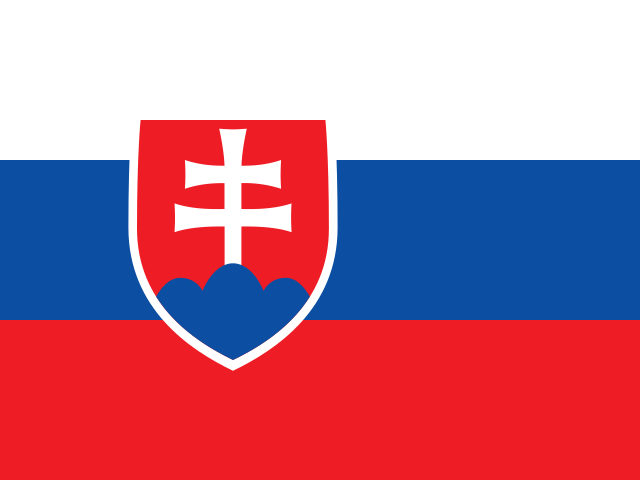
Flag of Slovakia
Travel guide

Learn Slovakia before you go

A small, mountainous country in the heart of Europe, with the granite peaks of the High Tatras, many castles, painted wooden villages and a capital on the Danube.
Take the full trip
CapitalBratislava
CurrencyEuro (€), since 1 January 2009
Official languageSlovak
Drives on theRight
Calling code+421

10 phrases to learn

In Slovak. Capital letters show the stressed part. Tap the heart to practise a phrase later.

Dobrý deň
DOH-bree dehn
Hello, good day
The polite greeting for most of the day, in shops and with strangers
Dobré ráno
DOH-breh RAA-noh
Good morning
Greeting someone early in the morning
Dobrý večer
DOH-bree VEH-chehr
Good evening
Greeting someone in the evening
Dobrú noc
DOH-broo nohts
Good night
Saying goodnight before bed
Do videnia
doh VEE-deh-nyah
Goodbye
Leaving a shop, restaurant or meeting
Ako sa máte?
AH-koh sah MAA-teh
How are you?
Asking politely after someone's health
Ďakujem, dobre
JAH-koo-yehm DOH-breh
Fine, thank you
Answering 'How are you?'
Volám sa ...
VOH-laam sah
My name is ...
Introducing yourself
Teší ma
TYEH-shee mah
Pleased to meet you
Meeting someone for the first time
Prepáčte
PREH-paach-tyeh
Excuse me, sorry
Getting someone's attention or apologising

At the table

  • Before eating, people wish each other 'Dobrú chuť' (enjoy your meal).
  • When glasses are raised, everyone says 'Na zdravie' (to your health).
  • Lunch, usually eaten between about 11:30 and 13:30, is traditionally the main meal of the day: a soup followed by a main course.
  • If you are invited to someone's home, it is customary to bring a bottle of wine or other drink as a gift.
  • In restaurants and bars, people usually round up the bill or leave around 5 to 10%, but it is not compulsory.

Local tips

Euros and tips

Slovakia has used the euro since 1 January 2009. In restaurants and bars people usually round up the bill or leave around 5 to 10%, but tipping is not compulsory.

Buy a motorway e-vignette before you drive

Motorways and some expressways can only be used with a prepaid electronic vignette, registered to your vehicle's number plate. Buy it online at the official site eznamka.sk or at a point of sale before you join the motorway, or risk a heavy fine.

Not a drop of alcohol when driving

Slovakia has a zero limit for drivers. Any alcohol in your blood can bring a fine of up to 1,300 euros and the loss of your licence. Dipped headlights must also be on at all times, day and night.

Check your insurance before hiking

If the Mountain Rescue Service (HZS) has to help you, you may have to pay costs of up to 1,000 euros, so make sure your travel insurance covers mountain rescue. Brown bears live in many mountain and forest areas.

High Tatra trails close in winter and spring

The high-mountain trails of Tatra National Park close for months over winter and spring: in 2026 they reopened on 1 June, after about seven months. Check the park's website before planning a high walk, and stay on marked trails.

Emergency numbers

112 is the official emergency number for police, ambulance and fire, free from any phone, as everywhere in the European Union. You can also call 155 for an ambulance, 158 for the police and 150 for the fire service.

Lunch is the main meal

Lunch, usually eaten between about 11:30 and 13:30, is traditionally the main meal of the day, and it usually means a soup followed by a main course. Plan your big meal of the day around it.

Dishes to try

  • Bryndzové halušky: Small, soft boiled lumps of potato dough, tossed with bryndza, a soft and tangy sheep's cheese, and topped with crisp fried bacon. It is considered the national dish.
  • Bryndzové pirohy: Half-moon dumplings filled with bryndza cheese mixed with mashed potato, served with more bryndza thinned with milk or sour cream, and topped with bacon or fried onion.
  • Strapačky: The same potato dumplings as halušky, but mixed with stewed sauerkraut instead of bryndza cheese.
  • Kapustnica (sauerkraut soup) (kapustnica): A thick, sour soup of fermented cabbage, usually with smoked meat, sausage and dried mushrooms. Every region, valley and village cooks it a little differently.
  • Segedínsky guláš (segedínsky guláš): A stew of pork and sauerkraut finished with cream or sour cream, usually served with slices of steamed bread dumpling (knedľa).
  • Vyprážaný syr (fried cheese) (vyprážaný syr): A thick slice of cheese dredged in flour, dipped in egg, coated in breadcrumbs and deep-fried until golden, with a soft, melting inside.
  • Zemiakové placky (potato pancakes) (zemiakové placky): Pancakes of grated potato fried in oil until crisp and golden, eaten hot on their own or as a side dish.
  • Lokše (lokše): Thin flatbreads of cooked potato and flour baked dry on a hot plate. They are spread with goose fat, filled with sauerkraut or goose liver, or served with a goose feast.

Cities to see

  • Bratislava (capital): Bratislava Castle above the Danube, St Martin's Cathedral, where Hungarian kings were crowned, Its compact, walkable Old Town.
  • Košice: The Cathedral of St. Elizabeth, the largest church in Slovakia, Its long main street for walking, Steelmaking.
  • Prešov: The ruins of Šariš Castle nearby, Slovakia's only salt mining company, Solivary, The seat of the Greek Catholic Church.
  • Žilina: The Privilegium pro Slavis of 1381, Budatín Castle, A large Kia car plant.
  • Nitra: Zobor hill above the town, Its role in Great Moravian history, Its long tradition of farming.
  • Banská Bystrica: The Museum of the Slovak National Uprising, Its colourful main square, Easy access to the mountains.

Landmarks and the city map are on the Slovakia trip