World Stroll
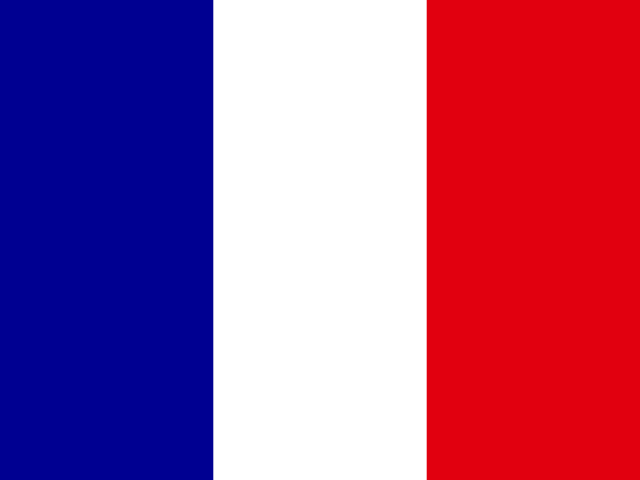
Flag of France
Family roots

Discover your French roots

Cathedrals and castles, cafés and cheeses, and a way of life built around a good meal.

France is the largest country in the European Union. Its mainland is roughly six-sided, so the French often call it 'l'Hexagone': it runs from the English Channel and the Atlantic coast to the Alps, the Pyrenees and the sunny Mediterranean shore.

Over two thousand years France has been a Roman province, a powerful kingdom and the home of a revolution that spread the ideas of liberty and equality around the world. Kings built Versailles, Napoleon built an empire, and engineers built the Eiffel Tower.

Questions to ask the older generation

Memories fade faster than photos. Ask these over a meal or a phone call, and write the answers down.

  1. Which town or region of France did our family come from? Was it near Marseille, Lyon, Toulouse?
  2. Who was the first in the family to leave France, when, and why?
  3. Which dishes from France were cooked at home? Did anyone make Baguette or Croissant?
  4. Does anyone in the family still speak French, or use a few words of it?
  5. Were there songs, prayers, games or holidays from France that the family kept?
  6. Are there old photos, letters or documents from France? Who has them?
  7. If you could visit France together, where would you go first?

A short history of France

From Roman Gaul to the modern republic, France has been at the centre of European history, and many of its turning points still shape the world today.

  1. 52 BC

    Vercingetorix surrenders at Alesia

    The Gaulish chief Vercingetorix led a great revolt against Julius Caesar but surrendered after the siege of Alesia. Gaul became part of the Roman world for the next five centuries.
  2. 1066

    William of Normandy conquers England

    William, Duke of Normandy, won the Battle of Hastings and became king of England. For centuries afterwards French was the language of the English court.

  3. 1429

    Joan of Arc frees Orléans

    During the Hundred Years' War, a young peasant woman, Joan of Arc, helped the French army end the English siege of Orléans. She later became a national heroine and a saint.

  4. 1789

    The storming of the Bastille

    On 14 July 1789 crowds in Paris stormed the Bastille prison, a symbol of royal power. The French Revolution had begun, and 14 July is now the national day.

  5. 1889

    The Eiffel Tower opens

    Gustave Eiffel's iron tower was built for the Paris world's fair of 1889, held a hundred years after the Revolution. Many Parisians first thought it was ugly.

  6. 1958

    The Fifth Republic begins

    A new constitution, shaped by General Charles de Gaulle, created a strong president. France is still governed under this Fifth Republic.

  7. 1998

    France wins the World Cup at home

    France hosted the football World Cup and won it for the first time, beating Brazil 3 to 0 in the final near Paris.

  8. 2024

    Paris hosts the Olympic Games

    Paris hosted the Summer Olympics for the third time, after 1900 and 1924. That December, Notre-Dame reopened after the fire of 2019.

Family recipes to cook together

French words to teach the grandchildren

Greetings

  • mercimair-SEEthank you

Basics

  • ouiWEEyes
  • nonNOHN (nasal, the n is barely said)no

Time

  • aujourd'huioh-zhoor-DWEEtoday
  • demainduh-MAN (nasal)tomorrow

Food and drink

  • eauOHwater
  • painPAN (nasal)bread
  • vinVAN (nasal)wine
  • fromagefroh-MAHZHcheese
  • cafékah-FAYcoffee (usually an espresso), or a café
  • l'additionlah-dee-SYOHNthe bill (in a restaurant)

Travel

  • gareGAHRtrain station

Towns and regions

  • Paris, Île-de-France: The Eiffel Tower, The Louvre.
  • Marseille, Provence-Alpes-Côte d'Azur: The Old Port, Bouillabaisse.
  • Lyon, Auvergne-Rhône-Alpes: Gastronomy and bouchons, The Festival of Lights in December.
  • Toulouse, Occitanie: Pink brick buildings, Airbus.
  • Nice, Provence-Alpes-Côte d'Azur: The Promenade des Anglais, Its winter carnival.
  • Bordeaux, Nouvelle-Aquitaine: Wine, Place de la Bourse and its water mirror.
  • Strasbourg, Grand Est (Alsace): The European Parliament, Its Gothic cathedral.
  • Lille, Hauts-de-France: Flemish architecture, A giant flea market every September.
  • Avignon, Provence-Alpes-Côte d'Azur: The Palace of the Popes, The Pont d'Avignon.
  • Reims, Grand Est (Champagne): Reims Cathedral, Champagne cellars.
  • Rennes, Brittany: Half-timbered houses, Galettes and crêpes.

A heritage evening with the family

Cook one of the recipes, print the large-print pack about France, and finish with the big-screen quiz or the words crossword. Grandchildren can colour the flag.
More about France