 Austria
 Germany
 Poland
 Slovakia
Cyril and Methodius arrive
Prince Rastislav of Great Moravia asked the Byzantine emperor for teachers. The brothers Cyril and Methodius came, bringing the Glagolitic alphabet and a church service in a Slavic language.
A free large-print PDF. Choose what goes in: facts, map, history, dishes and recipes, phrases, fun facts, a quiz with or without answers. Made for clubs, care homes, libraries and family afternoons.
Czechia, also called the Czech Republic, is a landlocked country in Central Europe. It is made of three historical lands: Bohemia in the west, a basin drained by the Vltava and Elbe rivers and ringed by low mountains; Moravia in the east, hilly and known for its vineyards; and a small part of Silesia in the northeast. Rain that falls here flows to three different seas: the North Sea, the Baltic and the Black Sea.
Slavs settled the land in the early Middle Ages. The Přemyslid dukes built a Bohemian state that became a kingdom, and in the 14th century King Charles IV made Prague one of the great cities of Europe. For almost four centuries the Czech lands were ruled by the Habsburgs. In 1918 Czechs and Slovaks founded Czechoslovakia, which lived through Nazi occupation, four decades of communist rule and the peaceful Velvet Revolution of 1989. On 1 January 1993 the country split peacefully into Czechia and Slovakia.
Today Czechia is a parliamentary republic of about 10.9 million people. It joined NATO in 1999 and the European Union in 2004, but it still uses its own currency, the Czech koruna. As of September 2026 it has 17 places on the UNESCO World Heritage List, from the historic centre of Prague to Baroque gardens and a modernist villa.
The Czech story runs from a Slavic realm that welcomed two Greek missionaries, through the kingdom of Bohemia and the golden age of Charles IV, the Hussite wars and almost four centuries of Habsburg rule, to Czechoslovakia, the Velvet Revolution and a peaceful split in 1993.
Prince Rastislav of Great Moravia asked the Byzantine emperor for teachers. The brothers Cyril and Methodius came, bringing the Glagolitic alphabet and a church service in a Slavic language.
Duke Wenceslas of Bohemia was killed, probably in 935, and legend says his younger brother Boleslaus was behind it. He became the patron saint of the Czech state and the 'Good King Wenceslas' of the English Christmas carol.
Frederick II, then King of Sicily and later Holy Roman Emperor, granted Ottokar I and his heirs the hereditary title of King of Bohemia. The Kingdom of Bohemia lasted in law until the end of the First World War.
King Charles IV, who also became Holy Roman Emperor, founded a university in Prague. Today it is one of the oldest universities in the world still in continuous operation.
The Prague preacher and church reformer Jan Hus was burned as a heretic at the Council of Constance on 6 July 1415. His followers, the Hussites, soon rose up in Bohemia.
On 30 July 1419 a crowd of Hussites threw town councillors out of the windows of Prague's New Town Hall. It started the Hussite Wars, in which the Hussites defeated five crusades sent against them.
King Louis II died fighting the Ottomans at the Battle of Mohács, and the crown of Bohemia passed to Ferdinand I of Habsburg. The Habsburgs ruled the Czech lands until 1918.
Protestant nobles threw two royal governors and their secretary out of a window of Prague Castle on 23 May 1618. All three survived, but the revolt that followed started the Thirty Years' War.
On 8 November 1620, just outside Prague, the Bohemian rebels were crushed by the Catholic army of Emperor Ferdinand II. Protestants had to convert or leave, and Habsburg rule grew much stronger.
As Austria-Hungary collapsed at the end of the First World War, independence was proclaimed in Prague on 28 October 1918. Tomáš Garrigue Masaryk became the first president of Czechoslovakia.
On 30 September 1938 Germany, Britain, France and Italy agreed in Munich that Germany could take the Sudetenland, the border region where about three million mostly German-speaking people lived. Czechoslovakia was not at the table.
In February 1948 the Communist Party, backed by the Soviet Union, took full power. One-party rule lasted for the next 41 years.
Party leader Alexander Dubček tried to build 'socialism with a human face', with more freedom of speech and travel. On 21 August 1968 troops of the Soviet Union and four other Warsaw Pact countries invaded to stop the reforms.
Peaceful protests began on 17 November 1989 and ended 41 years of communist rule. On 29 December the playwright and dissident Václav Havel became president.
Czechoslovakia was peacefully dissolved at the end of 31 December 1992, a split often called the Velvet Divorce. On 1 January 1993 the Czech Republic and Slovakia became independent countries.
After joining NATO in 1999, the Czech Republic became a member of the European Union in 2004 and joined the Schengen area in 2007.
Czech cooking is hearty Central European food built on pork, beef, duck and goose, rich sauces, cabbage and, above all, dumplings. A traditional lunch, the main meal of the day, starts with a hot soup and continues with a main course of meat, sauce and a side on the same plate. Sweet pastries filled with fruit, poppy seed or curd cheese are more often eaten with afternoon coffee than as a dessert. As of September 2026, Czechs drink more beer per person than any other nation, and the golden pilsner style was born in the city of Plzeň.
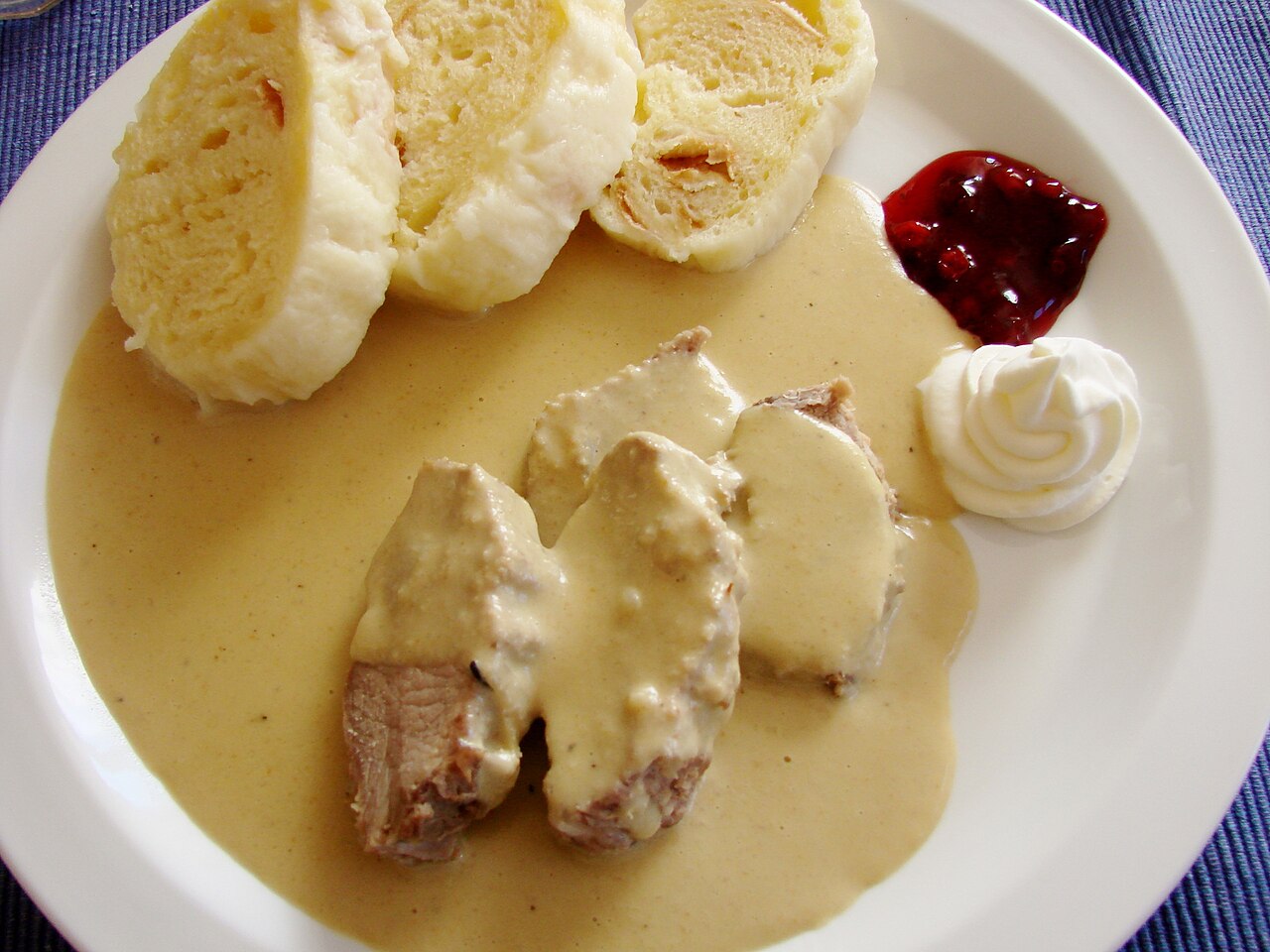
Slices of slow-cooked beef in a smooth, golden sauce made from root vegetables (carrot, parsley root, celeriac and onion) blended with cream and spices. It is served with bread dumplings, a spoon of whipped cream, cranberry sauce and a slice of lemon.
Svíčková is the Czech word for tenderloin, but the dish is usually made with cheaper beef topside. The name is sometimes wrongly translated as 'candle sauce', because svíčka means candle.
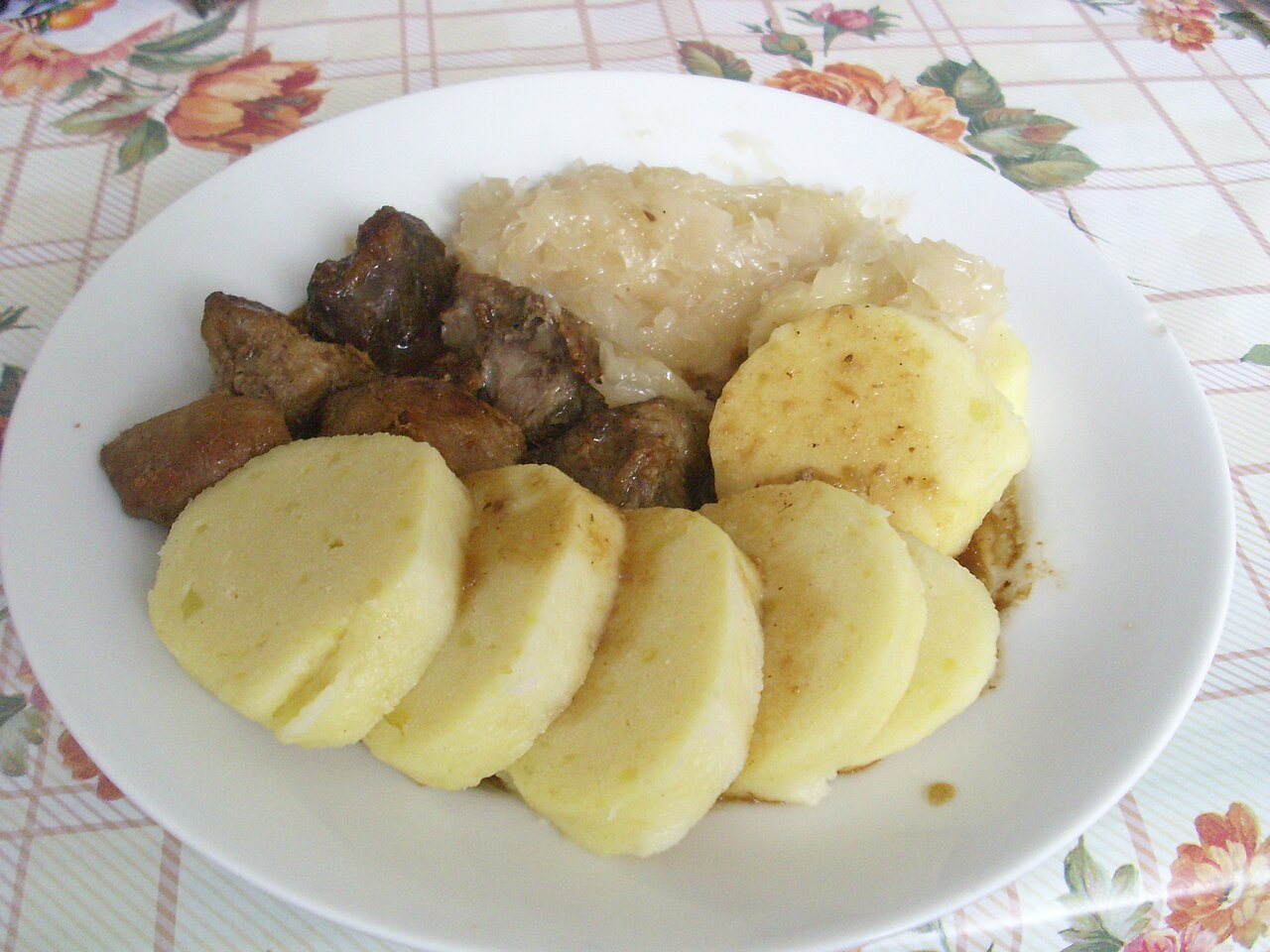
Roast pork seasoned with caraway and garlic, served with slices of dumpling and sweet-and-sour cabbage, with the meat juices poured over. It is often called the most typical Czech dish.
The nickname simply lists the three parts of the plate: pork, dumpling, cabbage.
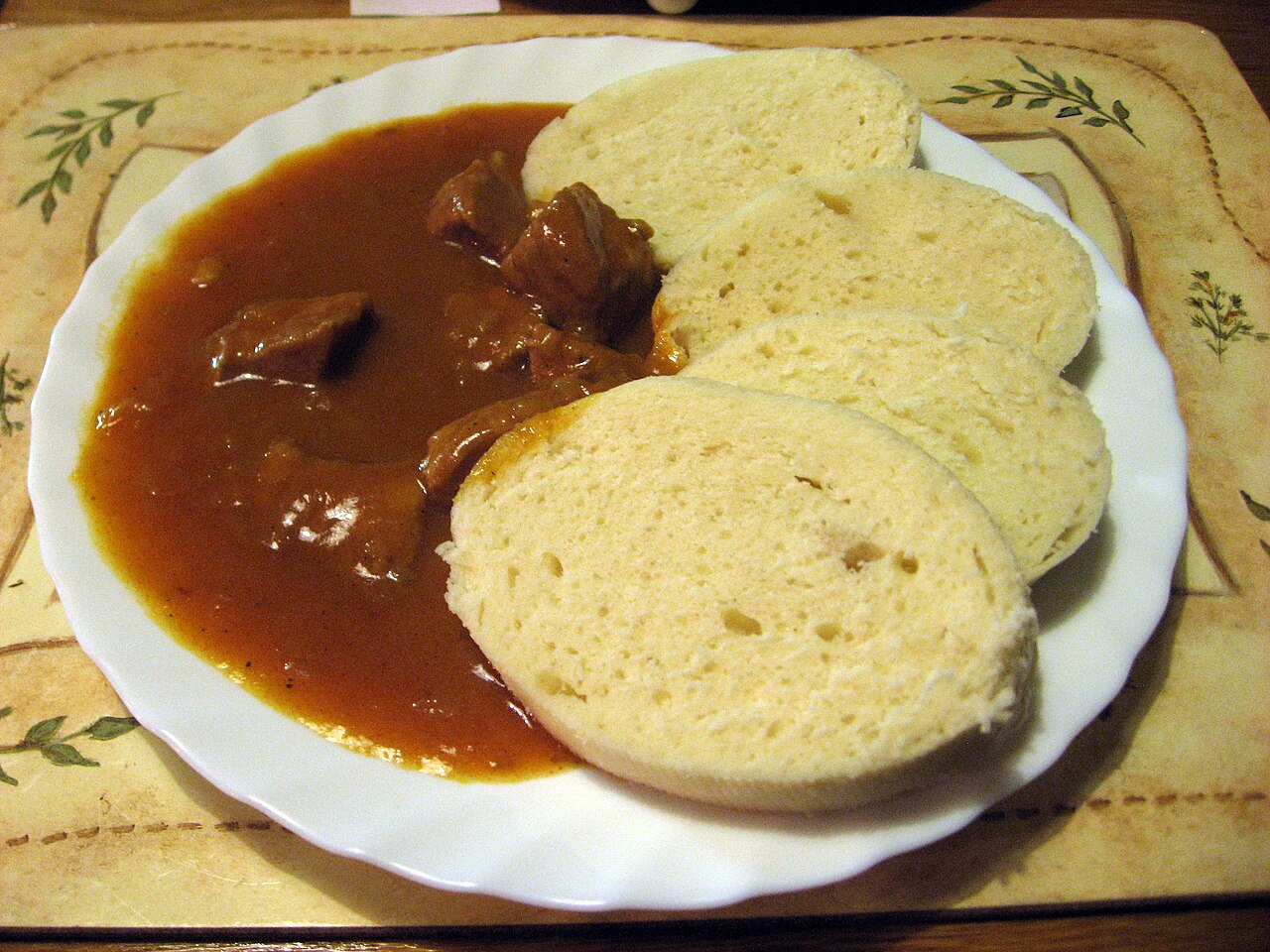
A thick stew of beef or pork cooked with onions and spices, usually served with bread dumplings or bread.
Czech guláš is a stew. The Hungarian gulyás is closer to a soup, which Czechs call gulášovka.
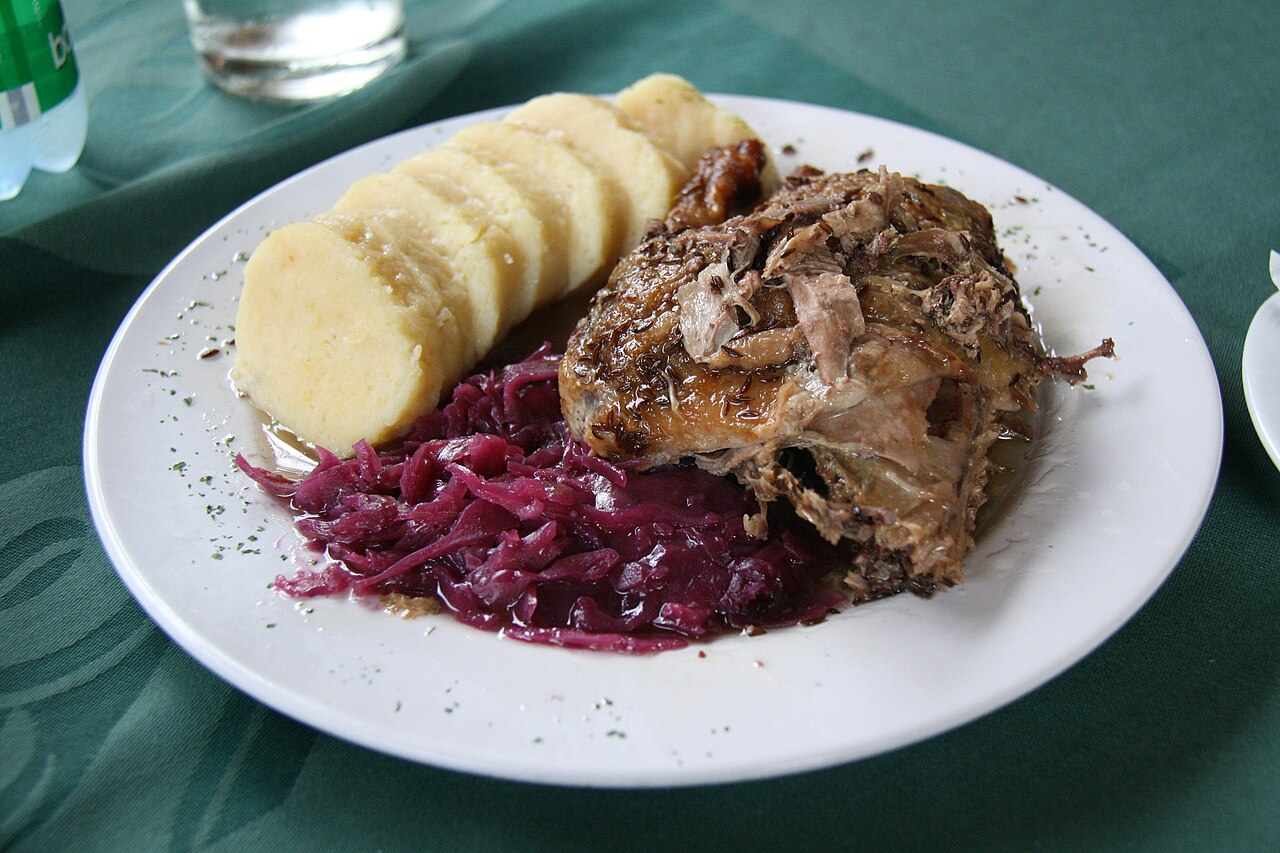
A whole duck roasted until the skin is crisp, served with braised red cabbage and bread or potato dumplings.
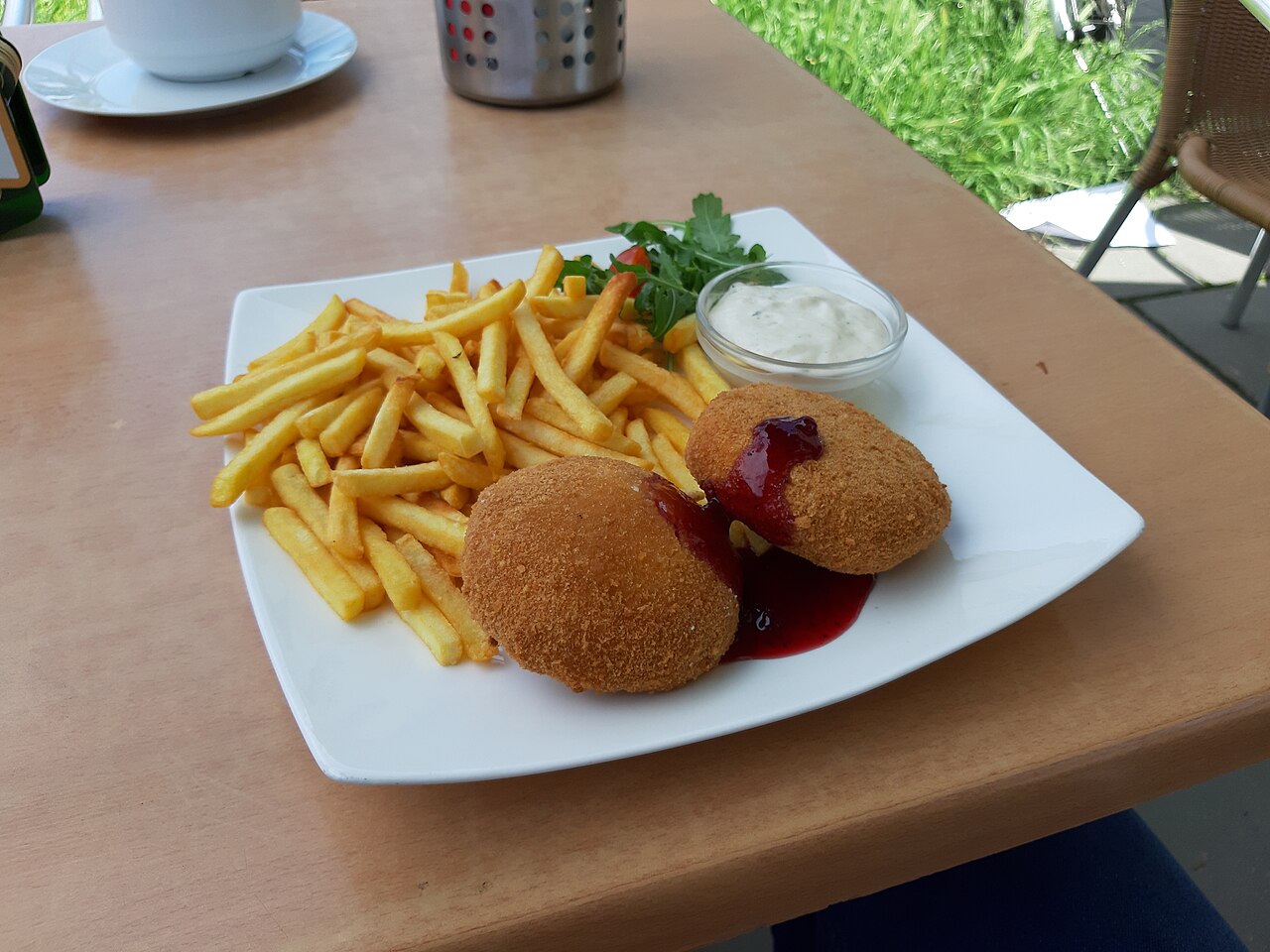
A thick slice of cheese, usually Edam, coated in flour, egg and breadcrumbs and fried until golden and melting inside. It comes with tartar sauce and potatoes or chips, and is a favourite street food and canteen lunch.
Made with Hermelín, a soft cheese like Camembert, the dish changes its name to smažený hermelín.
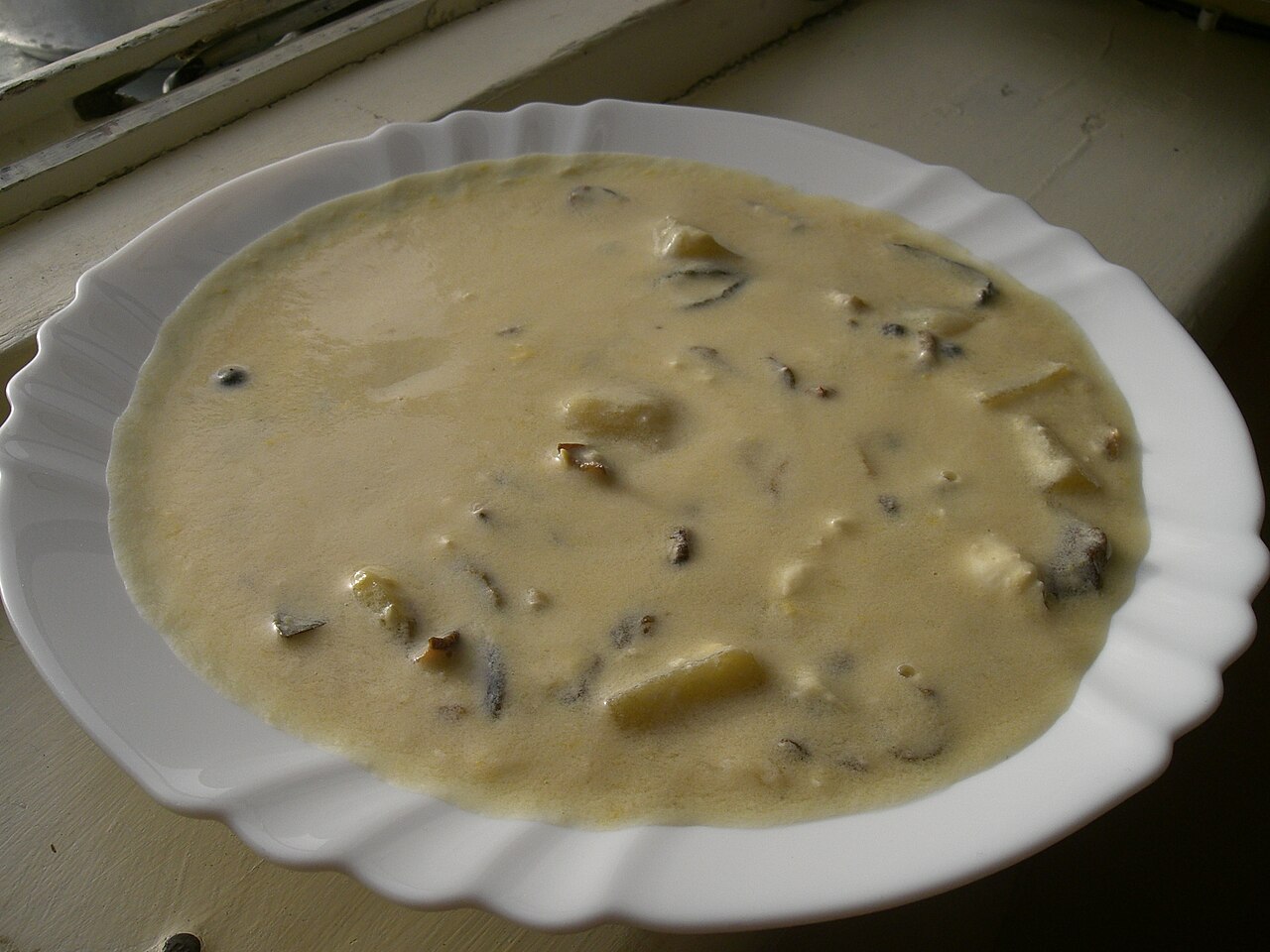
A thick, white soup of potatoes, mushrooms, cream and plenty of fresh dill, often finished with a poached egg, sometimes a quail's egg.
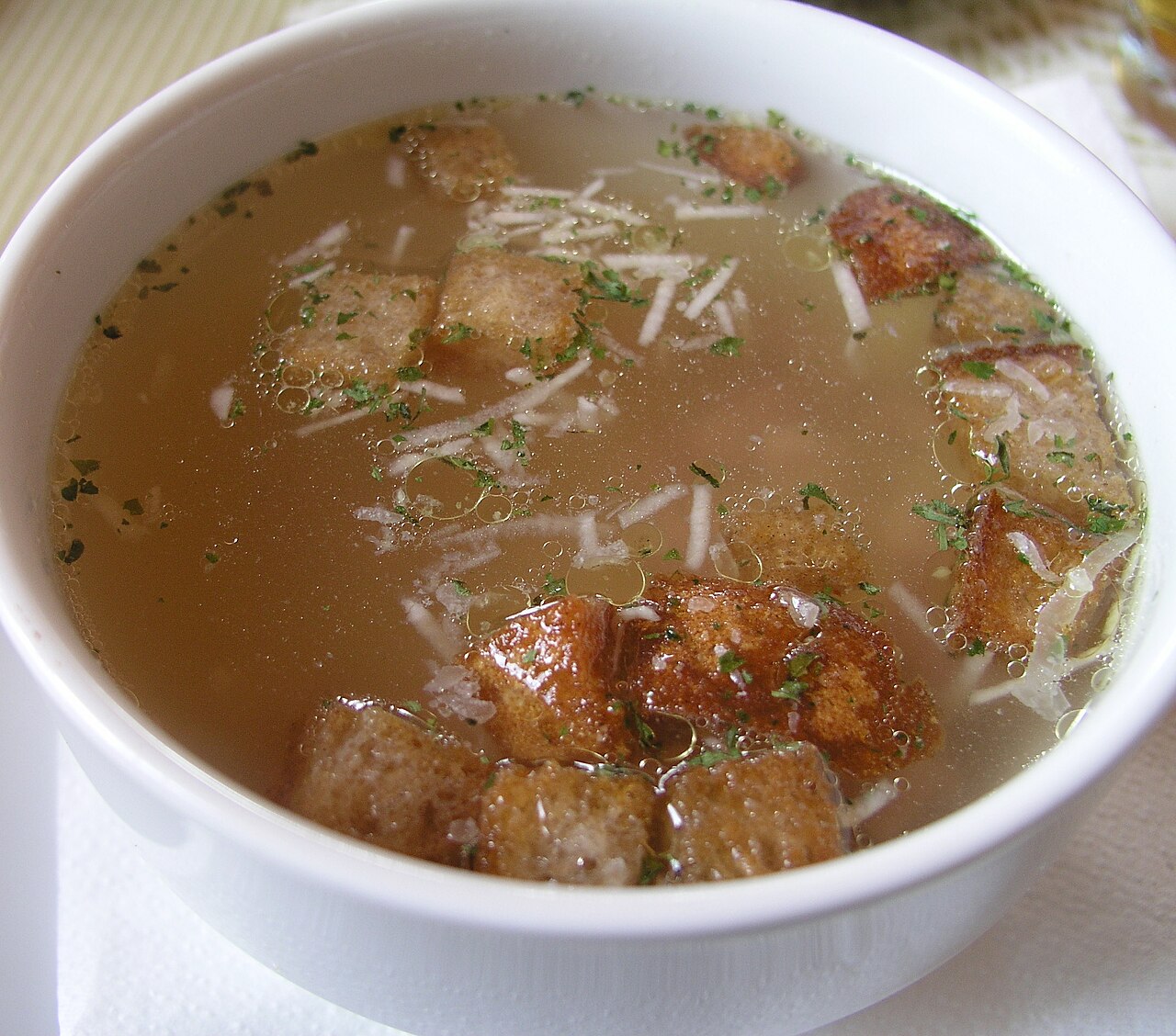
A simple, strongly flavoured garlic soup served with fried croutons, and sometimes with sausage or cheese.
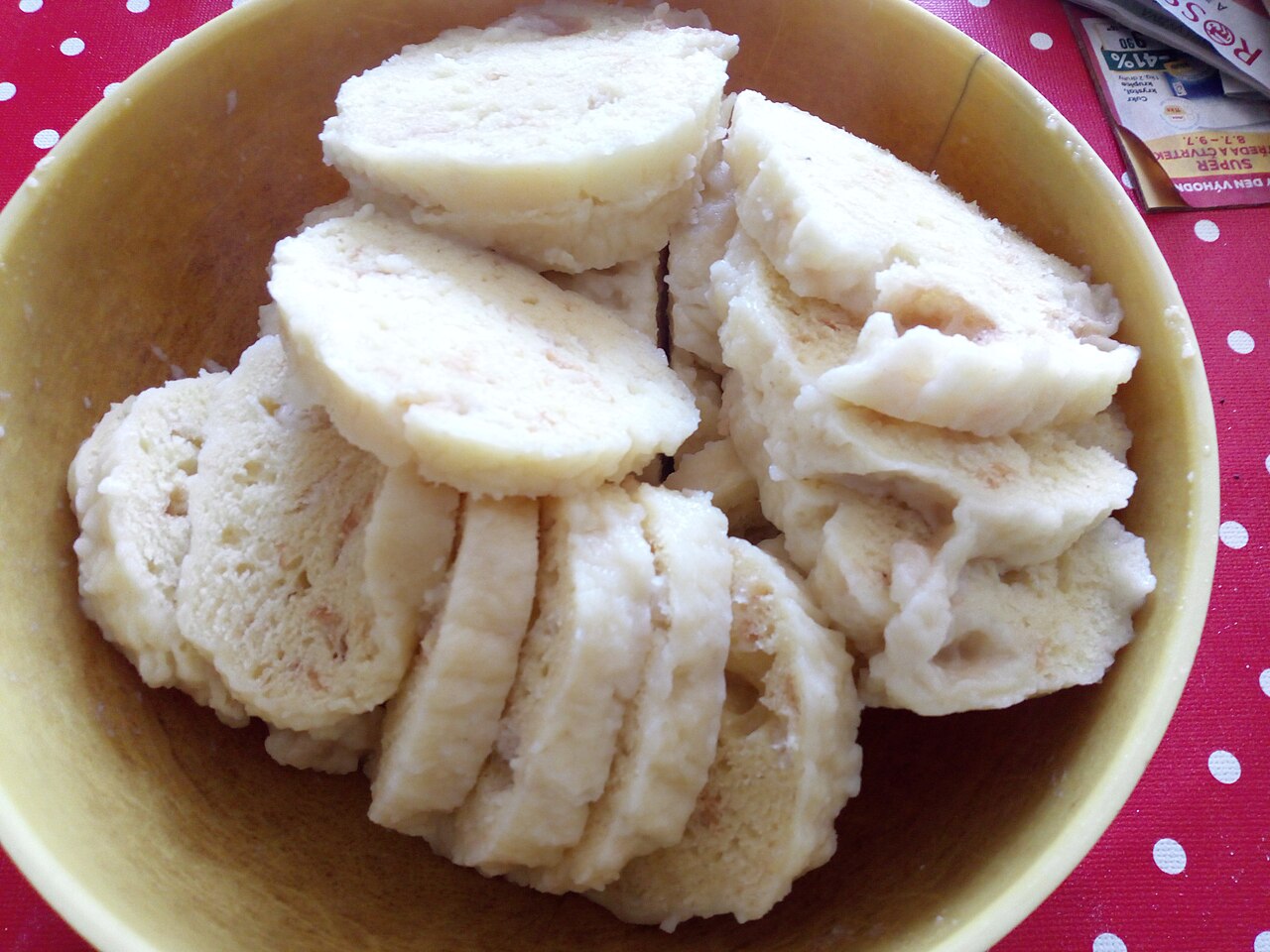
Large dumplings of wheat flour, often mixed with cubes of stale bread rolls, steamed and then cut into slices like bread. They soak up the sauce of svíčková, goulash and roast pork.
Leftover dumpling slices are often fried the next day with eggs.
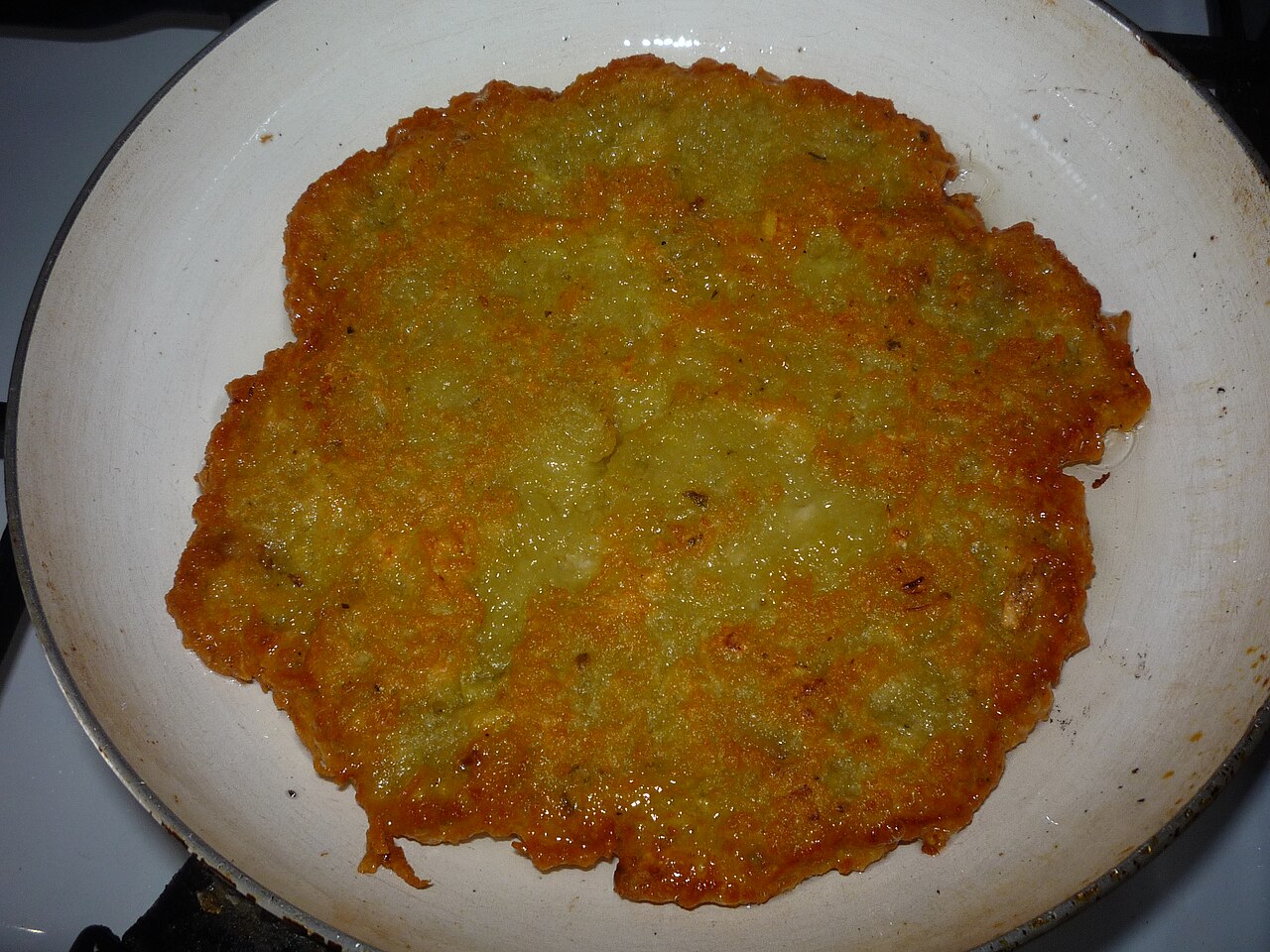
Crisp pancakes of grated raw potato, flour and egg, flavoured with garlic and marjoram and fried in fat. They are eaten on their own or as a side dish.
In the Plzeň area they are called vošouch, in South Bohemia cmunda, and in Těšín Silesia stryk.
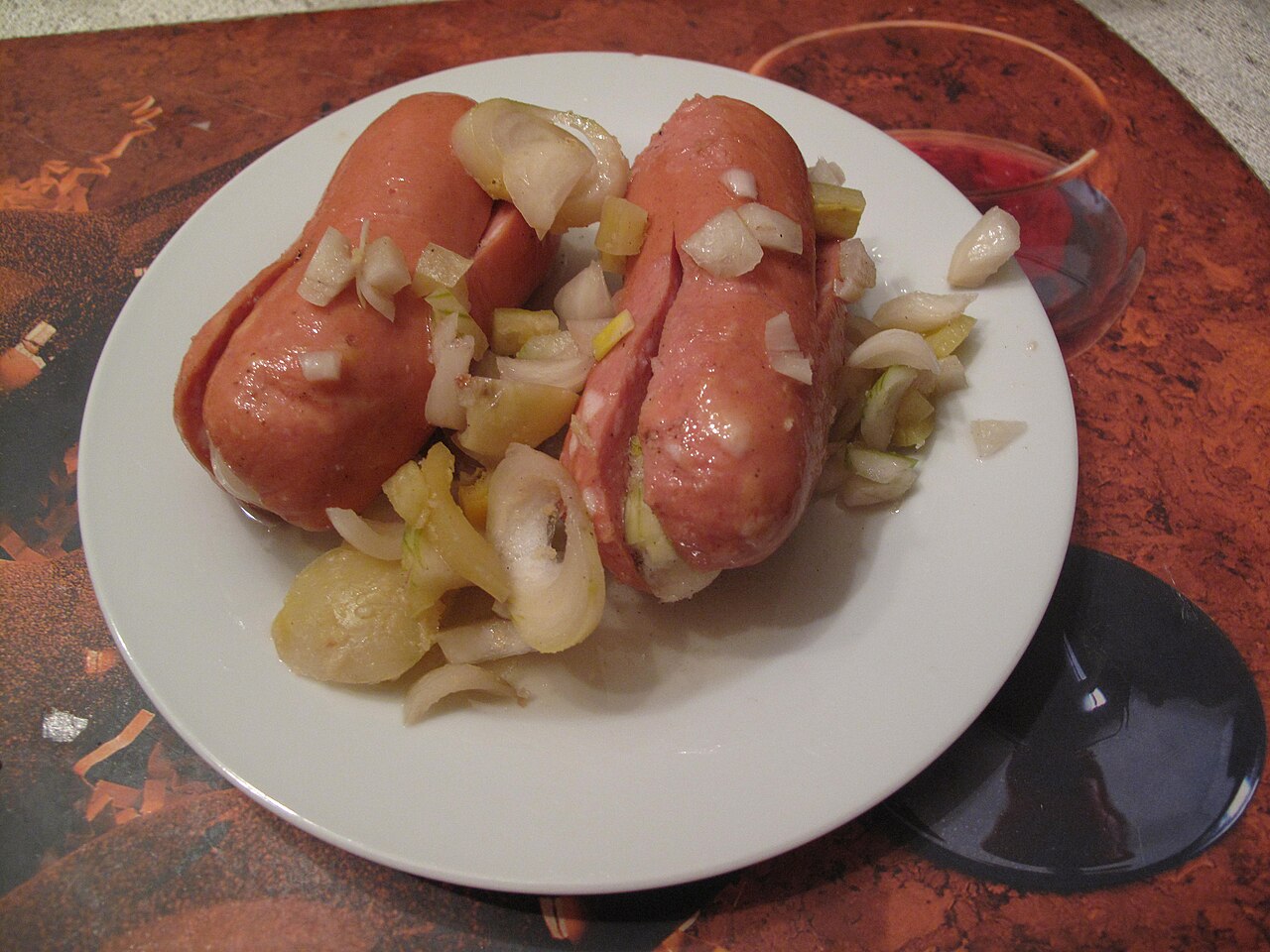
Fat pork sausages pickled in a sweet-and-sour vinegar with onion, black pepper, bay leaf and chilli. They are a classic snack in many Czech pubs.
Utopenci literally means 'drowned men'.
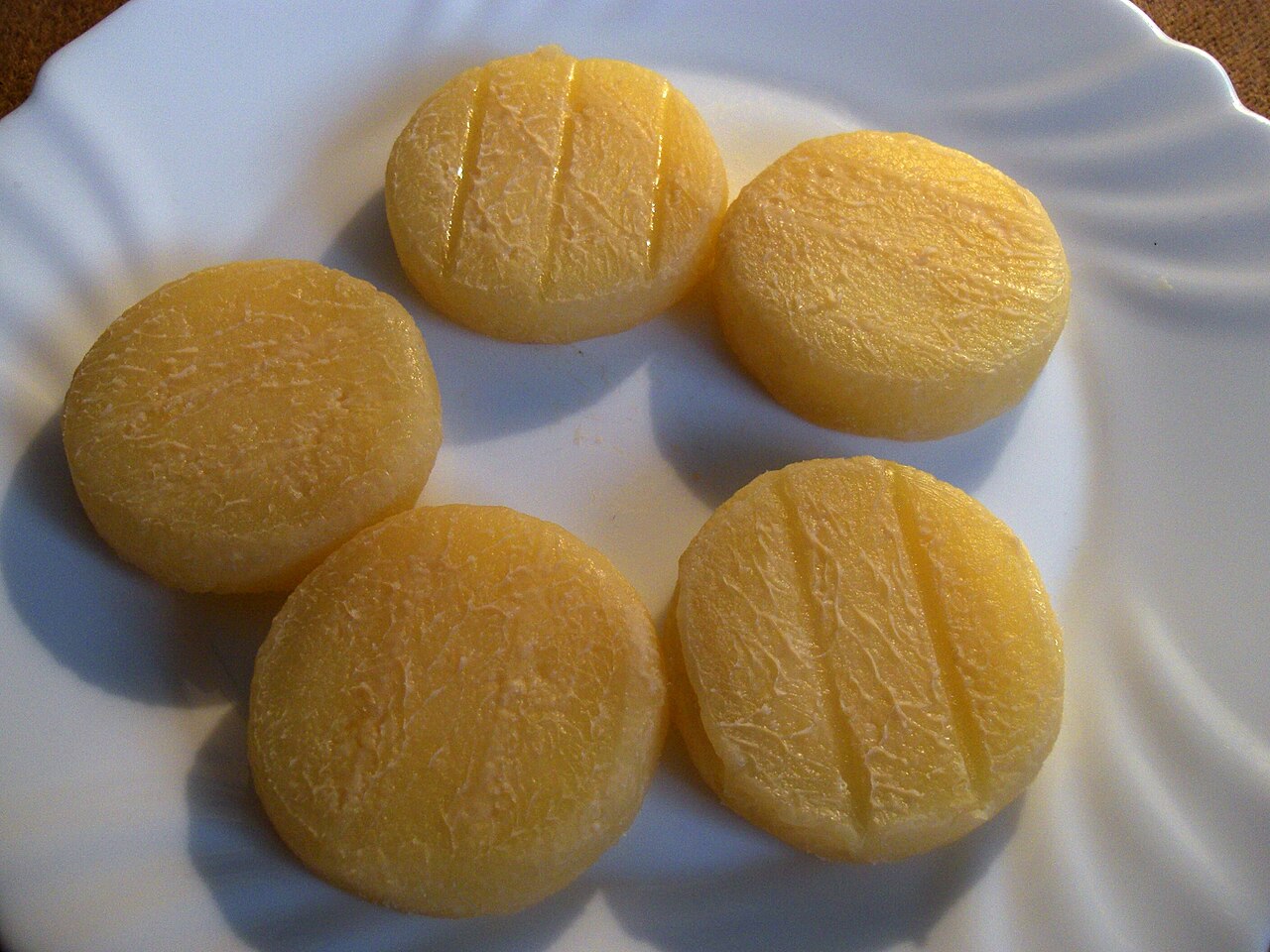
Small, ripened cheeses made from low-fat curd cheese, with a yellowish skin, a very strong smell and a sharp taste. They are a classic snack with beer and can also be fried or marinated.
The cheese is first mentioned in writing in 1452, and it has only about 0.5% fat.
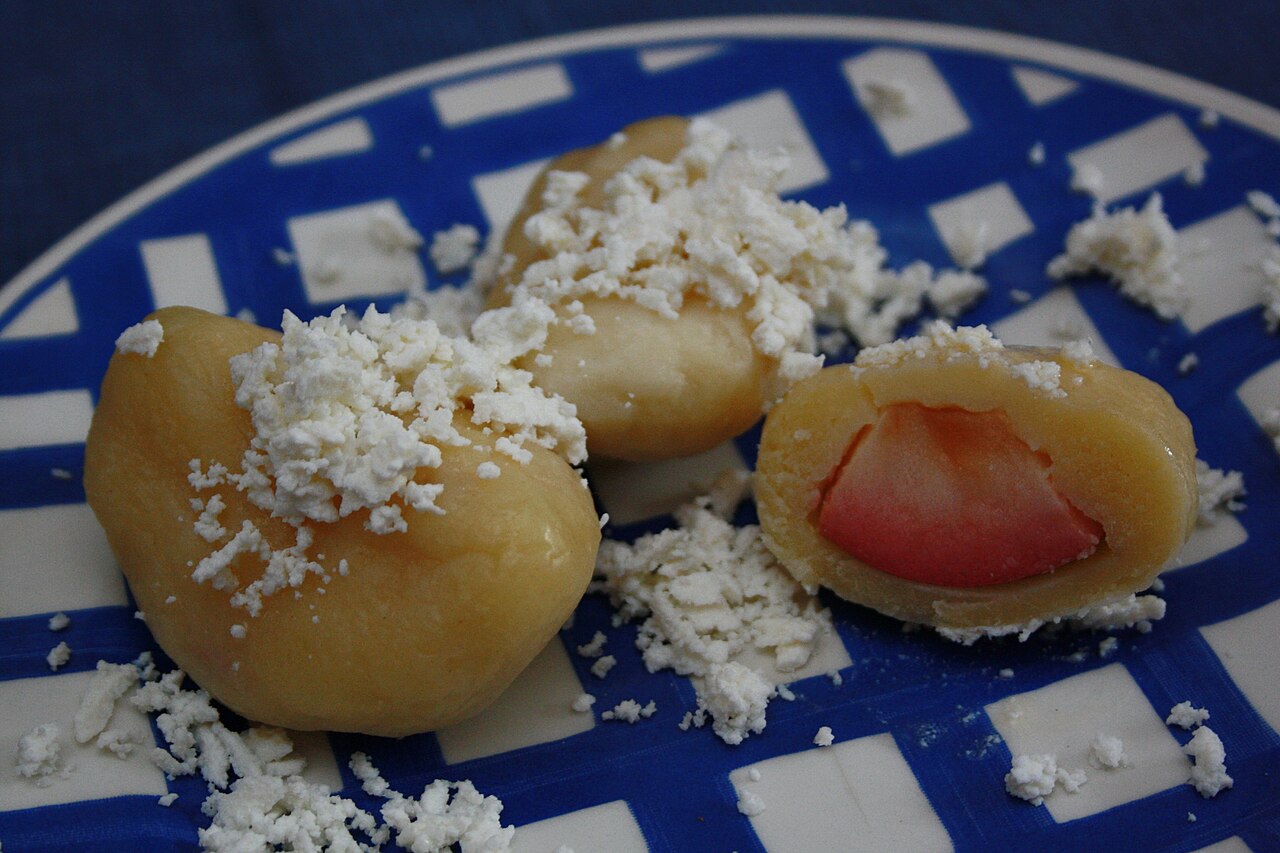
Soft dumplings wrapped around whole plums, apricots or strawberries, boiled and served with melted butter, sugar and grated curd cheese or poppy seed.
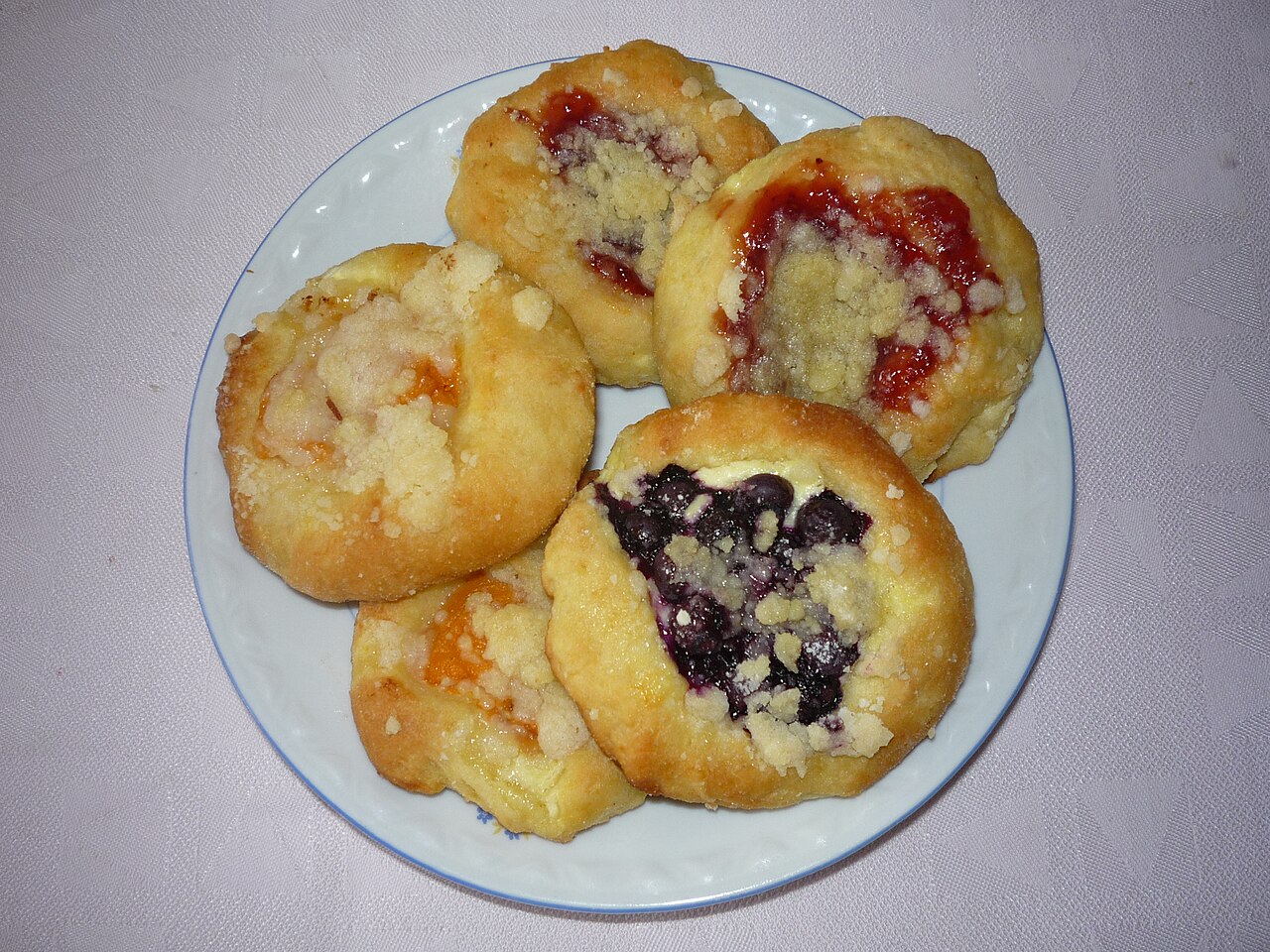
Soft yeast pastries with a filling of poppy seed, curd cheese, plum jam or apricot showing in the middle. They take work to make and are baked for special occasions.
In some regions koláče are handed out to friends and family instead of wedding invitations. Czech immigrants took the tradition to Texas and the American Midwest.
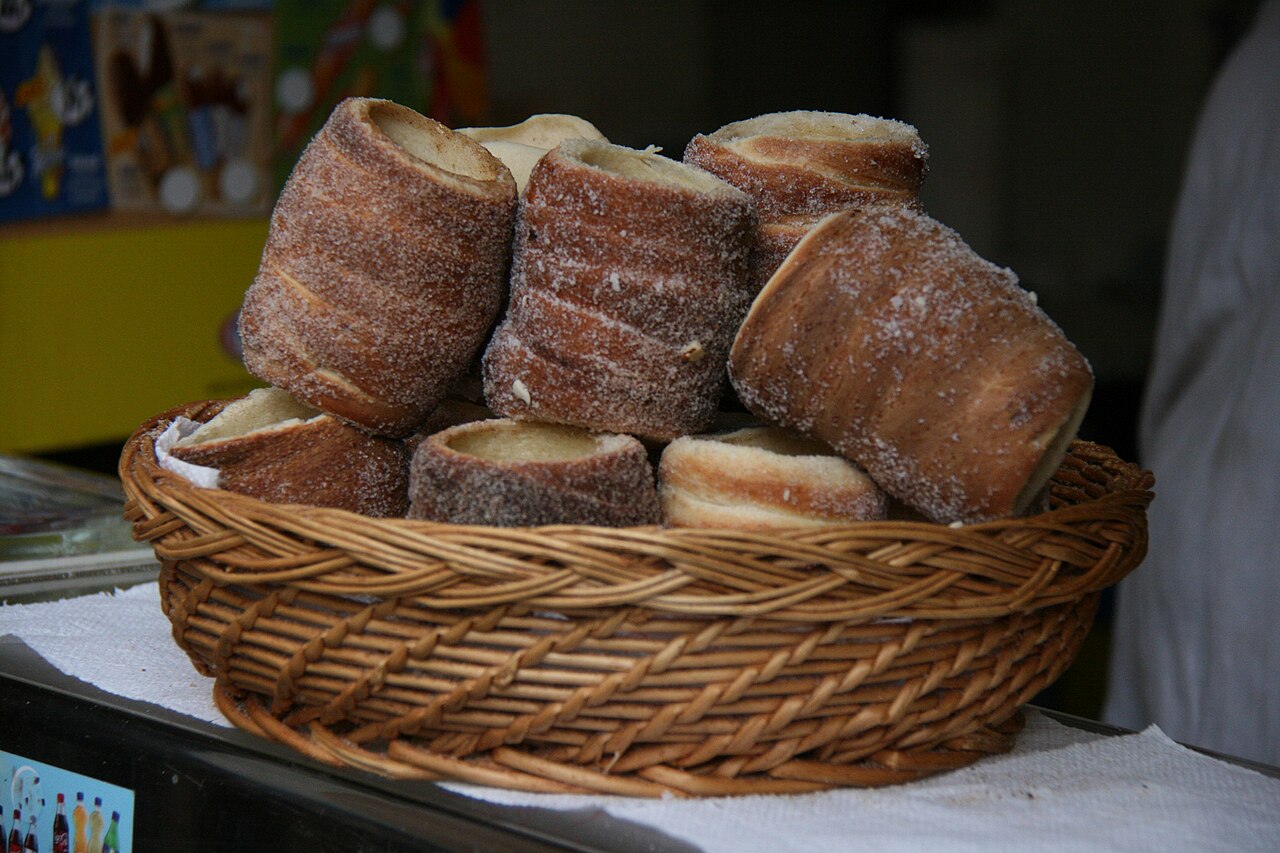
A spiral of sweet dough wrapped around a stick, baked over heat and rolled in sugar and chopped walnuts. In Prague it is sold on every tourist street, often filled with ice cream.
Although it is often sold as an 'old Bohemian' treat, trdelník spread in Prague only from the early 2000s. Its traditional home is the Slovak town of Skalica, near the Moravian border.
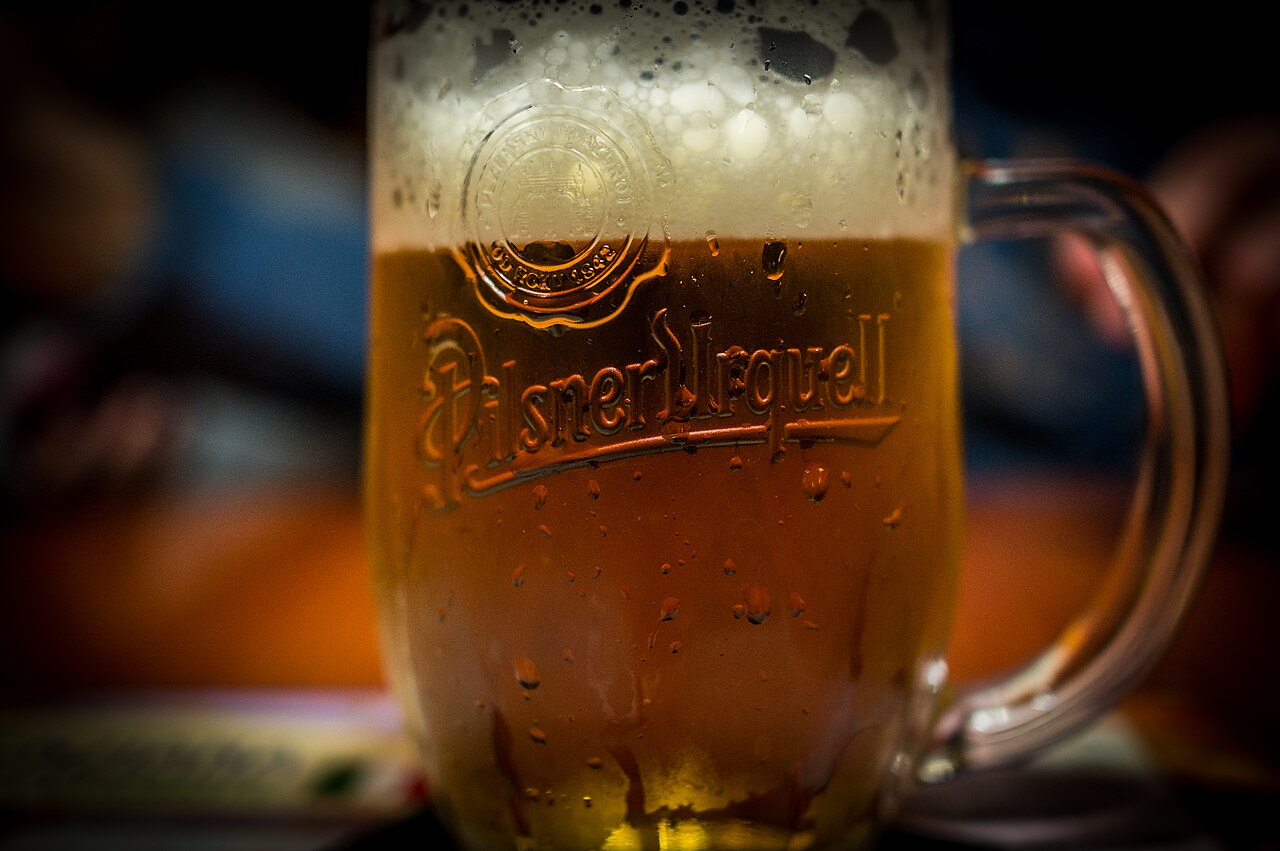
A clear, golden, bottom-fermented beer with a thick foam and the bitter aroma of Saaz hops. The original, Pilsner Urquell, is still brewed in Plzeň.
The first pale lager was brewed in Plzeň by the Bavarian brewer Josef Groll and first served on 11 November 1842. Most of the beer drunk in the world today is a pale lager descended from it.
Prague is by far the biggest city, but much of Czechia's charm lies in its smaller towns: Moravian Brno and Olomouc, the brewing cities of Plzeň and České Budějovice, the spa town of Karlovy Vary and the old silver town of Kutná Hora.
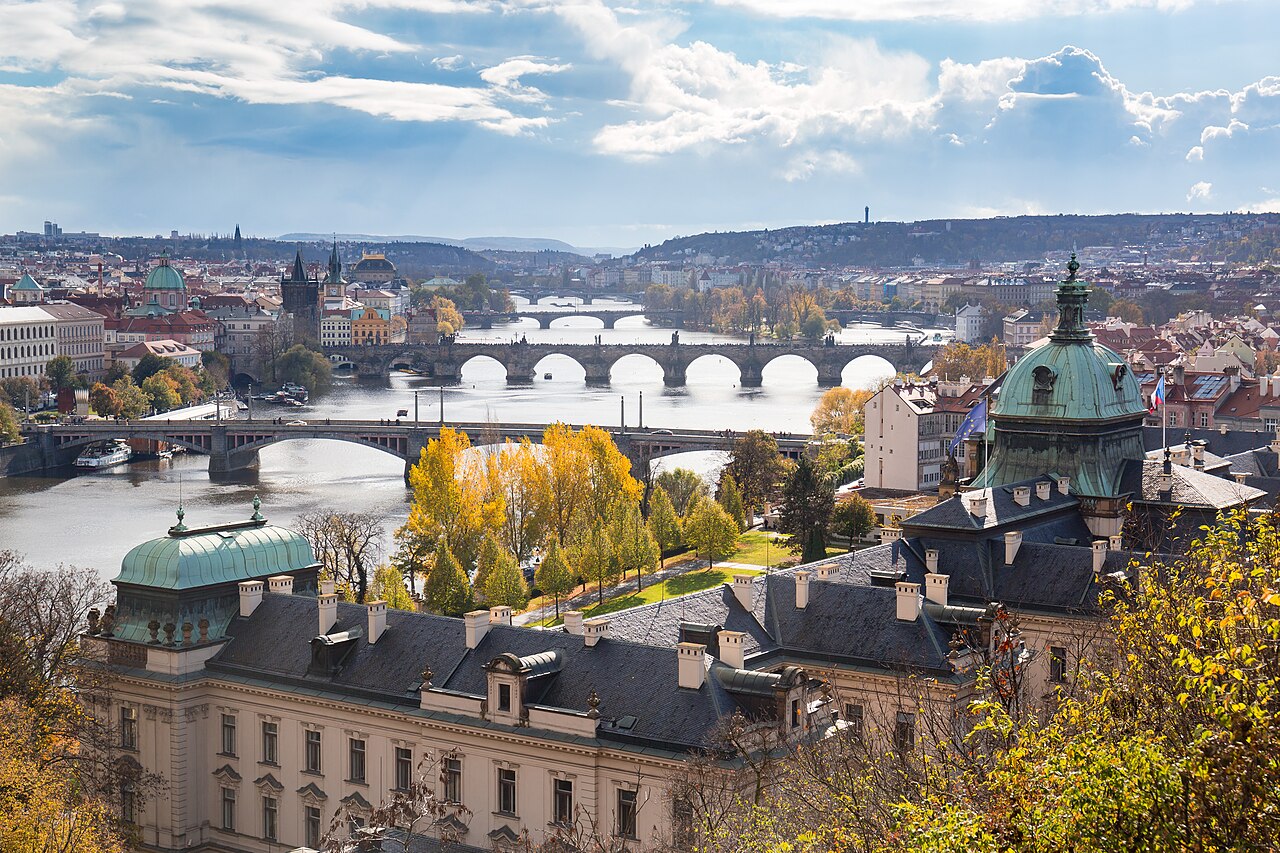
The capital and largest city, home to about 1.4 million people, on both banks of the Vltava. Nicknamed the 'City of a Hundred Spires', it has a historic centre on the UNESCO list since 1992.
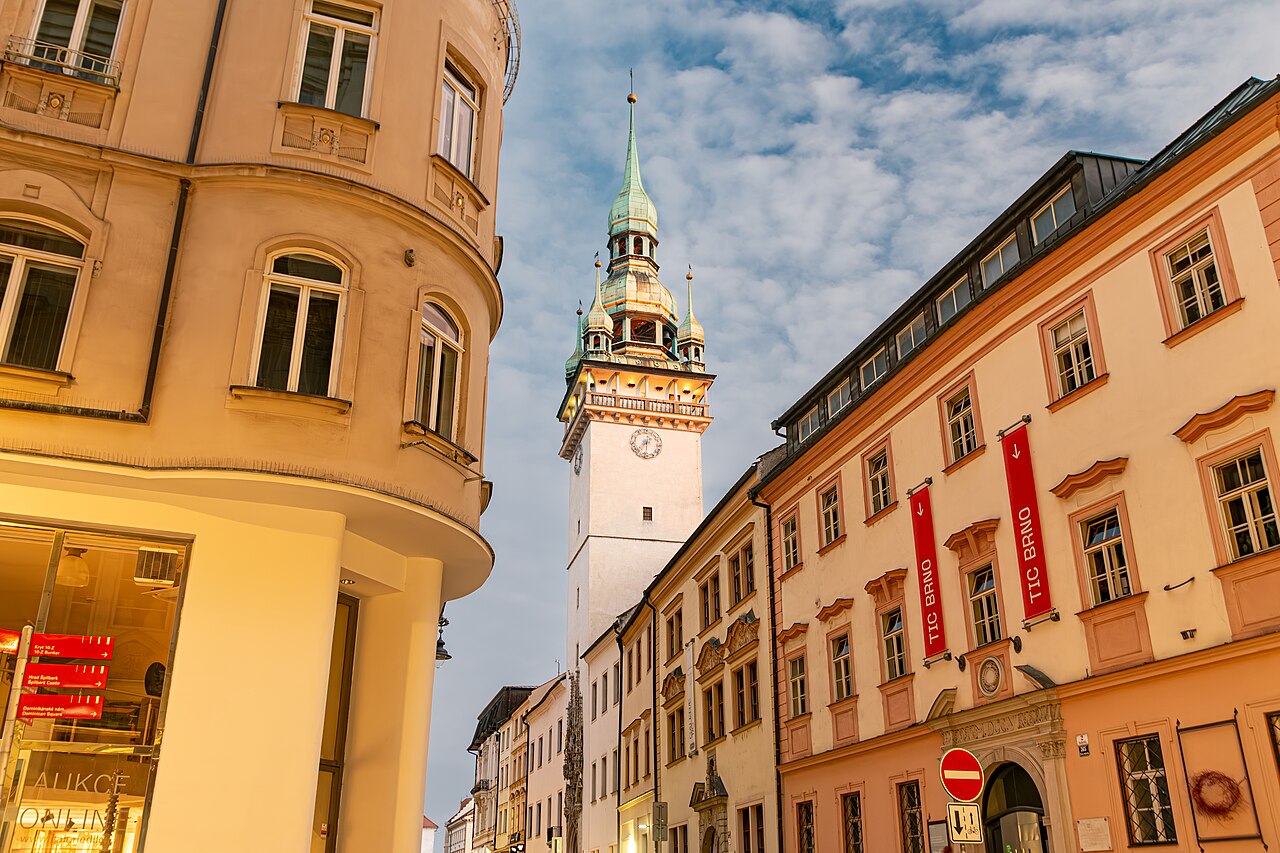
The second-largest city, with about 404,000 people, and the capital of Moravia from the Middle Ages until 1948. Czechia's highest courts sit here.
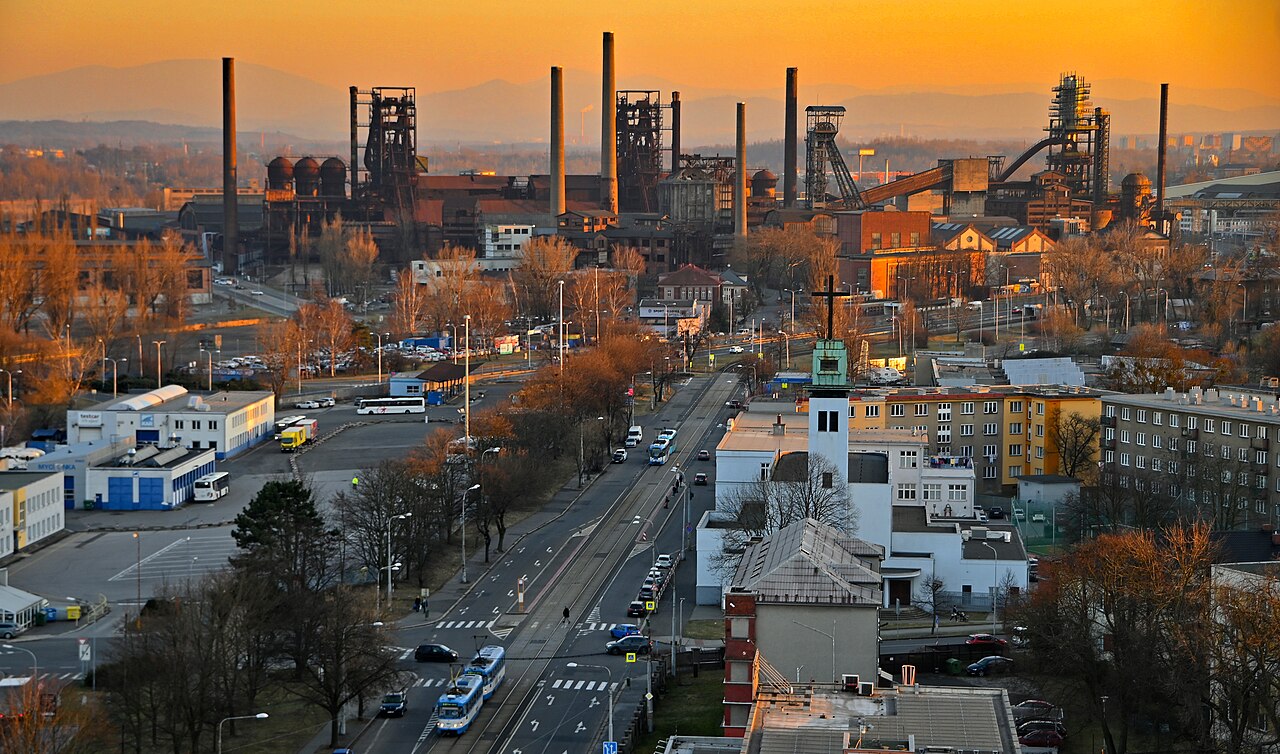
The third-largest city, near the Polish border, which grew on a great coalfield and was called the 'steel heart' of Czechoslovakia. Since 1989 its economy has changed a great deal.
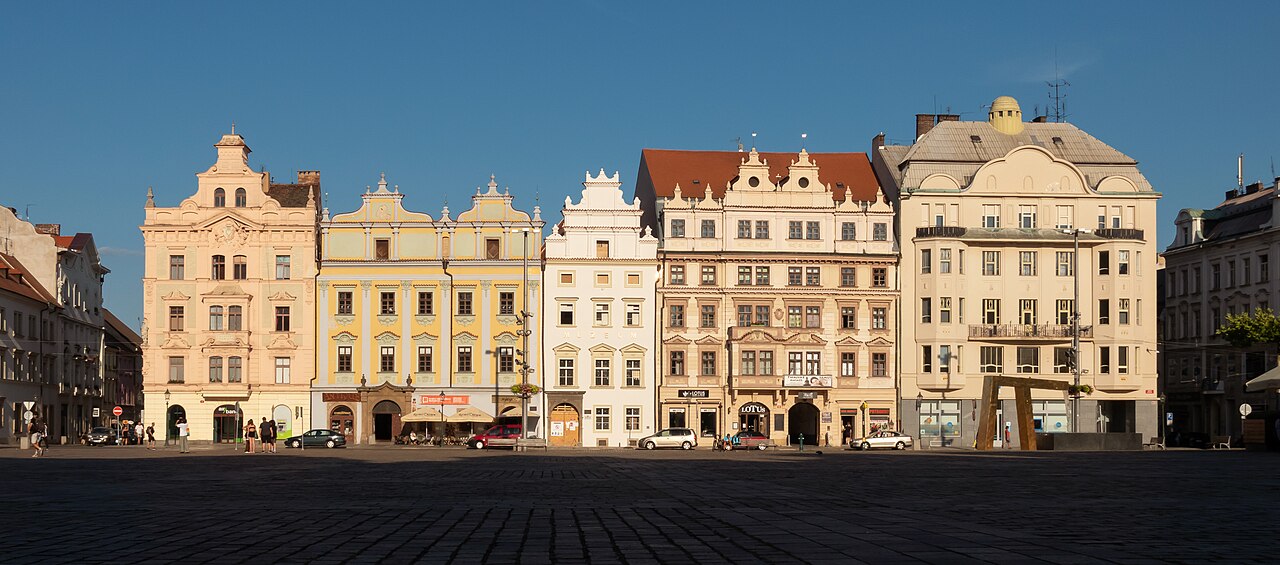
The fourth-largest city, about 78 km west of Prague, where four rivers meet. It is known worldwide as the home of pilsner beer and of the Škoda Works engineering company.
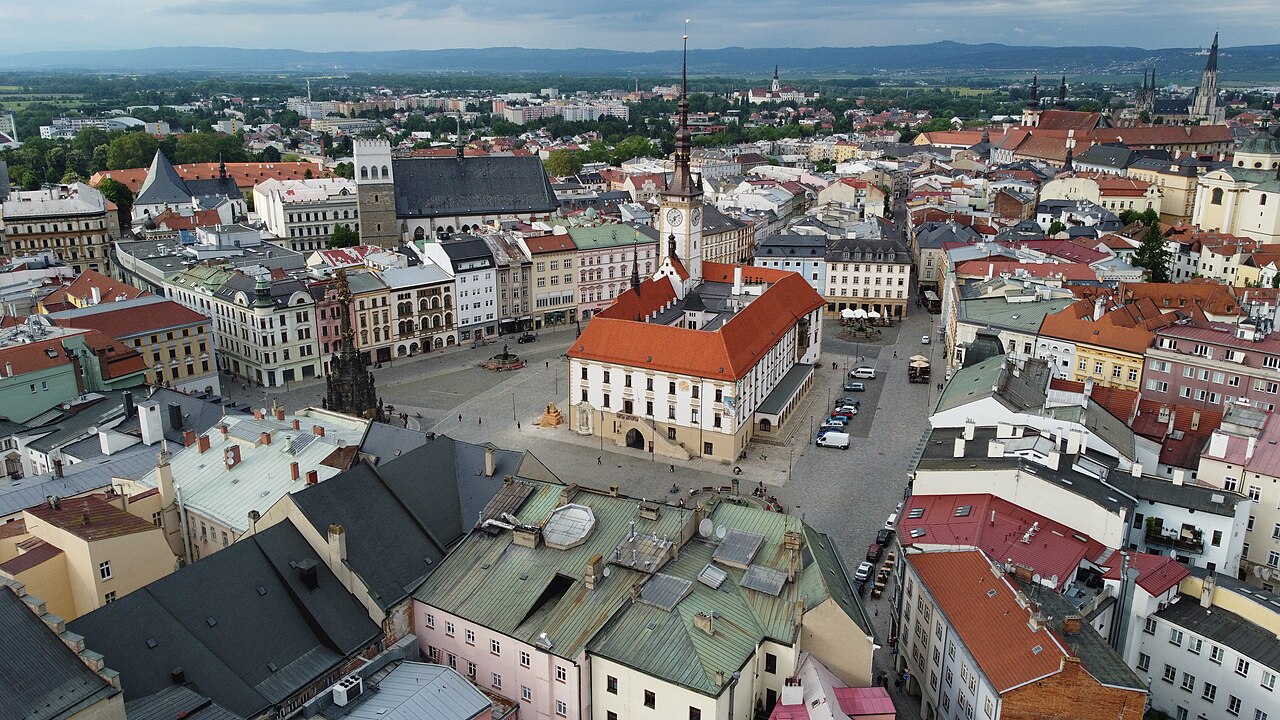
A university and church city on the Morava river, once a co-capital of Moravia. Its well-kept old centre is full of Baroque fountains and churches.
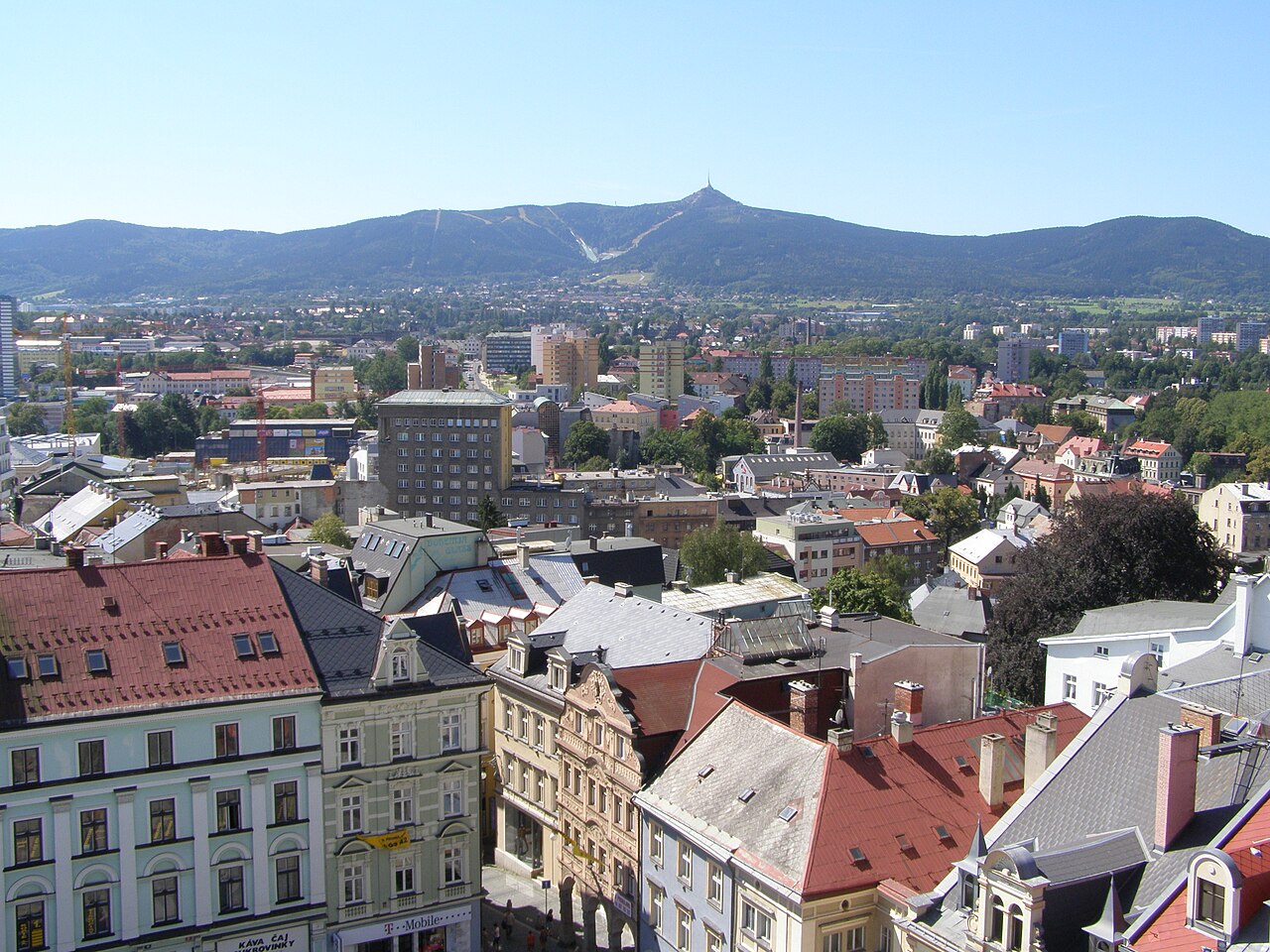
The fifth-largest city, with about 108,000 people, in a basin surrounded by mountains. Its textile mills once earned it the nickname 'Manchester of Bohemia'.
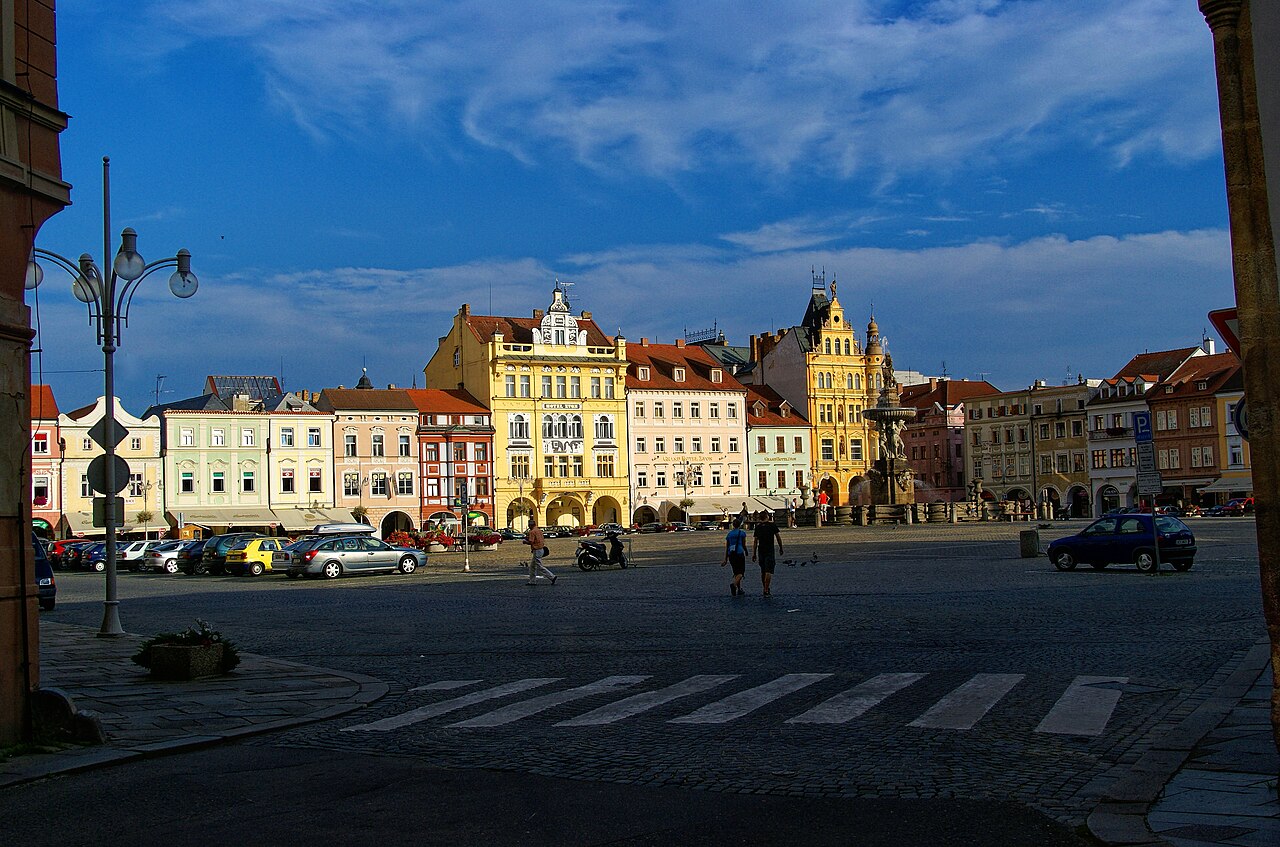
The main city of South Bohemia, known for its long brewing tradition. Its central square, named after King Přemysl Otakar II, is one of the largest town squares in the country.
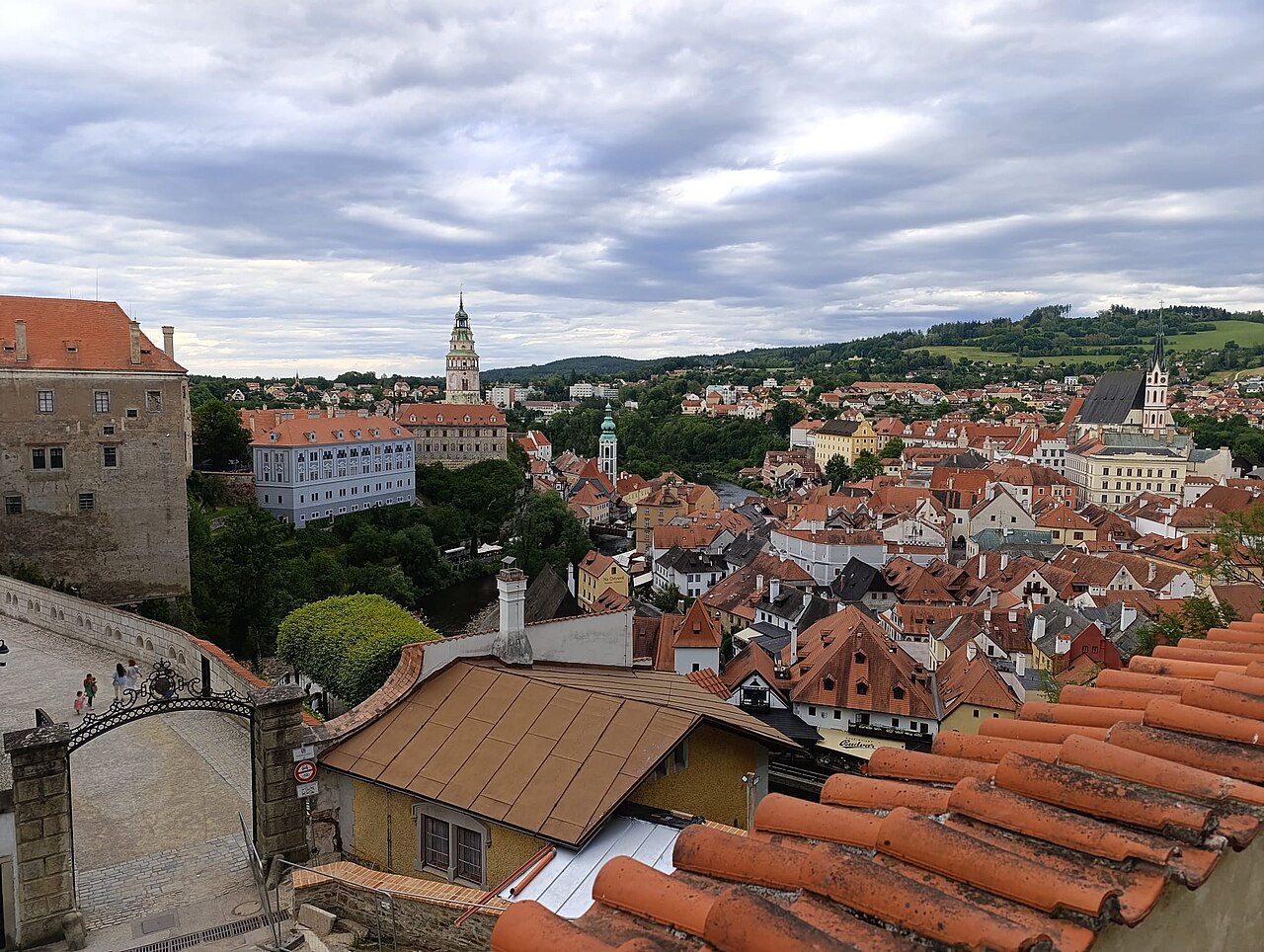
A small town of about 13,000 people in a tight bend of the Vltava, below a huge castle. Its Gothic, Renaissance and Baroque centre has been on the UNESCO list since 1992.
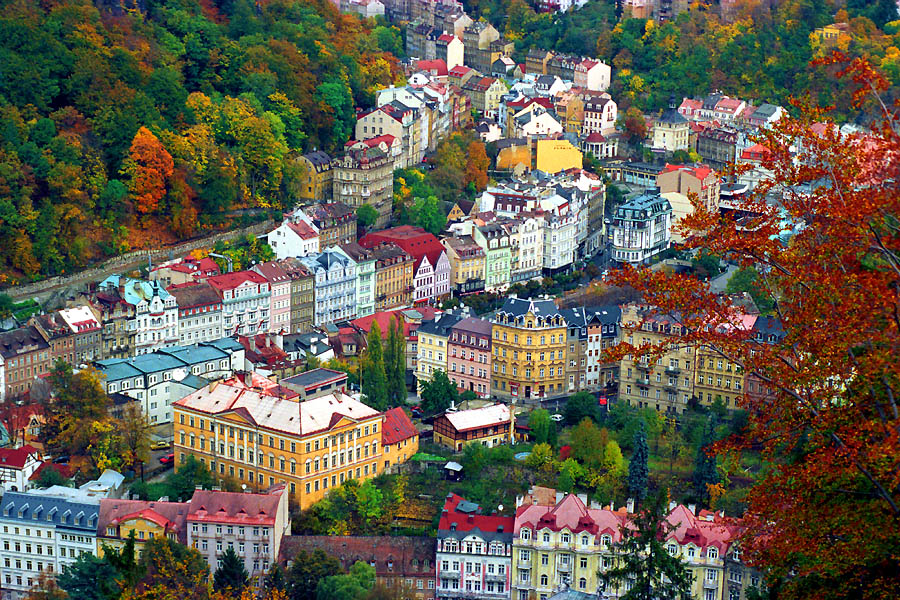
The most visited spa town in Czechia, built around hot springs and named after its founder, Charles IV. It is part of the UNESCO site 'Great Spa Towns of Europe'.
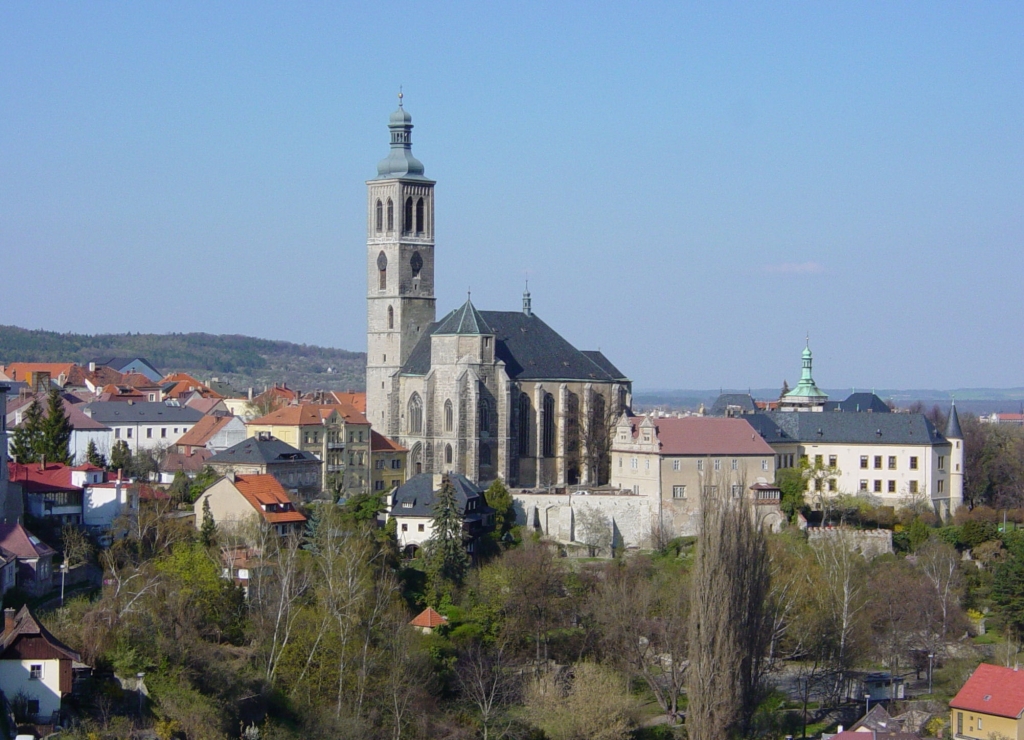
A town of about 22,000 people in Central Bohemia that grew rich from its medieval silver mines. Its historic centre, with St Barbara's Church and the Cathedral of Our Lady at Sedlec, has been on the UNESCO list since 1995.
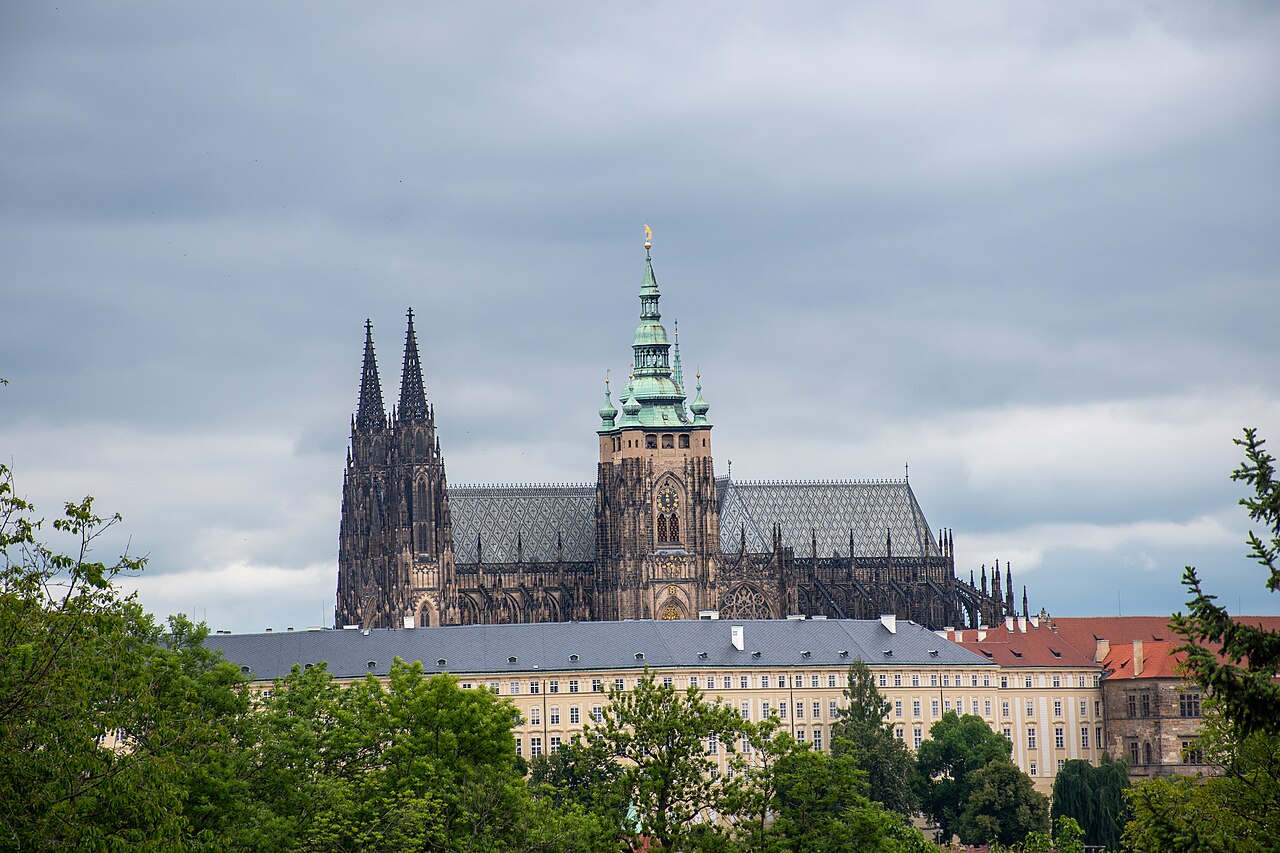
A vast complex of palaces, churches and courtyards on a hill above the Vltava, first built in the 9th century. Kings of Bohemia, emperors and presidents have ruled from here, and it is still the office of the Czech president. It covers almost 70,000 square metres and is the most visited sight in the country.
UNESCO World Heritage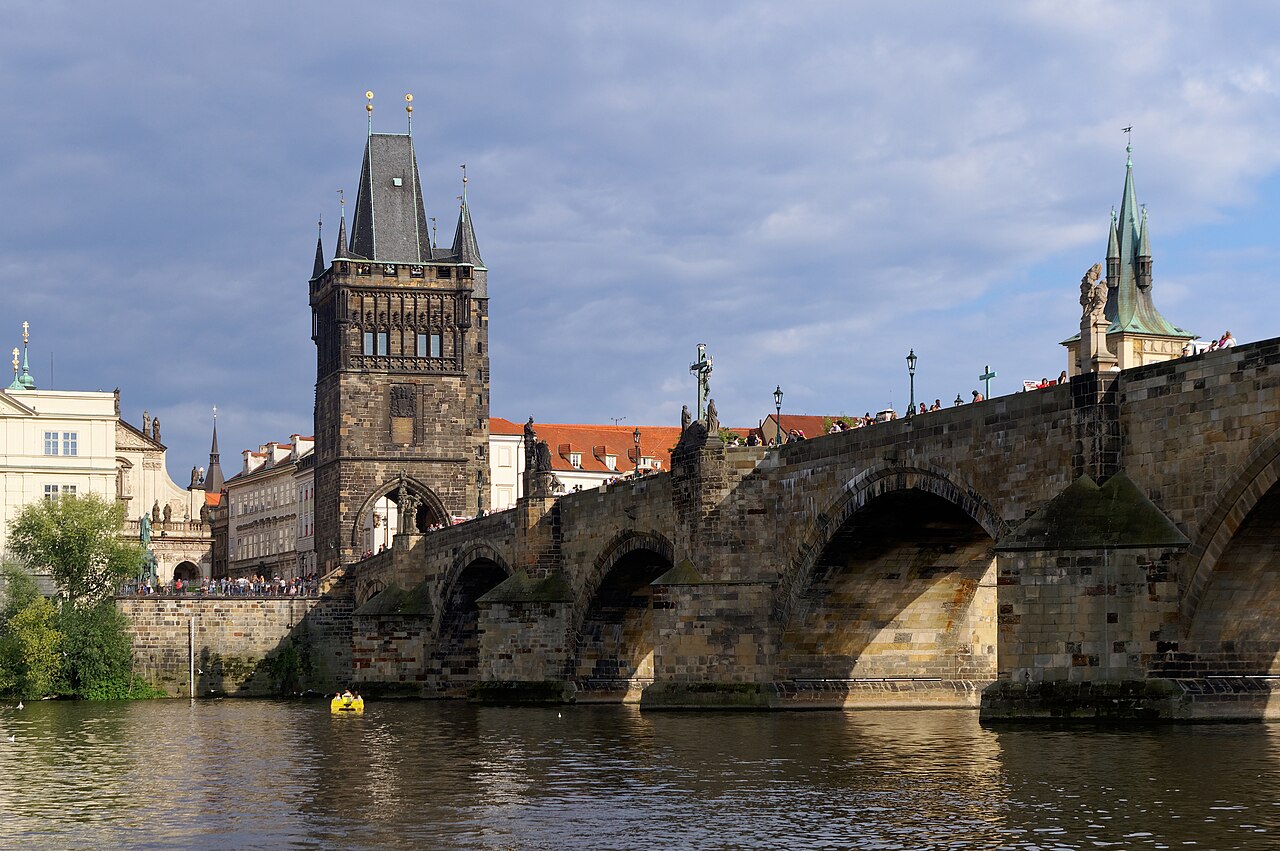
A stone bridge over the Vltava begun in 1357 under King Charles IV. It is 516 metres long, rests on 16 arches, has a tower at each end and is lined with 30 statues, most of them Baroque.
UNESCO World Heritage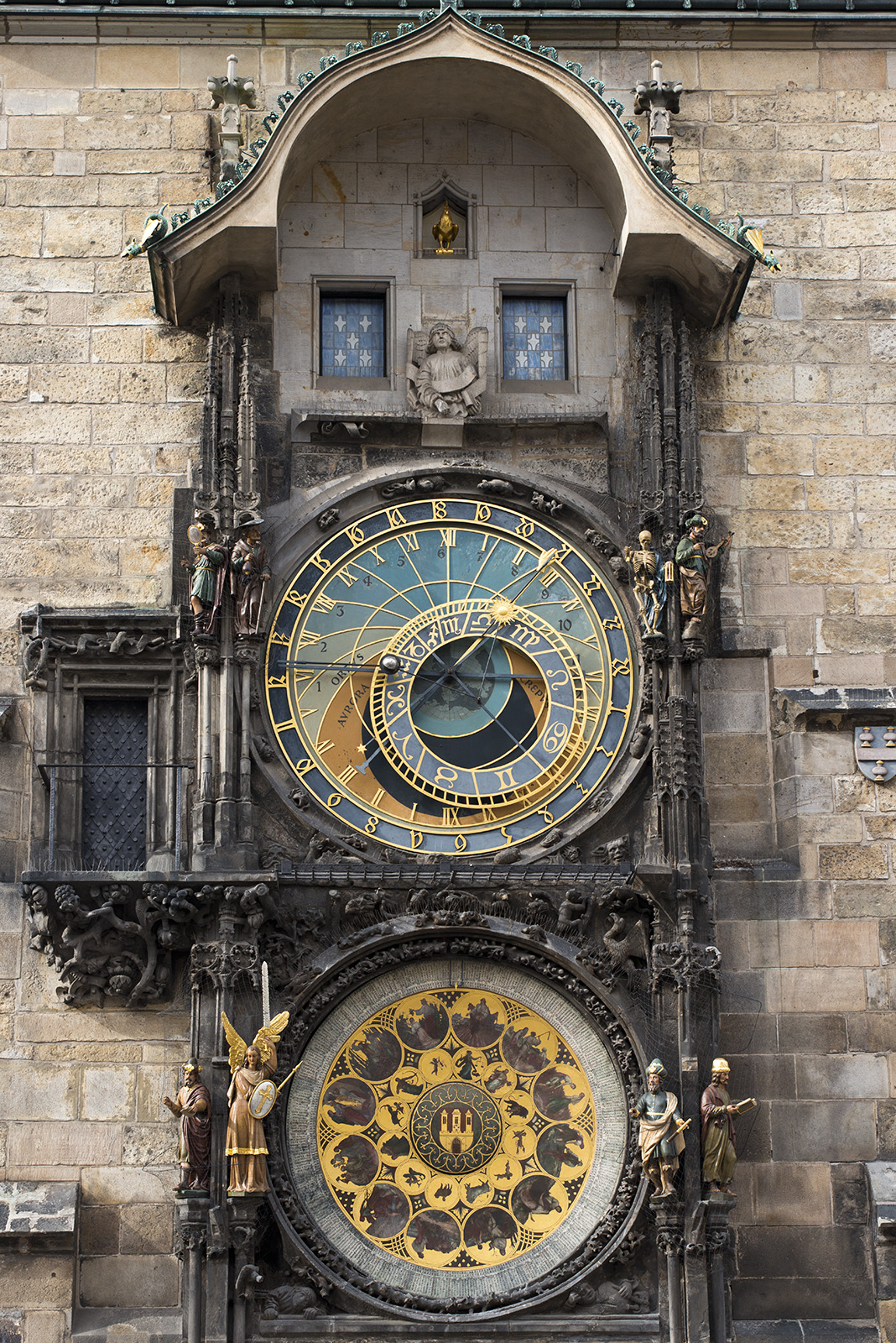
A medieval clock on the wall of the Old Town Hall, first recorded in 1410. Its dial shows the positions of the Sun and Moon, and every hour a skeleton representing Death strikes the time while figures of the Apostles parade past.
UNESCO World Heritage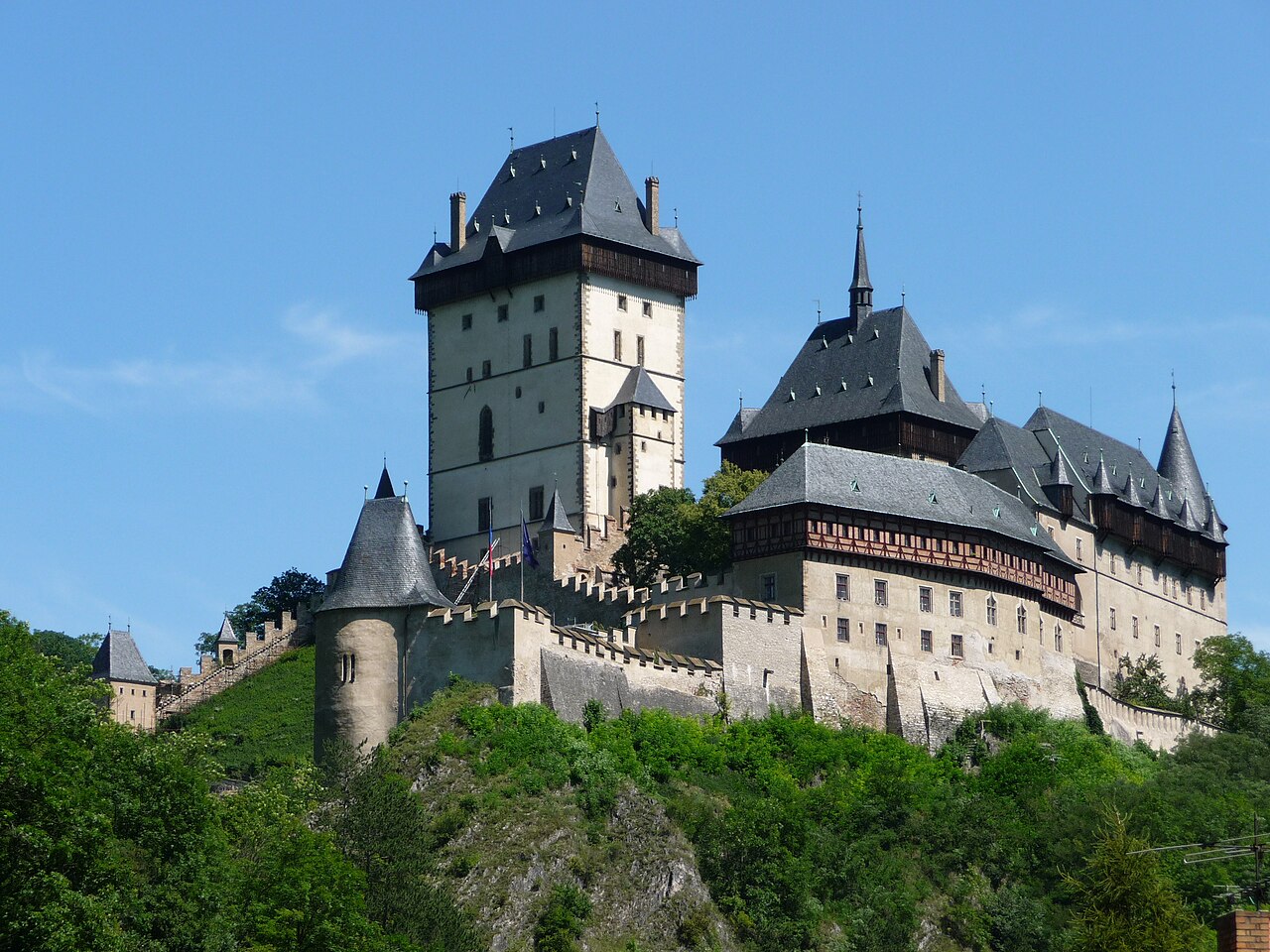
A large Gothic castle southwest of Prague, founded by Charles IV in 1348 to keep the imperial regalia, the Bohemian crown jewels and holy relics safe. It is one of the most visited castles in the country.
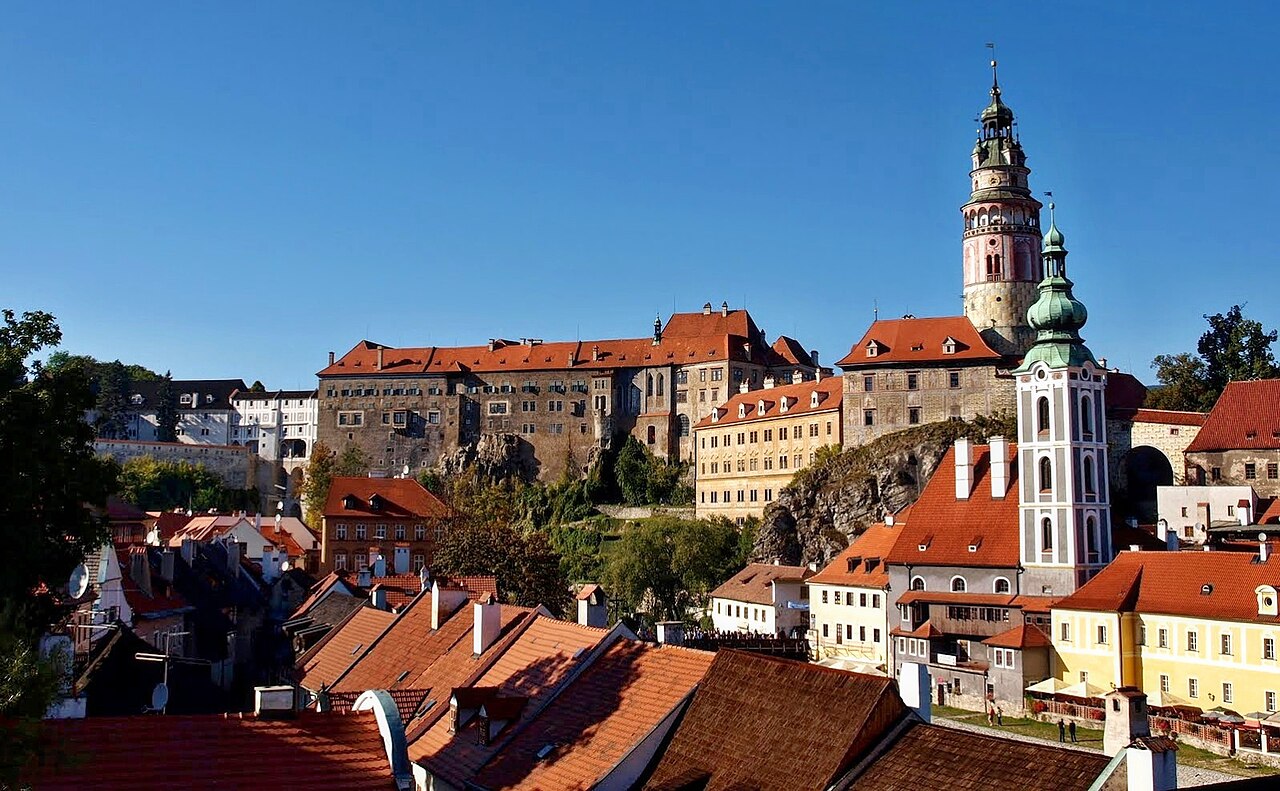
The second-largest castle complex in the country after Prague Castle, rising on a rock above the Vltava. It dates back to 1253 and was rebuilt by the Rosenberg family. Its Baroque theatre from 1767 is one of the best preserved in the world.
UNESCO World Heritage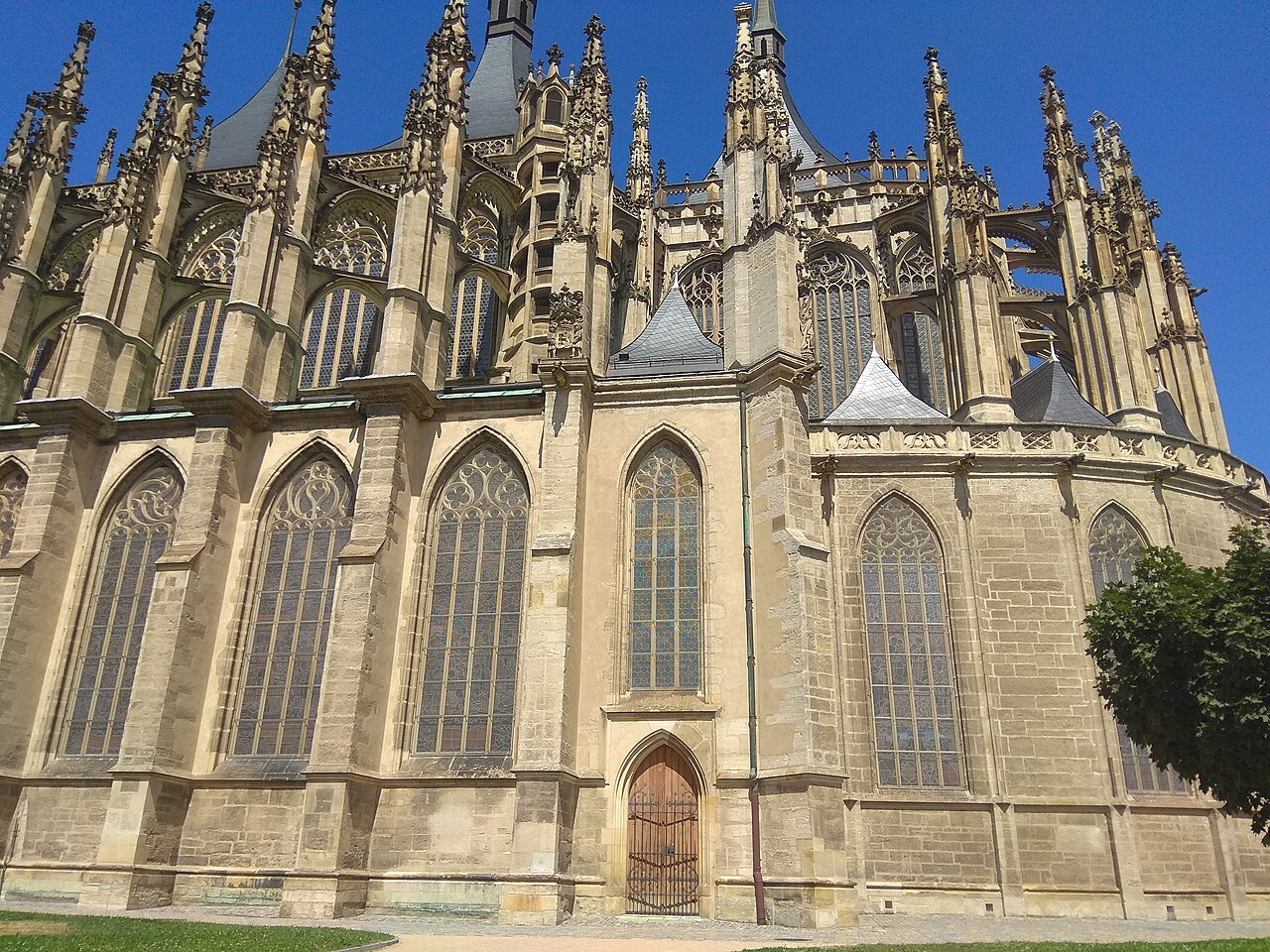
One of the most famous Gothic churches in Central Europe, dedicated to the patron saint of miners in a town that lived from silver. Building began in 1388 but stopped for decades during the Hussite Wars, and the church was only completed in 1905.
UNESCO World Heritage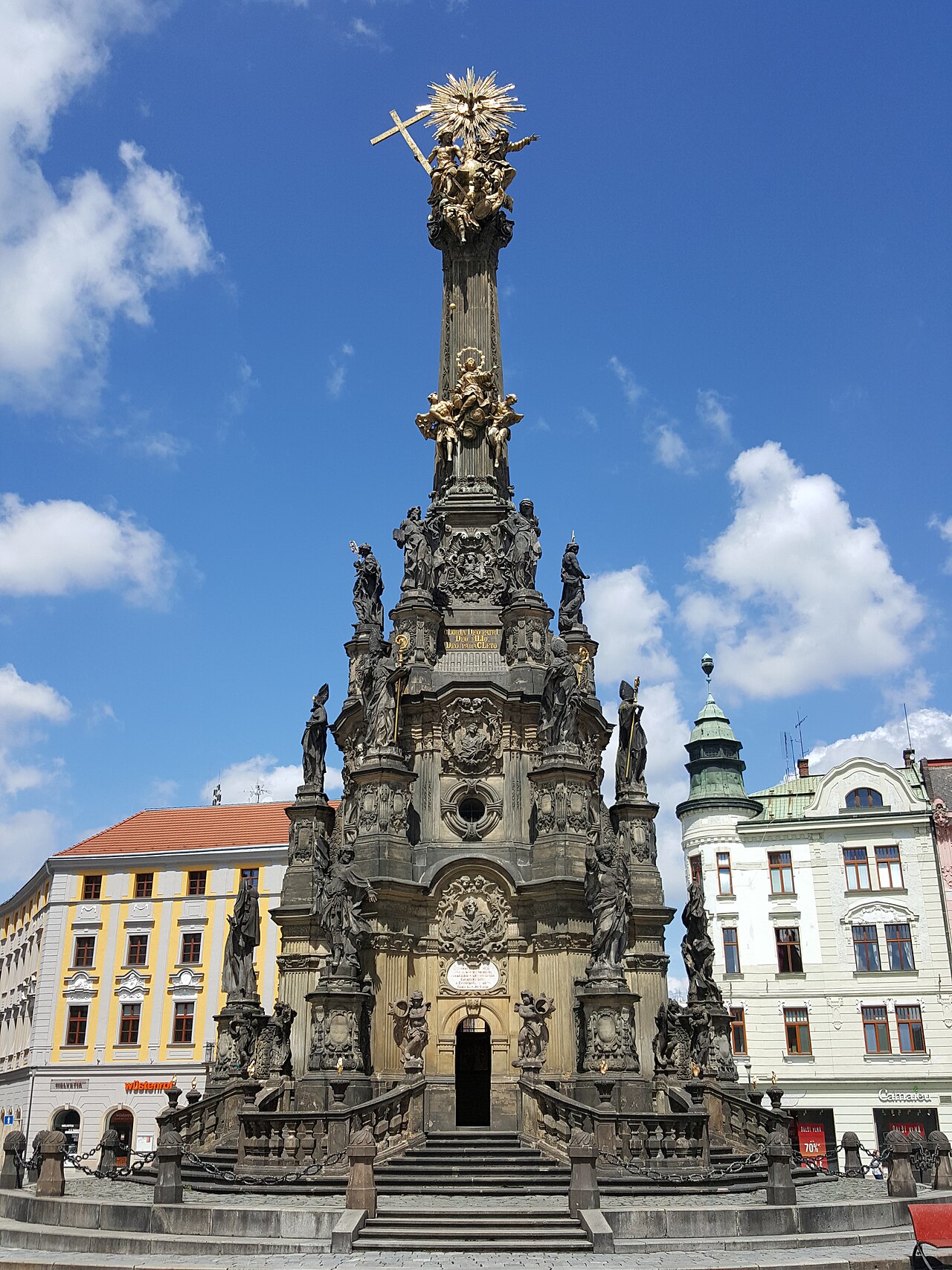
A towering Baroque monument on Olomouc's Upper Square, built between 1716 and 1754. It was added to the UNESCO list in 2000 as an outstanding example of Central European Baroque.
UNESCO World Heritage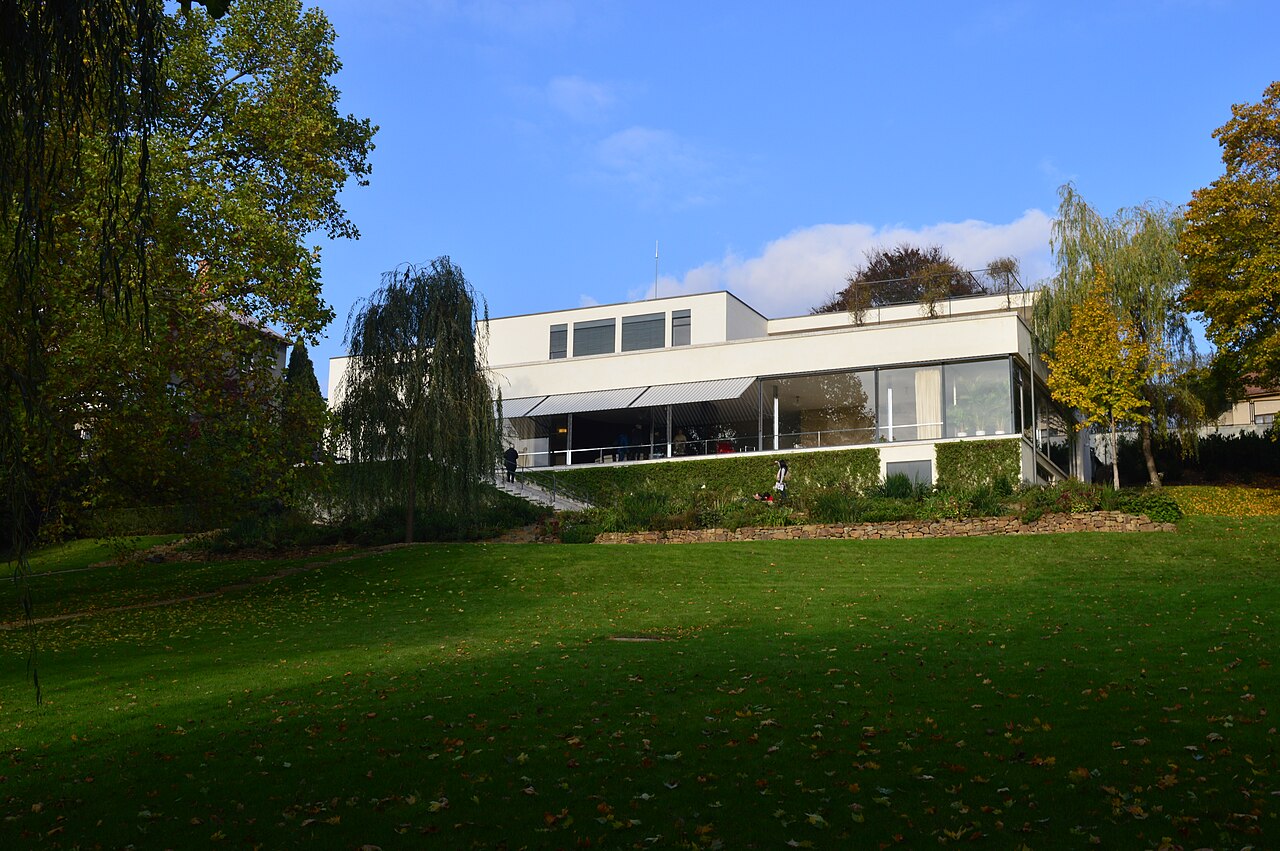
A modernist family home designed by Ludwig Mies van der Rohe and Lilly Reich and built between 1928 and 1930. Its steel frame allowed an open living space with huge windows, two of which can be lowered into the floor.
UNESCO World Heritage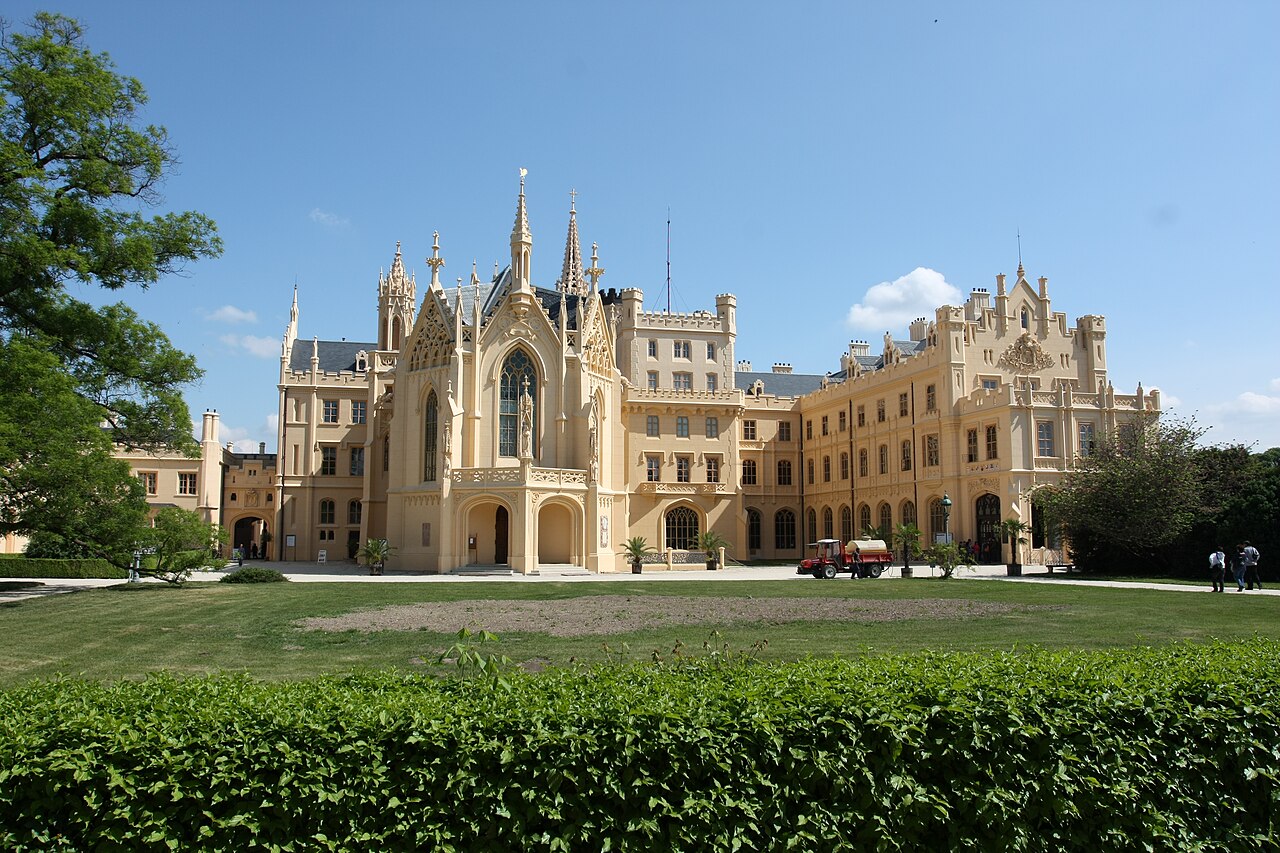
About 283 square kilometres of castles, parks, ponds and small pavilions in South Moravia, designed on purpose by one family, the Liechtensteins. It lies south of Brno.
UNESCO World Heritage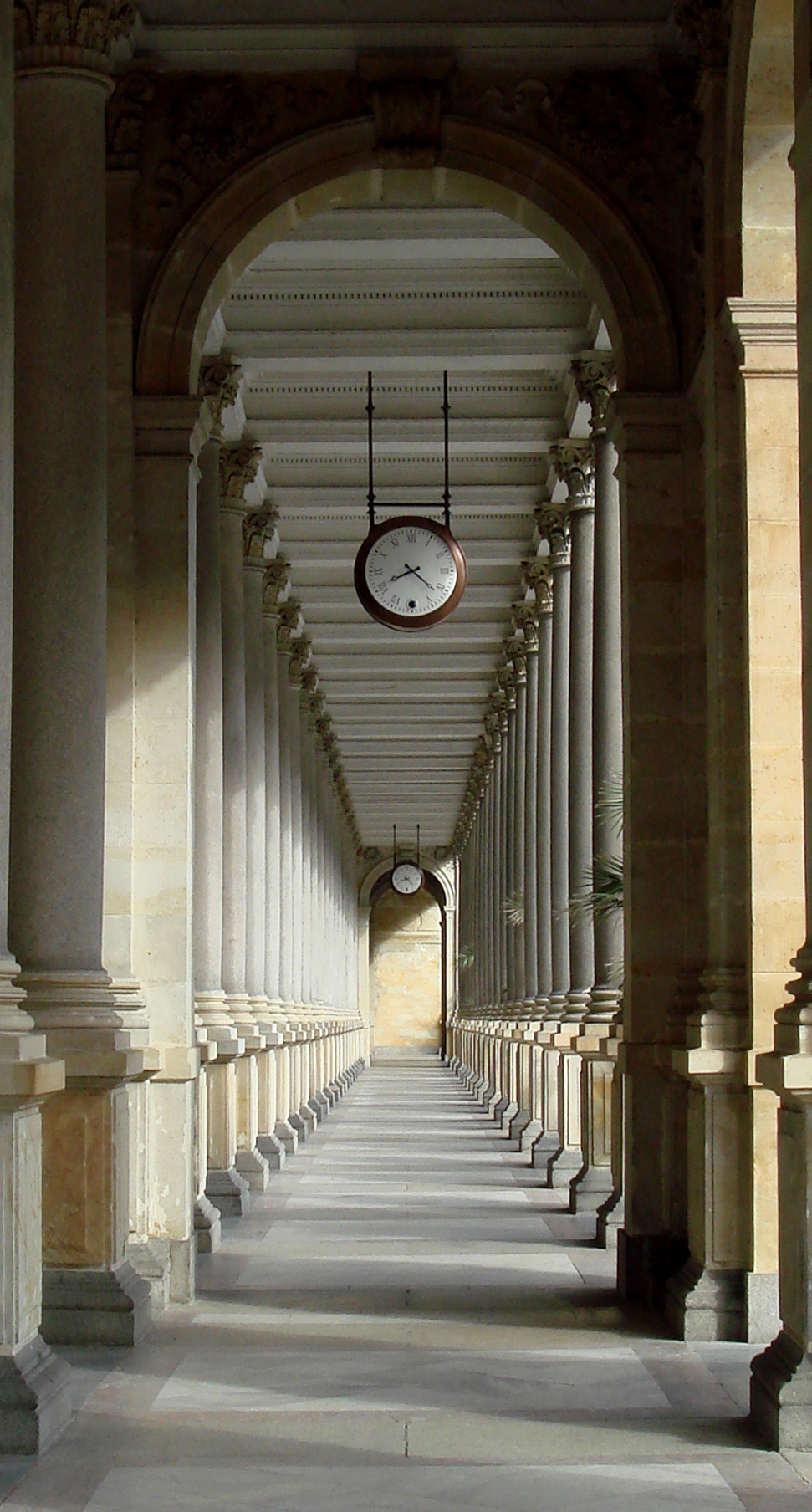
Hot springs and grand spa buildings from the 18th to the 20th century, where European aristocrats once came to take the waters. Since 2021 the town has been part of the UNESCO site 'Great Spa Towns of Europe'.
UNESCO World HeritageThe word 'robot' comes from Czech. It first appeared in Karel Čapek's 1920 play R.U.R., and Čapek said his brother Josef had invented it. In Czech, 'robota' means the forced labour that serfs once had to do for their lords.
Modern soft contact lenses go back to the Czech chemists Otto Wichterle and Drahoslav Lím, who developed the soft gel material for them around 1960.
The first sugar cube factory was set up in the Czech town of Dačice by Jakub Kryštof Rad, who patented his sugar cubes in 1843. A monument with a sugar cube on top stands in the town today.
Although Czechia is landlocked, its rivers flow to three different seas: the North Sea (through the Elbe), the Baltic (through the Oder) and the Black Sea (through the Morava and the Danube).
Czechia even rents a piece of port in Hamburg, Germany, called the Moldauhafen. It was given to Czechoslovakia by the Treaty of Versailles, and the lease runs out in 2028.
As of September 2026, Czechs drink more beer per person than the people of any other country, although consumption has fallen in recent years.
Prague Castle is listed by Guinness World Records as the largest ancient castle in the world. It is about 570 metres long and about 130 metres wide.
A legend says Charles IV laid the first stone of Charles Bridge at 5:31 in the morning on 9 July 1357. Written as 1357 9 7 5 3 1, the time reads the same backwards and forwards.
The short English name 'Czechia' was made official by the Czech government in 2016. Both 'Czechia' and 'Czech Republic' are still used.
The carol 'Good King Wenceslas' is about a real Czech ruler: Wenceslas, Duke of Bohemia in the 10th century, who became the patron saint of the Czech state.
Czech hikers follow a system of painted trail markers in red, blue, green and yellow that the Czech Tourist Club began in 1889. Slovakia uses the same system, and it has been copied in mountains as far away as Romania, Albania and Mongolia.
The Czech letter ř stands for a rare sound, a trilled r said together with a 'zh' sound. It is found as a separate sound in only a few languages in the world, and the composer Antonín Dvořák has it in his name.
Czech words can have long clusters of consonants and a few have no vowels at all, because the letters r and l can act as vowels. 'Čtvrt', meaning a quarter, is one example.
Pronunciation is written the way it sounds; the capital letters show where the stress goes. Audio is coming soon.
Czechia is in the European Union but uses its own money, the Czech koruna (Kč). Some shops take euros, usually at a poor rate. Use cash machines or exchange offices away from the main tourist streets, and never change money with people on the street.
Rounding up the bill is normal. In restaurants used to visitors, about 10% is usual if you were happy, and it is not added to the bill. Give the tip to the waiter before you leave the table.
The number for all emergencies is 112. There are also direct numbers: 155 for an ambulance, 158 for the police and 150 for the fire brigade.
To drive on motorways you need a vignette (dálniční známka), bought online at edalnice.cz. Headlights or daytime running lights must be on all day, all year. The alcohol limit for drivers is zero: not even one beer.
Look for the 'denní menu', a two- or three-course lunch at a low price. It is often written only in Czech and usually ends by about 13:00 or 14:00.
If you are invited into a Czech home, take off your shoes at the door. Hosts usually offer slippers.
Czechia is a safe country, but pickpockets work in crowds at the famous sights and on busy trams. In Prague, use a reputable taxi company or an app, or simply take the cheap and reliable public transport.