A free large-print PDF. Choose what goes in: facts, map, history, dishes and recipes, phrases, fun facts, a quiz with or without answers. Made for clubs, care homes, libraries and family afternoons.
Kazakhstan is a vast country in the heart of Eurasia, the ninth largest in the world and the largest with no coast on the open ocean. It stretches from the Caspian Sea in the west to the Altai and Tian Shan mountains in the east, and a small part west of the Ural River lies in Europe. Most of the land is steppe, dry grassland, together with semi-desert, and it is one of the most thinly populated countries on earth.
For thousands of years this was the land of horse-riding nomads. Saka warriors, Turkic tribes and the Mongols passed through, Silk Road towns such as Otrar and Turkistan grew rich on trade, and in the 15th century the Kazakh Khanate was founded. The Russian Empire gradually took control in the 18th and 19th centuries, and in Soviet times Kazakhstan went through a terrible famine, the Virgin Lands farming campaign, nuclear testing and the first human flight into space. It became independent on 16 December 1991, the last Soviet republic to do so.
As of mid-2026 about 20.6 million people live in Kazakhstan. Most are Kazakhs, with a large Russian minority and many smaller groups, including Uzbeks, Ukrainians, Uyghurs, Tatars, Germans and Koreans. Kazakh is the state language and Russian is also widely used. Almaty in the green southeast is the biggest city, while Astana, a modern capital built up on the northern steppe since 1997, is the seat of government. The country is rich in oil, gas and minerals, and visitors come for the mountains around Almaty, the Silk Road monuments of the south and the famous hospitality.
CapitalAstana
PopulationAbout 20.6 million (official estimate, mid-2026)
Official languageKazakh is the state language; Russian is also used officially, as set out in the constitution
CurrencyKazakhstani tenge (KZT, symbol ₸), introduced on 15 November 1993
AreaAbout 2,724,900 km², the ninth-largest country in the world and the largest landlocked one
GovernmentPresidential republic. A new constitution, approved by referendum on 15 March 2026 and in force since 1 July 2026, replaces the two-chamber parliament with a single chamber called the Kurultai
Highest mountainKhan Tengri, about 7,010 m including its ice cap (6,995 m of rock), on the border where Kazakhstan, Kyrgyzstan and China meet
Longest riverThe Irtysh, 4,248 km in total, which flows from China through northeastern Kazakhstan into Russia. The Ural, Ishim and Syr Darya also cross the country
NeighboursRussia to the north and west, China to the east, Kyrgyzstan, Uzbekistan and Turkmenistan to the south. Across the Caspian Sea lie Azerbaijan and, further south, Iran
Drives on theRight
Calling code+7, shared with Russia. The code +997 was reserved for Kazakhstan in 2021, but as of 2026 +7 is still used
The Kazakh steppe was a highway of peoples. Early horse herders, Saka warriors buried with gold, Turkic tribes and the Mongols all crossed it, and Silk Road cities flourished along its southern rivers. The Kazakh Khanate rose in the 15th century and was slowly absorbed by the Russian Empire. The Soviet period brought both great suffering, above all the famine of the early 1930s and four decades of nuclear tests, and great change, from new cities to the launch pad of the space age. Since 1991 Kazakhstan has been an independent country.
3500 BC
The Botai herd horses
Between about 3700 and 3100 BC, people of the Botai culture lived in villages of pit-houses on the northern steppe and depended heavily on horses. Wear marks on horse teeth suggest they used bridles, which makes Botai one of the earliest known places where people kept horses, although scientists still debate the details.
300 BC
The Golden Man is buried
In the 4th or 3rd century BC a young Saka noble was buried in a mound at Issyk, near today's Almaty, with about 4,000 gold ornaments. Found in 1969, the 'Golden Man' has become a national symbol and stands on top of the Independence Monument in Almaty.
1219
Genghis Khan takes Otrar
After the governor of Otrar, a Silk Road city on the Syr Darya, had a Mongol trade caravan killed in 1218, Genghis Khan besieged the city in 1219, and it fell after about five months. Its fall opened the Mongol conquest of Central Asia.
1389
Timur orders the Yasawi mausoleum
Timur commissioned a huge mausoleum in Turkistan for the Sufi poet Khoja Ahmed Yasawi, who died in 1166. Work stopped when Timur died in 1405, so it was never fully finished, but it became the model for Timurid architecture.
1465
The Kazakh Khanate is founded
The sultans Kerei and Janibek led their followers away from the Uzbek khan and founded the Kazakh Khanate. The year 1465 is the date accepted in Kazakh history writing, and in 2015 the country celebrated 550 years of Kazakh statehood.
1731
The Junior Zhuz turns to Russia
On 10 October 1731 Abu'l Khayr, khan of the Junior Zhuz in the west, swore loyalty to the Russian Empress Anna to gain help against his rivals. Over the next hundred years the Russian Empire extended its rule over the whole Kazakh steppe.
1930
The great famine begins
Forced collectivisation took the herds of the nomads and pushed them onto collective farms. In the famine that followed, known in Kazakh as Asharshylyq, an estimated 1.3 to 2.3 million people died between 1930 and 1933, most of them Kazakhs, and many others fled to China and neighbouring lands.
1936
The Kazakh SSR is created
Kazakhstan, until then an autonomous republic inside Soviet Russia, became a full union republic of the Soviet Union, the Kazakh Soviet Socialist Republic, with Alma-Ata as its capital.
1949
The first Soviet nuclear test
The first Soviet atomic bomb was exploded at the Semipalatinsk Test Site on the steppe west of Semipalatinsk, now Semey. By 1989 there had been 456 tests, with serious effects on the health of local people. The site was closed on 29 August 1991.
1954
The Virgin Lands campaign
The Soviet leader Nikita Khrushchev sent hundreds of thousands of young volunteers to plough up the grasslands of northern Kazakhstan for wheat. Harvests rose at first, but soil erosion followed, and the newcomers changed the make-up of the population.
1961
Gagarin flies from Baikonur
On 12 April 1961 Yuri Gagarin became the first person in space, launched from the Baikonur Cosmodrome in the Kazakh steppe. Sputnik 1, the first artificial satellite, had also been launched from there in 1957.
1986
The Jeltoqsan protests
In December 1986 young Kazakhs protested in Alma-Ata after Moscow replaced the long-serving Kazakh party leader with a Russian official from outside the republic. The protests were put down by force. Jeltoqsan means 'December' in Kazakh.
1991
Independence
Kazakhstan declared its independence on 16 December 1991, the last Soviet republic to do so. Ten days later the Soviet Union ceased to exist. 16 December is the national Independence Day.
1997
The capital moves north
On 10 December 1997 the capital moved from Almaty to Akmola, on the Ishim River. The city was renamed Astana, meaning 'capital', in 1998, became Nur-Sultan in 2019 in honour of the first president, and went back to the name Astana in 2022.
2005
The Kokaral dam is finished
Soviet irrigation had drained the rivers that fed the Aral Sea, once the fourth-largest lake in the world. In 2005 Kazakhstan completed the Kokaral dam to hold water in the northern part of the sea, and its level and fish have partly come back.
2026
A new constitution
On 15 March 2026 voters approved a new constitution in a referendum. It came into force on 1 July 2026, replacing the constitution of 1995 and creating a single-chamber parliament, the Kurultai. 15 March is now Constitution Day.
Kazakh food grew out of nomadic life: meat from sheep, horses, cattle and camels, milk in many forms, and dough that could be cooked in a single iron cauldron called a kazan. A festive meal is laid on a low table, the dastarkhan, covered with small dishes of bread, fried baursak, dried fruit, sweets, nuts and cold meats such as horse sausage. Then comes the main dish, usually beshbarmak, with meat carved by the host, followed by bowls of hot broth. Tea, strong and black with milk, is served before, during and after everything, and fermented mare's or camel's milk is drunk in summer. Russian, Uzbek, Uyghur, Dungan, Korean and Tatar cooks have added dumplings, noodles, salads and pastries of their own.
Бесбармақ (besbarmaq), also simply ет (et, 'meat')
All of Kazakhstan, the national dish
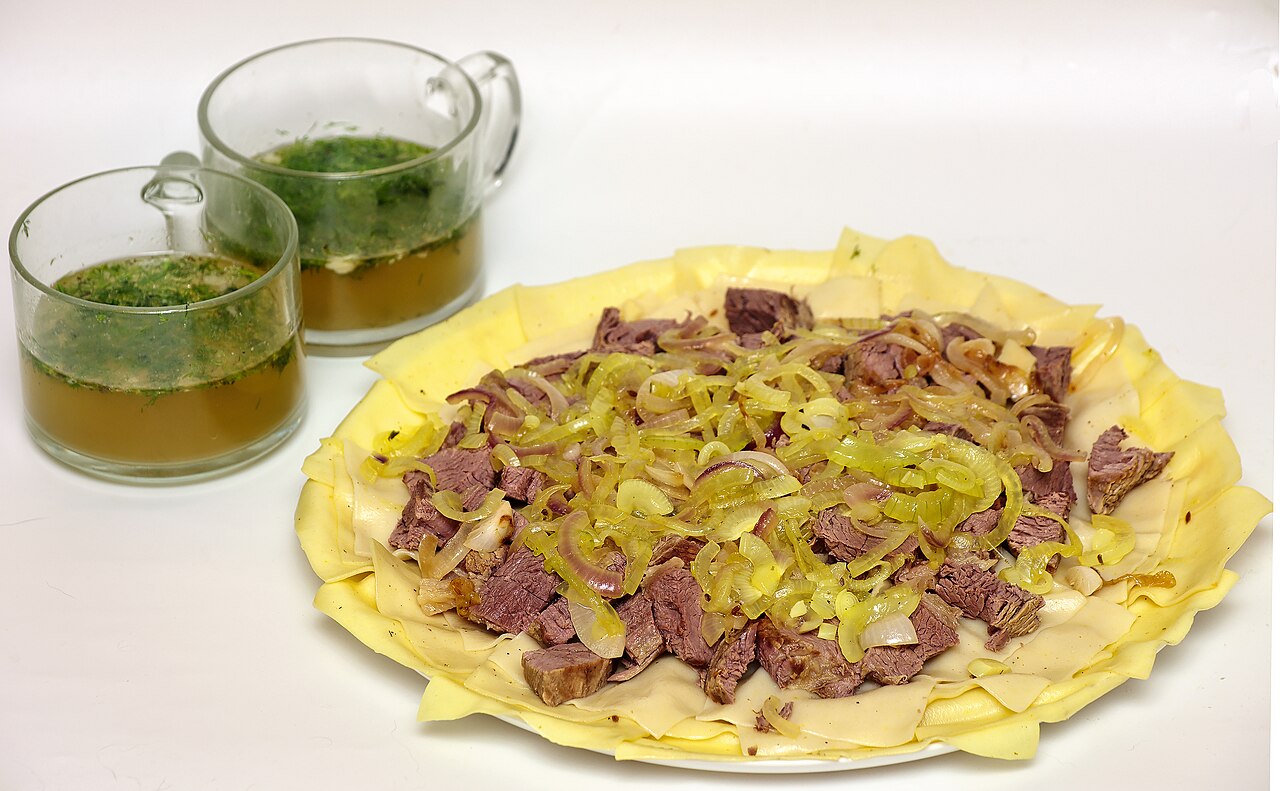
Large pieces of boiled mutton or horse meat, often with horse sausage, served on a wide platter over sheets of thin boiled dough and topped with onions softened in the rich broth. The broth itself, sorpa, is drunk from bowls alongside. The name means 'five fingers', because it was traditionally eaten with the hands.
The host carves the meat and hands out the pieces in order of honour: the most respected guest may be offered the boiled sheep's head, and shares it out with others at the table.
See the recipe
Serves 6
3 h
Ingredients
1.5 kg lamb on the bone (shoulder or neck), or a mix of lamb and beef
2 onions, 1 whole and 1 sliced into rings
1 bay leaf, salt and black peppercorns
For the dough: 300 g plain flour, 1 egg, about 120 ml water and a pinch of salt
A small bunch of parsley or dill, chopped
Method
Put the meat in a large pot, cover with about 3 litres of cold water and bring slowly to the boil, skimming off the foam. Add the whole onion, bay leaf and peppercorns, and simmer gently for 2 to 2.5 hours until the meat is very tender. Salt towards the end.
Meanwhile mix the flour, egg, water and salt into a firm dough, knead for a few minutes and rest it for 30 minutes under a bowl.
Roll the dough out very thinly and cut it into squares of about 7 cm.
Lift the meat out, keep it warm and cut it into large pieces. Put the onion rings in a ladle of hot broth with some pepper and let them soften.
Cook the dough squares in the simmering broth, a few at a time, for 3 to 4 minutes, and lay them on a large platter.
Pile the meat on the dough, spoon the onions and a little broth over the top, and scatter with herbs. Serve the rest of the hot broth in bowls.
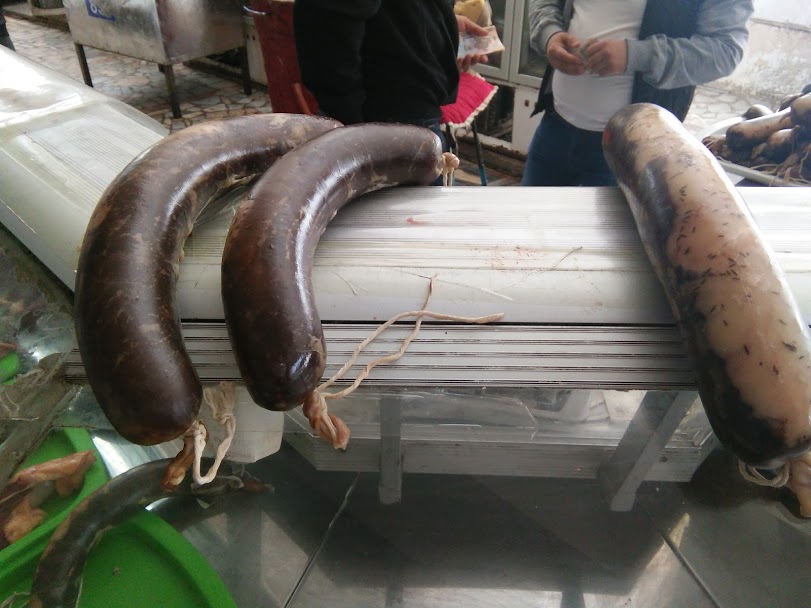
A handmade sausage of horse meat and fat, dried or smoked and then boiled. It is sliced into rounds, each with a ring of white fat, and served cold as a starter with other cold meats, or cooked together with beshbarmak on festive days.
Kazy was once a dish only the wealthy could afford, because it takes the best meat from a well-fed horse.
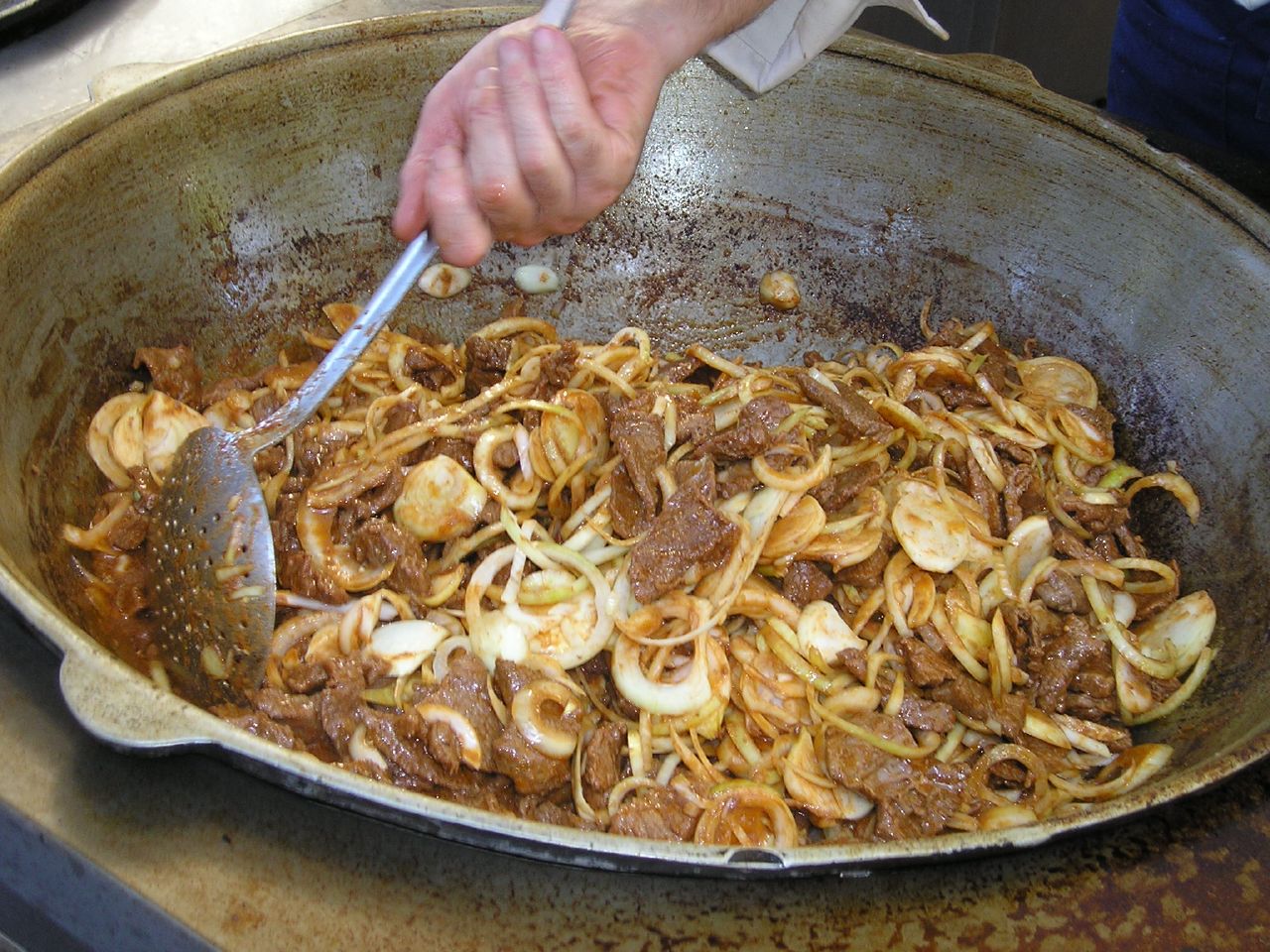
A hearty dish of fried meat and offal, such as liver, heart and kidneys, cut small and cooked with onions in a cauldron. Nomads traditionally made it from a freshly slaughtered sheep, frying it in animal fat; potatoes, which reached the region in the 19th century, are often added today.
See the recipe
Serves 4
1 h
Ingredients
400 g lamb shoulder, cut into 2 cm pieces
300 g lamb liver and heart (or all liver), cut into 2 cm pieces
2 tablespoons lamb fat or vegetable oil
2 onions, sliced
2 potatoes, cut into cubes (optional)
Salt, black pepper and a pinch of ground cumin
Fresh parsley or dill to serve
Method
Heat the fat in a heavy pan or wok until very hot. Fry the lamb pieces for 8 to 10 minutes until browned.
Add the heart and fry for 5 minutes.
Add the onions and potatoes, if using, with a splash of water. Cover and cook gently for about 20 minutes until the potatoes are soft, stirring now and then.
Add the liver and fry uncovered for 3 to 4 minutes, until just cooked through with no pink juices. Liver becomes tough if overcooked.
Season with salt, pepper and cumin, scatter with herbs and serve hot with bread.
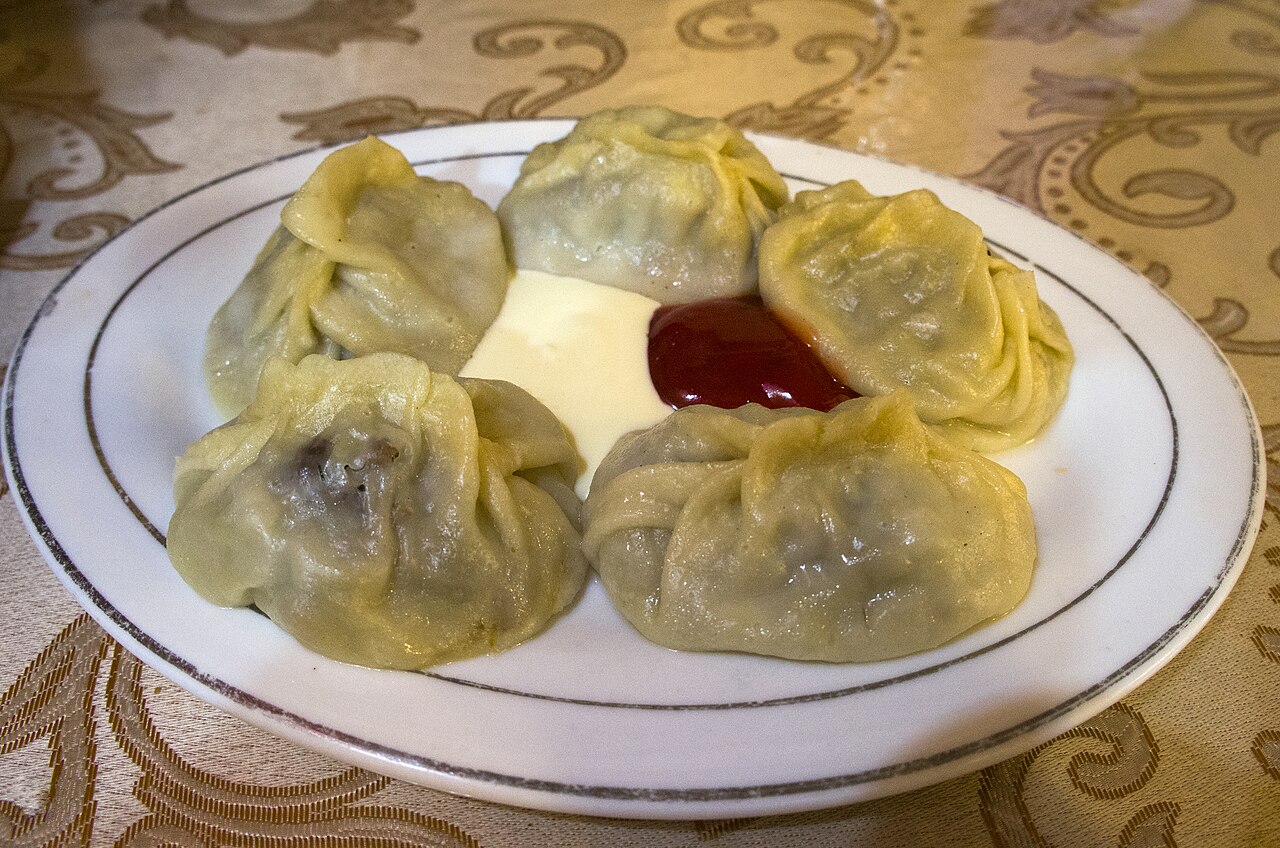
Large steamed dumplings filled with minced lamb or beef, onion and black pepper, sometimes with pumpkin. They are cooked in a tall steamer with several tiers and served with butter, sour cream or an onion sauce.
See the recipe
Serves 4
1 h 30 min
Ingredients
For the dough: 400 g plain flour, 1 egg, about 180 ml water and a pinch of salt
500 g minced lamb or beef (with some fat)
3 onions, very finely chopped
150 g pumpkin, finely diced (optional)
1 teaspoon salt and 1 teaspoon black pepper
Butter or sour cream to serve
Method
Mix the flour, egg, water and salt into a smooth, firm dough. Cover and rest for 30 minutes.
Mix the meat, onions, pumpkin, salt, pepper and 2 tablespoons of cold water into a juicy filling.
Roll the dough thinly and cut it into 10 cm squares. Put a spoonful of filling in the middle of each, bring the corners together and pinch the edges closed.
Brush the steamer tiers with oil, set the dumplings on them with space in between, and steam over boiling water for 40 to 45 minutes. The meat must be cooked right through.
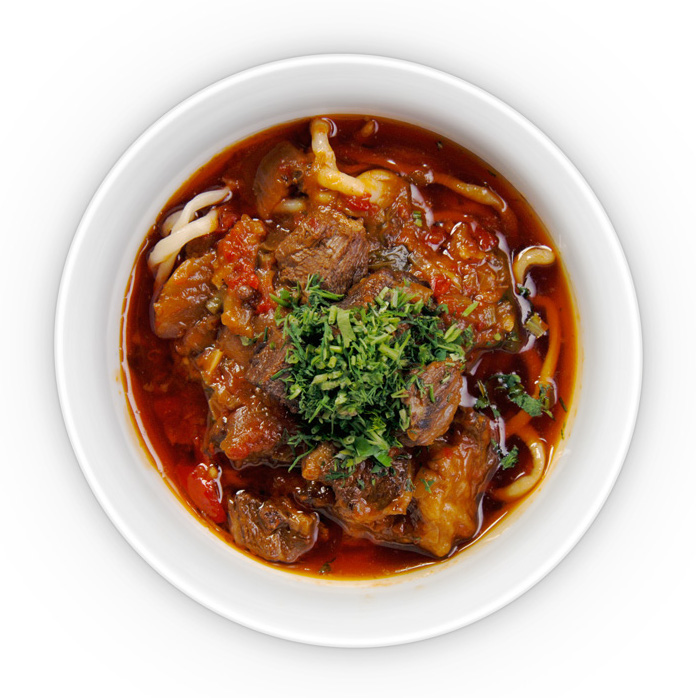
Southeast Kazakhstan and all big cities, from Uyghur and Dungan cooking
Long, hand-pulled wheat noodles topped with a stir-fried sauce of meat, peppers, tomatoes, onion and garlic. In Kazakhstan it is known as a national dish of the Uyghur and Dungan communities, and it is found in cafés all over the country.
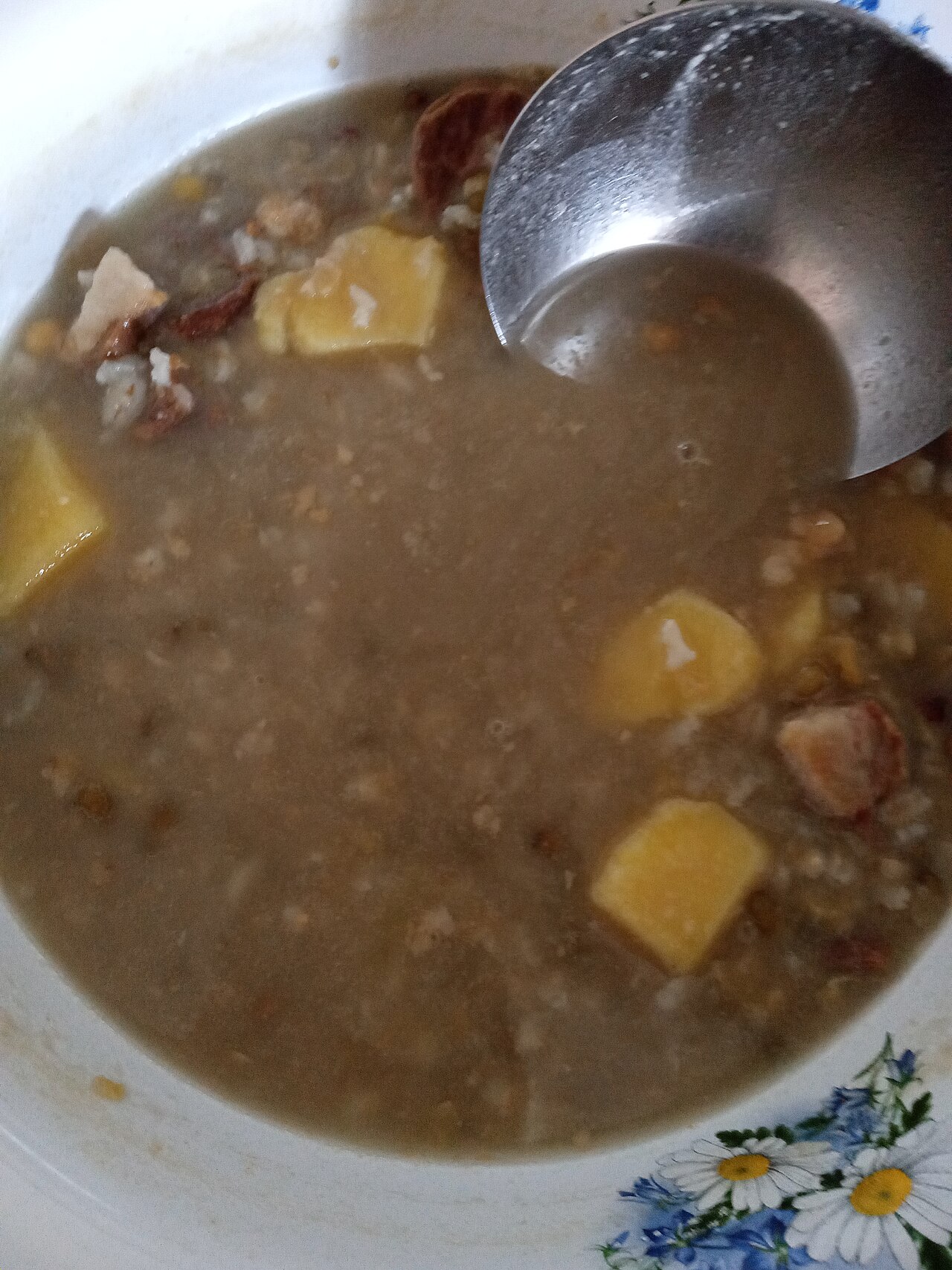
All of Kazakhstan, made for the spring festival of Nauryz
A thick soup made once a year for Nauryz, the spring new year in March. It is cooked from seven ingredients, which vary by region but usually include meat, fat, water, milk, grain and salt. The seven ingredients stand for good fortune and plenty in the coming year.
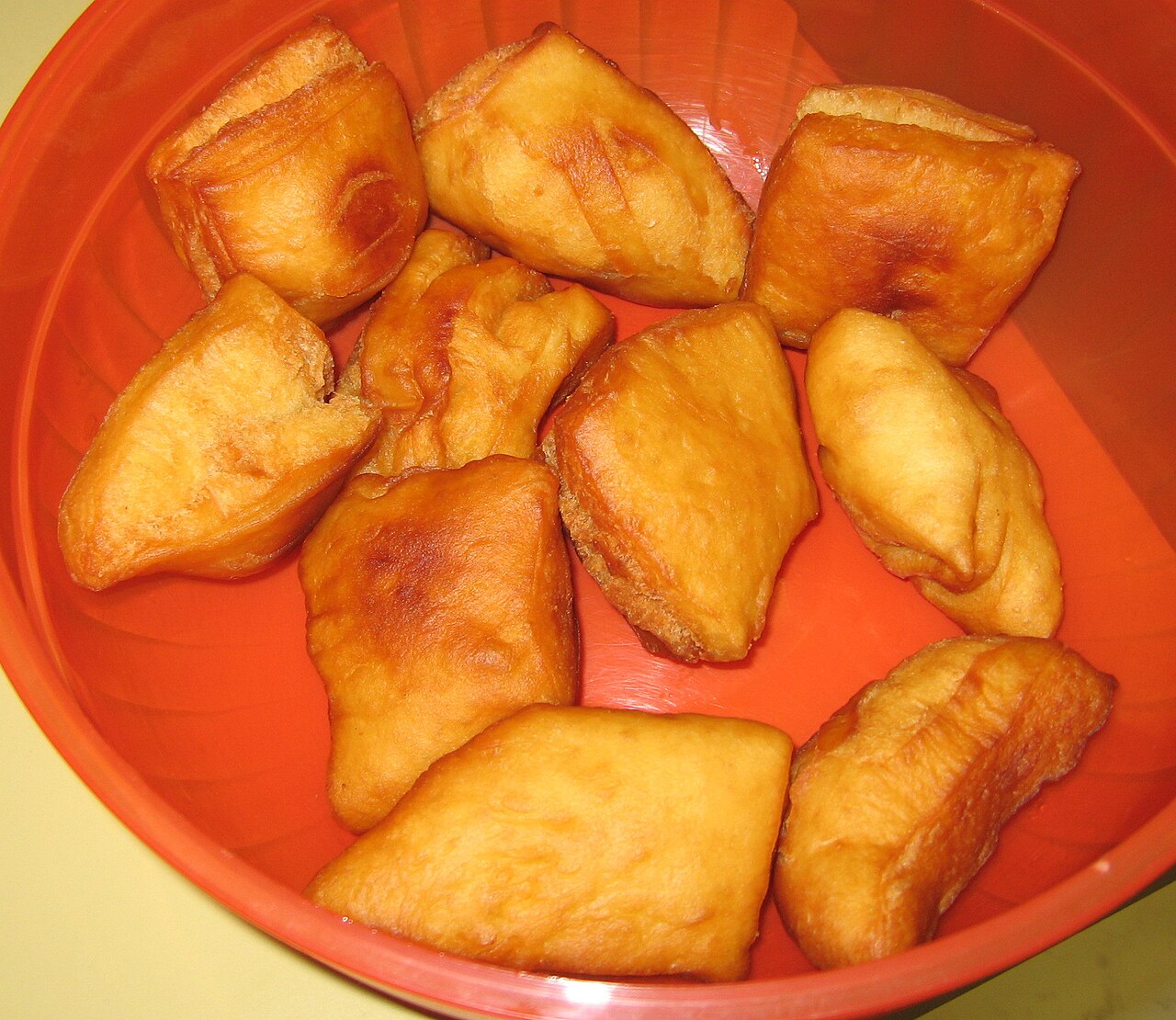
Small puffy pieces of fried dough, golden outside and soft inside, piled high on every dastarkhan. They are eaten with tea, butter, honey or jam, and a family gathering without baursak is hard to imagine.
See the recipe
Serves 8
2 h
Ingredients
500 g plain flour
250 ml warm milk
1 teaspoon dried yeast
1 tablespoon sugar and 1 teaspoon salt
1 egg
30 g butter, melted
About 1 litre vegetable oil for frying
Method
Stir the yeast and sugar into the warm milk and leave for 10 minutes until frothy.
Mix in the egg, melted butter, salt and flour, and knead into a soft dough. Cover and leave in a warm place for about an hour, until doubled.
Roll the dough out about 1 cm thick and cut into small squares, diamonds or rounds.
Heat the oil in a deep pan to about 170 °C. Fry the pieces a few at a time for 2 to 3 minutes, turning them, until puffed and golden. Hot oil is dangerous: never leave the pan, and keep children away.
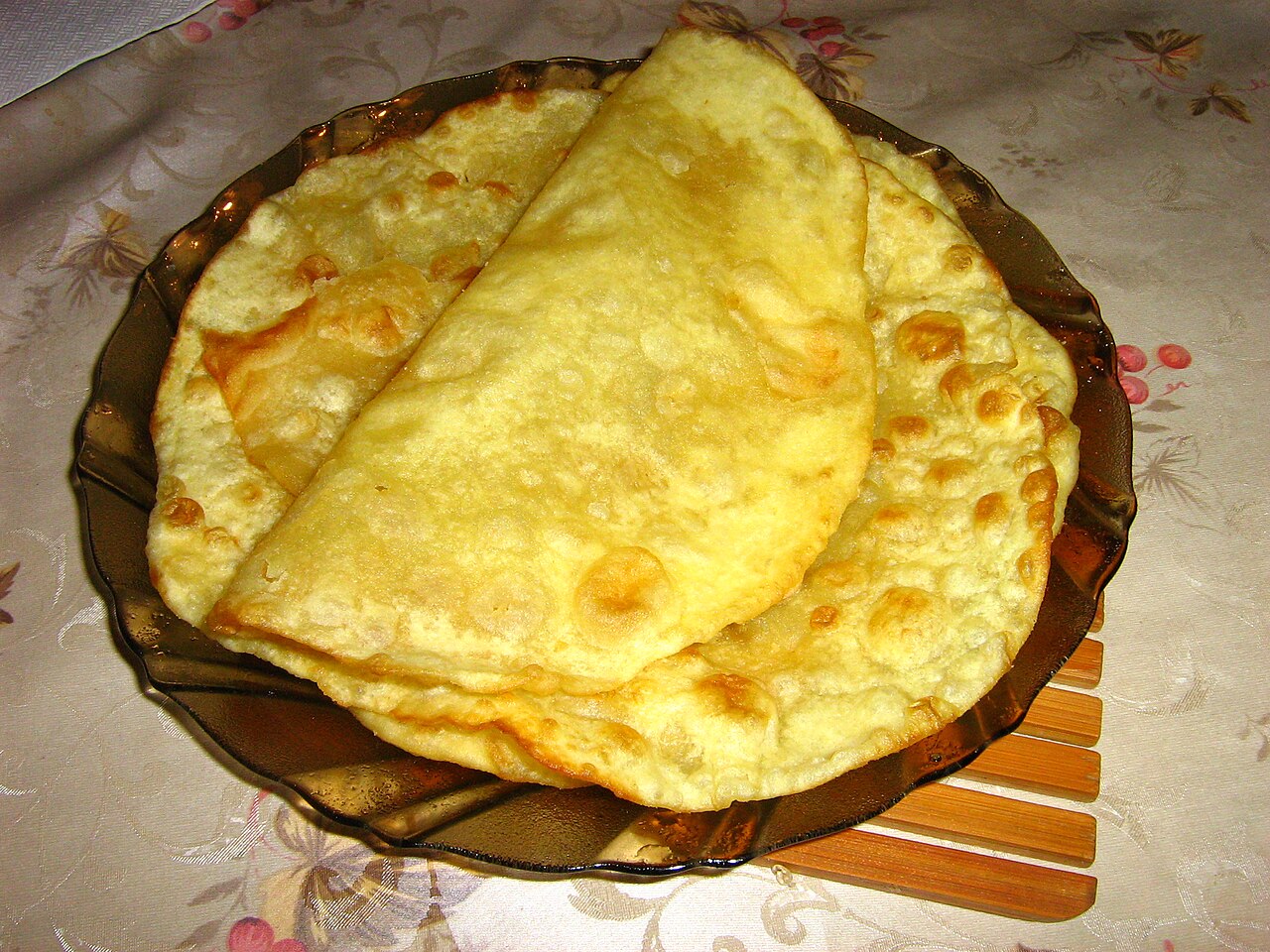
A thin, round flatbread fried in oil in a shallow pan, soft and slightly chewy. It is eaten with tea and is also made for gatherings in memory of the dead.
Families often fry seven shelpek, 'jeti nan', on Thursdays to remember their ancestors, one for each. It is said that the smell of frying bread feeds their spirits.
See the recipe
Serves 4
30 min
Ingredients
300 g plain flour
180 ml milk or water
1 tablespoon vegetable oil, plus more for frying
1 teaspoon sugar and a pinch of salt
Half a teaspoon of baking powder
Method
Mix the flour, baking powder, sugar and salt, add the milk and a tablespoon of oil, and knead to a soft dough. Rest it for 10 minutes.
Divide into 7 balls and roll each into a very thin round, about 20 cm across.
Heat 1 cm of oil in a wide frying pan. Fry each round for about 1 minute on each side until golden with a few bubbles. Hot oil is dangerous: never leave the pan.
Drain on kitchen paper and stack them. Serve warm with tea, butter or honey.
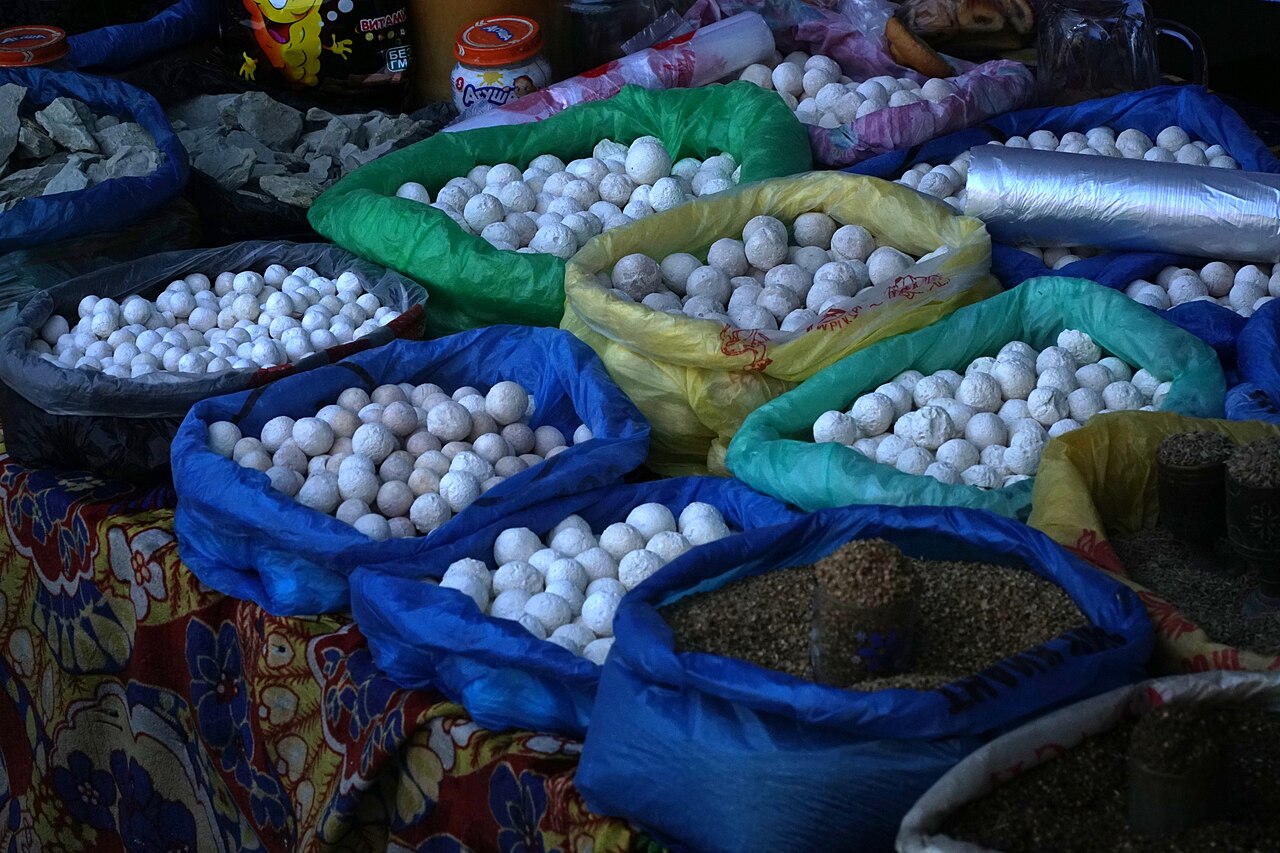
Small hard balls of strained sour milk, salted and dried until white. Kurt keeps for months, which made it perfect food for nomads on the move, and today it is sold in every market as a salty snack.
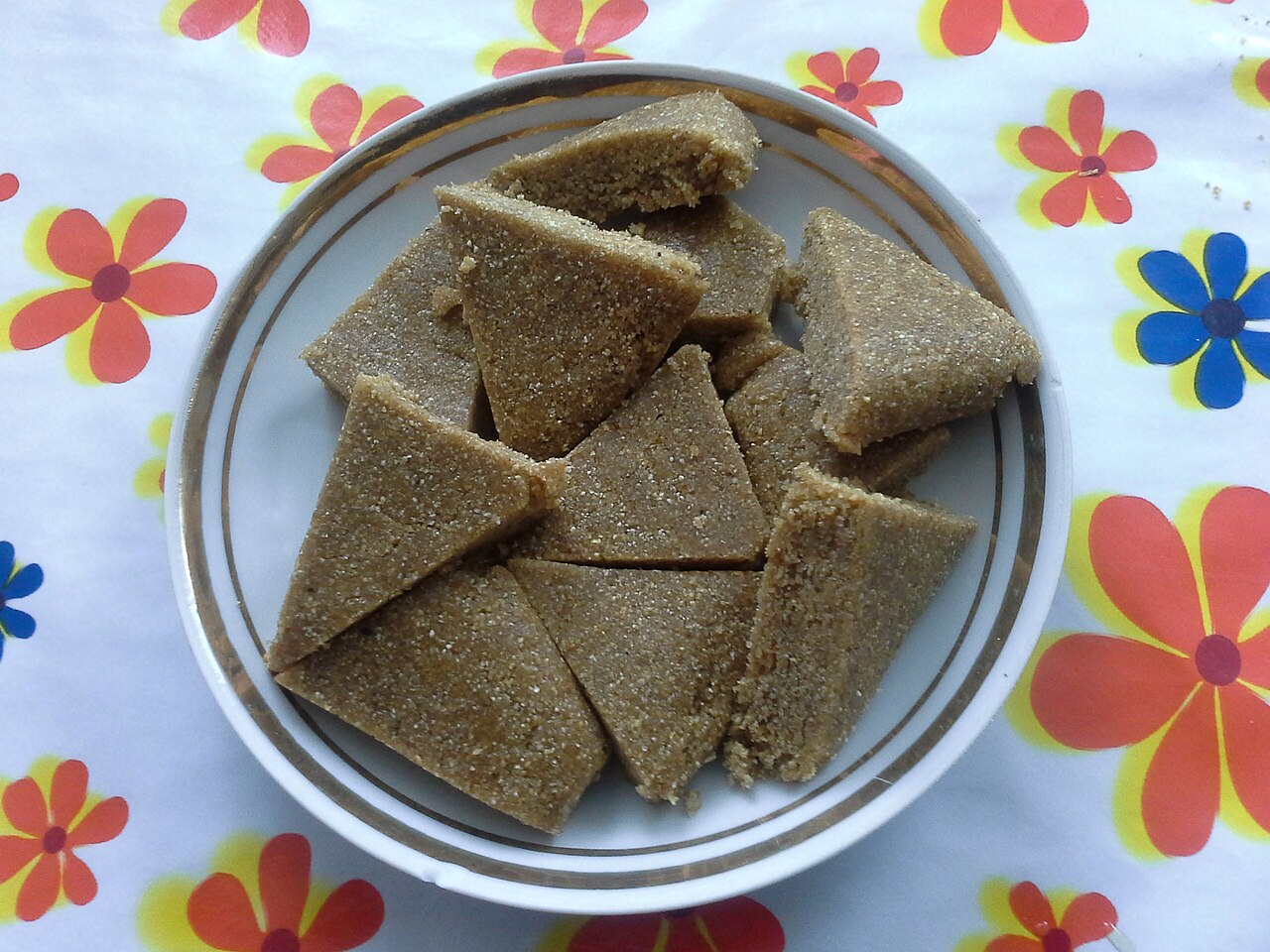
A sweet made without baking, from roasted crushed millet mixed with butter, sugar or honey, and often raisins, pressed firmly and cut into pieces. Easy to make in a single cauldron, it is still prepared for festive gatherings.
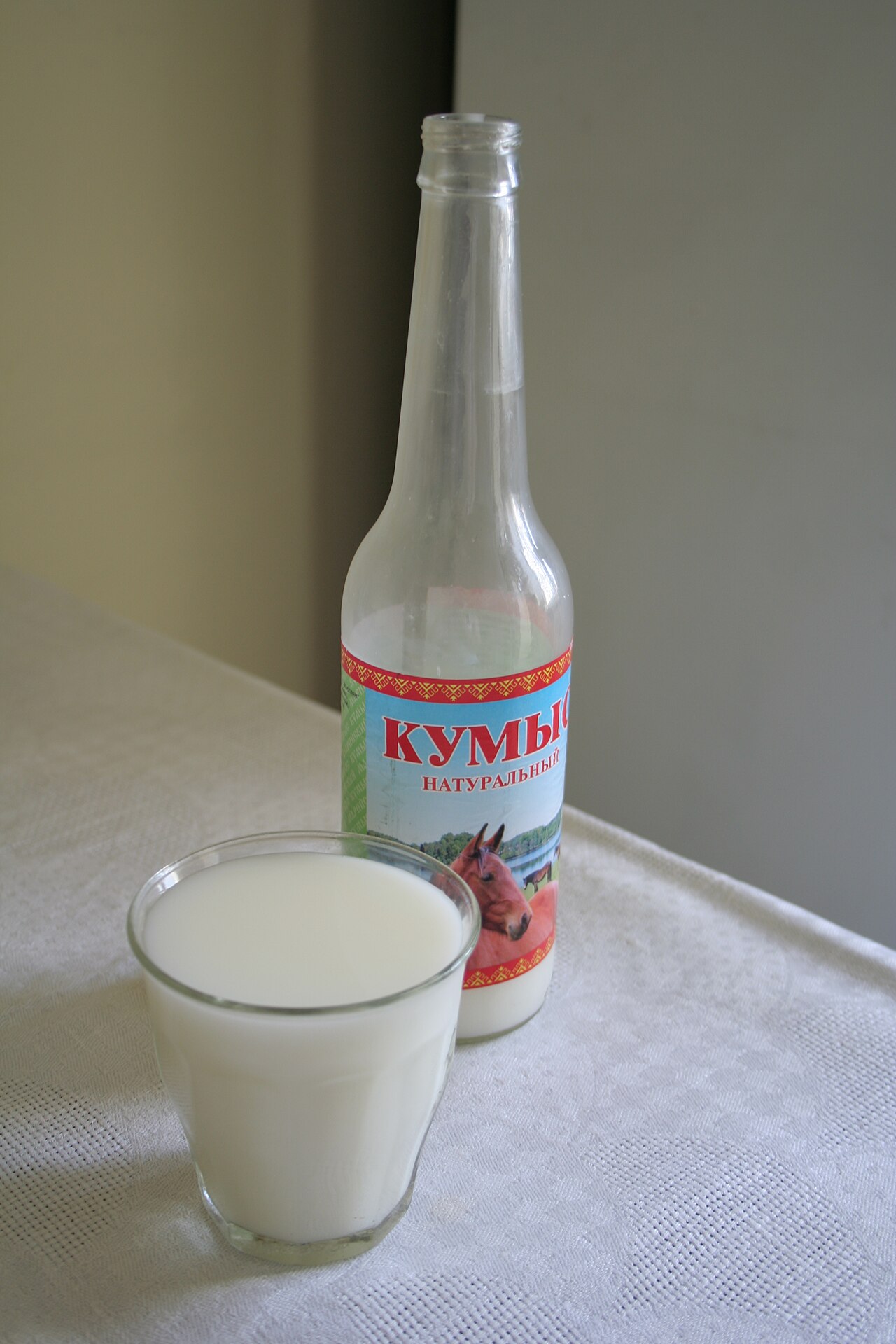
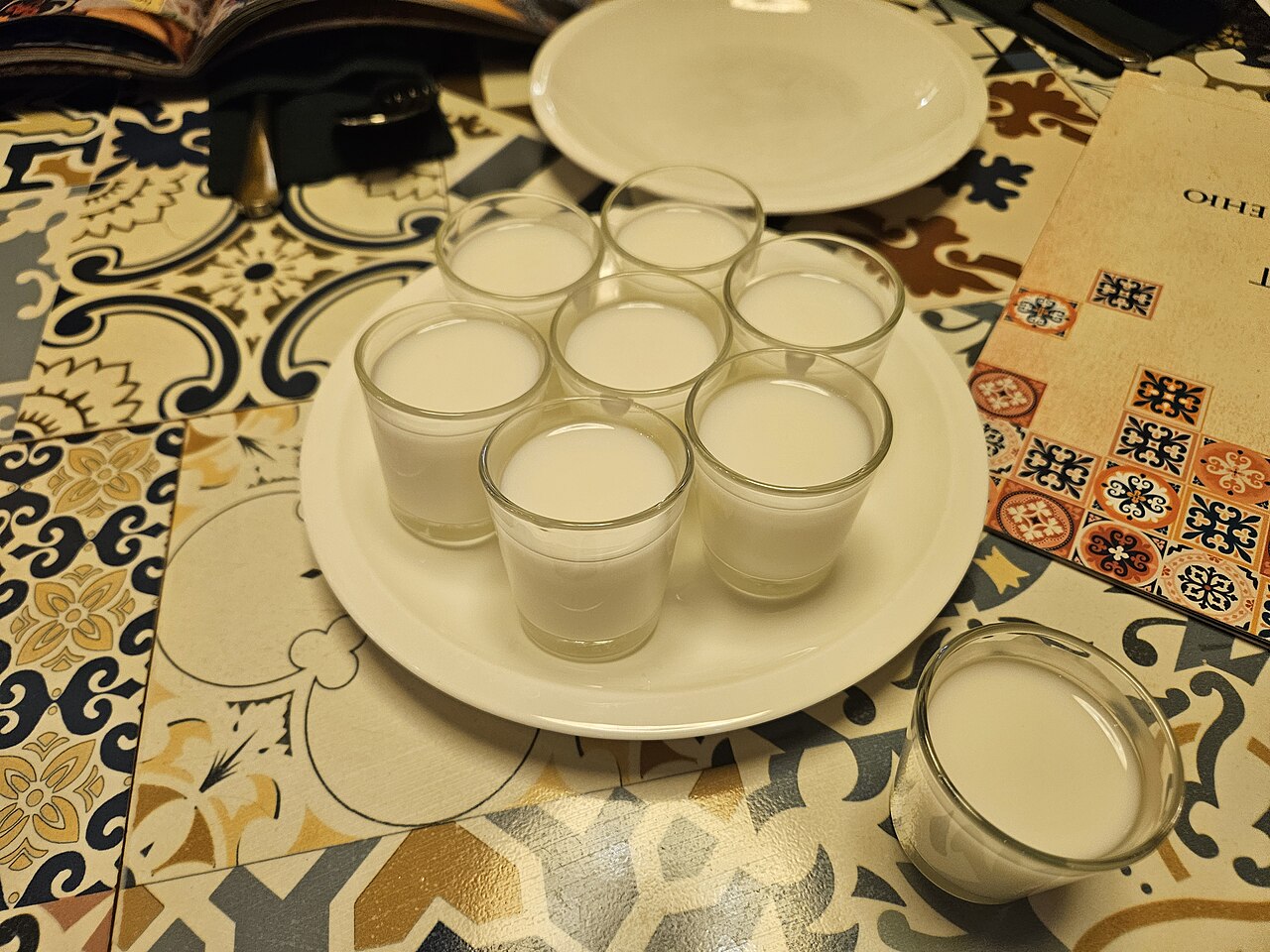
Fermented mare's milk, slightly sour, a little fizzy and very mildly alcoholic. It is served in wide bowls, and many Kazakhs value it as a healthy drink. Because mare's milk is scarce, factory versions are often made with cow's milk.
Kymyz contains only a little alcohol, usually between 0.7 and 2.5 percent, less than most beers.
Western and southern Kazakhstan, where camels are kept
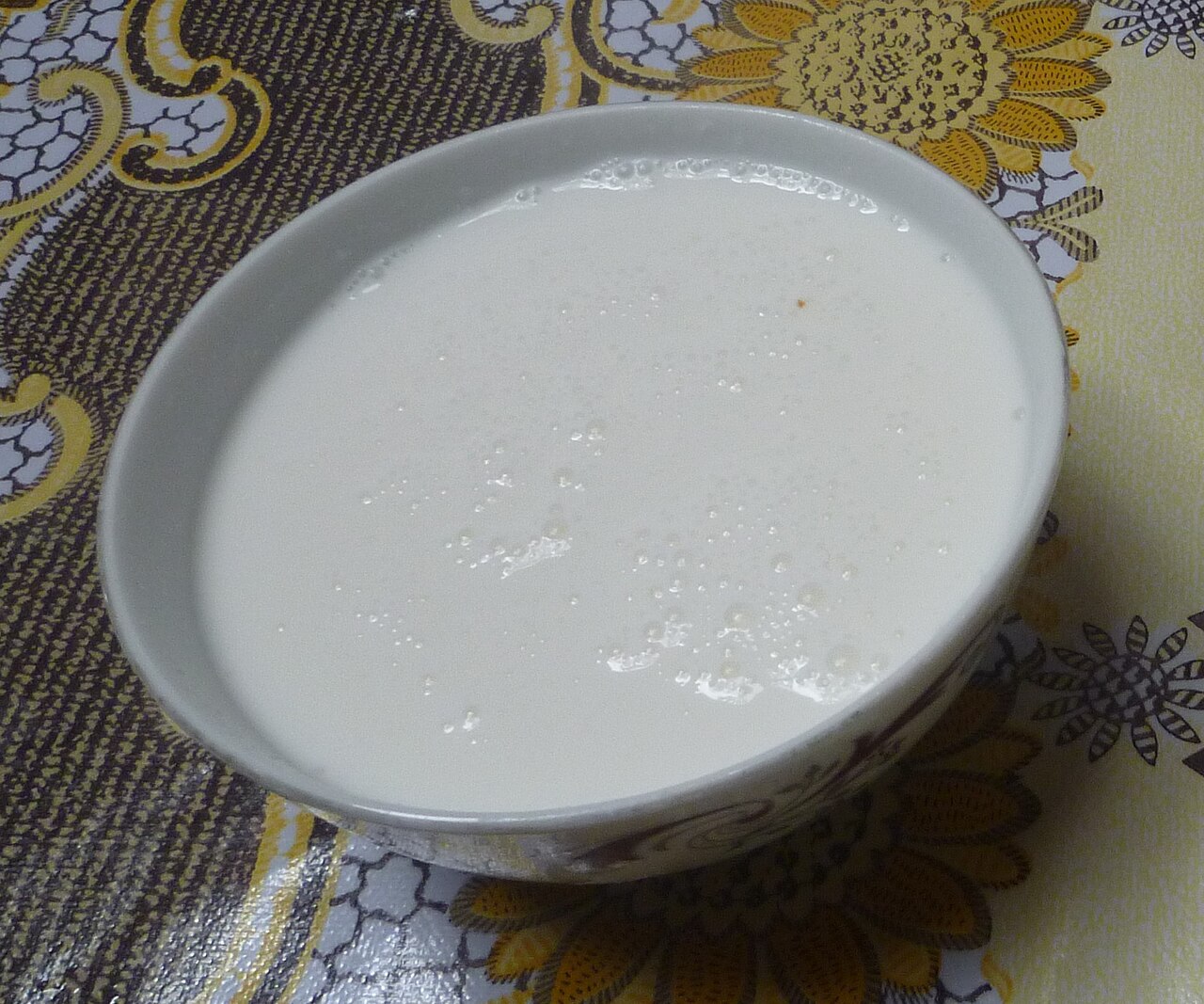
Fermented camel's milk, white, sparkling and sour, a staple summer drink of the camel-herding west. It spoils quickly, so it is best tasted fresh on a farm or in a local market.
A cool, salty drink made from thick sour milk (katyk) or strained yoghurt thinned with water, and in modern times with fizzy water. It is a favourite on hot summer days and with rich meat dishes.
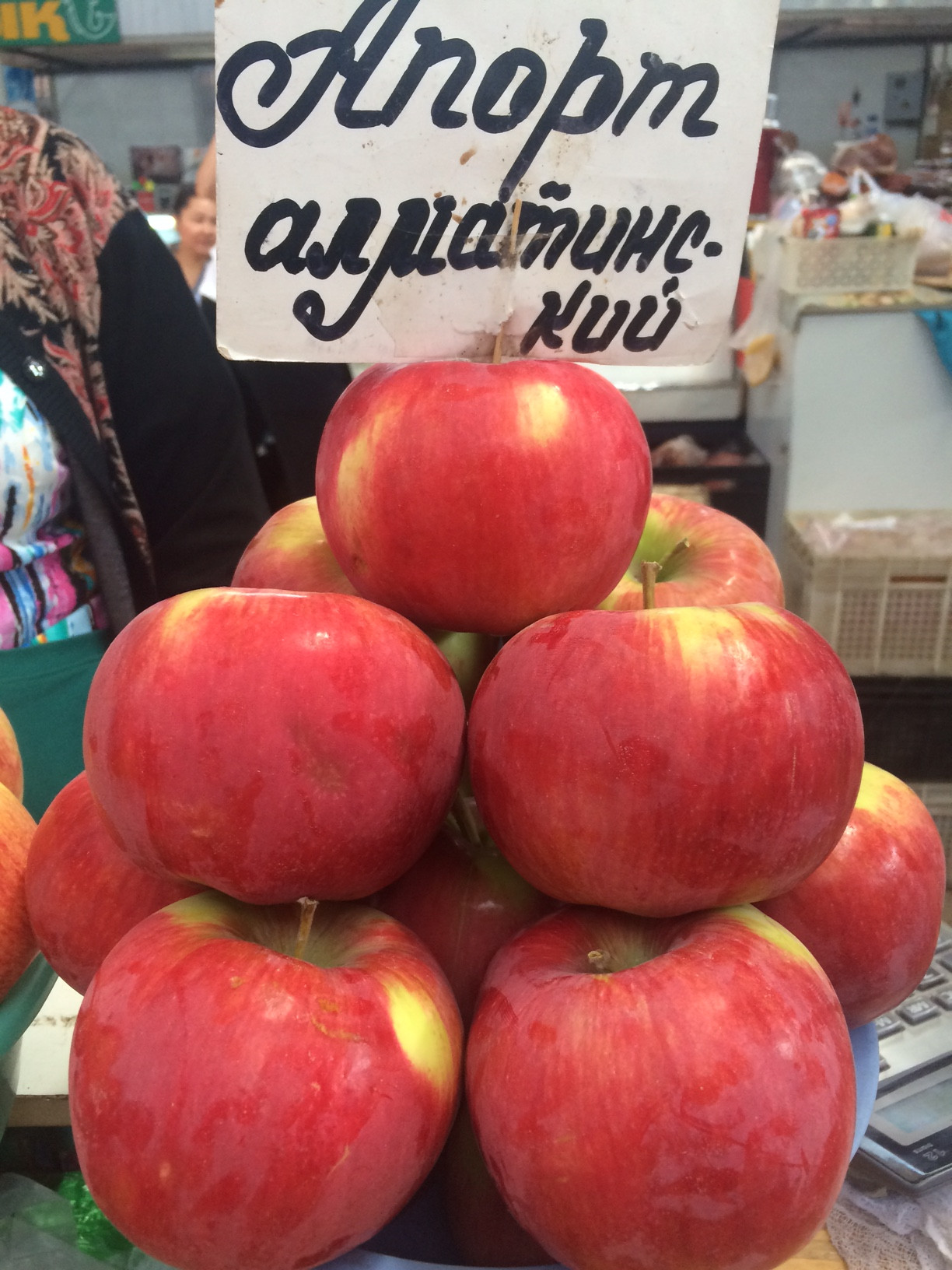
Huge, fragrant red apples grown in the mountain foothills around Almaty, usually weighing 200 to 500 g each. Aport is the city's famous apple and is sold in its markets every autumn. It is thought to have come to Almaty, then called Verny, in 1865 and was crossed there with the local wild apple.
The wild apple forests of the Tian Shan, around Almaty, are home to Malus sieversii, which DNA studies show is the main ancestor of the apples eaten around the world today.
Table manners
A guest is always given the place of honour at the table and a special welcome. Meals are traditionally laid out on a low table called a dastarkhan.
Tea is poured only part of the way up the bowl, called a kese. A small pour is a sign of respect, because the host will refill it again and again to keep your tea hot. A full bowl can hint that it is time to leave.
The host carves the meat for beshbarmak and hands out the best pieces to the most honoured guests and to children. The most honoured guest may be offered the boiled sheep's head to share out.
Tea comes with every meal, usually strong black tea with milk, and a festive meal often ends with kymyz and then more tea.
Vegetarians should ask before ordering: even dishes without meat are very often cooked in meat stock.
Kazakhstan's cities lie far apart across the steppe. Astana, Karaganda, Semey and Oskemen are in the cold north and east, Almaty and Shymkent in the warm, mountain-ringed south, and Turkistan on the old Silk Road near the Syr Darya. In the west, Aktobe, Atyrau and Aktau are the centres of the oil industry, with Atyrau and Aktau close to the Caspian Sea.
City of republican significance, on the Ishim River in the north
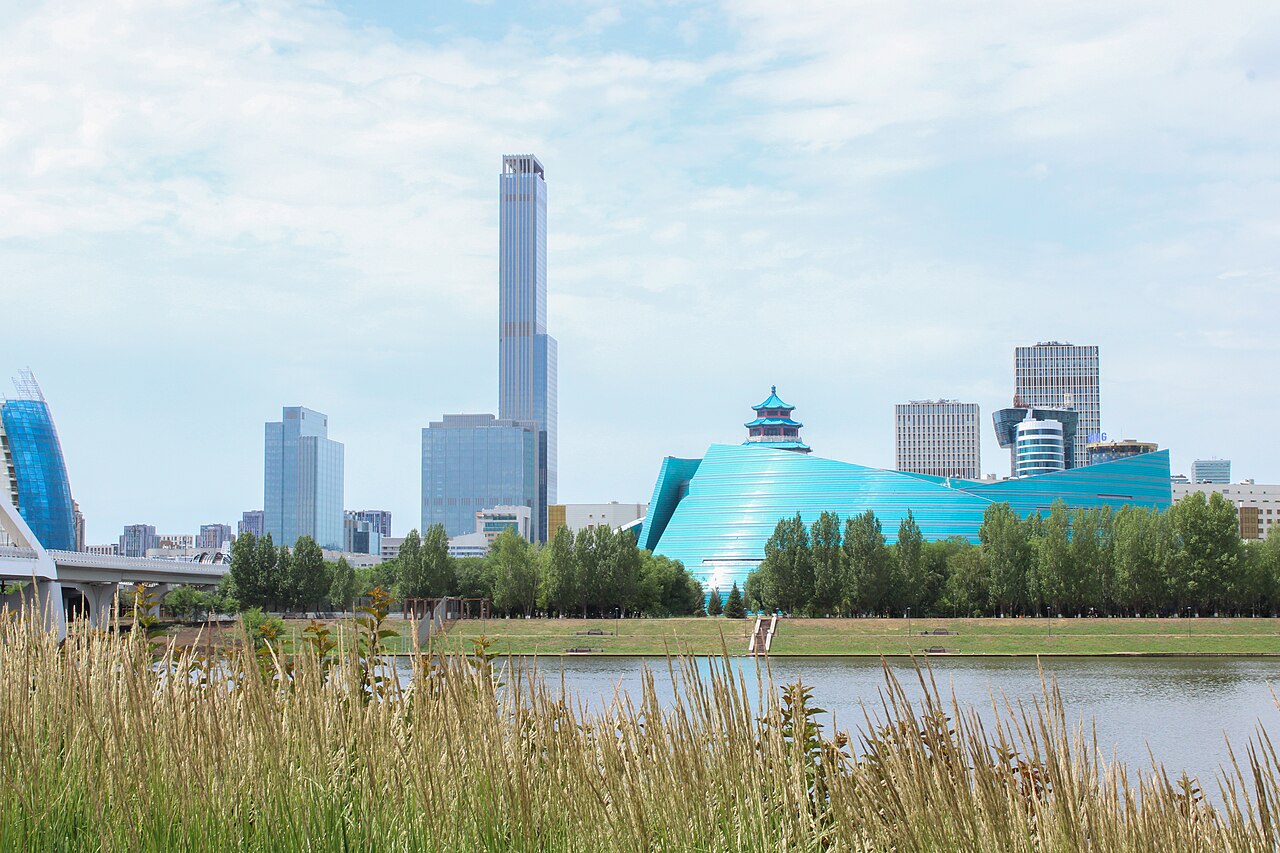
The capital since 10 December 1997. Founded in 1830 as Akmoly, it was later called Akmolinsk, Tselinograd, Akmola, Astana, Nur-Sultan from 2019, and Astana again since 2022. With about 1.5 million people it is the second-largest city, full of bold new buildings, and the second-coldest national capital in the world after Ulaanbaatar.
City of republican significance, in the southeast at the foot of the Tian Shan
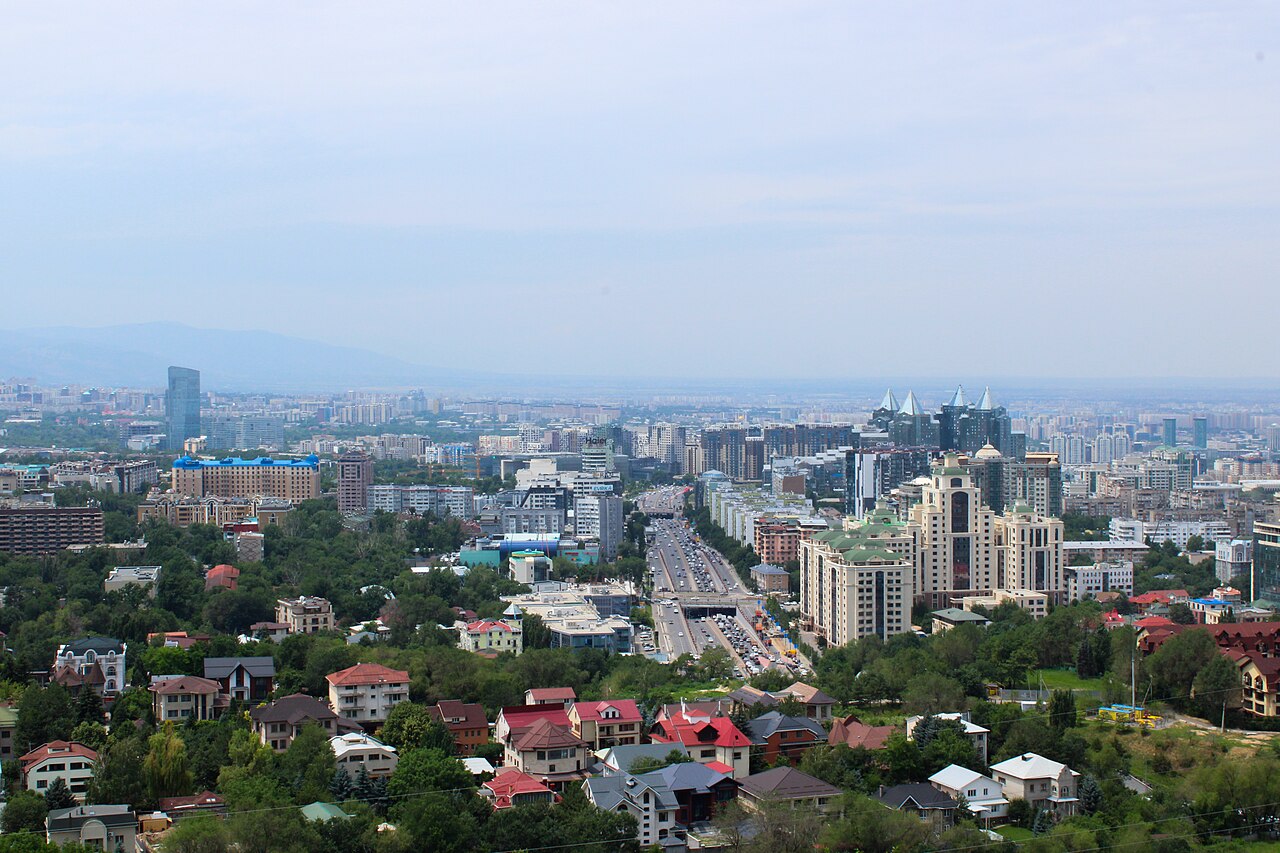
The largest city, with more than two million people, and the capital until 1997. Once called Verny and then Alma-Ata, it lies below snowy peaks of the Trans-Ili Alatau and is the country's main centre of business, culture and education.
The third-largest city, about 120 km north of Tashkent in Uzbekistan. It dates back at least to the 12th century as a stop on the Silk Road caravan route, and today it is a lively, warm city with large Uzbek and Russian communities.
The largest city in the west of the country, on the Ilek River, with more than half a million people. It lives from oil and gas, metalworking and mining.
An ancient Silk Road town near the Syr Darya and a place of pilgrimage thanks to the mausoleum of the poet and Sufi teacher Khoja Ahmed Yasawi. Its name comes from 'Hazrat-i-Turkistan', the 'Saint of Turkistan', a title of Yasawi. In 2021 the Organization of Turkic States named it the spiritual capital of the Turkic world.
Called Semipalatinsk until 2007, this old town on the Irtysh River is linked with the great Kazakh poet and thinker Abai Kunanbayuly. Since 2022 it has been the centre of the new Abai Region. The Soviet nuclear test site lay on the steppe to the west.
The largest city in the east, also known by its Russian name Ust-Kamenogorsk. It was founded in 1720 as a fort where the Ulba River meets the Irtysh, and today it is a centre of metal industry and a gateway to the Altai mountains.
Known until 1991 as Guryev, this city stands where the Ural River flows into the Caspian Sea. The river is often described as the border between Europe and Asia, so the city has a European and an Asian bank. It is a centre of the oil and gas industry.
A port city on the eastern shore of the Caspian Sea, on the Mangyshlak Peninsula. Built in Soviet times, it is a base for the oil industry and for trips to the desert canyons and underground mosques of Mangystau.
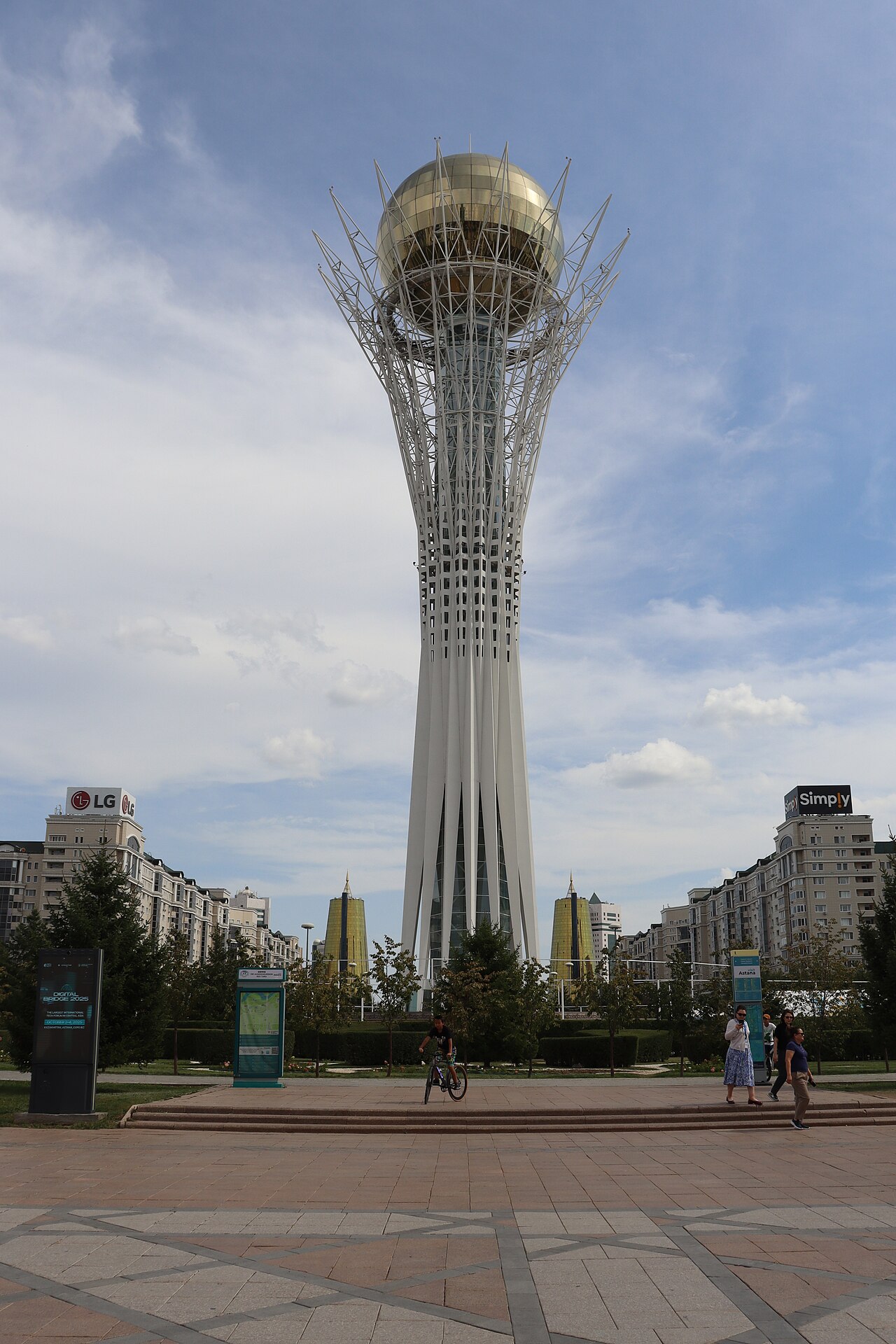
A 105 m white tower holding a golden glass ball, built to mark the move of the capital to Astana. It recalls a legend of the tree of life, where the magic bird Samruk laid its golden egg. A lift takes visitors up to the ball for views over the city.
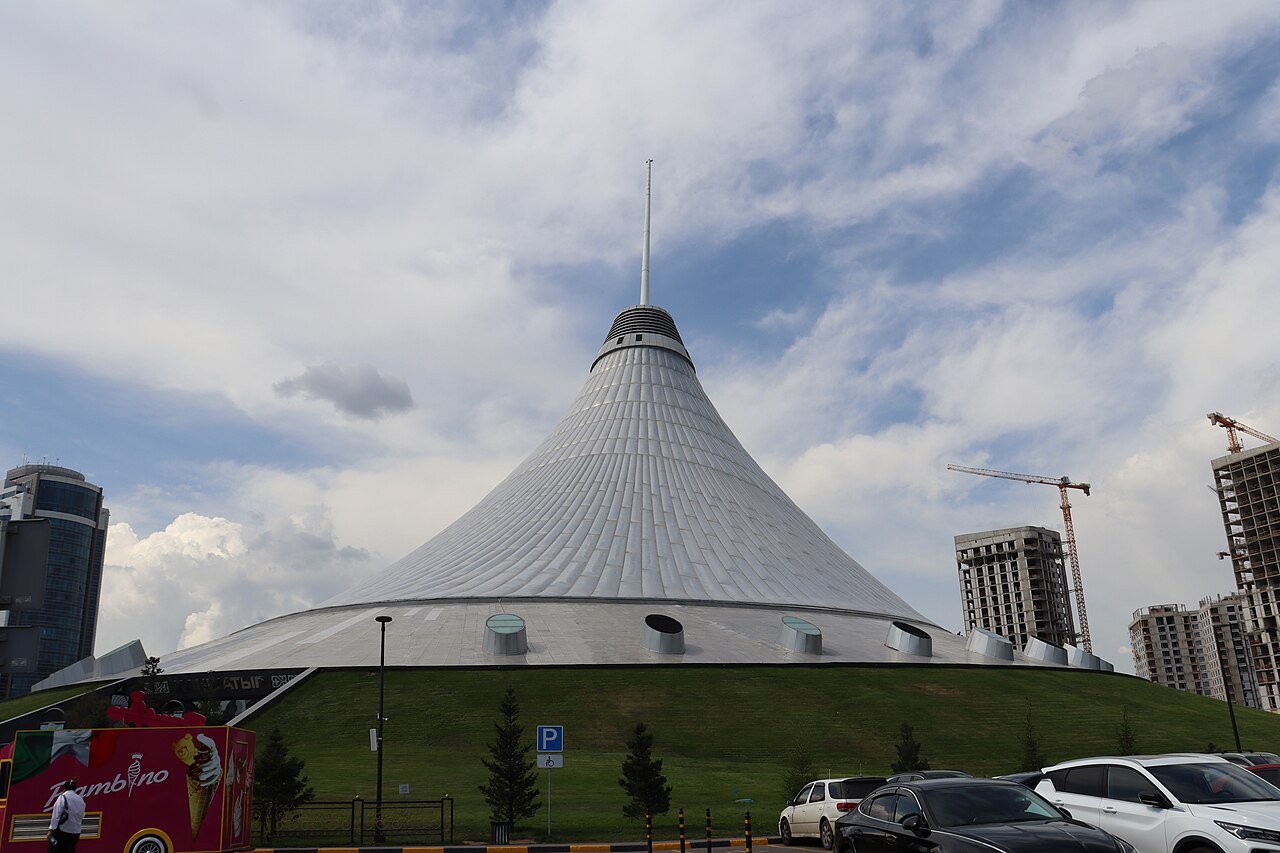
A giant transparent tent designed by the British architect Norman Foster, 150 m tall including its spire. Under it are shops, a park, a small river and even an indoor beach, kept warm while winter outside can drop to minus 35 °C.
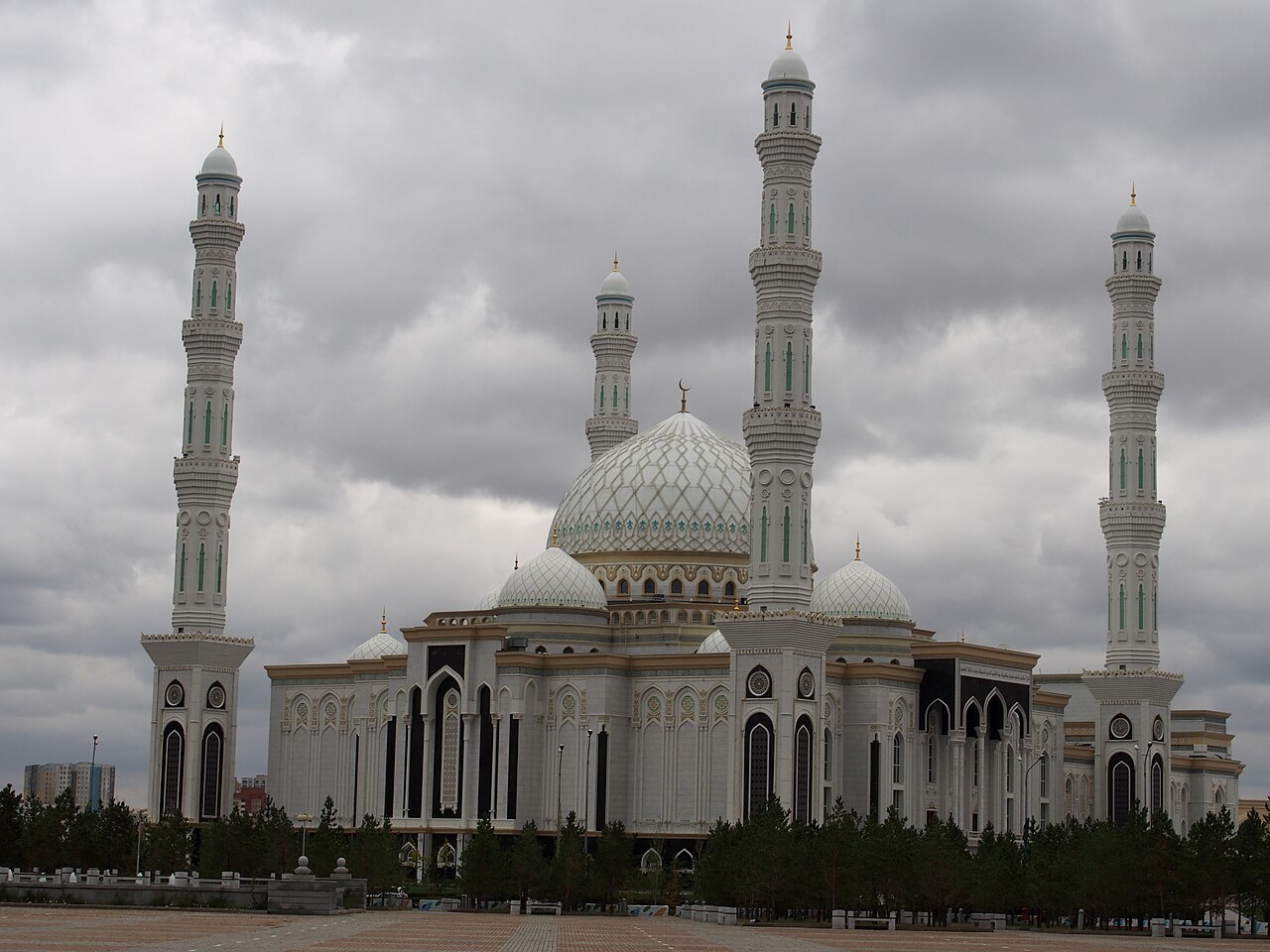
A large white mosque in classical Islamic style with Kazakh ornaments, opened in 2012 on the bank of the Ishim River. Its main dome, 51 m high, is the largest in Kazakhstan, and four 77 m minarets stand at its corners. It can hold 5,000 worshippers.
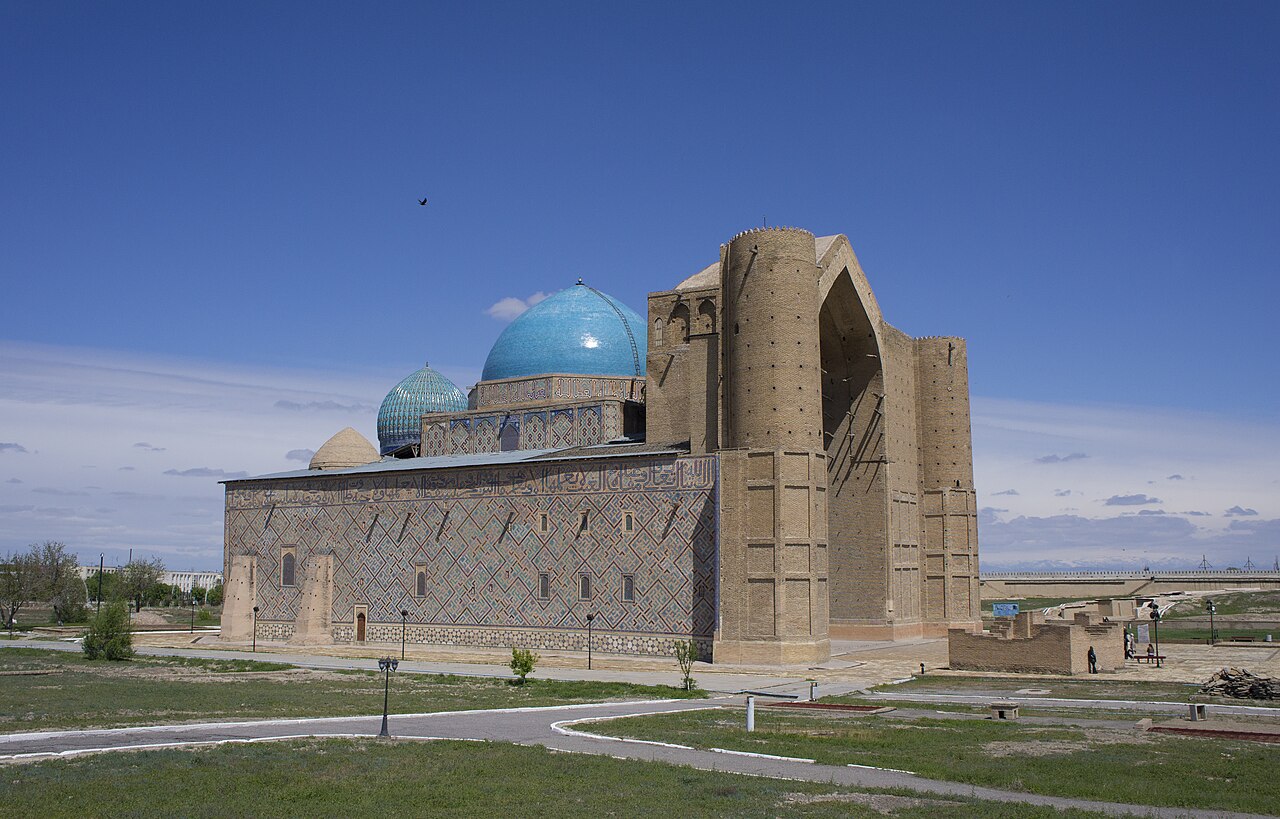
A huge mausoleum with turquoise domes, begun in 1389 on the orders of Timur for the 12th-century Sufi poet Khoja Ahmed Yasawi. It was never quite finished, yet it is one of the best-preserved Timurid buildings. In 2003 it became Kazakhstan's first World Heritage Site.
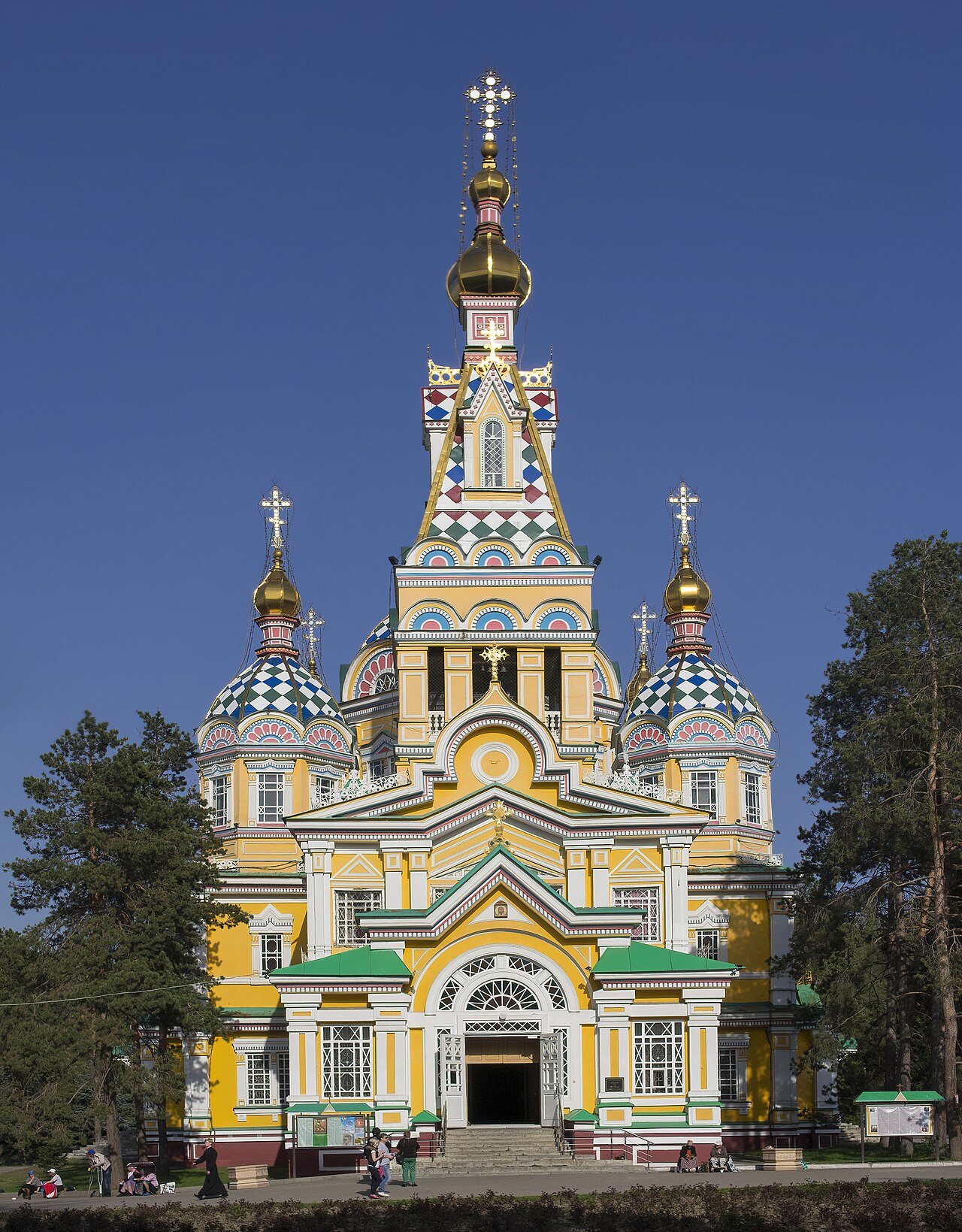
A brightly painted Russian Orthodox cathedral in Panfilov Park, completed in 1907. It is 56 m tall and made of wood, and it is said to have been built without nails. It is also known as Zenkov Cathedral.
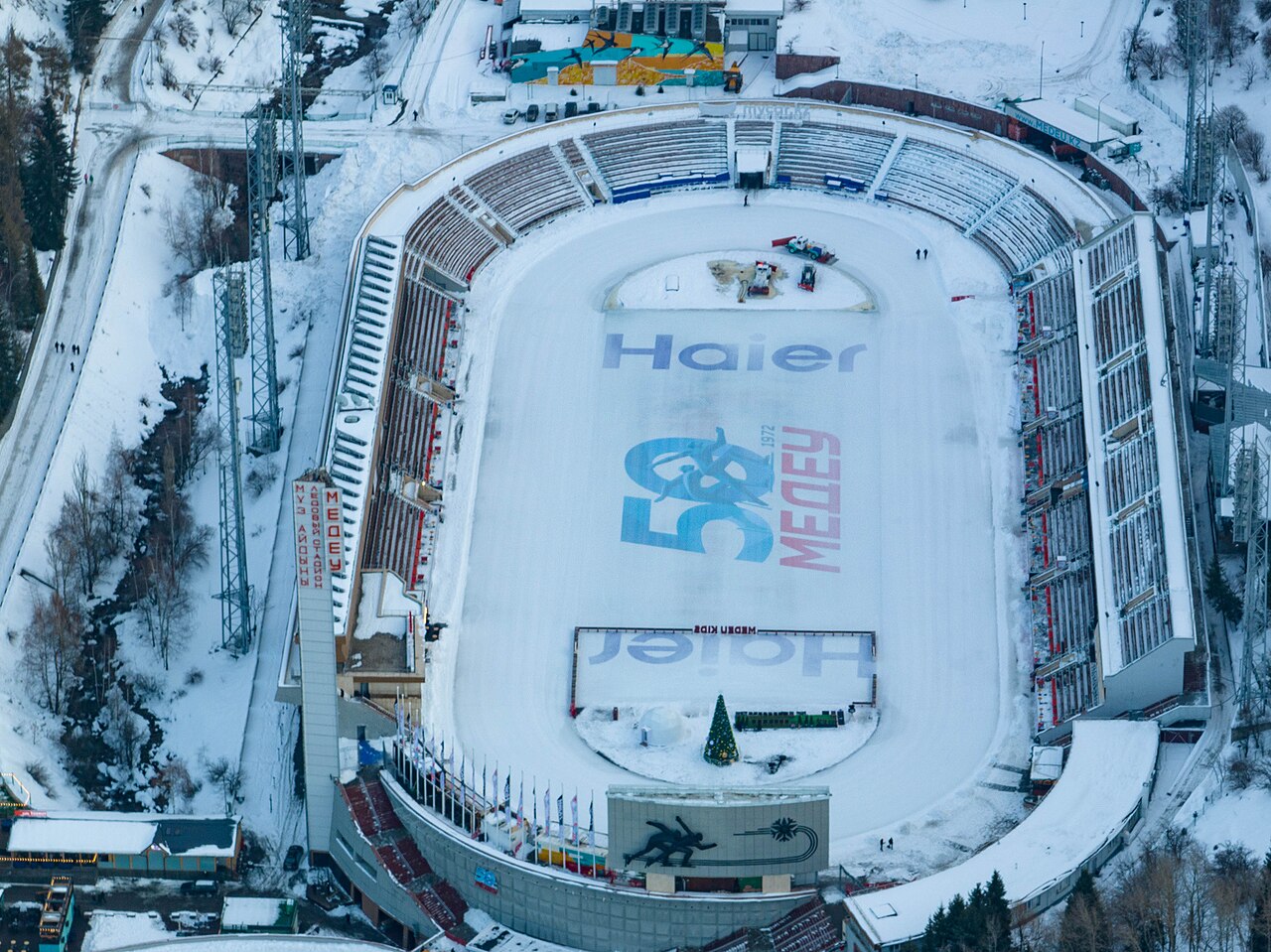
A huge outdoor skating rink high in a mountain valley on the edge of Almaty, at 1,691 m above sea level. Many speed skating world records were set here, and in winter anyone can skate with the mountains all around.
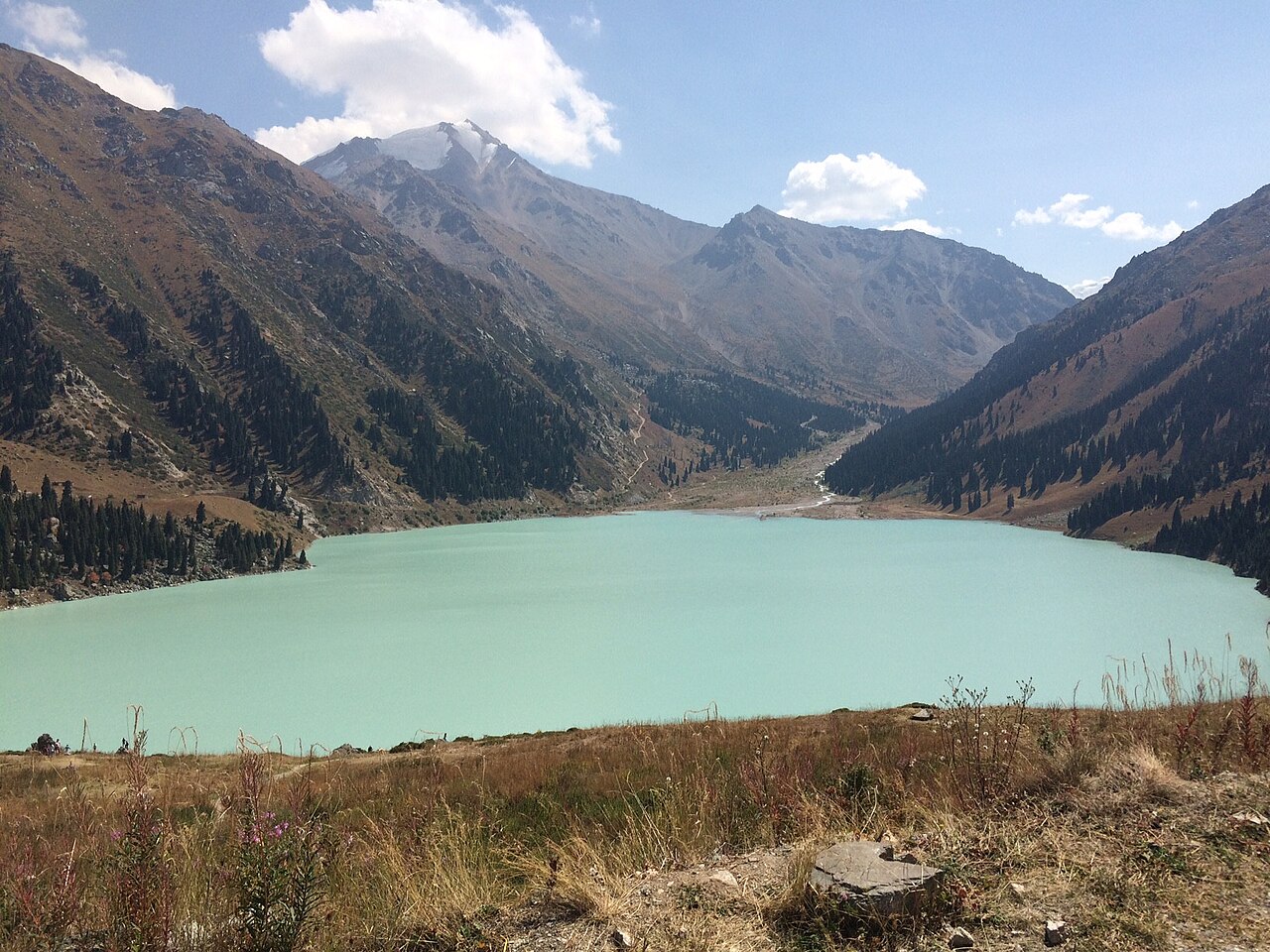
A turquoise mountain lake 2,511 m above sea level, about 15 km south of central Almaty, surrounded by peaks of the Trans-Ili Alatau. The colour of the water changes with the seasons. It supplies the city with drinking water, so swimming is not allowed.
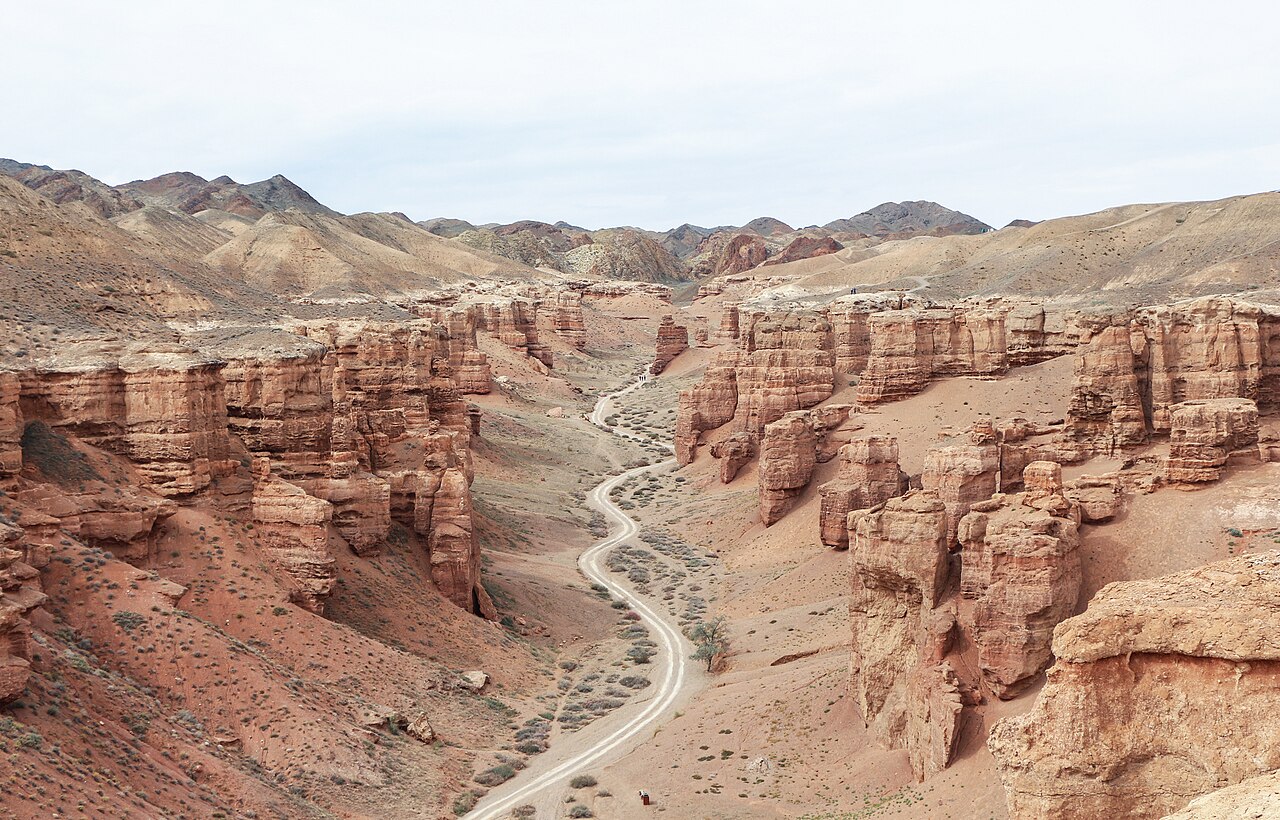
A red sandstone canyon on the Charyn River, about 200 km east of Almaty near the Chinese border, part of Charyn National Park. Its most visited stretch, the Valley of Castles, is lined with towers and walls shaped by wind and water, with cliffs of 150 to 300 m.
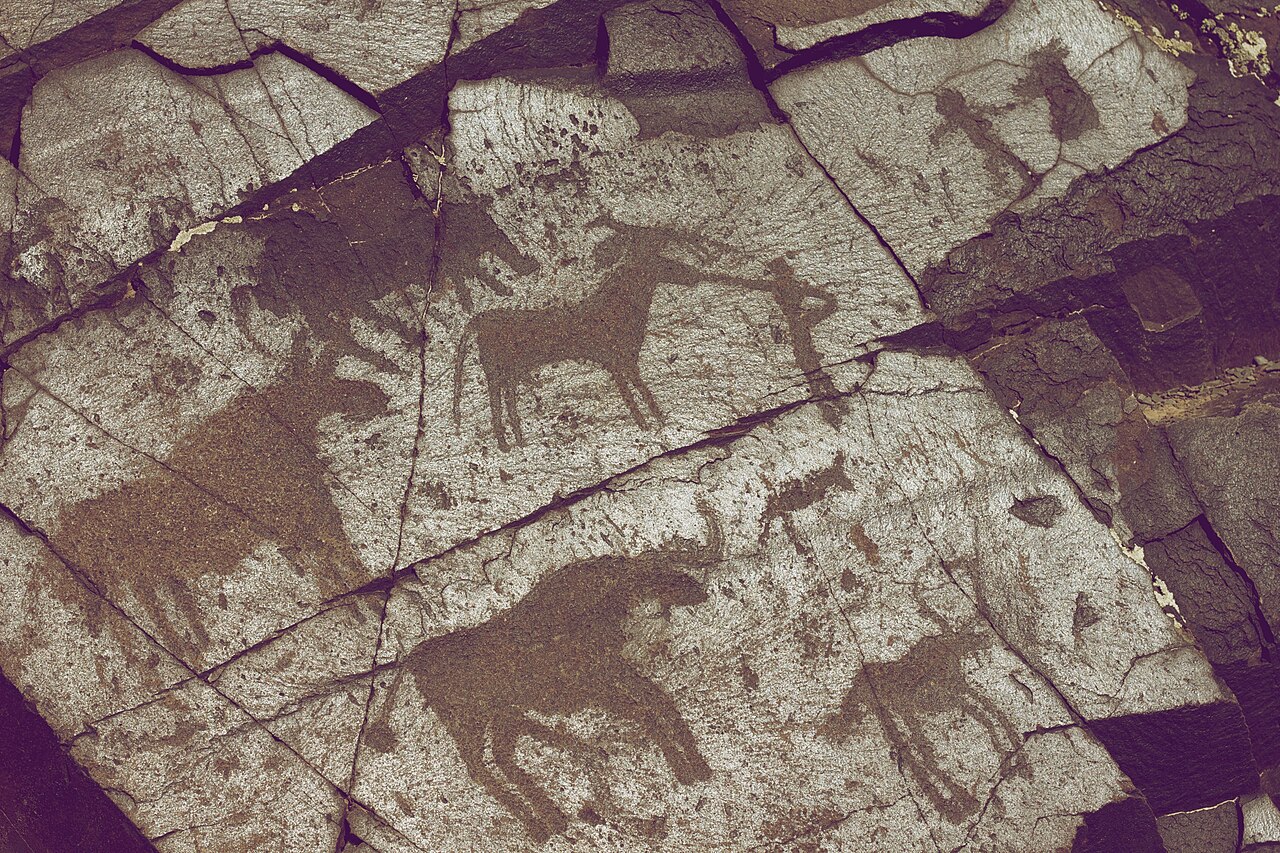
About 5,000 images carved into dark rock in and around a small canyon about 170 km by road northwest of Almaty. The oldest date from the Bronze Age, about 3,000 years ago, and the newest from the 18th or 19th century. Horses, bulls, hunters and warriors show how people lived and worshipped on the steppe. It has been a World Heritage Site since 2004, listed by UNESCO as Tanbaly.
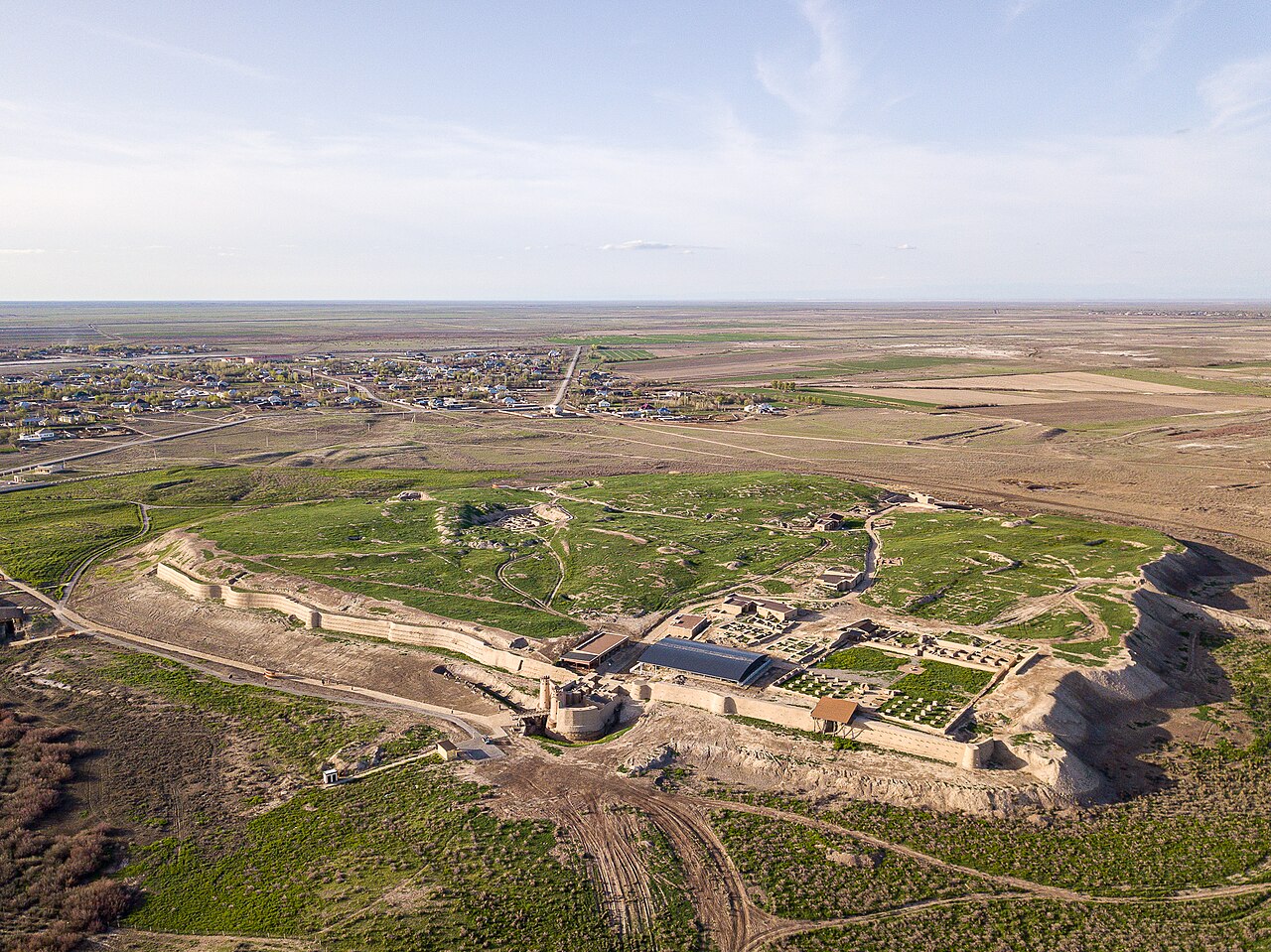
The ruins of a great Silk Road city on the Syr Darya, south of Turkistan, also known in the past as Farab. Otrar was taken by Genghis Khan's army in 1219 after a five-month siege. Today low walls and excavated streets rise from the plain.
Kazakhstan is the largest landlocked country in the world and the ninth largest of all countries, with an area of about 2.7 million km², roughly the size of Western Europe.
02
The border between Kazakhstan and Russia is about 7,644 km long, the longest continuous land border in the world.
03
The wild apple forests around Almaty are home to Malus sieversii, which DNA studies show is the main ancestor of the eating apple. The city's old name, Alma-Ata, is often translated as 'father of apples', although that meaning is disputed.
04
The first satellite, Sputnik 1, in 1957, and the first person in space, Yuri Gagarin, in 1961, were both launched from Baikonur in the Kazakh steppe. Russia leases the cosmodrome from Kazakhstan until 2050.
05
Astana is the second-coldest national capital in the world after Ulaanbaatar in Mongolia. Winter nights of minus 30 to minus 35 °C are common.
06
Astana has had six names since it was founded in 1830: Akmoly, Akmolinsk, Tselinograd, Akmola, Astana and Nur-Sultan, and then Astana again from 2022. As of 2022 it held the Guinness World Record for the capital with the most name changes in modern times.
07
The Semipalatinsk Test Site saw 456 Soviet nuclear tests between 1949 and 1989. It closed on 29 August 1991, and the United Nations now marks 29 August as the International Day against Nuclear Tests.
08
The Aral Sea was once the fourth-largest lake on earth. It shrank after its rivers were diverted for cotton, but since the Kokaral dam was finished in 2005 the northern part in Kazakhstan has partly recovered.
09
The 'Golden Man' of Issyk, a young Saka noble buried more than 2,000 years ago, was dressed in more than 4,000 gold ornaments. A golden warrior figure based on this find stands on top of the Independence Monument in Almaty.
10
As of 2026, Kazakhstan has seven UNESCO World Heritage Sites. The newest, added in 2026, are the rock mosques and sacred sites of Mangystau in the west.
11
Kazakh is written in Cyrillic letters, but the country is switching to a Latin alphabet. The target date has moved from 2025 to 2031, so as of 2026 you will see both scripts.
12
Kazakhstan shares the telephone code +7 with Russia. The code +997 was reserved for Kazakhstan in 2021, but the switch was dropped in 2023.
13
Khan Tengri, Kazakhstan's highest peak, is made of marble. At sunset it glows red, and in Kazakh it is also called Kantau, the 'blood mountain'.
14
The dombra, a long-necked lute with two strings, is the principal national instrument of Kazakhstan.
Kazakh (Cyrillic, with the new Latin spelling in brackets) Pronunciation is written the way it sounds; the capital letters show where the stress goes. Audio is coming soon.
As of September 2026, visitors from the UK and many other countries can stay without a visa for up to 30 days at a time, and no more than 90 days in any 180. Your passport needs at least 30 days of validity beyond arrival and a blank page. Rules change, so check official advice before you travel.
Carry your passport
You must carry your original passport or ID at all times; police may ask for it, and copies are not accepted. Hotels register foreign guests with the authorities within three working days, so keep your papers ready at check-in.
Plan for huge distances
Kazakhstan is enormous: Almaty and Astana are nearly 1,000 km apart in a straight line. Domestic flights save time, and a daily express train runs between Astana and Almaty.
Dress for the season
Summers are hot and dry, but winters are severe, especially in Astana, where minus 30 to minus 35 °C is common from mid-December to early March. Pack for the season you travel in.
Take care with photographs
Do not photograph military sites, border areas, airports or some government buildings; equipment can be confiscated. Some places, including the town of Baikonur, need special permission to visit.
Use booked taxis
Order taxis through an app or your hotel rather than stopping cars in the street, to avoid overcharging and unlicensed drivers.
Know the emergency numbers
The general emergency number is 112. You can also call 101 for fire, 102 for police and 103 for an ambulance. Almaty lies in an active earthquake zone, so note the safety instructions in your hotel.
Learn a few words of Kazakh
Russian is spoken almost everywhere, especially in cities, but a simple 'sälemetsız be' and 'raqmet' in Kazakh will earn you warm smiles.
 China
China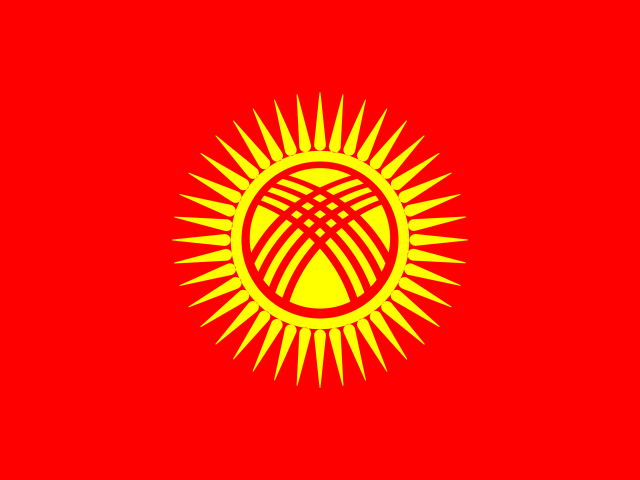 Kyrgyzstan
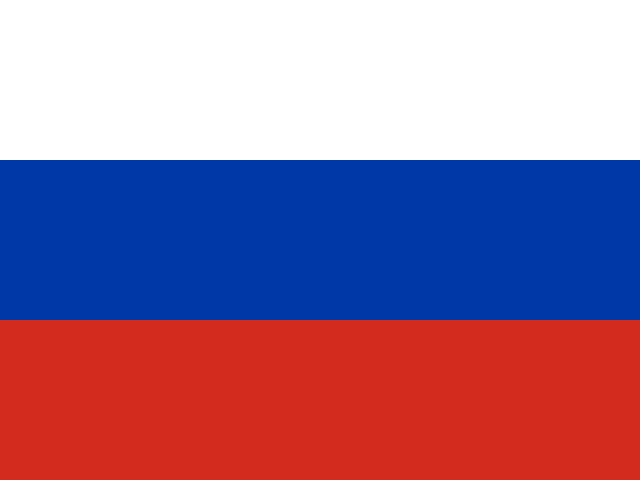 Russia
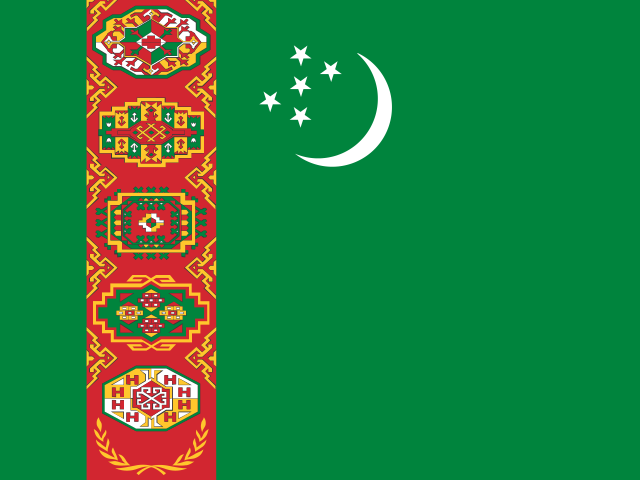 Turkmenistan
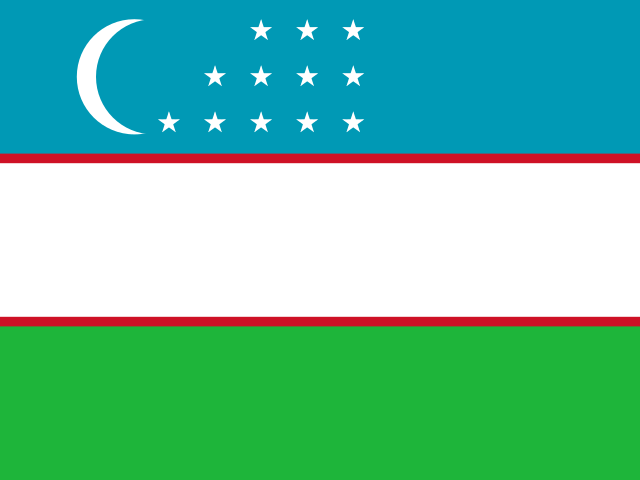 Uzbekistan