World Stroll
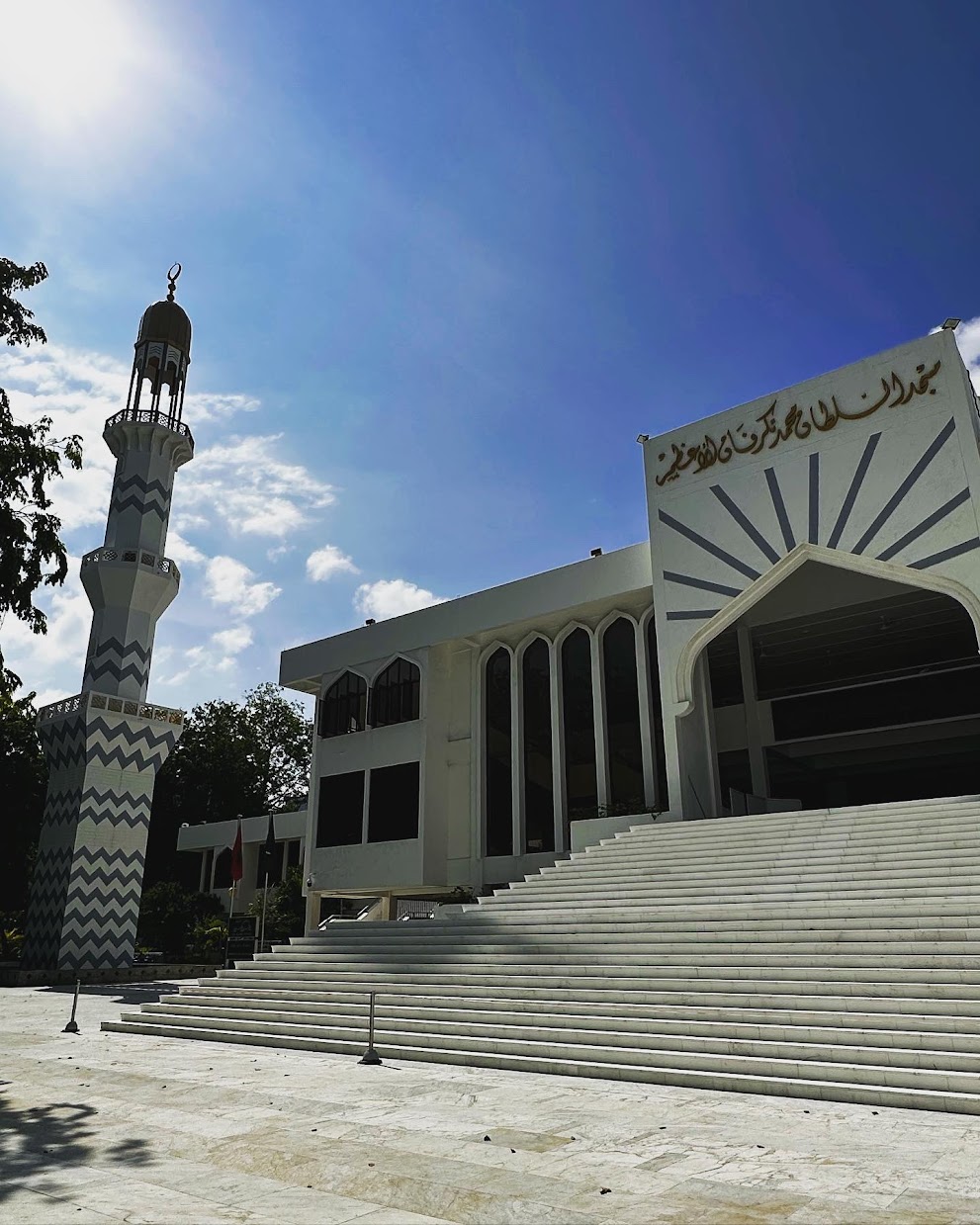
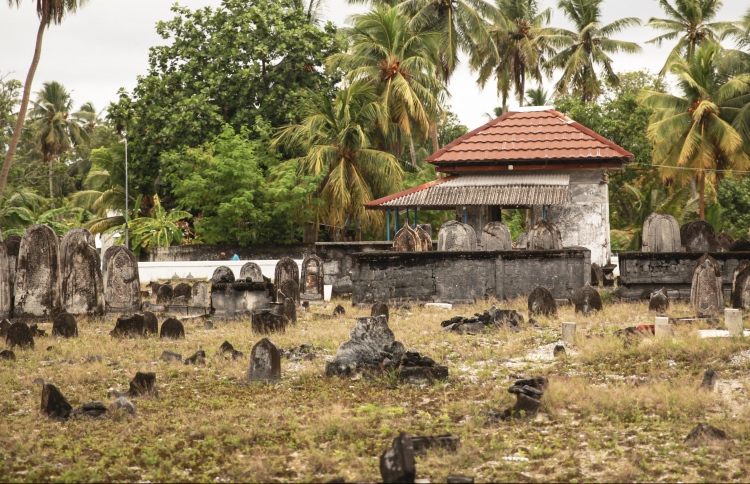
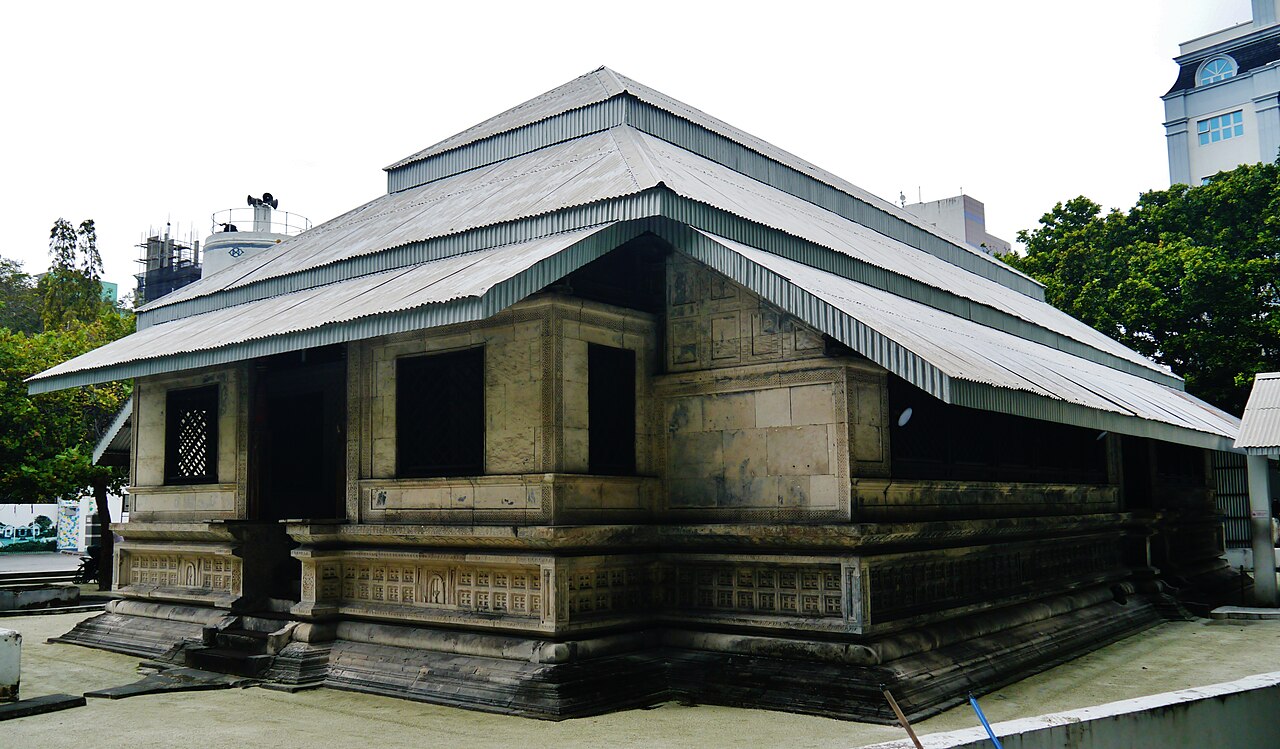
Malé Friday Mosque
Photo: Zairon, CC BY-SA 4.0
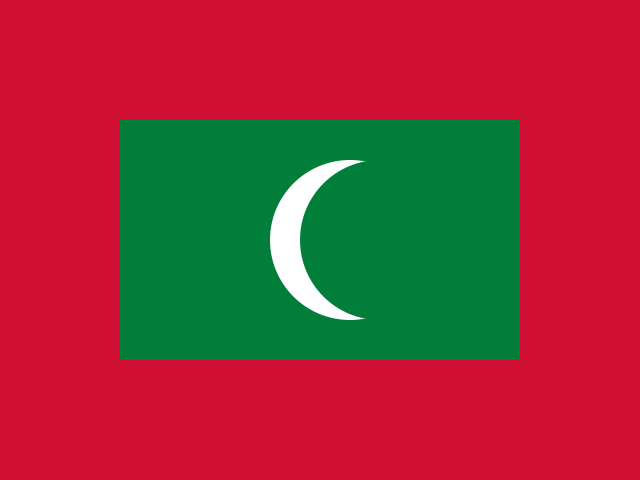
Flag of Maldives
Southern Asia

Maldives

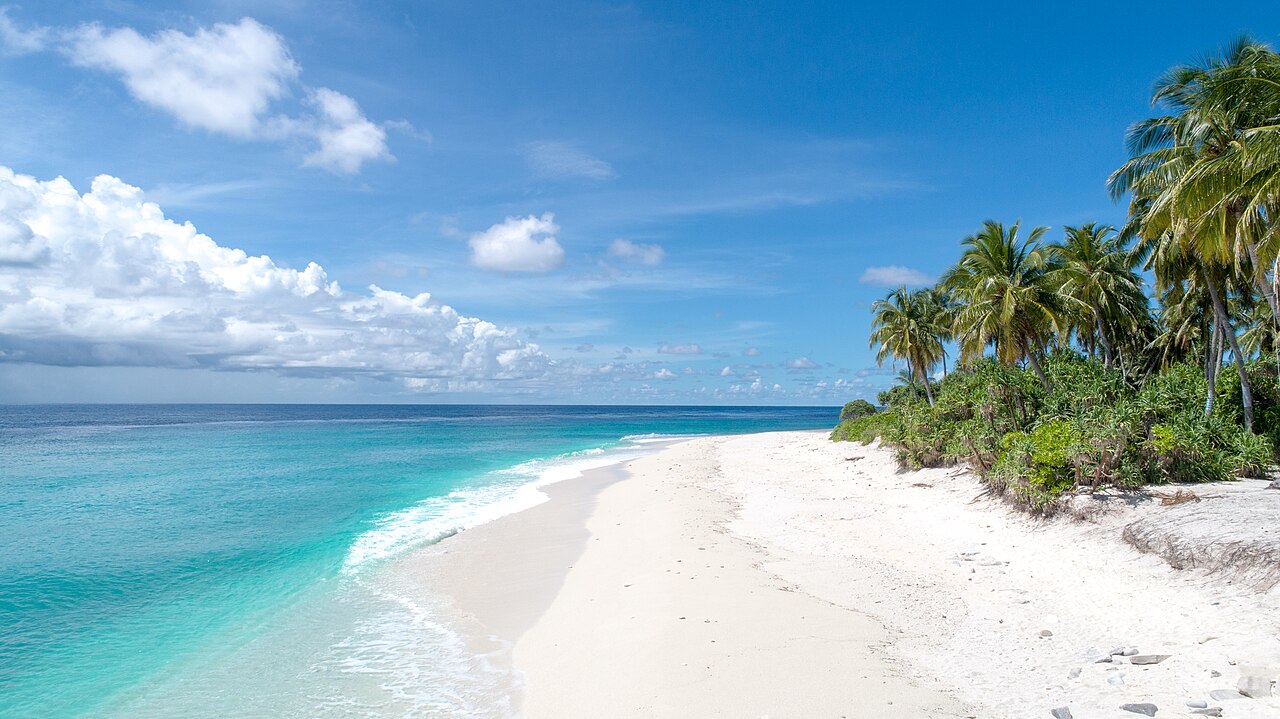
A long necklace of coral atolls strung across the equator in the Indian Ocean, where tuna is in almost every dish, the sea is turquoise and the highest natural ground is only a few metres above the waves.

Start the trip Skip to the quiz About five relaxed minutes.

Your trip to Maldives

  1. Stroll through nine short parts: the story, the food, the cities and a few words. One at a time, with "Next".
  2. Take the quiz as the last step: 10 friendly questions, no timer.
  3. Get your stamp in your passport.
Explore Maldives
You have explored 0 of 9 parts. Scroll on to discover the rest.
EthiopiaIndiaMyanmarSomaliaSri LankaThailandYemen
Going to the Maldives?Phrases, table manners and local tips on one printable page.Send a postcard from the MaldivesA free digital postcard for family and friends.
Overview

The Maldives at a glance

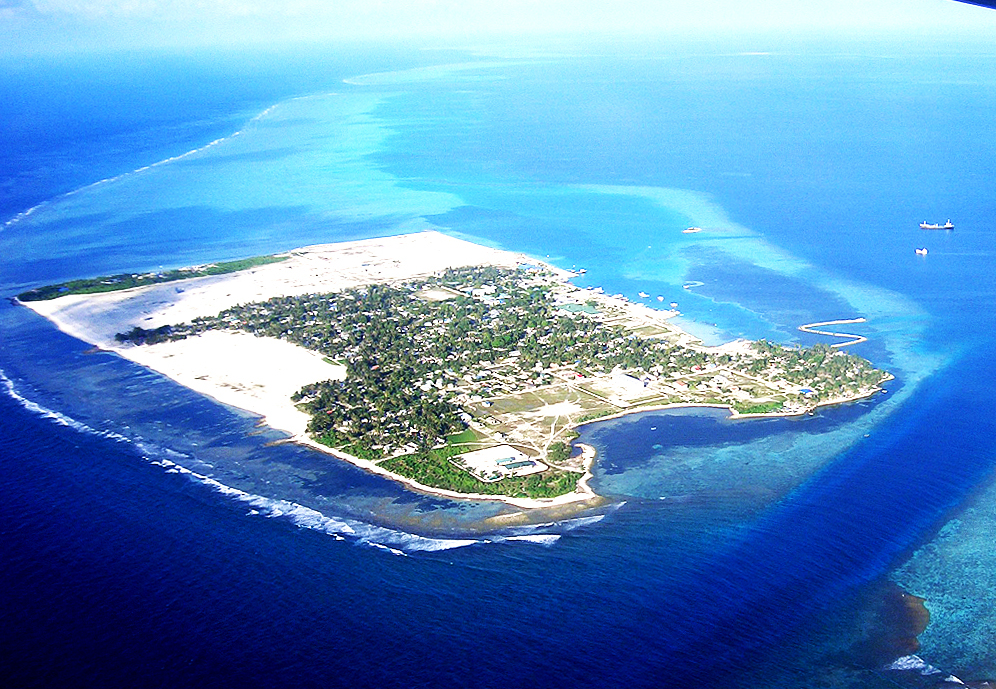
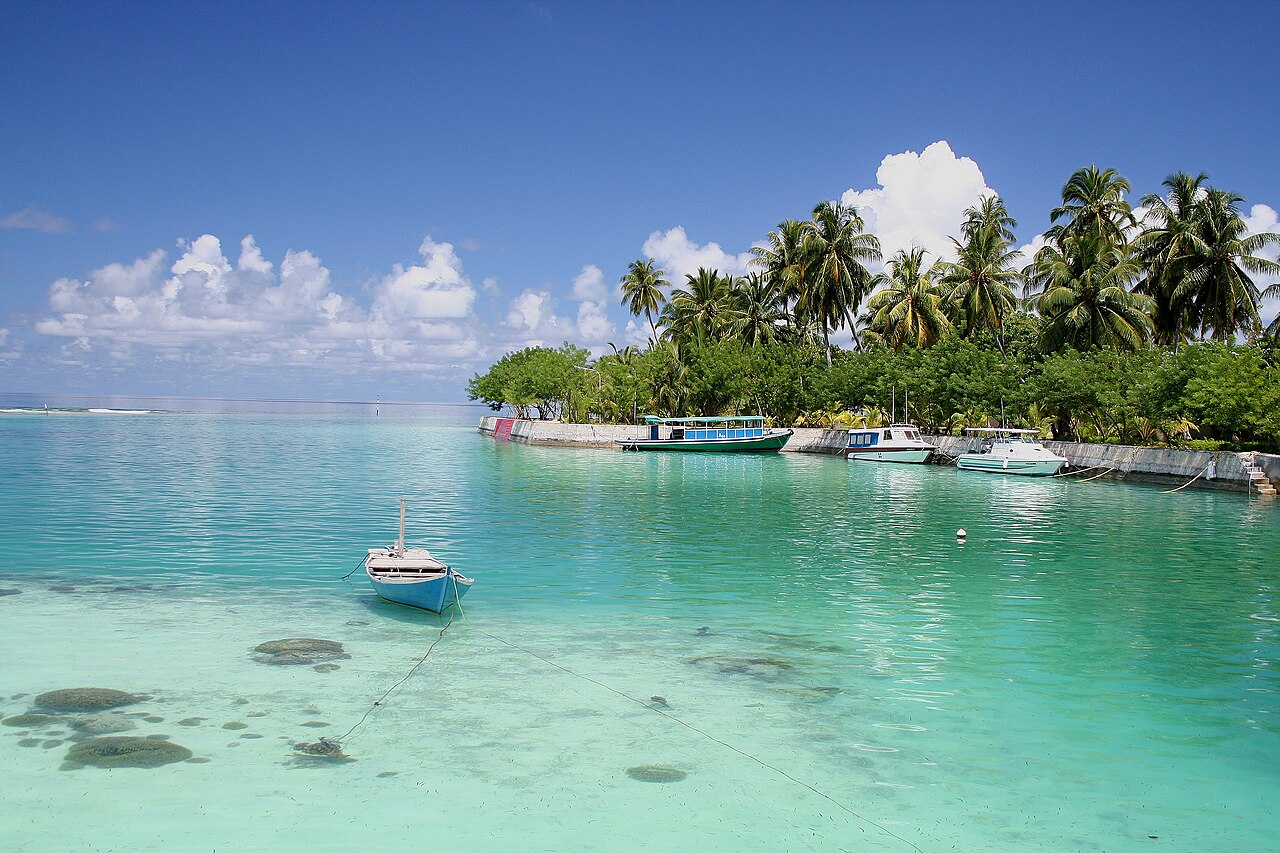
The Maldives is an island country in the Indian Ocean, southwest of India and Sri Lanka. It is a chain of 26 natural atolls, rings of coral reef around shallow lagoons, that stretches for about 870 km from north to south and crosses the equator. Its roughly 1,190 coral islands add up to only about 300 km² of dry land, spread over some 90,000 km² of sea, which makes it the smallest country in Asia by area. Most islands rise less than one metre above the sea, and the Maldives is often called the lowest-lying country in the world.

People have lived here for well over 2,000 years. For centuries the islands were Buddhist, and in the 12th century the king converted to Islam, which is still the religion of the country and the heart of daily life. Sultans ruled from the island of Malé for more than 800 years. Arab, Persian and Indian traders came for cowrie shells, used as money across Asia and Africa, and for coir, the rope made from coconut husk. The Portuguese held Malé for fifteen years in the 16th century, and the British later handled the islands' defence and foreign affairs. Independence came in 1965 and the country became a republic in 1968.

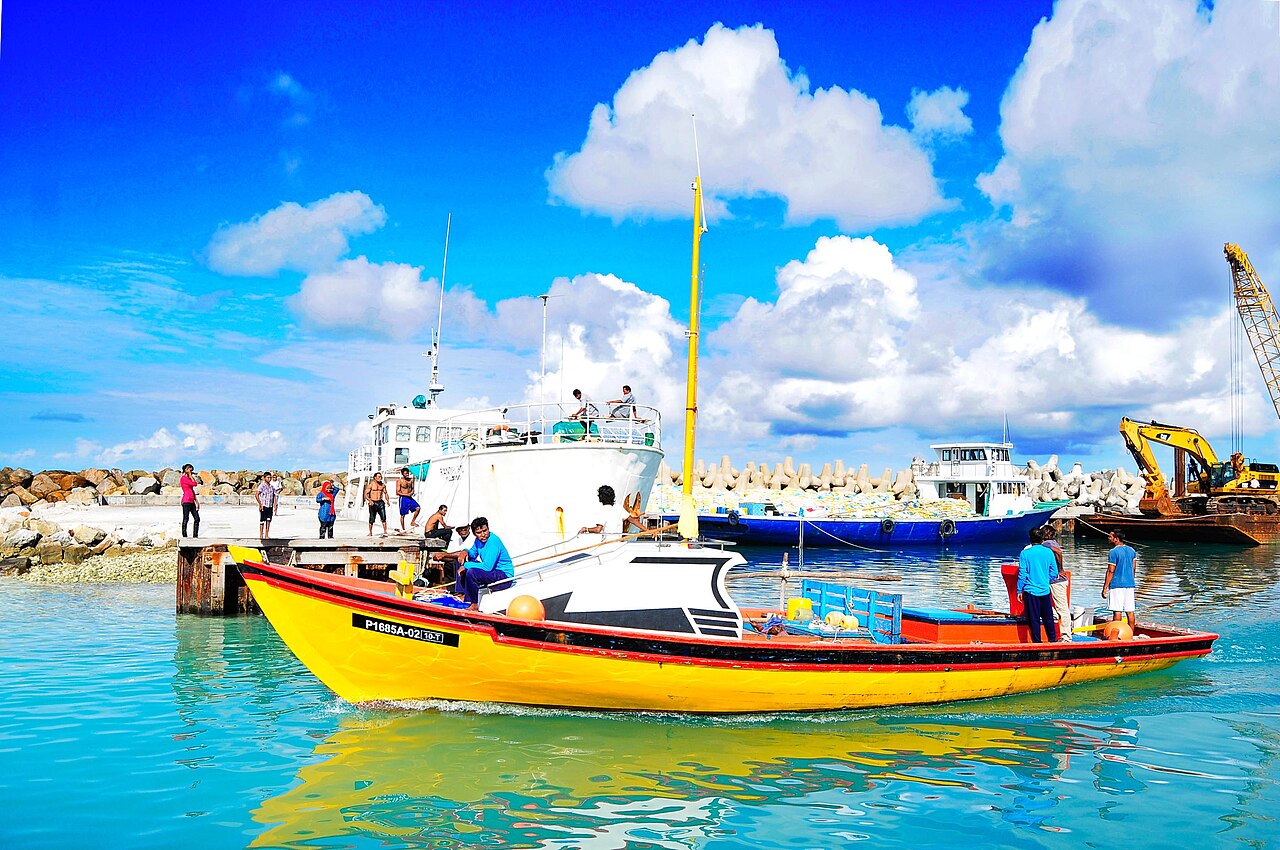
Today about half a million people live in the Maldives, about two in five of them in the crowded capital, Malé. Only about 200 islands are lived on by local people, and many others are given over to resorts, each on its own island. Tourism is the largest part of the economy, and fishing, mostly for tuna, much of it caught with simple poles and lines, comes second. Visitors come for coral reefs, whale sharks, reef fish and white beaches, while the islanders themselves are proud of their own language, Dhivehi, and of Thaana, the script made for it.

CapitalMalé
PopulationAbout 0.5 million (515,132 at the 2022 census, including about 132,000 foreign residents)
Official languageDhivehi (Maldivian), written in the Thaana script. English is widely used in business, tourism and schools
CurrencyMaldivian rufiyaa (MVR), divided into 100 laari
AreaAbout 300 km² of land, spread over about 90,000 km² of sea
GovernmentPresidential republic. The president is both head of state and head of government
Highest mountainNone. The highest natural ground is only about 2.4 m above sea level, though some sources give 5.1 m for a point on Villingili in Addu Atoll
Longest riverNone. The Maldives has no rivers, only a few small freshwater lakes, such as the two on Fuvahmulah
NeighboursNo land borders. The nearest lands across the sea are India's Lakshadweep islands to the north, India and Sri Lanka to the northeast, and the Chagos Archipelago to the south
Drives on theLeft
Calling code+960
The story

A short history of the Maldives

The story of the Maldives runs from early settlers from South Asia and a long Buddhist age, through the arrival of Islam in the 12th century and eight centuries of sultans ruling from Malé, to short Portuguese rule, a British protectorate, independence in 1965 and a republic from 1968. In recent decades the islands have built a tourism industry from nothing, survived a coup attempt and the 2004 tsunami, and adopted a new constitution in 2008.

  1. 250 BC

    Buddhism reaches the islands

    Buddhism probably reached the Maldives around the 3rd century BC, in the time of the Indian emperor Ashoka, and remained the main religion for about 1,400 years. The Dhivehi language, the first scripts and many customs took shape in this period, and nearly all of the country's old ruins are Buddhist stupas and monasteries, such as the mound called the Havitta on Fuvahmulah, probably an old stupa.

  2. AD 362

    Gifts for a Roman emperor

    The Roman historian Ammianus Marcellinus recorded that envoys from a people called the Divi brought gifts to the emperor Julian in 362. Many historians believe the Divi came from the Maldives.

  3. 1153

    The king converts to Islam

    Dhovemi, the last Buddhist king, converted to Islam and took the name Sultan Muhammad al-Adil. Some copper-plate grants give the later date of 1193. Maldivian tradition credits a visiting Muslim scholar, Abu al-Barakat Yusuf, whose tomb, the Medhu Ziyaaraiy, stands opposite the Friday Mosque in Malé. Six dynasties of sultans followed.

  4. 1558

    The Portuguese take Malé

    The Portuguese set up a garrison in Malé, run from their colony at Goa in India, and tried to force the islanders to become Christians.

  5. 1573

    Thakurufaanu drives out the Portuguese

    Muhammad Thakurufaanu and his brothers, from the northern island of Utheemu, fought the Portuguese for years, landing on a different island each night. In 1573 they reached Malé and took the garrison by surprise, ending fifteen years of Portuguese rule. The victory is remembered every year as National Day, on the 1st of Rabi al-Awwal in the Islamic calendar.

  6. 1658

    The Friday Mosque is completed

    Sultan Ibrahim Iskandar I finished the new Friday Mosque (Hukuru Miskiy) in Malé, built from carved coral stone on the site of an older mosque. It is the oldest and most ornate mosque in the country and has been in use ever since.

  7. 1887

    A British protectorate

    An agreement with Britain formally made the Maldives a British protectorate. The sultan kept control of home affairs, while Britain handled defence and relations with other countries.

  8. 1932

    The first constitution

    The country's first written constitution was ratified on 22 December 1932. It set up a cabinet and a parliament, but it failed within a year, and the document was publicly torn up.

  9. 1941

    A secret naval base on Addu

    During the Second World War the Royal Navy secretly built a base, known as Port T, in the deep lagoon of Addu Atoll, with an airstrip on the island of Gan. It later became RAF Gan, which the British used until 1976.

  10. 1953

    The first republic

    The sultanate was suspended and a republic was declared, but it lasted only months. A revolt in August 1953 ended it, and the sultanate was restored in 1954.

  11. 1965

    Independence from Britain

    On 26 July 1965 an agreement signed in Colombo ended British responsibility for the defence and foreign affairs of the Maldives. The date is celebrated as Independence Day.

  12. 1968

    The Maldives becomes a republic

    After a referendum in March 1968 in which about 81 per cent voted for a republic, the monarchy was abolished and the Second Republic was declared on 11 November 1968, ending more than 800 years of sultans.

  13. 1972

    The first tourist resort opens

    Kurumba, on an island near Malé, opened on 3 October 1972 as the first tourist resort in the Maldives. Tourism grew from two resorts in 1972 to about 130 island resorts by 2018 and became the biggest part of the economy.

  14. 1988

    A coup attempt is defeated

    On 3 November 1988 armed mercenaries landed in Malé and tried to seize the government. The government asked for help, and Indian paratroopers flown in that night restored order within hours, in what India called Operation Cactus.

  15. 2004

    The Indian Ocean tsunami

    On 26 December 2004 the tsunami from the great earthquake off Sumatra swept across the low islands. More than a hundred people died, fourteen islands had to be evacuated completely and the damage was put at around 62 per cent of the country's yearly economic output.

  16. 2008

    A new constitution

    A new constitution came into force on 7 August 2008, with independent commissions for the courts, elections and the fight against corruption. Later that year the country held its first presidential election with several parties competing.

At the table

What to eat in the Maldives

Maldivian cooking is built on three things: fish, coconut and starch. The fish is almost always tuna, fresh, boiled, smoked or dried, and coconut is grated, squeezed into milk or used as oil. A traditional meal is rice with garudhiya, a clear tuna broth, and small sides of lime, chilli and onion, or rice and roshi flatbread with a tuna curry. Breakfast is often mas huni scooped up with warm roshi and sweet black tea. In the afternoon, cafes called hotaa fill their counters with hedhikaa, small fried snacks such as gulha and masroshi, eaten with tea. Taro, breadfruit and sweet potato are boiled and eaten with grated coconut, and unlike many Pacific islanders, Maldivians have no tradition of eating raw fish.

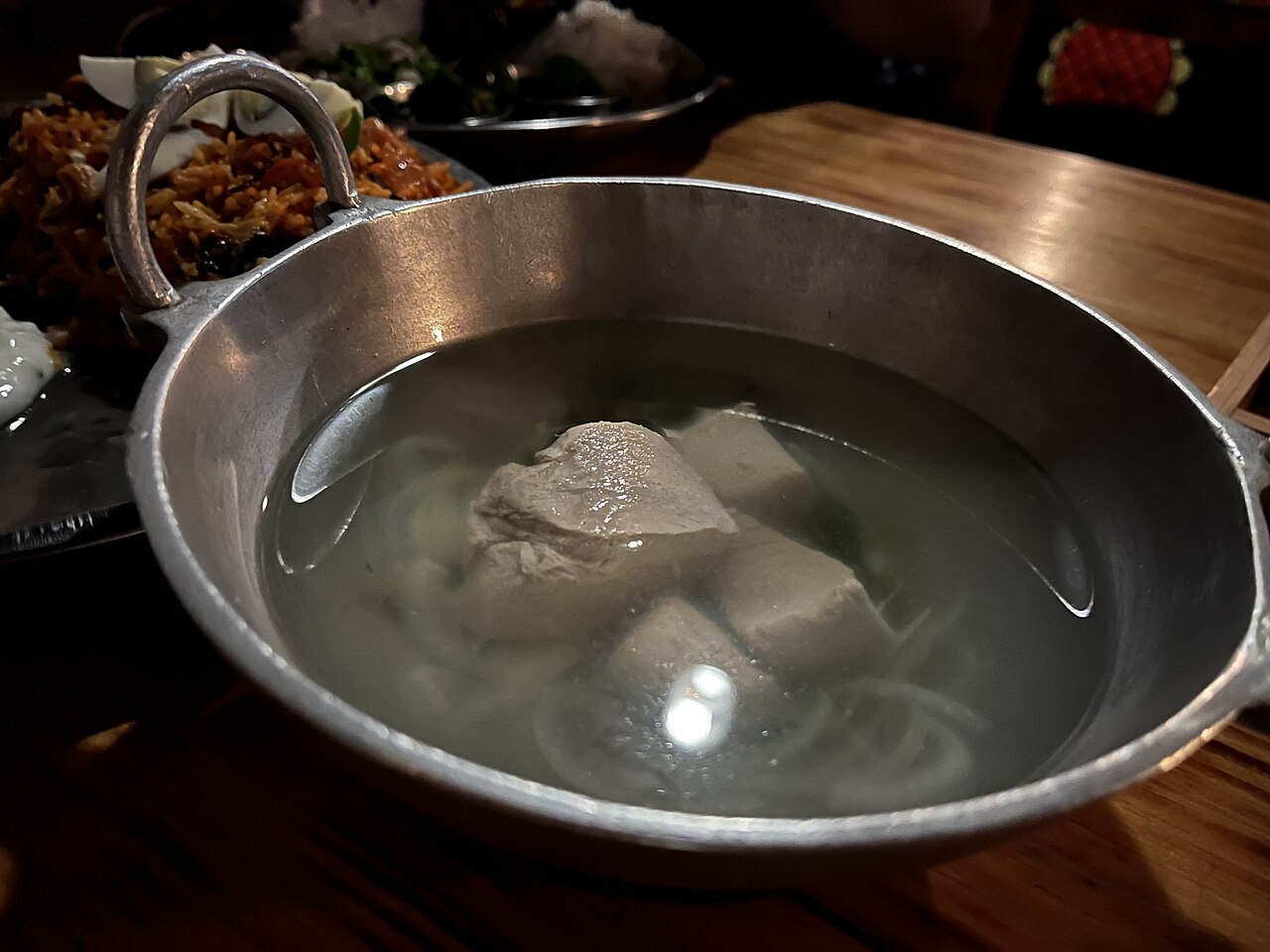
Garudhiya
Photo: LittleT889, CC BY 4.0
Main courseRecipe

Garudhiya (tuna broth)

Garudhiya
The whole country
Read moreShow less

A clear, salty broth made by boiling fresh tuna, usually skipjack, in water with salt, carefully skimming off the foam. It is eaten with steamed rice and small sides of lime, chilli and onion, or with roshi, taro or breadfruit and grated coconut. It is often called the national dish.

When garudhiya is boiled for hours until all the water has gone, it becomes rihaakuru, a thick brown fish paste.

See the recipe
Serves 445 min

Ingredients

  • 800 g very fresh tuna (skipjack or yellowfin), kept cold until cooking, cut into thick steaks, with a piece of bone if possible
  • 1.5 litres water
  • 1 1/2 teaspoons salt
  • Optional: a few curry leaves, 1 small onion, sliced, and 1 green chilli, slit lengthwise
  • To serve: steamed rice, lime wedges, sliced red onion and fresh chillies

Method

  1. Rinse the tuna pieces well and put them in a large pan with the water and salt.
  2. Bring slowly to the boil. As grey foam rises to the top, skim it off with a spoon and throw it away; keep skimming until the broth is clear.
  3. Add the curry leaves, onion and chilli if you like a little flavour, then simmer gently for 20 to 25 minutes, until the fish is cooked through.
  4. Taste and add a little more salt if needed.
  5. Serve the broth and fish in bowls with hot rice. Each person squeezes in lime and adds onion and chilli to taste, mixing a little rice into the broth with each mouthful.
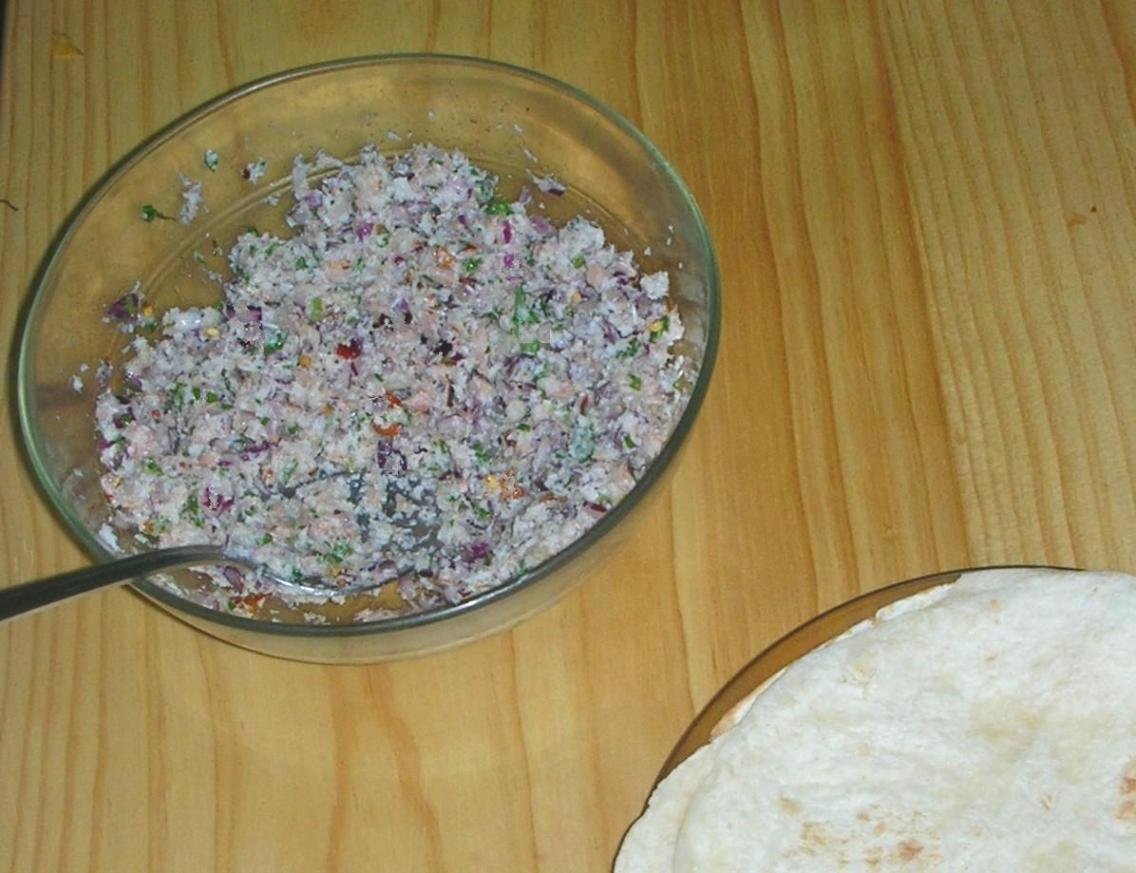
Mas huni
Photo: Xavier Romero-Frias, CC BY-SA 3.0
Side dishRecipe

Mas huni (tuna and coconut breakfast)

Mas huni
The whole country
Read moreShow less

The classic Maldivian breakfast: tuna mixed with grated fresh coconut, finely chopped onion, chilli, lime juice and salt, rubbed together by hand. It is scooped up with warm roshi flatbread and eaten with sweet black tea. In the past it was made with dried Maldives fish; today many people use canned tuna.

When fish was scarce, cooks stretched mas huni with chopped green leaves such as moringa.

See the recipe
Serves 415 min

Ingredients

  • 2 tins (about 300 g drained) tuna in water or brine, drained
  • 150 g freshly grated coconut (or unsweetened desiccated coconut soaked in a little warm water for 10 minutes)
  • 1 small red onion, very finely chopped
  • 1 to 2 fresh green or red chillies, very finely chopped
  • Juice of 1 lime
  • Salt to taste
  • To serve: warm chapatis or other flatbread, and sweet black tea

Method

  1. Put the chopped onion and chilli in a bowl with a pinch of salt and squeeze them together with your fingers for a minute, so they soften and release their juice.
  2. Add the drained tuna and flake it finely with a fork.
  3. Add the grated coconut and the lime juice and mix everything together well, rubbing it between your fingers so the coconut takes on the flavour.
  4. Taste and add more salt, lime or chilli if you like.
  5. Serve at once with warm flatbread, tearing off a piece and using it to scoop up the mixture.
Mas riha
Photo: Jpatokal at wts wikivoyage, CC BY-SA 3.0
Main courseRecipe

Mas riha (tuna curry)

Mas riha
The whole country
Read moreShow less

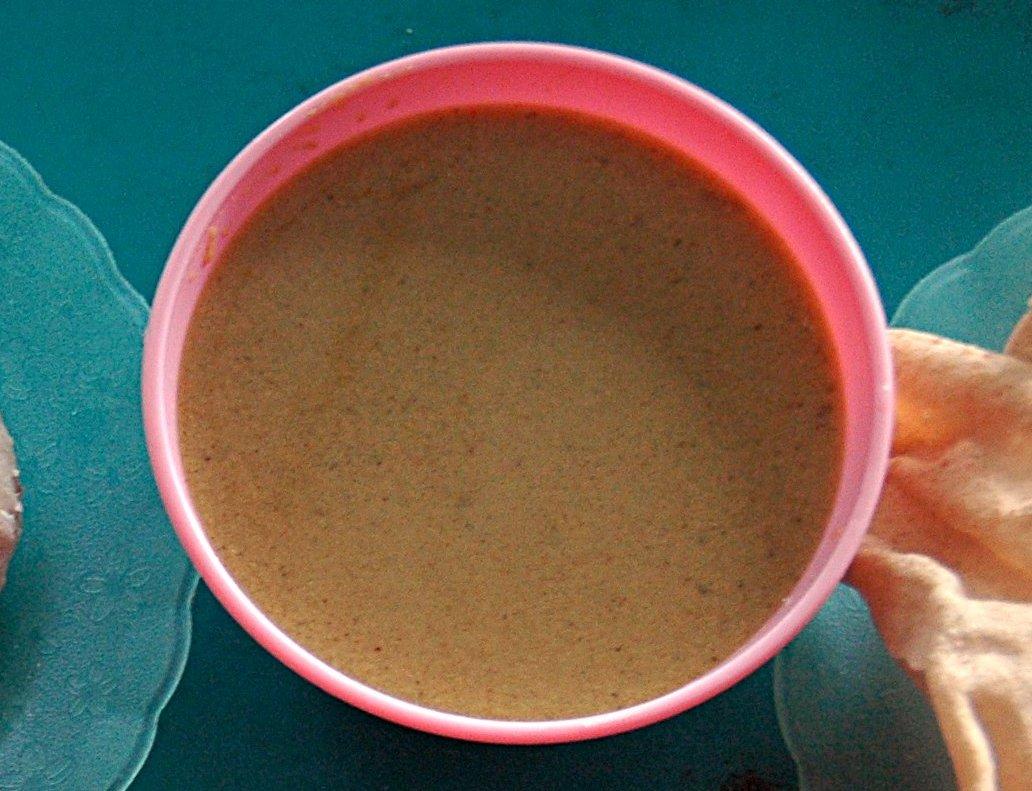
The most important Maldivian curry: diced fresh tuna cooked slowly with fried onions and spices, then finished with coconut milk. It is eaten with steamed white rice, or for breakfast with roshi and hot tea.

See the recipe
Serves 445 min

Ingredients

  • 600 g very fresh tuna steak, kept cold until cooking, cut into 2 cm cubes
  • 2 tablespoons coconut or vegetable oil
  • 1 large onion, finely sliced
  • 3 cloves garlic and a 2 cm piece of ginger, crushed together
  • A small handful of curry leaves
  • 1 to 2 green chillies, slit lengthwise
  • 2 tablespoons mild curry powder and 1/2 teaspoon ground turmeric
  • 250 ml water
  • 200 ml coconut milk
  • 1 teaspoon salt

Method

  1. Heat the oil in a pan and fry the onion over medium heat until soft and golden, about 8 minutes.
  2. Add the garlic, ginger, curry leaves and chillies and fry for 2 minutes, then stir in the curry powder and turmeric for 30 seconds.
  3. Add the tuna cubes and stir gently to coat them in the spices.
  4. Pour in the water, add the salt and simmer gently for about 15 minutes, without stirring too much so the fish keeps its shape.
  5. Stir in the coconut milk and simmer for 5 more minutes without letting it boil hard. Serve with rice or flatbread.
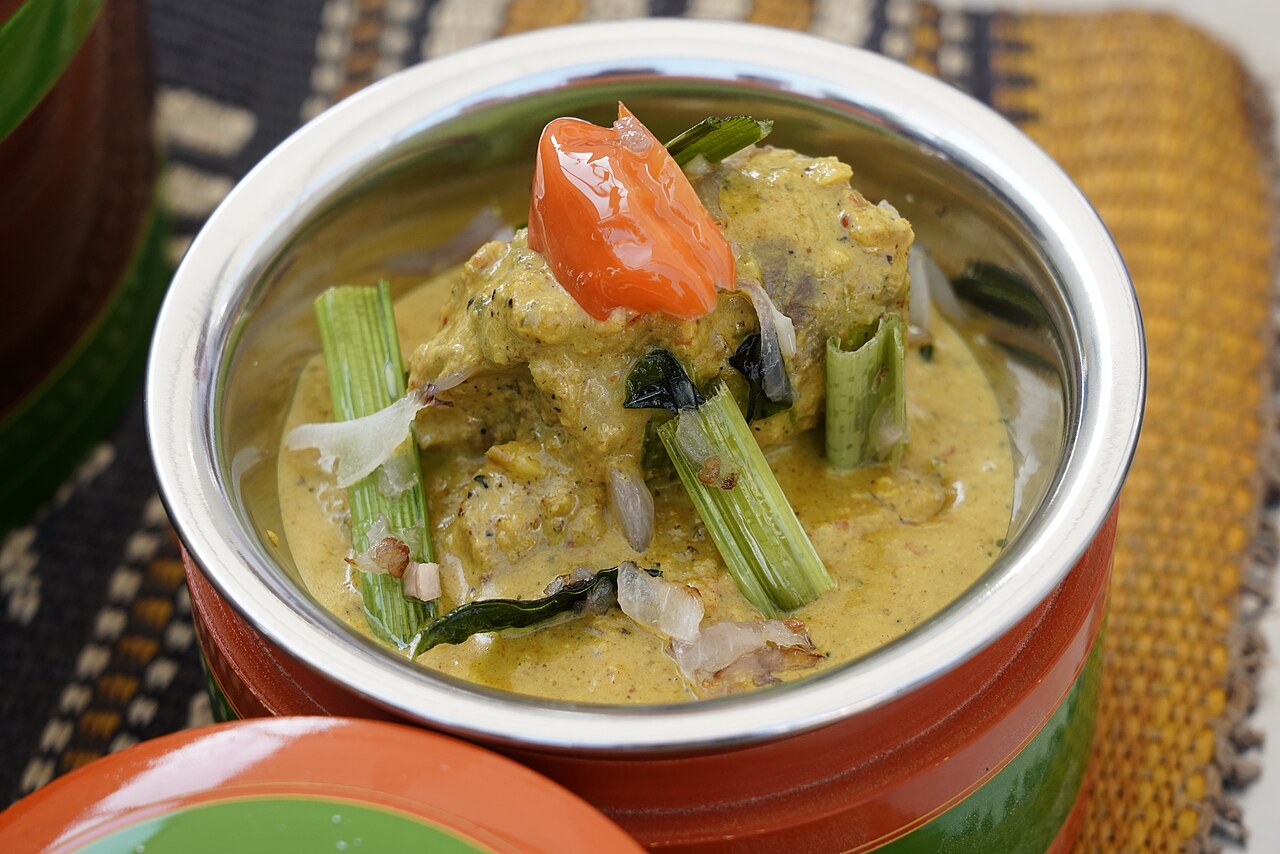
Kandu kukulhu (rolled tuna curry)
Photo: Satdeep Gill, CC BY-SA 4.0
Main course

Kandu kukulhu (rolled tuna curry)

Kandu kukulhu
The whole country
Read moreShow less

Tuna fillets rolled up with curry paste, tied with a strip of coconut leaf and cooked in coconut milk. The curry is usually prepared overnight and served with rice or roshi.

The name means 'chicken of the sea'.

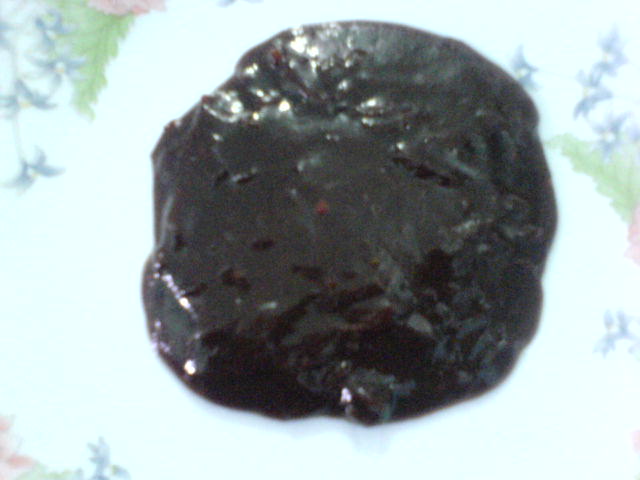
Rihaakuru
Photo: Mohamed Ishan, Public domain
Side dish

Rihaakuru (tuna paste)

Rihaakuru
The whole country
Read moreShow less

A thick, dark brown paste made by boiling down the broth left over from cooking tuna for hours, until almost all the water has gone. It is eaten almost every day in many homes, plain with rice, taro, breadfruit or roshi, or fried with onion, curry leaves and chilli.

Some people abroad spread it on bread, much like Marmite or Vegemite.

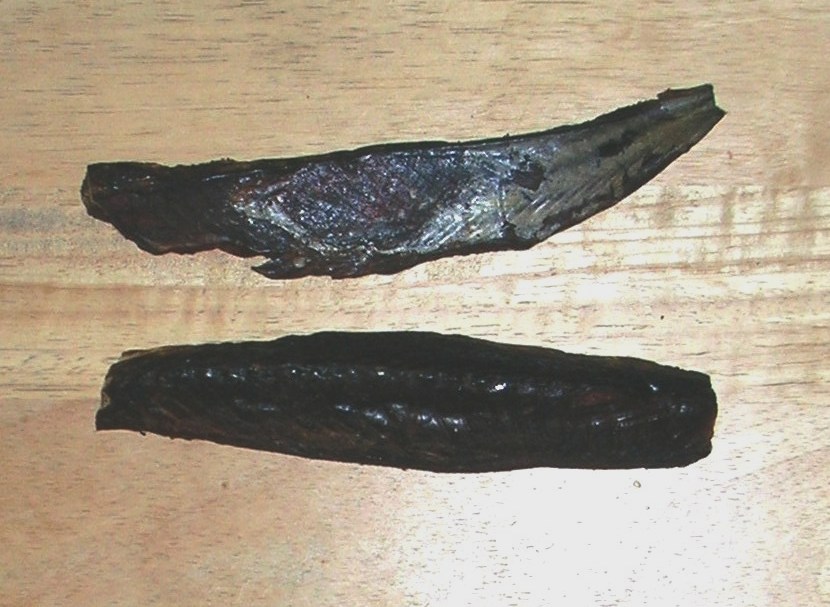
Maldives fish
Photo: Xavier Romero-Frias, CC BY-SA 3.0
Side dish

Maldives fish (cured tuna)

Valhoamas
The whole country
Read moreShow less

Tuna that has been boiled, smoked and dried in the sun until it is as hard as wood. Shaved or pounded into flakes, it flavours mas huni, curries and snacks. It keeps for a very long time without a fridge, and for centuries it was one of the islands' main exports to Sri Lanka.

Maldives fish is so loved in Sri Lanka that it is an essential ingredient in coconut sambol there.

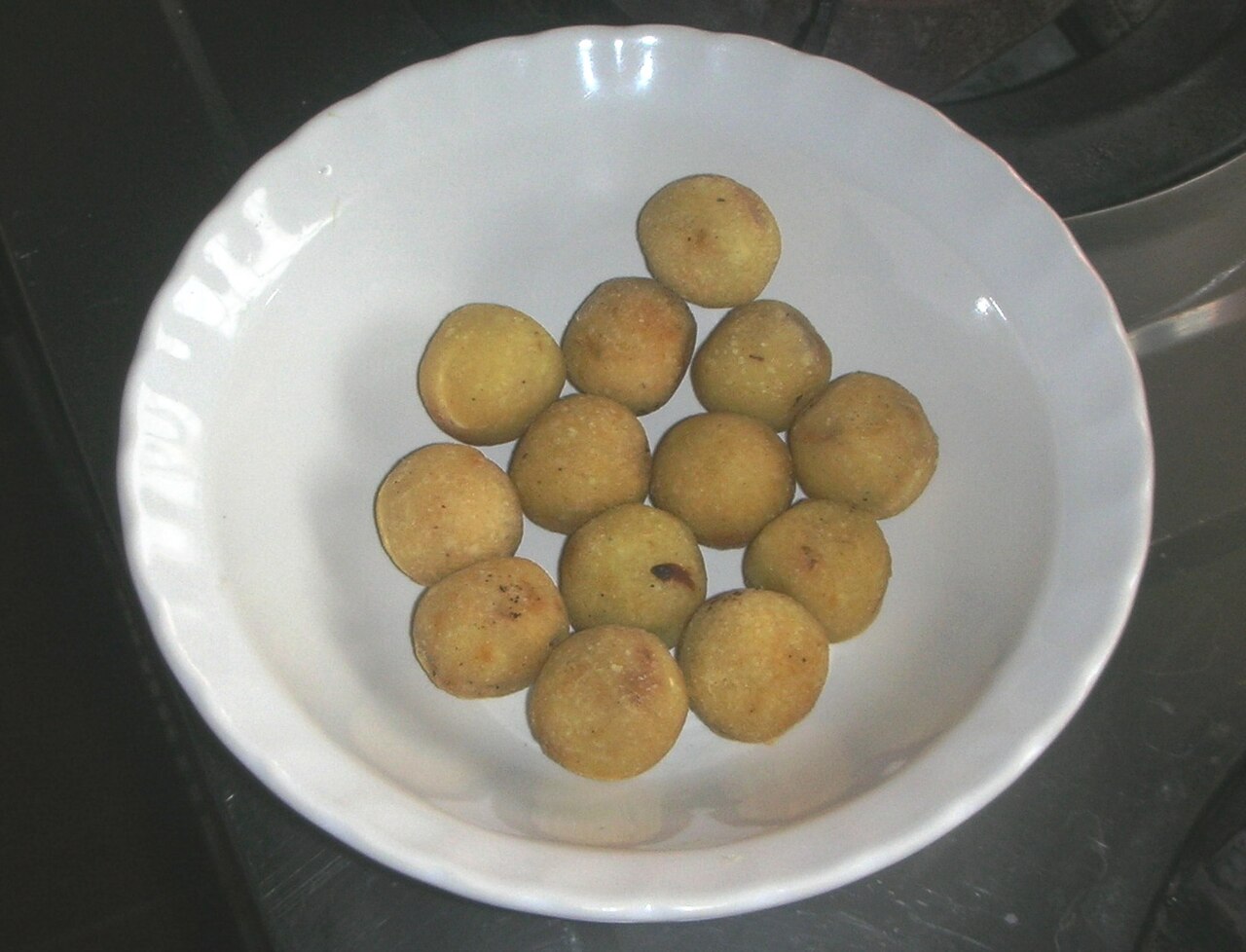
Gulha
Photo: Xavier Romero-Frias, CC BY-SA 3.0
SnackRecipe

Gulha (fried tuna dumplings)

Gulha
The whole country
Read moreShow less

Small round dumplings of dough stuffed with tuna, grated coconut, onion and chilli, then deep-fried until golden. They range from the size of a marble to a little bigger than a ping-pong ball and are a favourite with afternoon tea.

See the recipe
Serves 61 h

Ingredients

  • For the dough: 250 g plain flour, 1/2 teaspoon salt, 1 tablespoon vegetable oil and about 120 ml warm water
  • For the filling: 1 tin (about 150 g drained) tuna, 100 g freshly grated or desiccated coconut, 1 small onion, very finely chopped, 1 green chilli, very finely chopped, a few curry leaves, finely chopped, juice of 1/2 lime and salt to taste
  • Vegetable oil for deep-frying

Method

  1. Mix the flour, salt and oil, then add the water a little at a time and knead to a smooth, firm dough. Cover and rest for 15 minutes.
  2. Mix all the filling ingredients together well with your fingers, as for mas huni.
  3. Pinch off a piece of dough the size of a walnut, flatten it into a small cup in your palm, put in a teaspoon of filling and pinch the dough closed. Roll it gently into a ball. Repeat with the rest.
  4. Heat the oil in a deep pan to about 170 °C, or until a small piece of dough sizzles at once. Never leave hot oil alone.
  5. Fry the gulha a few at a time for 4 to 5 minutes, turning them, until deep golden. Lift out onto kitchen paper and serve warm with sweet tea.
Masroshi (stuffed flatbread)
Photo: Jpatokal at wts wikivoyage, CC BY-SA 3.0
Snack

Masroshi (stuffed flatbread)

Masroshi
The whole country
Read moreShow less

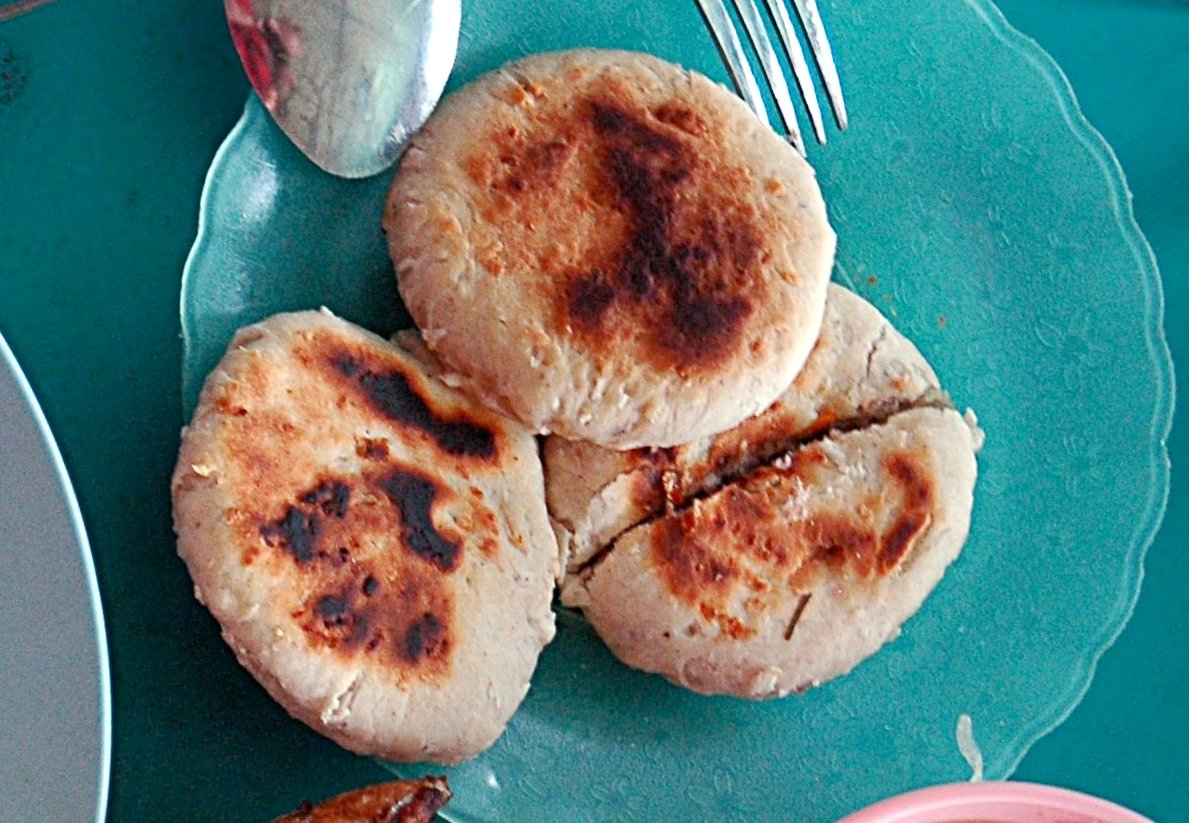
A favourite short eat: a disc of roshi dough wrapped around a filling of tuna, coconut, onion, garlic and ginger, then baked or fried. It is sold in hotaa cafes everywhere, often with a squeeze of lime.

Roshi (flatbread)
Photo: Gaurav Dhwaj Khadka, CC BY-SA 4.0
Bread

Roshi (flatbread)

Roshi
The whole country
Read moreShow less

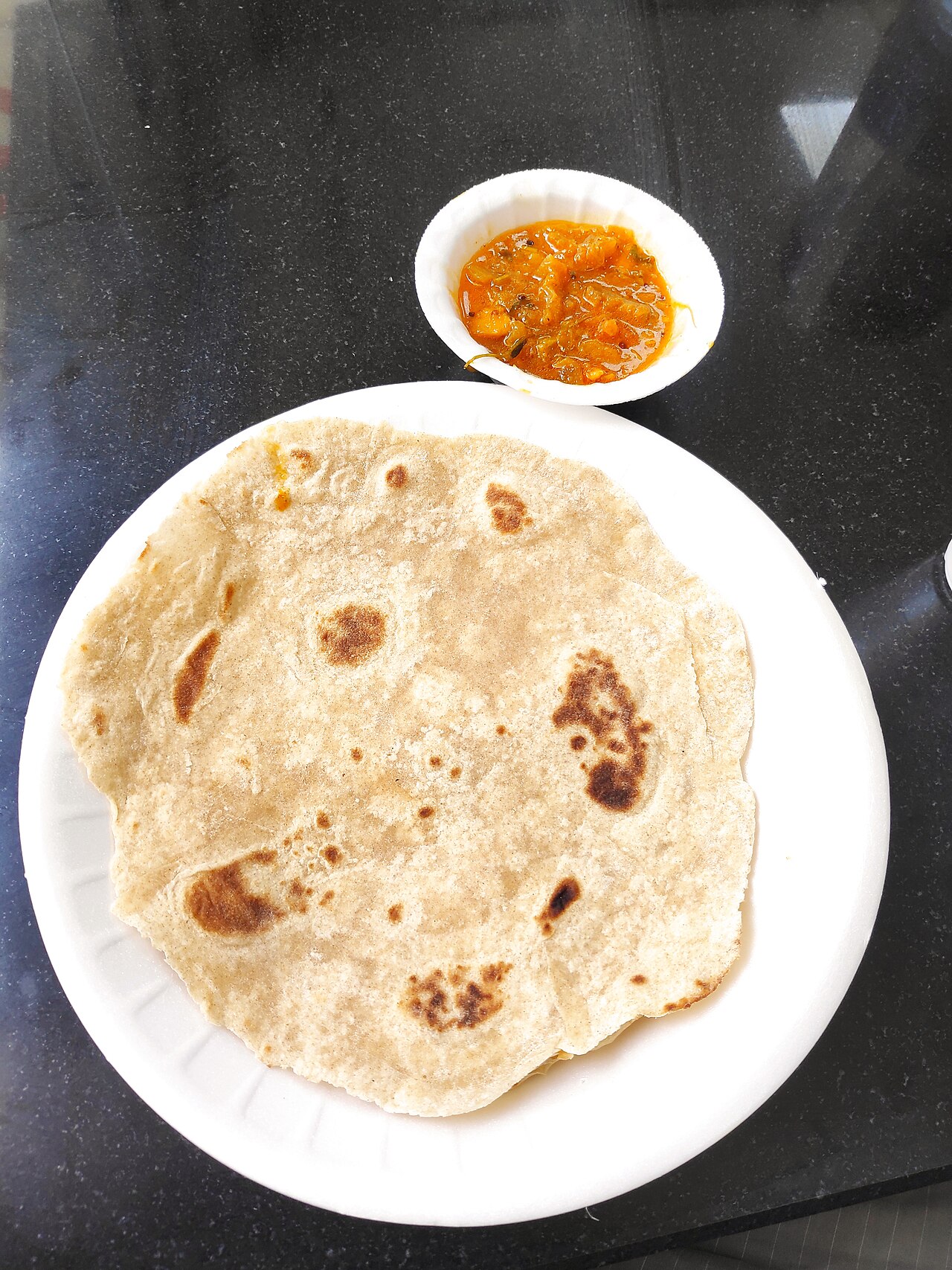
A thin, unleavened round flatbread, the Maldivian version of the Indian chapati or roti, cooked on a hot griddle. It is torn by hand and used to scoop up mas huni at breakfast, or eaten with curries and garudhiya instead of rice.

Kashikeyo (screwpine fruit)
Photo: Matheenfaiz, CC BY-SA 4.0
Snack

Kashikeyo (screwpine fruit)

Kashikeyo
The whole country
Read moreShow less

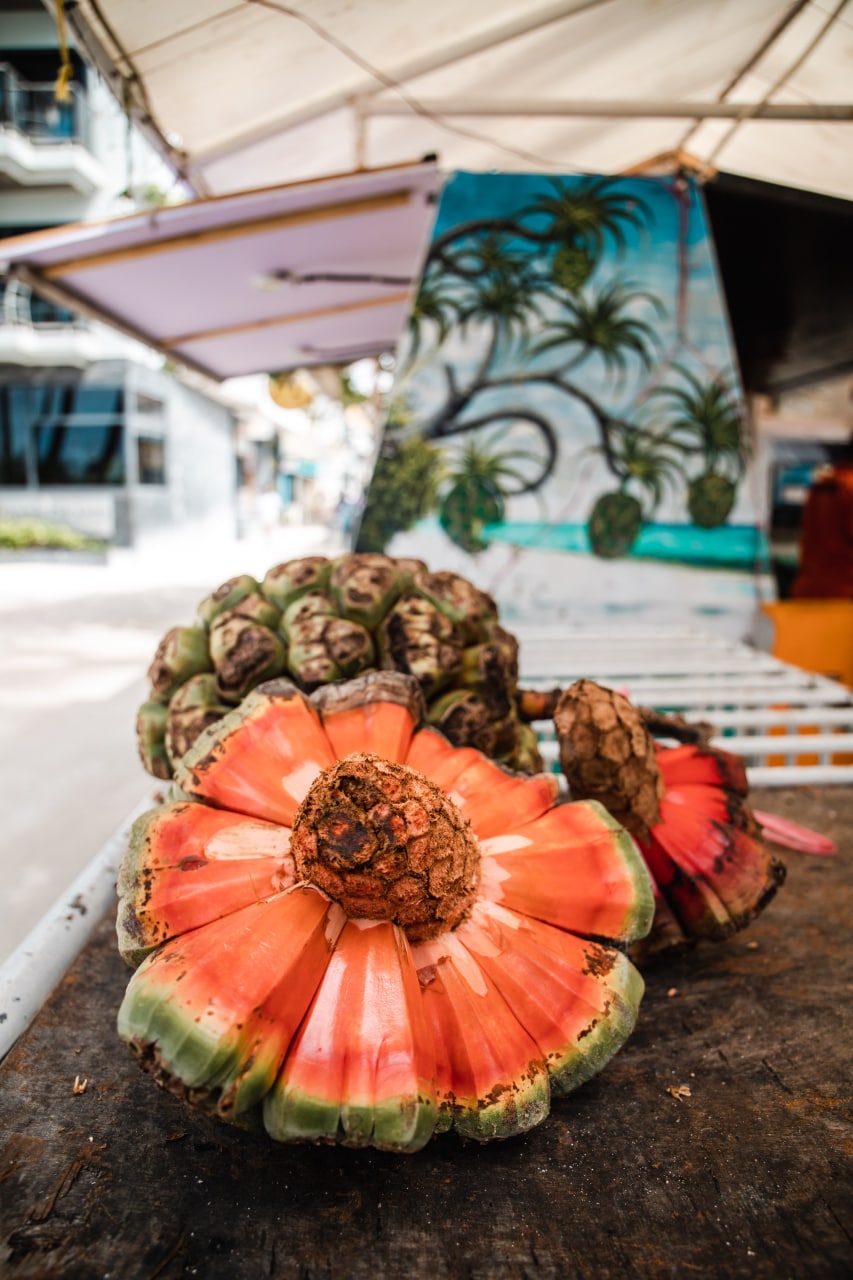
The big, knobbly fruit of the screwpine tree. It is sold in markets and is mostly eaten raw, cut into thin slices, but it is also a common ingredient in Maldivian cooking.

Table manners

  • A traditional Maldivian meal is rice with garudhiya, the clear tuna broth, and small sides of lime, chilli and onion. Each person seasons their own bowl.
  • At breakfast, mas huni is scooped up with pieces of roshi torn by hand, and washed down with sweet black tea.
  • Local cafes called hotaa put out plates of hedhikaa, small fried snacks almost always filled with fish, to go with tea. They are the cheapest way to eat like a Maldivian in Malé.
  • Alcohol is not sold on islands where Maldivians live. It is served only in resorts, on licensed boats and in a hotel on the airport island, and bottles brought in by visitors are taken at customs.
  • During Ramadan, do not eat, drink or smoke in public during the day outside the resorts. Just before Ramadan begins, families and friends gather for Maahefun, a feast of fish, coconut and root-vegetable snacks.
Cities

8 cities to know

In the Maldives a 'city' is an island town. Malé, the capital, packs about 200,000 people onto its city islands, and the new reclaimed island of Hulhumalé is growing fast next to the airport. Maafushi, a short boat ride south, is the best-known local island for visitors. In the north are Naifaru and Dhidhdhoo, the capitals of their atolls, while far to the south lie Thinadhoo, just north of the equator, and Fuvahmulah and Addu City, just south of it, where people speak their own dialects of Dhivehi.

MaléHulhumaléMaafushiNaifaruDhidhdhooThinadhooFuvahmulahAddu City
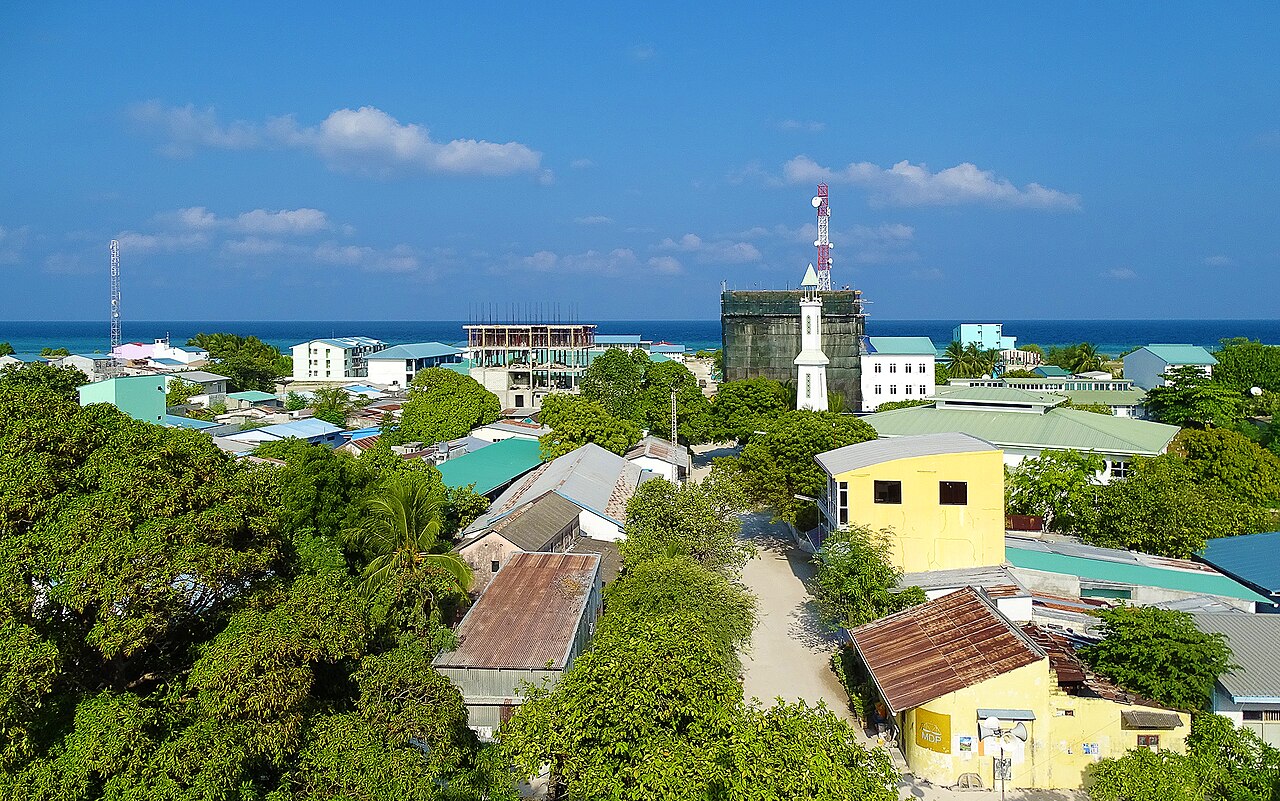
Malé
Photo: Shahee Ilyas, CC BY-SA 3.0

MaléCapital

Malé City, Kaafu Atoll
Read moreShow less

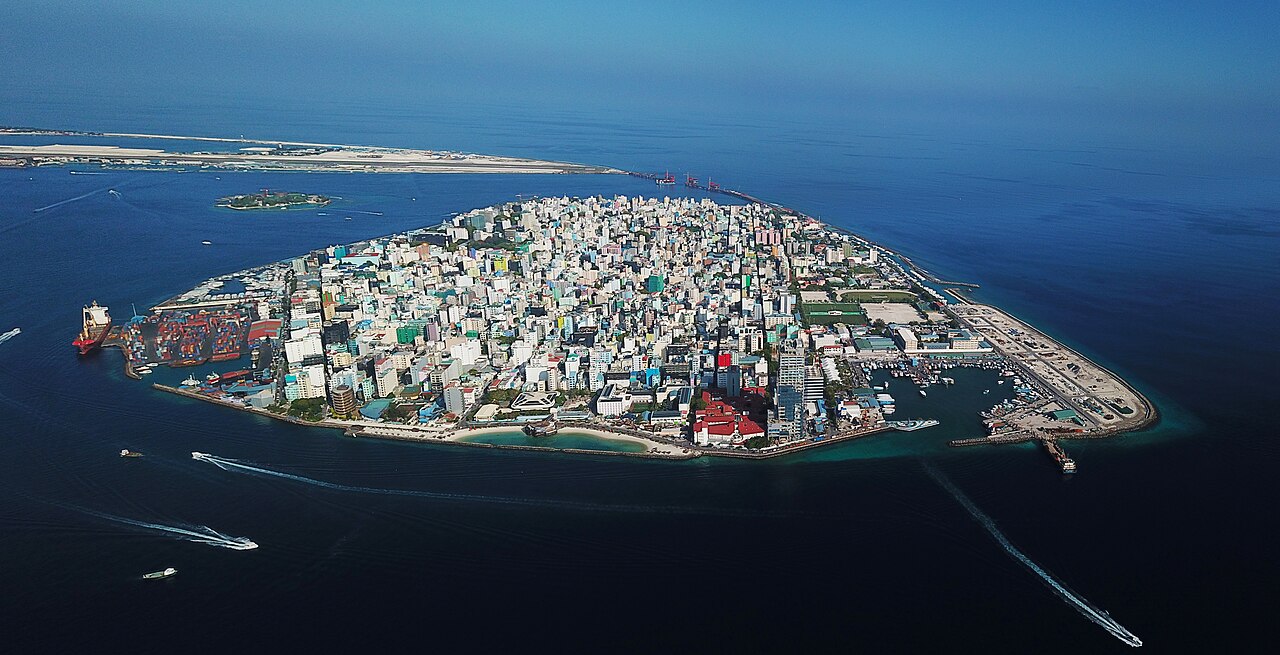
The capital and by far the largest city, on the southern edge of North Malé Atoll. The city, which also includes the airport island and several nearby islands, had about 212,000 people at the 2022 census, and the central island is so built up that it is one of the most densely populated places in the world. It was the King's Island, from which sultans ruled for centuries, and it is still the centre of government, trade and religion.

  • The coral-stone Friday Mosque and the golden dome of the Islamic Centre
  • The commercial harbour, the heart of the country's trade
  • The Sinamalé Bridge to the airport and Hulhumalé
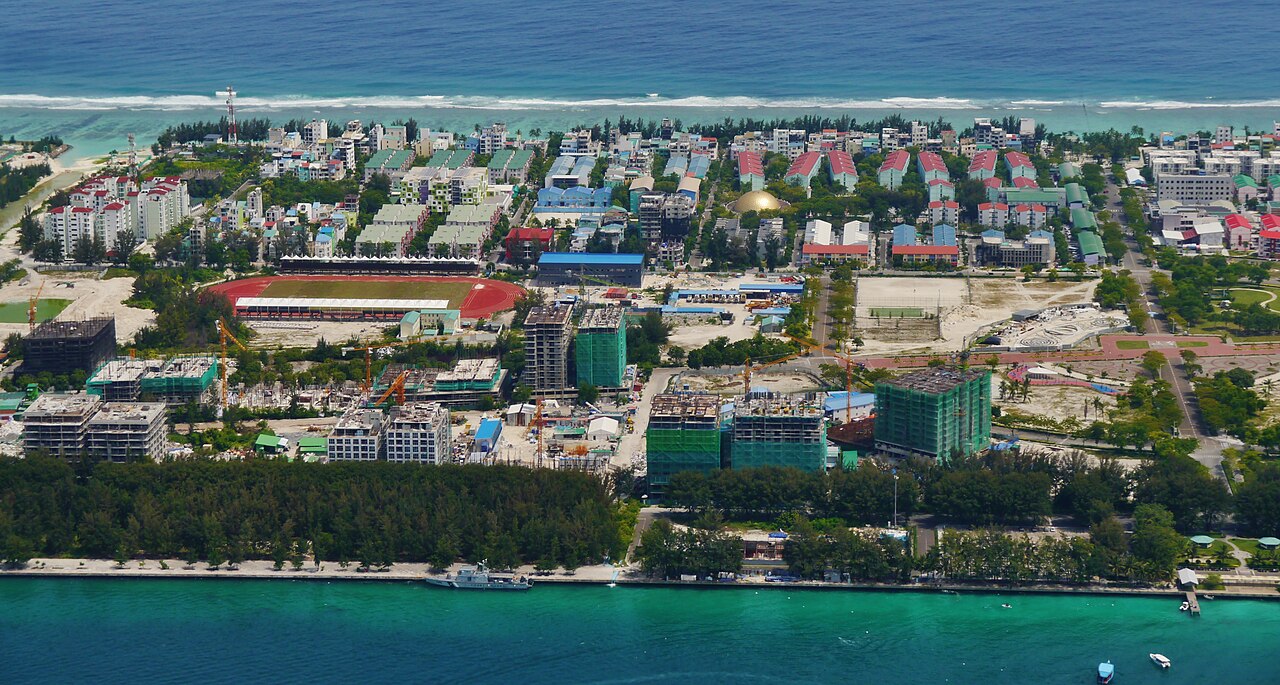
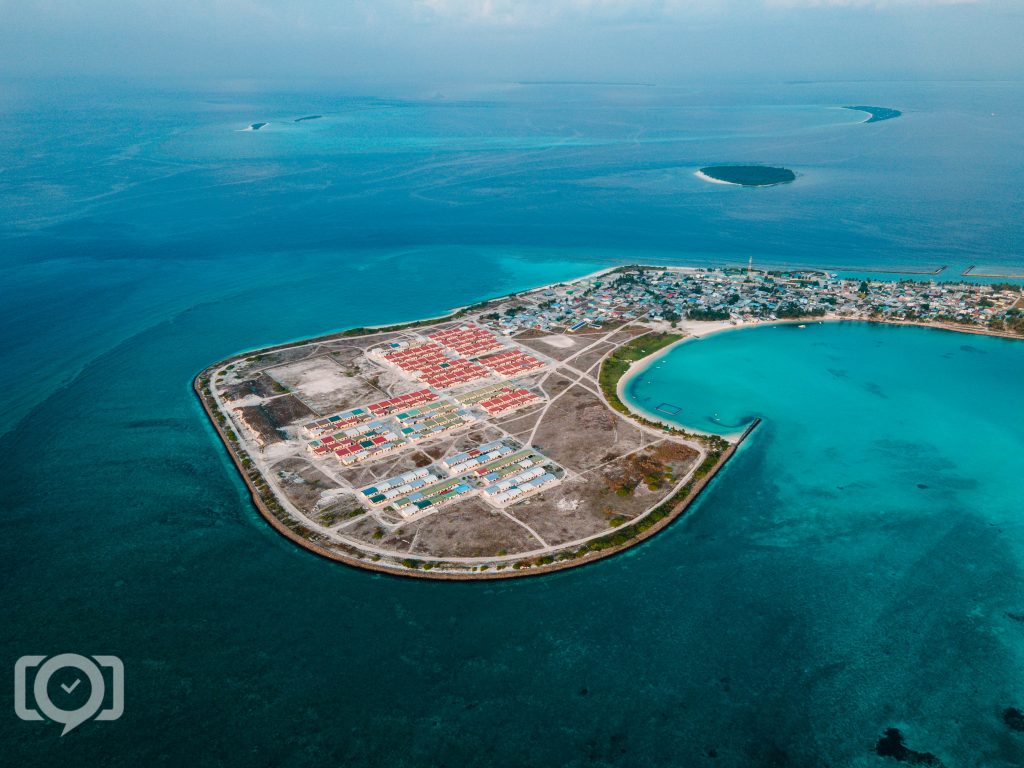
Hulhumalé
Photo: Zairon, CC BY-SA 4.0

Hulhumalé

Malé City, Kaafu Atoll
Read moreShow less

A new island built by pumping sand from the sea floor onto a lagoon northeast of the airport, starting in 1997. The first residents moved in in 2004, and by the end of 2019 more than 50,000 people lived there. It is part of Malé City and was planned to give the crowded capital room to grow on higher ground.

  • Wide, planned streets and apartment blocks
  • A long public beach close to the airport
  • Being the fourth-largest island in the country, entirely man-made
Maafushi
Photo: Buiobuione, CC BY-SA 4.0

Maafushi

Kaafu Atoll
Read moreShow less

A local island about 26 km south of Malé where about 4,500 people live. It was badly damaged by the 2004 tsunami and rebuilt. Being close to Malé and the airport, it has become a favourite with visitors staying on local islands, and in 2016 it already had more than 55 guesthouses, the most of any local island.

  • More guesthouses than any other local island
  • Souvenir shops visited by guests from nearby resorts
  • Rebuilding after heavy damage in the 2004 tsunami
Naifaru
Photo: Haflaa at Wikipedia, CC BY 4.0

Naifaru

Lhaviyani Atoll
Read moreShow less

The capital and most populous island of Lhaviyani Atoll, about 140 km north of Malé, with about 4,800 people at the 2022 census. Local historians think it has been lived on for more than 400 years.

  • Being the capital and most populous island of Lhaviyani Atoll
  • A huge old tombstone by the Friday Mosque, said to belong to a man who fell in a battle in 1753
  • Land reclaimed from the lagoon in 2004
Dhidhdhoo
Photo: Knowledge mv, CC BY-SA 4.0

Dhidhdhoo

Haa Alif Atoll
Read moreShow less

The capital of Haa Alif, the northernmost atoll, in the centre of the atoll. It was once an uninhabited island looked after by the royal house of Utheemu, and was settled in the 19th century by people escaping pirate raids on their own island.

  • The Haa Alif Atoll Education Centre, founded in 1982
  • Boat trips to Utheemu, birthplace of the national hero Thakurufaanu
  • The lowest crime rate among the country's ten most populous islands
Thinadhoo City
Photo: Xumm1du at English Wikipedia, Public domain

Thinadhoo

Gaafu Dhaalu, Huvadhu Atoll
Read moreShow less

The capital of Gaafu Dhaalu, in Huvadhu Atoll just north of the equator. It was once the wealthiest island in the country, but in 1962, after the southern atolls had broken away from Malé, it was forcibly emptied and destroyed. People later returned and rebuilt it. It became a city in 2023.

  • Its own dialect of Dhivehi
  • Being the main town of Huvadhu, the atoll with more islands than any other in the world
  • A history of independence and revolt
Fuvahmulah
Photo: Asaymirus, CC BY-SA 4.0

Fuvahmulah

Gnaviyani Atoll
Read moreShow less

A single large island, about 4.5 km long, that forms an atoll of its own, about 490 km south of Malé and just south of the equator. With no lagoon around it and big ocean swells, it was long hard to reach, until a harbour and an airport (2011) opened it up. Inside are two freshwater lakes, marshy taro fields and tropical woodland.

  • Thoondu, the beach of shiny white pebbles
  • Diving with tiger sharks
  • Its own dialect, and the ruins of an old Buddhist stupa called the Havitta
Addu City
Photo: Mark Hodson Photos, CC BY 2.0

Addu City

Addu Atoll (Seenu)
Read moreShow less

The southernmost atoll and the second-largest city, about 530 km south of Malé. Its main islands are joined by causeways and a link road, and Hithadhoo, where the map pin is, is the main district. The British had a naval base and then an air base on the island of Gan here from 1941 to 1976, and Gan's old runway is now an international airport.

  • The old RAF base on Gan
  • Diving on the wreck of the British Loyalty, a tanker scuttled in the lagoon in 1946
  • Kōgaṇṇu, the oldest and largest cemetery in the Maldives
Landmarks

Places everyone should see once

Malé Friday Mosque
Photo: Zairon, CC BY-SA 4.0
Malé

Malé Friday Mosque (Hukuru Miskiy)

Read moreShow less

The oldest and most ornate mosque in the Maldives, completed in 1658 on the site of a mosque from 1153. Its walls are made of coral blocks cut and fitted together without mortar, and inside are fine wood carvings and lacquerwork. Beside it stands a round blue and white minaret from 1675 and a graveyard of carved coral tombstones. As of 2026, it is one of six coral stone mosques on UNESCO's tentative list, which means they have been proposed but are not yet a World Heritage Site. A full nomination was submitted in 2026.

Islamic Centre (Maldives)
Photo: Rhalu7, CC0
Malé

Islamic Centre (Grand Friday Mosque)

Read moreShow less

The large white mosque with a golden dome that dominates the Malé skyline near the main jetty. Opened on 11 November 1984 and named after the national hero Muhammad Thakurufaanu, it holds about 5,000 worshippers and has a minaret 41 m high. Inside are wood carvings and Arabic calligraphy. It was the largest mosque in the country until 2022.

Muliaage
Photo: Hassan R., CC BY 2.0
Malé

Muliaage

Read moreShow less

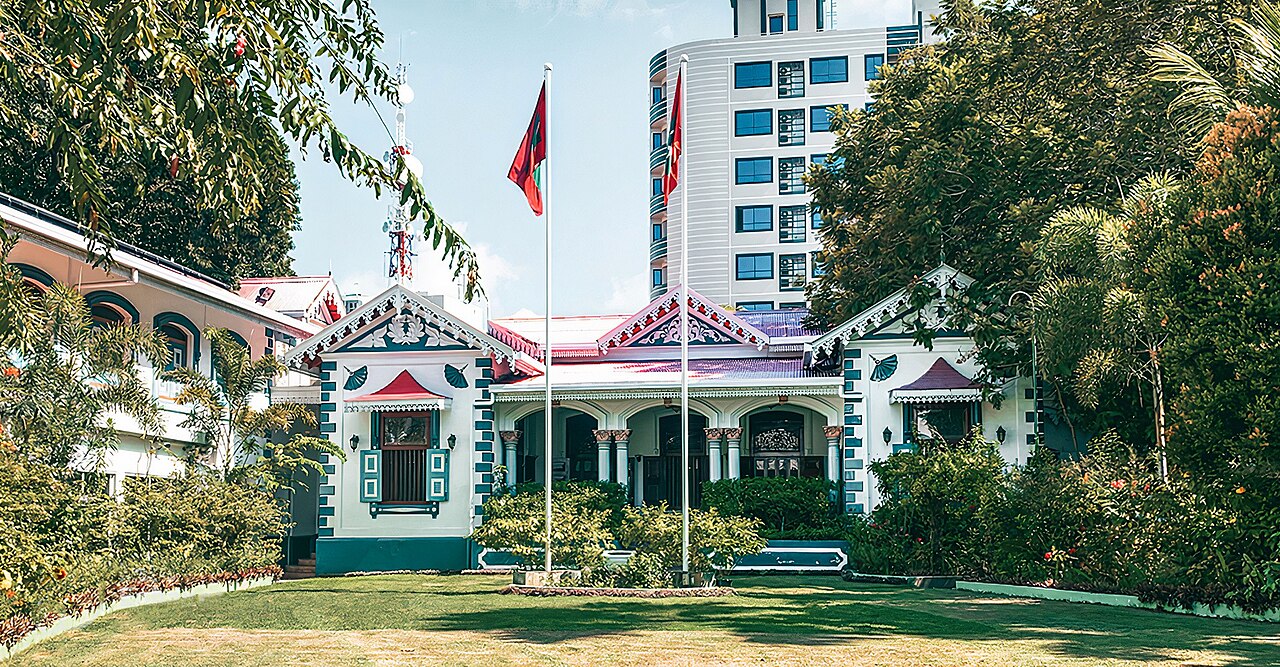
A graceful white mansion in the historic centre of Malé, built from 1914 to 1919 in the style of colonial bungalows in Ceylon. A sultan built it for his son and heir, and since 1953 it has served on and off as the official residence of the country's president.

National Museum and Sultan Park
Photo: Zairon, CC BY-SA 4.0
Malé

National Museum and Sultan Park

Read moreShow less

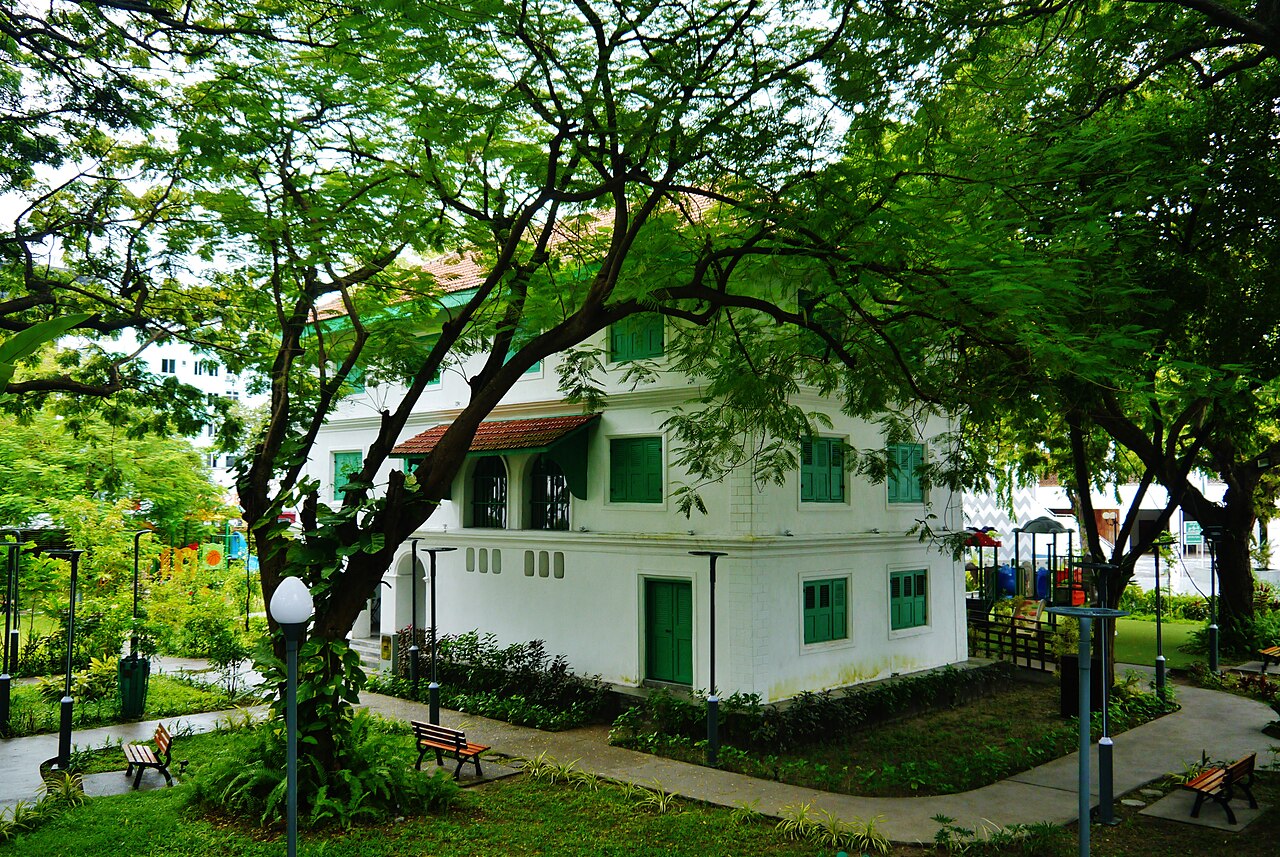
The museum stands in Sultan Park, on the grounds of the old royal palace, most of which was pulled down in the late 1960s. Opened in 1952, it shows thrones, royal sunshades, costumes, coins, lacquerwork and a 13th-century carved wooden panel from the Friday Mosque. A new building, a gift from China, opened on Independence Day 2010.

Sinamalé Bridge
Photo: Panda 51, CC BY-SA 4.0
Malé

Sinamalé Bridge

Read moreShow less

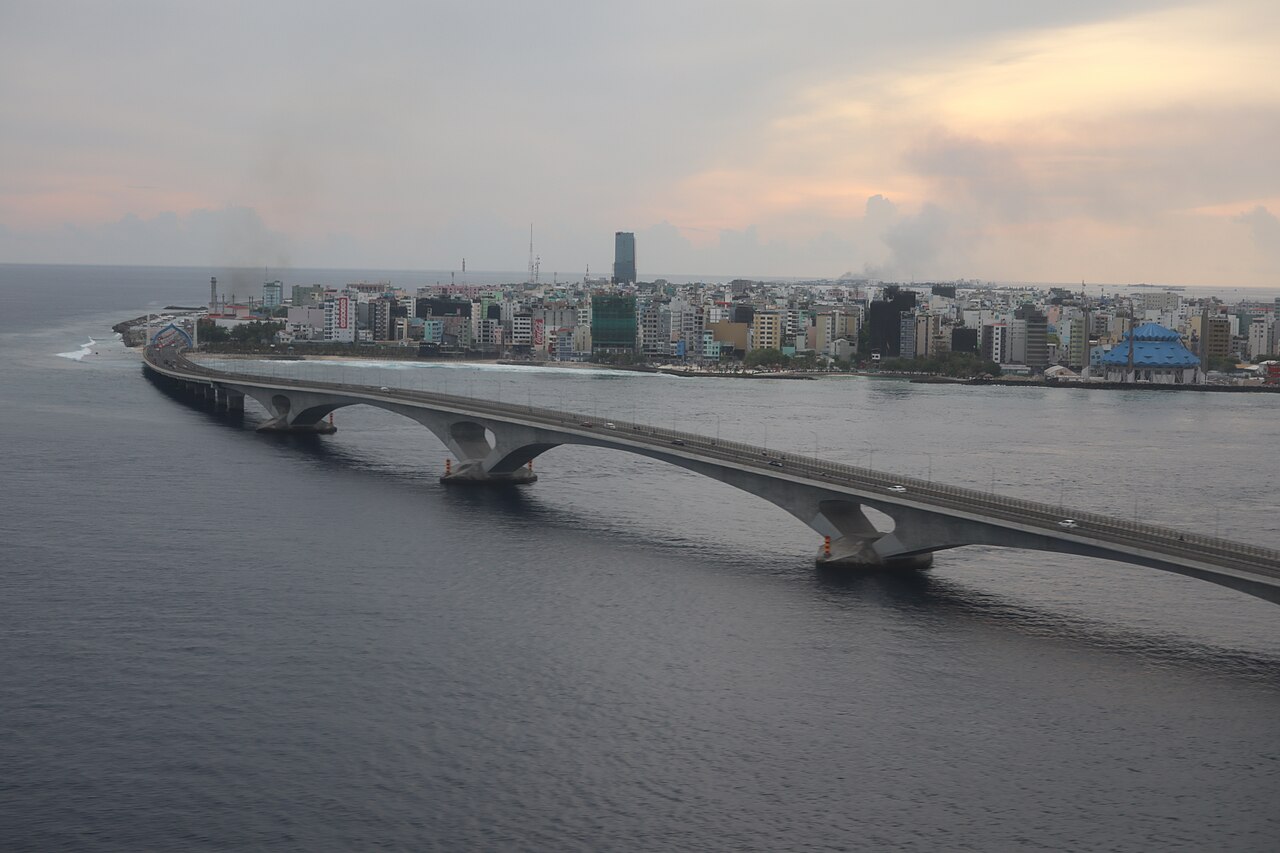
The first bridge between islands in the Maldives, opened on 30 August 2018. It is 2.1 km long and crosses a sea channel about 50 m deep to link Malé with the airport island of Hulhulé and with Hulhumalé, with lanes for cars, motorcycles and people on foot.

Utheemu
Photo: Andreas Faessler, CC BY-SA 4.0
Near Dhidhdhoo

Utheemu Ganduvaru

Read moreShow less

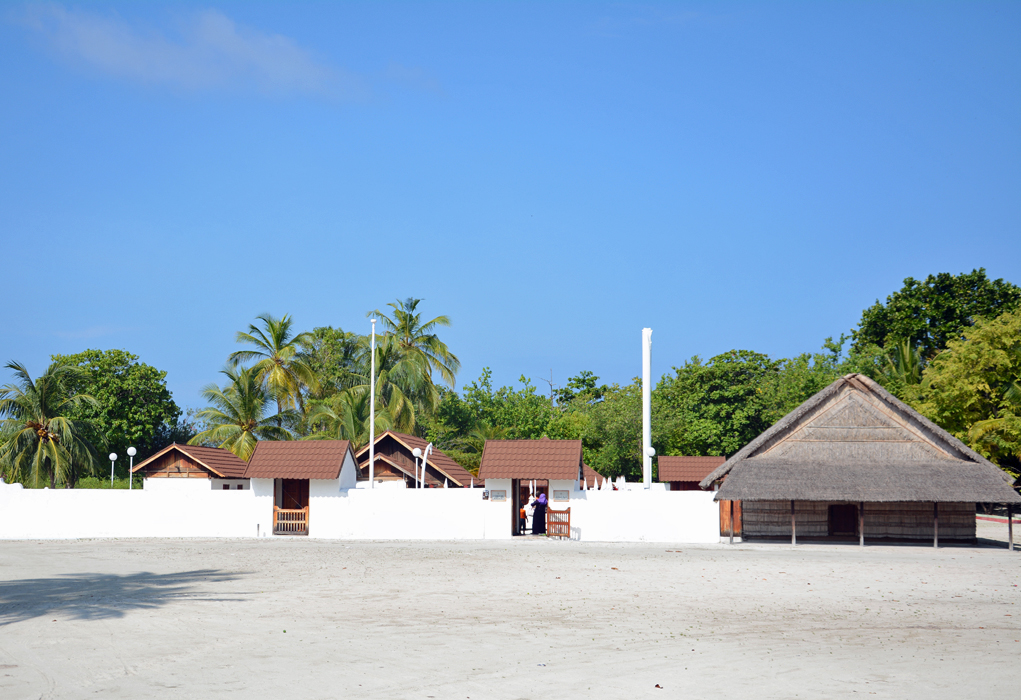
The wooden palace on the island of Utheemu, in the far north, where Muhammad Thakurufaanu, the hero who drove out the Portuguese in 1573, was born and grew up. Along with Muliaage, it is one of the closest things left to a royal Maldivian palace. Utheemu is a short boat ride from Dhidhdhoo.

Thoondu Beach
Photo: Asaymirus, CC BY 4.0
Fuvahmulah

Thoondu Beach

Read moreShow less

A beach on the north of Fuvahmulah made not of sand but of small, smooth, shiny white pebbles that are said to be found nowhere else. Hundreds of people come every day, and in most years the sand moves out towards the reef and forms a natural pool called the Bissaaveli. It was declared a protected area in 2012.

Kōgaṇṇu
Photo: Maldives Collections, CC BY-SA 2.0
Addu City

Kōgaṇṇu Cemetery

Read moreShow less

The oldest and largest cemetery in the Maldives, in the Meedhoo district of Addu City, begun about 900 years ago for the first Muslims of the atoll. It has more than 1,500 tombstones carved from coral, including the largest in the country, and was listed on the 2022 World Monuments Watch.

Fun facts

Things you might not know

  1. 01

    The Maldives is often called the lowest-lying country in the world: its highest natural ground is only about 2.4 m above sea level, and its average is about 1.5 m.

  2. 02

    The English word 'atoll', a ring of coral islands around a lagoon, comes from the Dhivehi word atholhu.

  3. 03

    Of about 1,190 islands, only around 200 are home to local people. Many others are resort islands, each with just one hotel.

  4. 04

    For centuries the Maldives exported huge numbers of cowrie shells, used as money across Asia and Africa. Arab traders called the islands the 'Money Isles', and a cowrie is still the symbol of the country's central bank.

  5. 05

    Dhivehi is written in Thaana, a script used for no other language, which runs from right to left like Arabic. Its first eighteen letters were based on numerals.

  6. 06

    In 2009 the government held what it called the world's first underwater cabinet meeting, to warn the world about rising seas.

  7. 07

    The Maldives stretches across the equator: Fuvahmulah and Addu Atoll lie in the Southern Hemisphere, while the rest of the country is in the north.

  8. 08

    The famous traveller Ibn Battuta lived in the Maldives for months in the 1340s, served as chief judge and married into the royal family.

  9. 09

    The first tourist resort, Kurumba, opened in 1972. Before that the islands were almost unknown to tourists.

  10. 10

    Hulhumalé, home to more than 50,000 people, is an island that did not exist before 1997: it was built by pumping sand from the sea floor onto a shallow lagoon.

  11. 11

    In 2022 the rufiyaa got its own currency sign, chosen in a national competition and based on the Thaana letter raa, the first letter of 'rufiyaa'.

  12. 12

    Bodu beru, 'big drum', is the best-known Maldivian music: about 20 performers, led by drums made from coconut palm trunks, speed up until the dancers move wildly. Performing it is called 'vibrating the island'.

  13. 13

    The coconut palm is the national tree, and Maldivian coir, rope made from coconut husk, was once exported as far as China and Yemen, and Arab sailors used it to sew together the planks of their ships.

Dhivehi (Maldivian) words

20 words to start with

In the Latin spelling used in the Maldives, 'dh' and 'th' are not like English 'th': they are a soft d and t made with the tongue on the teeth. 'Lh' is a special l sound, and a doubled consonant is held a little longer. Pronunciation is written the way it sounds; the capital letters show where the stress goes.

Greetings

  • assalaamu alaikumas-sa-LAA-mu a-LAI-kumhello (formal; literally 'peace be upon you')
  • maruhabaaMA-ru-ha-baahello (informal), and also 'welcome' or 'you're welcome'
  • shukuriyyaashu-ku-RIY-yaathank you
  • vakivelanVA-ki-ve-langoodbye

Basics

  • aanAANyes
  • noonNOONno
  • ma'aaf kureyma-AAF ku-RAYexcuse me, or sorry

Food

  • masMUSSfish
  • baiyBAIrice
  • fenFENwater
  • saiSAItea, and also an afternoon tea meal
  • lonuLO-nusalt

Numbers

  • ekehE-kehone
  • dheyehDHE-yehtwo
  • thinehTHI-nehthree

Time

  • miadhumi-A-dhutoday
  • maadhanMAA-dhantomorrow
  • hukuru dhuvasHU-ku-ru DHU-vasFriday (the day of the Friday prayer)

Getting around

  • maguMA-gustreet
  • uthuruU-thu-runorth
Say it like a local

Useful phrases

Dhivehi often leaves out words like 'I' and 'you'; the sentence means the same without them. In resorts and in Malé, English is widely spoken, but a few local words are always welcome.

Assalaamu alaikum
as-sa-LAA-mu a-LAI-kum
Hello (literally 'peace be upon you')
The polite greeting at any time of day. The reply is 'wa alaikumus salaam'.
Haalu kihineh?
HAA-lu KI-hi-neh
How are you?
A friendly question after the greeting
Ran'galhu, shukuriyyaa
RAN-ga-lhu, shu-ku-RIY-yaa
Fine, thank you
The usual answer to 'How are you?'
Kon nameh kiyanee?
KON NA-meh KI-ya-nee
What is your name?
Meeting someone new
Aharenge namakee ...
A-ha-ren-ge NA-ma-kee
My name is ...
Introducing yourself
Baddhalu vee thee varah ufaavejje
BAD-dha-lu VEE-thee VA-rah u-FAA-vej-je
Nice to meet you
After an introduction
Ingireysin vaahaka dhakkantha?
in-gi-RAY-sin VAA-ha-ka DHAK-kan-tha
Do you speak English?
Before asking for help. Leaving out 'you' is more polite with strangers.
Ahannakah neyn'gunu
a-HAN-na-kah NAYN-gu-nu
I don't understand
When someone speaks too fast
Faakhanaa kobaithoa?
FAA-kha-naa KO-bai-thoa
Where is the toilet?
In a cafe, a shop or at the harbour
Meege agu kihaavareh?
MEE-ge A-gu KI-haa-va-reh
How much is this?
Shopping at a market or souvenir shop
Agu bodu!
A-gu BO-du
Expensive!
Bargaining, with a smile
Varah meeru
VA-rah MEE-ru
It was delicious
Thanking a cook or a cafe owner
Aharen ooru maheh nukan
A-ha-ren OO-ru MA-heh NU-kan
I don't eat pork
Useful to know; pork is not served on local islands anyway
Baajjaveri hendhuneh
BAAJ-ja-ve-ri HEN-dhu-neh
Good morning
A friendly wish in the morning
Eheevedhee!
e-HEE-ve-dhee
Help!
In an emergency
Aharen doctareh beynun
A-ha-ren DOK-ta-reh BAY-nun
I need a doctor
If you are ill or hurt
Vakivelan
VA-ki-ve-lan
Goodbye
When leaving
Local tips

Before you go

Visa on arrival, but fill in IMUGA first

As of November 2026, UK travel advice says tourists get a 30-day visa on arrival, and that your passport must be valid for at least one month after you arrive. You must also complete the online traveller declaration, called IMUGA, within 96 hours before your flight lands.

Alcohol stays in the resort

Alcohol is sold only in resorts, on licensed boats and at a hotel on the airport island. Do not bring bottles into the country, as they are taken at customs, and never take a drink out of your resort: you can be arrested and deported for drinking or being drunk on an inhabited island.

Dress modestly on local islands

Outside the resorts, including on beaches used by local people, cover your shoulders and avoid short or tight shorts. On local islands, bikinis are allowed only on beaches set aside for tourists. Nudity and topless sunbathing are not allowed anywhere, including in resorts.

Respect Ramadan and Islam

Islam is the state religion, and practising another religion in public is against the law. During Ramadan, do not eat, drink or smoke in public in daytime outside the resorts, and dress and behave quietly near mosques.

The weekend is Friday and Saturday

The working week runs from Sunday to Thursday, and Friday and Saturday are the weekend. Keep this in mind when planning visits to offices in Malé.

Getting between islands

The main ways to travel between islands are by boat, by seaplane or by domestic flight. From the airport island, the Sinamalé Bridge takes you by road to Malé and Hulhumalé.

Swim safely and never carry drugs

Swim only in supervised areas or places marked as safe for tourists, and get out of the water if something does not feel right. The Maldives has zero tolerance for drugs: even a very small amount, including cannabis, can lead to arrest and severe penalties.

Sources (51)
Last step of the trip

Take the quiz, get your Maldives stamp

10 friendly questions about what you just read. No timer, and the ones you miss come back later for review.

Your trip to Maldives

Ready for the quiz?

10 questionsAbout 3 minutesNo timer

My notes on Maldives

Memories, a dish to cook, a place you want to see. Only you can see this. It saves by itself.

Your notes are kept in My collection.

More about the Maldives